The concept album is dead; long live the concept album. While the era of lying down and listening to a record from beginning to end is definitely over, the battle for the audience’s attention is stronger than ever. After all, why listen to a song for three-and-a-half minutes when you can watch some teenage girl lip-sync it at 2x speed while adult men chime in about her attractiveness? Some artists have embraced society’s shortened attention span by giving up on cohesive albums in favour of singles and playlists (and whatever the word “mixtape” means nowadays). But there a just as many artist who have gone in the other direction, crafting collections of songs that are so tightly linked together they simply need to be listened to in sequence. As a result, in one corner, we have artists like Drake and Mac DeMarco churning out music that runs the gamut from perfect pop songs to cack-handed crayon sketches, while in the other, we have Frank Ocean and SZA, who drop album-long statements only to disappear for years.
In this bifurcated marketplace, the old-fashioned concept album is yet another type of long-form engagement. But it’s worth noting that there’s a difference between what we might descriptively call a concept album and what we might more prescriptively call the Concept Album™. While the former can include any collection of songs with close thematic, motific or narrative links, the latter is essentially a genre unto itself, denoting a kind of theatrical approach to songcraft infused with wacky made-up concepts like pinball wizards, drug-addicted aliens and Ayn Rand. The Concept Album™ was pioneered by rock artists like The Who, David Bowie and Pink Floyd, and it reached the point of self-parody in less than a decade thanks to the work of Meat Loaf, Andrew Lloyd Webber and Pink Floyd.
Hip hop, by comparison, has somehow managed to avoid being burdened by.the Concept Album™. There have been hip hop concept albums, of course, but even high-concept classics like Public Enemy‘s Fear of a Black Planet, Little Brother‘s The Minstrel Show and Lupe Fiasco‘s The Cool have songs that can be pulled out and played in the middle of a DJ set.1For a great list of concept albums that have been created since the inception of hip hop in the 1970s, check out this list created by the team at Shatter the Standards. There’s a simple reason for this: the Concept Album™ is usually sung-through, like an opera, which gives it a grandiose theatricality, while the hip hop concept album balances its songs with spoken-word skits.
As this brilliant primer by Jeff Weiss outlines, skits were pioneered — in a moment of parallel invention — by Prince Paul and King Tee around the same time in 1988. The skit reached its zenith throughout the 90s with artists like Kool Keith and the Wu-Tang Clan making them an essential part of their sound. But skits have been on the decline for decades now; the rise of MP3s in the early 2000s and streaming in the 2010s has seen them disappearing from modern hip hop albums faster than safeguarding at the BBC. The only artists left using them are usually those from hip hop’s ever-thriving underground scene, such as Open Mike Eagle and Quelle Chris. Even Kanye West stopped using them after 808s & Heartbreak. In fact, there’s only one mainstream artist who’s continued to make skits an indelible parts of their albums: Kendrick Lamar.
Despite coming up during the 2010s, Lamar’s penchant for skits is one of the things that makes him feel like a familiar face to a generation of uncs and oldheads — the kind of people who act as if hip hop was better when we’d all gather round the hearth and listen to Method Man coming up with new ways to torture people. Between Section.80 and Good Kid M.A.A.D City, it’s clear that Lamar mastered the art of employing skits in an inventive way rather than simply using them as an opportunity to pad out an album with transgressive humour. His main trick involves structuring the skits as interstitial scenes from a larger narrative, which allows him to place the narrative exposition within the lyrics of the songs while using structural devices such as ellipsis and repetition to engage the listener in a puzzle-solving mission. For example, most of the songs on Good Kid, M.A.A.D City are followed by brief exchanges between characters like Kendrick’s parents or his friends, and these scenes either set up the next section of the narrative or add further context to something that’s already been described. To lessen the cognitive load caused by this narrative fragmentation, Lamar favours circularity in his storytelling: Good Kid, for example, begins with the Sinner’s Prayer being said by a group of young men, and this moment finds its context near the end of the album, when an old woman (played by Maya Angelou) asks Kendrick and his friends to pray with him instead of continuing a cycle of revenge. The rapper even takes this circular structure a step further on Damn, which opens with a voice asking “You decide are we going to live or die?” and closes with a real-life origin story of sorts where Lamar’s father avoided being murdered by showing kindness to Anthony “Top Dawg” Tiffith, who would eventually leave his life of crime to form Top Dawg Entertainment (TDE), the record label that first signed Lamar in 2005. After this revelation, the album flips around like a record being spun backwards, suggesting that the songs themselves can be played in reverse order — something that was later confirmed by the sequence of the songs being mirrored reversed on the Collectors Edition [sic].
Skits and schemas
All of these qualities — ellipsis, repetition and circularity — are present on To Pimp a Butterfly. We are given our first glimpse of the album’s structure with the spoken excerpt that appears at the end of “King Kunta”, where Kendrick says “I remember you was conflicted, misusing your influence”. The rest of the poem won’t be fully revealed until the final track, but Lamar reveals snippets of it along the way that increase in length each time. While this combination of ellipsis and repetition lacks the more subtle complexity that the rapper achieves on Good Kid M.A.A.D City and Damn, it does leads to a kind of propulsive structure — by the time we hear the third excerpt, we’re listening out for each instalment like Victorian readers waiting to find out what’s about to happen to Little Nell.
This cumulative structure makes it easy to assume, in hindsight, that the poem excerpts on To Pimp a Butterfly appear at the end of every song. In reality, they only turn up on five songs within the first ten tracks: “King Kunta”, “These Walls”, “Alright”, “For Sale? (Interlude)” and “Hood Politics”. Despite this, Cole Cuchna makes a convincing argument on the first season of his podcast Dissect that the album can be schematically mapped out against this poem along with the fable of the caterpillar and the butterfly (which, according to a now-lost Instagram story, was written by Punch at TDE after Lamar found himself “a bit lost in the concept”).
Cuchna places Good Kid, M.A.A.D City as the prelude to Butterfly, presenting the tale of the caterpillar trying to survive; the first three songs on Butterfly (from “Wesley’s Theory” to “King Kunta”) depict the caterpillar’s envy of the butterfly; the next three (from “Institutionalized” to “u”) show how the caterpillar is trapped by his mindset; the next five (from “Alright” to “How Much a Dollar Cost”) portray the caterpillar’s growing consciousness, which leads to a metamorphosis; the next four (from “Complexion (A Zulu Love)” to “i”) reflect how the butterfly achieves enlightenment yet recognises itself in the caterpillar; and the final track, “Mortal Man” provides an epilogue that asks us to reflect on whether or not Kendrick has achieved self-actualisation. While Cuchna and Hannah Sellers have already done a good job of turning this schema into a visually pleasing poster, I’ve provided a localised version of it below for posterity:2Allow me to expand on this point a little: Spotify owns Dissect, so it’s only a matter of time before a global tech company like that — one that ploughs money into fake musicians and Joe Rogan, that refuses to compensate the artists who are responsible for its existence, and that provides the capital for the militarisation of AI . . . a company like that might not care about their intellectual property enough to prevent a single hyperlink on one of their websites from becoming yet another piece of lost media. And this album map is just a bit too valuable to lose; if Carlo Linati and Valery Larbaud had thrown James Joyce’s schemas for Ulysses in the bin, there’s a good chance we’d still be arguing over the novel’s structure to this day. Besides, when it comes to archiving things for the future, plain text will always win out over images in terms of being able to be stored across multiple devices and file formats. So I figure it’s probably useful to have Cuchna’s schema written down somewhere like this.
Prelude
The caterpillar is a prisoner to the streets that conceived it. Its only job is to eat or consume everything around it in order to protect itself from this mad city. While consuming its environment, the caterpillar begins to notice ways to survive.
- Good Kid, M.A.A.D City
Act I
One thing it noticed is how much the world shuns him but praises the butterfly. The butterfly represents the talent, the thoughtfulness and the beauty within the caterpillar. But, having a harsh outlook on life, the caterpillar sees the butterfly as weak and figures out a way to pimp it to his own benefits.
- Wesley’s Theory
- For Free? (Interlude)
- King Kunta
Act II
Already surrounded by this mad city, the caterpillar goes to work on the cocoon which institutionalizes him. He can no longer see past his own thoughts. He’s trapped.
- Institutionalized
I remember you was conflicted,
misusing your influence
- These Walls
Sometimes I did the same, abusing my power, full of resentment.
- u
Resentment that turned into a deep depression;
found myself screaming in the hotel room.
Act III
While trapped inside these walls, certain ideas take root, such as going home and bringing back new concepts to this mad city. The result? Wings begin to emerge, breaking the cycle of feeling stagnant.
- Alright
I didn’t wanna self-destruct.
- For Sale? (Interlude)
The evils of Lucy was all around me,
so I went running for answers . . .
- Momma
. . . until I came home.
- Hood Politics
But that didn’t stop survivor’s guilt,
going back and forth trying to convince myself the stripes I earned,
or maybe how A-1 my foundation was.
- How Much A Dollar Cost
But while my loved ones was fighting the continuous war back in the city,
I was entering a new one—
Act IV
Finally free, the butterfly sheds light on situations that the caterpillar never considered, ending the internal struggle. Although the butterfly and caterpillar are completely different, they are one and the same.
- Complexion (A Zulu Love)
A war that was based on apartheid and discrimination.
Made me wanna go back to the city and tell the homies what I learned.
The word was respect.
- The Blacker The Berry
Just because you wore a different gang color than mine’s
doesn’t mean I can’t respect you as a black man . . .
- You Ain’t Gotta Lie (Momma Said)
. . . forgetting all the pain and hurt we caused each other in these streets.
- i
If I respect you, we unify and stop the enemy from killing us.
Epilogue
- Mortal Man
But I don’t know.
I’m no mortal man.
Maybe I’m just another nigga.
Orienteering
Within this schema, “Institutionalized” is directly attached to the poem excerpt that precedes it. While the first three tracks on the album represent Kendrick’s “conflicted” mindset and the way he’s “misusing [his] influence”, they mainly explore these themes through an external conflict with a clear protagonist and antagonist — between Kendrick and Uncle Sam on “Wesley’s Theory”, between Kendrick and America on “For Free? (Interlude)”, and between Kendrick and other rappers on “King Kunta”. By comparison, the conflict in “Institutionalized” is more morally ambiguous: Kendrick finds himself at odds with his childhood friend, who comes to the BET Awards with him and takes it as an opportunity to address his own economic deprivation by stealing from celebrities. Unlike the conflicts depicted in the first three tracks, there is no clear antagonist here; while Kendrick’s friend is driven by envy and jealousy, he is also having a fairly rational reaction to the cathedral of conspicuous consumption that is created for any red-carpet event. And it’s worth noting that we never actually hear Kendrick’s response to this experience; as the story unfolds, Lamar instead raps from the first-person perspective of his friend, making the case for why he should be allowed to hold up Kendrick’s “coworkers” at gunpoint.
The negative space left by Kendrick’s lack of reply is instead filled by the chorus, where Bilal tells the rapper that “shit don’t change until you get up and wash your ass”. This scatological proverb puts the burden of finding a solution back on Kendrick. On the one hand, he could simply choose to be yet another celebrity placing consumerism above everything (like Diddy or DJ Khaled). On the other, he could become another rapper who dies young from remaining too close to the violence of life in the hood (like Drakeo the Ruler or Mausberg, the inspiration for “King Kunta”). But Kendrick recognises that his ethical compass is pointing in a third direction — one that involves finding a way to help the community he comes from while still trying to escape the mindset that comes with it. He’s a butterfly who’s made a faux pas by bringing a caterpillar into the butterfly house, but the experience makes him realise that he can’t criticise either the caterpillar or the other butterflies until he’s made sense of how he feels about his own metamorphosis.
Paint it Black
If we see “Institutionalized” as the beginning of the album’s second act, then it makes sense that the music also marks a clear shift in tone from the three songs that precede it. As this nifty tool from Ableton indicates, the tempo of your average hip hop song falls somewhere between 60–100 BPM, with most classics being somewhere closer to 80–100 BPM. By comparison, the first three songs on To Pimp a Butterfly feel as if they’re speeding down the highway while driving under the influence: “Wesley’s Theory” begins in medias res at 115 BPM with Kendrick at the top of his game, surrounded by temptation, and the pace increases to a frenetic 131 BPM on “For Free? (Interlude)” while he rages at America. Even though the heart rate begins to lower on “King Kunta”, once Kendrick returns to hood to battle other rappers, the tempo of 107 BPM still keeps it simmering somewhere north of the laid-back G-funk songs that it echoes.
“Institutionalized”, by comparison, slows the pulse down to a more traditional rate, beginning at 90 BPM before dropping to 81 BPM for the rest of the song. As producer Rahki notes in his comments on WhoSampled, the song’s two halves come from it being a fix-up of two separate beats, with the first half belonging to a lesser known producer named Tommy Black. Although Black is based in Sweden, he became acquainted with the crew at TDE through MySpace, explaining how things came together in this interview with DJ Booth: “I was sending records to Ab-Soul and he immediately felt my sound. So we kept sending records and demos back and forth and he introduced me to his partners in crime, Kendrick and [Schoolboy] Q. Both of them sent me e-mails personally asking for production and it’s been going on since.” Black finally met Lamar in person after the rapper came to Gothenburg during his first European tear for Good Kid, M.A.A.D City in 2013. The producer played a set of chords for him and, soon enough, they were creating a song. “Kendrick immediately hopped on and started freestyling and tried different flows. He told [Derek] Ali to set it up so he could record in the tour bus studio straight away.” Four months later, Lamar had recorded the first verse but — as Black puts it — “the hook was still missing”.
Clouds, waves, textures
On an album full of left-turns, the first half of “Institutionalized” still manages to subvert our expectations. By this point we’ve heard synthesiser-laden P–Funk on “Wesley’s Theory”, Branford Marsalis-style hard bop on “For Free? (Interlude)” and DJ Quik-indebted G-funk on “King Kunta”. The thing that makes these songs cohere is that, sonically speaking, they don’t: instead, they rely on pastiche to represent the breadth of musical styles created by black Americans. By comparison, the opening of “Institutionalized” nudges us in a more sui generis direction by creating a sound that’s akin to waking up just before the golden hour and seeing the sunlight slowly go from a soft, diffuse glow to harsher rays.
The song begins with a four-bar repetition of a drum beat, achieving the musical equivalent of the rule of three by establishing a pattern across the first three beats of the bar only to break that pattern on the fourth turn.
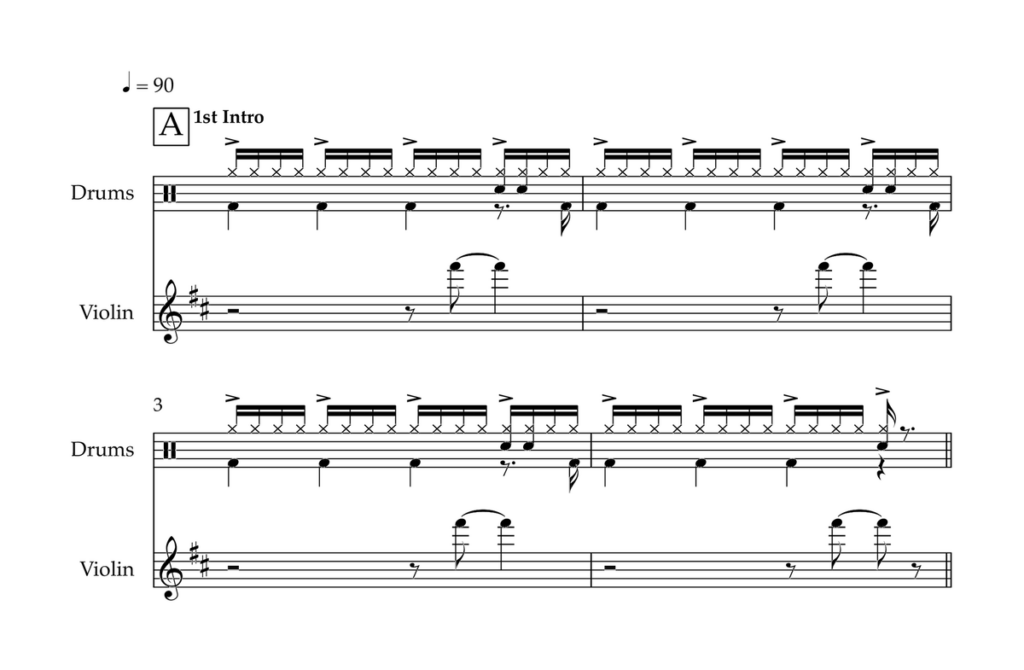
We hear the lock-step of the kick drum playing crotchets and the hi-hat playing accented semiquavers, along with some kind of quiet woodblock sound in the right ear, before a string synth plays a middle F# and a tuned-up snare provides a simple fill with two successive semiquavers. While the snare fill makes it seem as if we’re about to enter into the song, the violin instead abruptly cuts off and we find ourselves back where we started. It’s only on the fourth beat of the fourth repeated bar that we finally get to the track mute and realise we’re about to hear the rest of the arrangement kick in.
On the next downbeat, an electric organ arrives, playing Gmaj7/D with all the vibrancy of an overcast sky.*
*The tone of an acoustic pipe organ is shaped by using stops, which allow more or less air through the different pipes, and these pipes add overtones to the fundamental sound. It’s similar to the human voice, where you can change the sound vibrating from your vocal cords by moving the position of your tongue — your tongue is essentially one of the “stops” for your vocal tract, and in this sense, playing with the stops on a pipe organ is like conducting a choir. When Laurens Hammond and John M. Hanert set out to create an organ with electromechanical tonewheels in 1935, they ran into an issue: pressing a key on the keyboard (called a manual in organ parlance) produced a pure tone that sounded nothing like a pipe organ. Their solution was to connect each key to nine internal switches. Each switch would play a note at a lower volume that is harmonically connected to the the note being played on the keyboard; for example, playing C with the first switch on would add the sound of another C an octave below. By doing this, they were recreating the overtones of a pipe organ by triggering the notes that natural acoustics would provide.
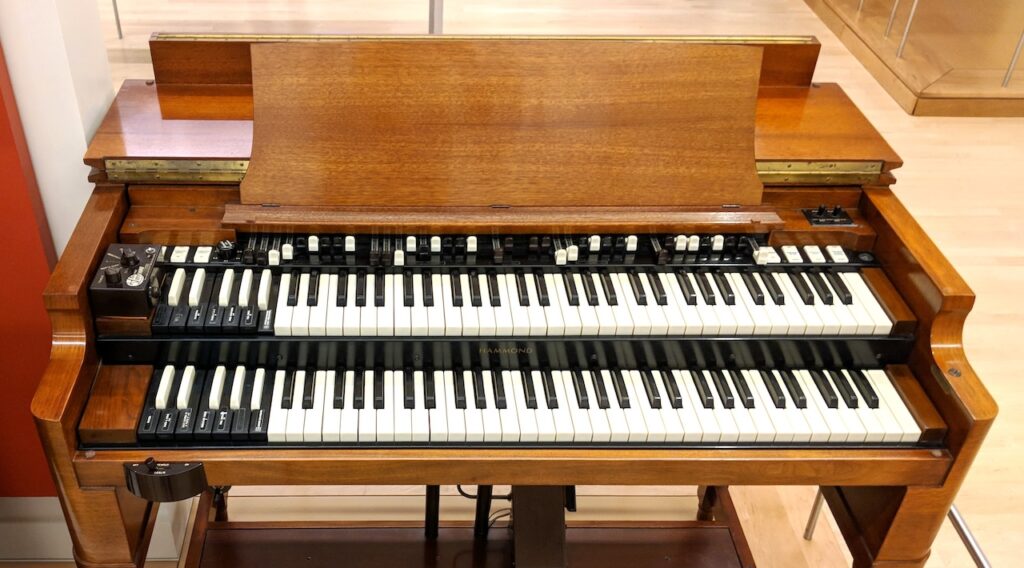
The only problem was that the two 61-key manuals required nine switches per key, which meant over a thousand switches would need to be controlled by the organist. Hammond and Hanert’s method for consolidating these switches was, frankly, ingenious: they grouped the switches across the keys, so that the first switch would turn on a note an octave lower for every key at the same time, and the second switch would do the same with a fifth below, and so on. They then assigned each numbered group to a volume fader, placing the faders above the keys in the same location a traditional organist would have their stops. These nine faders, known as drawbars, became part of the instrument’s USP, making it easy for traditional organists to adapt to the new instrument, while also providing the electric organ with a distinct range of tones. Hammond and Hanert’s innovation would eventually pave the way for the oscillators that Robert Moog would include in his first synthesiser. 3For a more in-depth exploration of the Hammond Organ, check out the Hammond Organ Co.’s own 50th Anniversary pamphlet.
In the manual for one of their electric organs, Hammond provide handy diagrams that outline how the drawbars work, including the pitches of the artificial overtones, their general timbre, and whether they create consonant or dissonant harmonics against the fundamental notes:
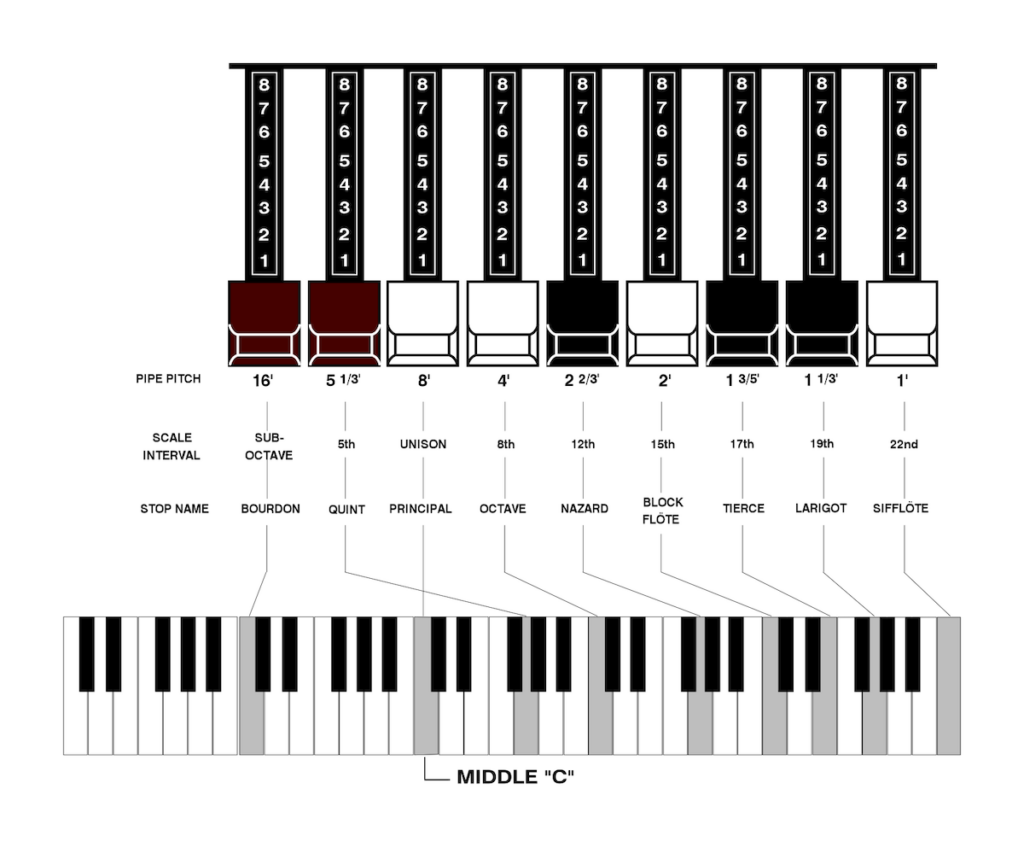
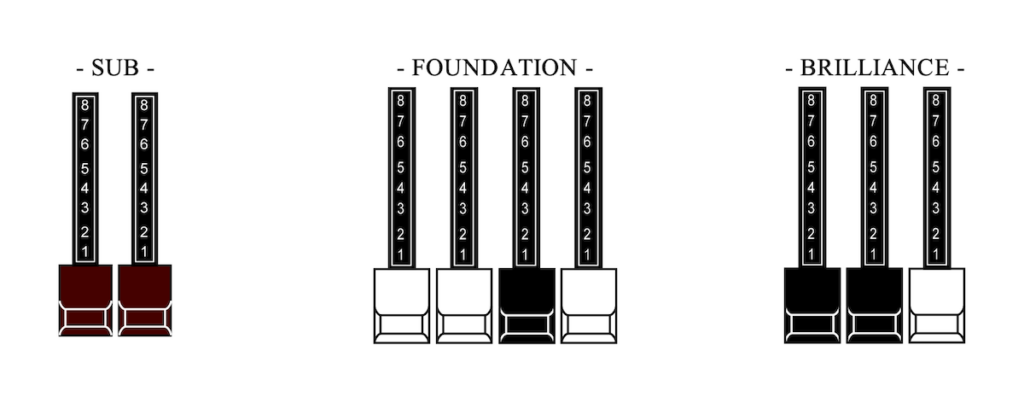
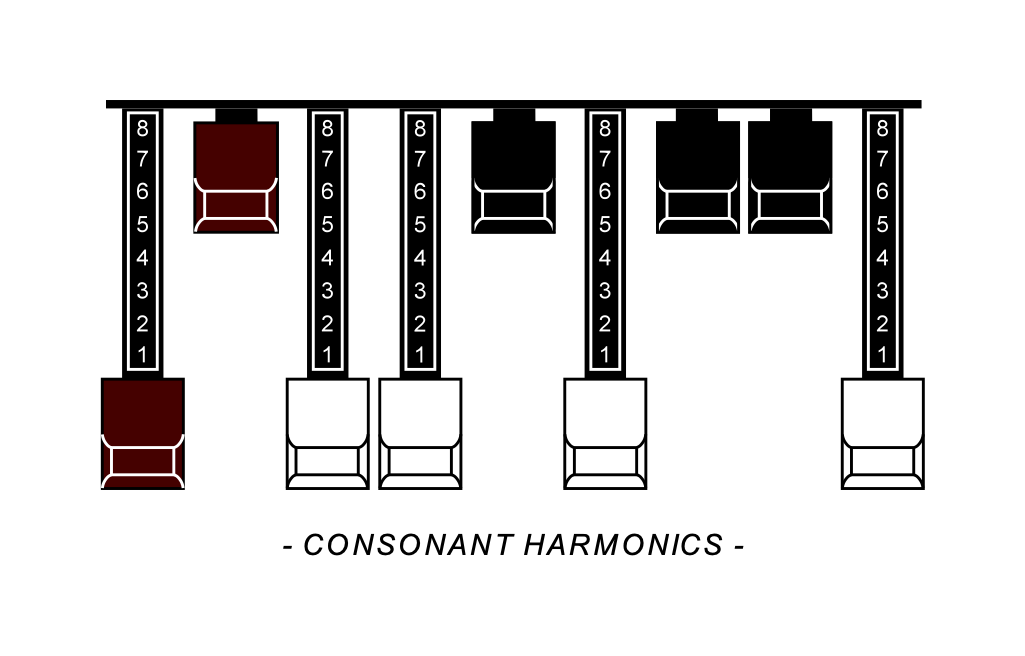
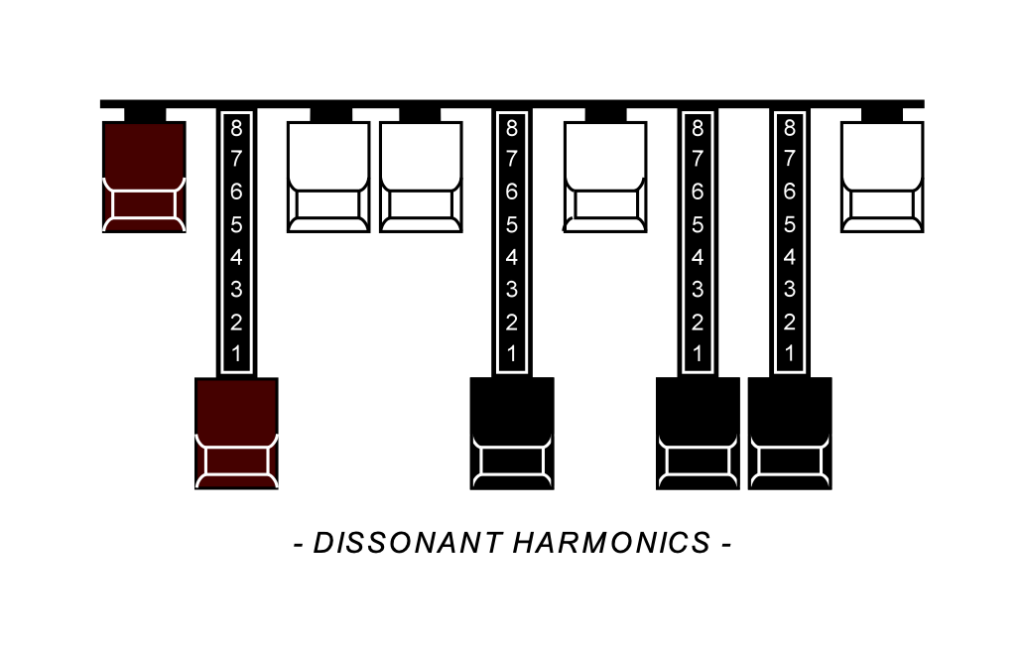
The sound that Tommy Black uses for the organ on “Institutionalized” is limited to the “foundation” drawbars, providing a clean and consonant sound with just a tiny bit of grit, which is exactly why it feels like seeing the sun rise in an overcast sky.
The particular timbre Black uses for the organ is created by pushing in most of the instrument’s drawbars in and only pulling out the ones that provide what Hammond call the “foundation” frequencies, without any lower or upper harmonic, providing a clean and consonant sound with just a tiny bit of grit, which is exactly why it feels like seeing the sun rise in an overcast sky. At the same time, we hear an electric guitar float in with a syncopated high F# that melts into a series of lapping waves through a chain of envelope filter, delay and chorus effects.
It’s unclear, initially, whether we’re in G major or D major (its adjacent partner in the circle of fifths) — the use of the fifth (D) as the bass note of Gmaj7 without any resolution while the guitar and violin highlight the lightly dissonant seventh (F#) seems intentionally designed to play with our sense of tonal stability, which explains why it creates an atmosphere that feels like waiting for daylight to break. This calm tension is also reflected in the drumbeat, which completely avoids the reassuring sway of a backbeat and instead pumps ahead on the kick drum while only providing two scant semiquavers on the snare for the second beat of every other bar.
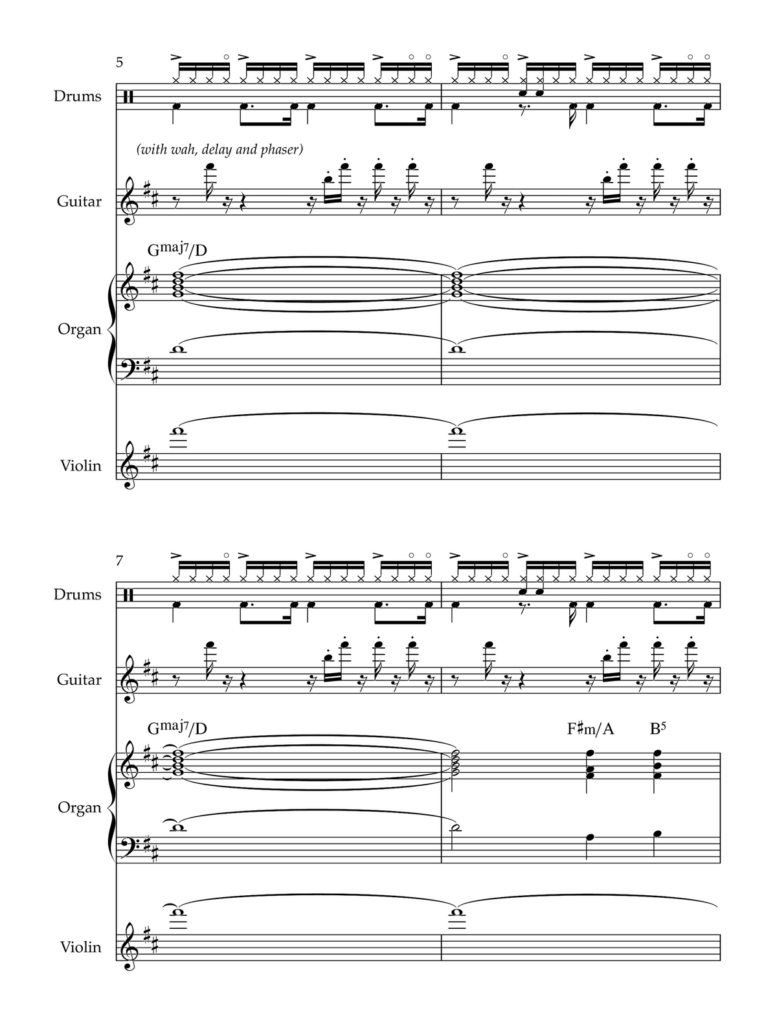
It’s not till the final two beats of the eighth bar that we hear F#min/A followed by B5, a iii–vi turnaround that more clearly establishes we’re in the key of D major. Except iii–vi isn’t traditionally considered a turnaround; in fact, it’s only the first half of the usual iii–vi–ii–V turnaround. And the iii–vi change takes us back to the IV (Gmaj7/D), instead of going to the ii, which would be the vi’s natural tonic as a secondary dominant. This unusual structure suggests that the chords are trying to avoid certain harmonic clichés, which lines up with the the theme of Lamar’s lyrics, where he asks, “What money got to do with it / When I don’t know the full definition of a rap image?” While Kendrick is beginning to recognise the hollowness behind hip hop’s iconography, the chords recognise that there’s a similar hollowness in simply doing things the way they’ve been done before.
As the progression repeats for a second and third time, other elements begin to break through: a deep yet punchy synth bass pops up to play a few notes and swallow everything else in the mix; the sound of birds chirping drifts in and out. Then, at bar 16, we’re met with another complete track mute for three beats as Kendrick says “I could still kill me a nigga. So what?”. It’s worth noting Lamar’s timbre here; while “For Free? (Interlude)” found him sounding like a saxophone and “King Kunta” saw him channeling the coarse texture of James Brown’s voice, here he provides a high-pitched, nasal tone that suggests he’s speaking from a juvenile viewpoint, which makes sense since he’s claiming he’s still capable of violence; at this point, K-Dot is a long way from the enlightenment of the butterfly.
In addition, there are two subtle details that become apparent in the space left by the muted track: the reverb distinctly makes it sound like he’s in a room, alone, and there’s the low rumble of turntable noise just below this, which is at odds with the clean, digital sound of the rest of the arrangement. In both cases, there are obvious practical reasons for these elements — most instruments, including vocals, sound unnatural without reverb, and the turntable rumble connects this section of the song to the classic boom-bap sound of its second half. But we could also interpret this brief moment of silence in contrast to the layered complexity of “King Kunta”. Where that song features Kendrick’s threats towards other rappers being tacitly supported by increasingly dense layers of percussion and background noise, the threat in this song simply languishes in silence — a silence that is made all the more notable precisely because it contains an echo and a rumble, conjuring up the loneliness of an empty room rather than the promise of a blank canvas.
Having spent 16 bars establishing the basic structure and harmony, the 17th bar sees most of the instruments go completely off-piste: the synth bass comes in half a beat late with a D followed by two very off-kilter broken octaves playing E followed by F#. The organ comes in late too, hitting a Cdim(maj7) chord half a beat into the bar. This is, essentially, one of the most dissonant chords around, featuring both a tritone between the 1 and ♭5 and an unresolved tension by placing a major 7th on top of it instead of using the expected neighbouring notes of the♭7th (for a Cm7(♭5)) or 1st (for a straight Cdim). On top of that, there isn’t a C chord of any kind that belongs in the key of D major, which means that while it’s the kind of chord that might be used as a substitution to pass between two neighbouring chords, it’s definitely not something that we would usually linger on.
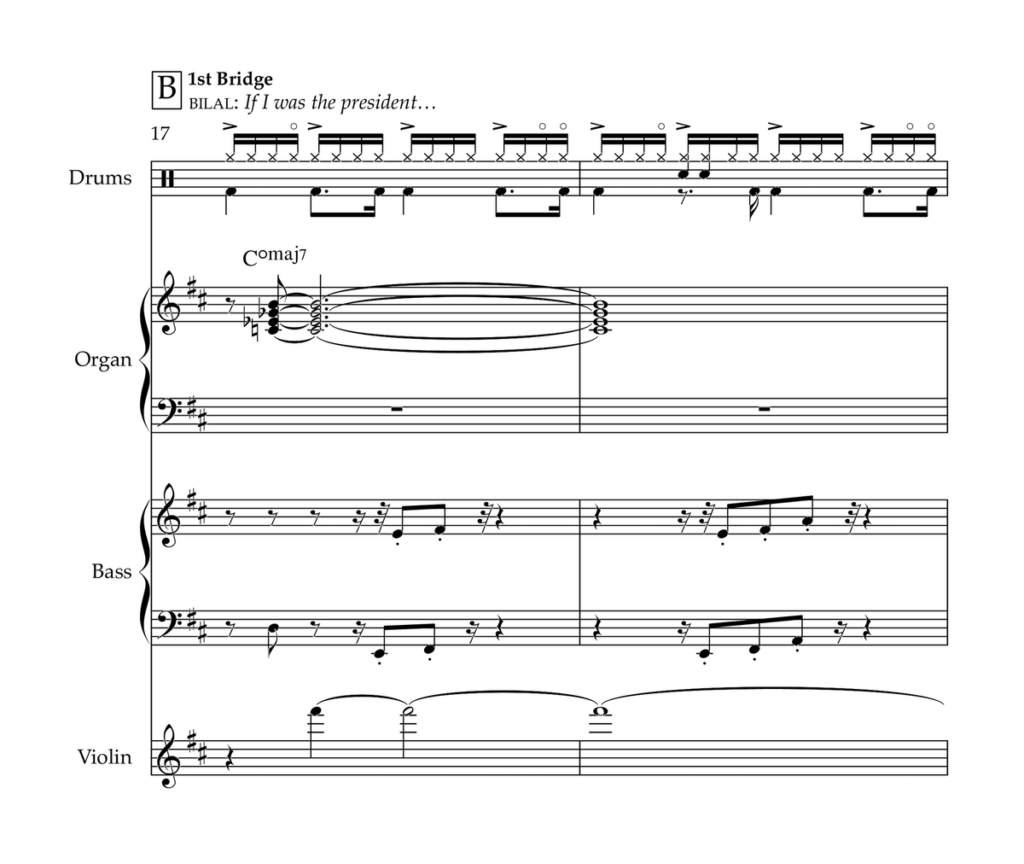
Yet linger we do, to the point where it becomes clear that the chord must be a bridge into a different key. As previously mentioned, G major’s closest family member is the key of D, with the only different note being that D major swaps the subdominant C out for C#. And while Cdim(maj7) isn’t the usual IV chord in the key of G major, it’s pretty common in jazz music to turn the IV of a major key into a minor or diminished chord, since it adds a bluer hue to the mood (see Antônio Carlos Jobim and Newton Mendonça‘s “Meditation” for a great example of this). So the appearance of the Cdim suggests we’re modulating to G major.

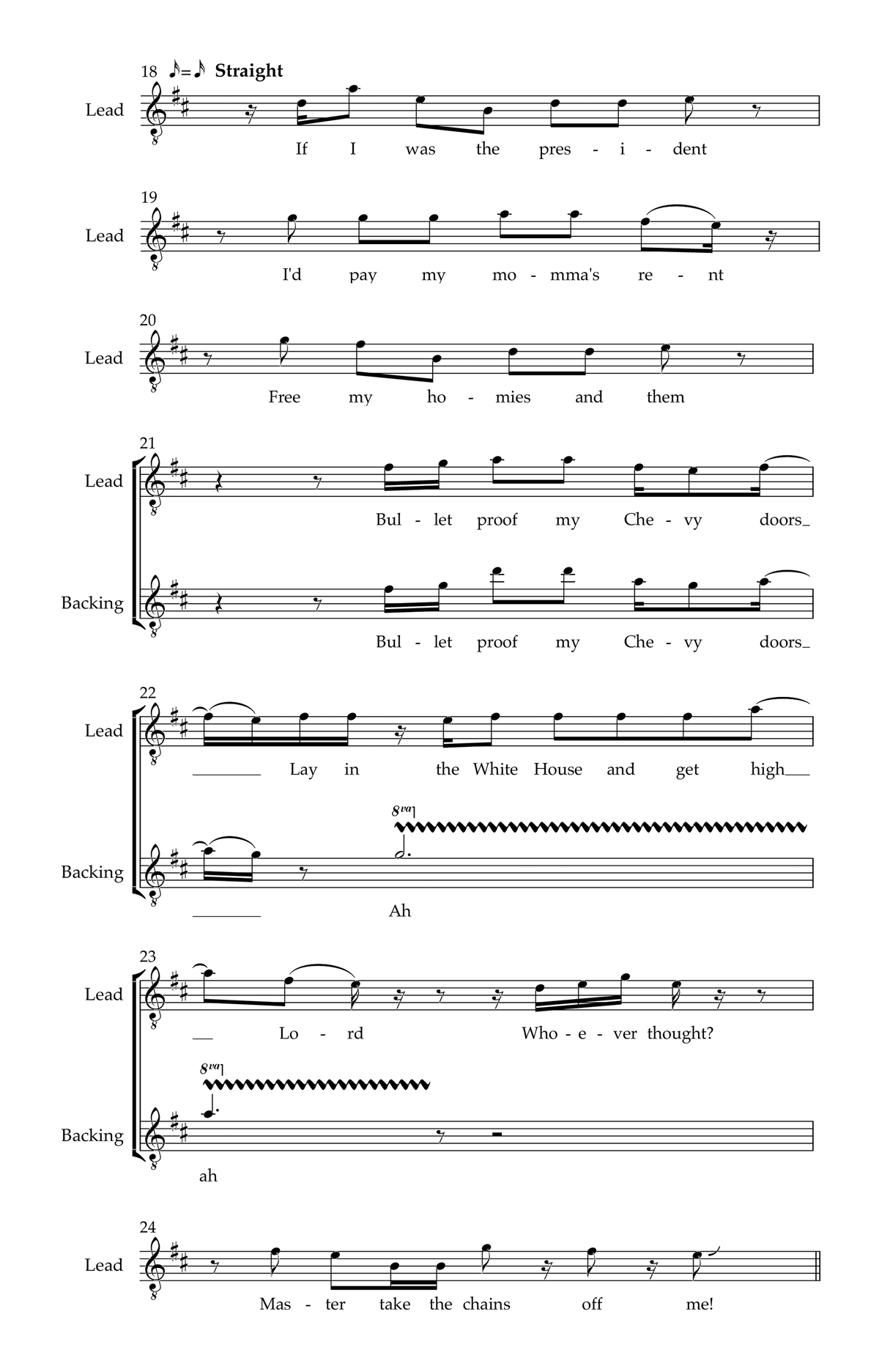
And we do modulate to G major — but to be more exact, we modulate to G major’s relative key of E minor instead, since bar 19 contains a quick shift from Cdim(maj7)/B – Emin/A – Emin9/D, emphasising the minor tonic. As these storm clouds gather in, Bilal comes in with a melody that cannily manages to avoid C or C#, leaning into the harmonic ambiguity. This shift to a more melancholic mood is reflected in the lyrics, where the singer’s idle daydream of becoming the president and helping the community quickly curdles into him bulletproofing a Chevy and getting high in the White House, before crying “Master, take the chains off me!”
The prodigal son
This desire for freedom after indulging your impulses is one that Bilal probably recognises all too well. While many of the artists on To Pimp a Butterfly have gone on to spearhead the new wave of jazz, hip hop, soul and R&B in the 2010s and beyond, Bilal was lucky enough to be there last time it happened in the early 2000s. While studying at The New School for Jazz and Contemporary Music in New York, he began to link up with musicians like James Poyser, Questlove and J Dilla. Between them, they created a movement that later came to be known as the Soulquarians. Despite coming from different genres, the Soulquarians shared a desire to push black music in a more earthy and experimental direction — one that would honour the boundary-breaking spirit of artists like Prince and Stevie Wonder. For the first few years, they were lucky enough to experience both critical and commercial success, with albums like D’Angelo’s Voodoo and Erykah Badu’s Mama’s Gun going Platinum according to the RIAA certifications. The next round of albums saw the acclaim remain, but the sales began to dwindle; Bilal’s own debut, 1st Born Second, only managed to sell 319,000 copies, a couple 100,000 short of going RIAA Gold. Soon, however, the critical acclaim began to recede too, with Common’s Electric Circus and Erykah Badu’s Worldwide Underground both being met by lukewarm reviews.
But it was the debacle around Bilal’s second album, Love for Sale, that put the nail in the coffin of the Soulquarian’s renaissance. While most of the Soulquarians have an affinity for jazz music, Bilal is the only singer who’s a dyed-in-the-wool jazz musician. This fact becomes clear the moment you hear his voice: it’s an instrument that he can push in any direction, sliding from a low baritone all the way up to a clear falsetto while simultaneously twisting the timbre from a baby’s coo to a banshee’s scream. While Bilal’s first album did showcase this talent, as he says in this interview, he had to make compromises when it came to the production: “The album sounds like a dope-ass mix-tape: Bilal featuring Dr. Dre, Bilal featuring Jay Dilla, Bilal featuring Floetry. At a certain point, that starts to eat at your own natural creativity”. So when it came to his second album, he took inspiration from the success of the other Soulquarians and tried to push it in a more experimental direction, avoiding clichés like straightforward love songs, verse-chorus structures, plain chord voicings and sterile digital recording methods. And he brought in a cadre of actual jazz musicians to help him achieve it, including fellow New School friends like Leron Thomas and Robert Glasper. Meanwhile, his record label, Interscope, had been dismayed by the modest sales of 1st Born Second and wanted him to produce something that would sell more records.
Inevitably, a war of attrition began — while they kept pushing for him to make something more commercially viable, he kept ignoring their requests by trying to create something more experimental and worthy of critical acclaim. As he completed the record, the label became increasingly aware that they were being given a different meal from the one they’d ordered. Then, in early 2006, an unmastered copy of it somehow leaked online. Soon, the album was everywhere: on blogs, on torrents, on peer-to-peer networks. While Bilal viewed this as less than ideal, the good news was that the handful of journalists who weren’t beholden to promotional cycles gave Love for Sale a glowing review. Mathan Erhardt at Inside Pulse summed it up best when he said, “It’s a genuine masterpiece that’s received nothing but praise”.
And Interscope, seeing that the album was out in the world and gaining an audience, decided to shelve it.
The fact that an old-world record label rejected Bilal’s avant-garde work while it was embraced by over 500,000 listeners online really speaks to the transitional stage that the music industry was going through at the time. Bilal was 27 when Love for Sale leaked in 2006; by comparison, Kendrick Lamar was 17 when he chose to release his first mixtape online for free in 2005. Unlike Bilal, Lamar had the advantage of making his bones in the midst of the mixtape era, where even superstars-in-the-making like The Weeknd could build an audience online before deciding whether they wanted to hitch their wagon to the juggernaut of a major label. So when Lamar began decided to push his own second album for a major label in a more jazzy, experimental direction in 2014, he had the kind of bargaining power that Bilal could only dream of in 2006. It’s worth seeing Bilal’s inclusion on To Pimp a Butterfly, then, as a spiritual passing of the torch from the Gen X Soulquarians to the Millennials of the West Coast Get Down, Top Dawg Entertainment and the L.A. beat scene, continuing the mission of combining artistic experimentation, critical acclaim and commercial success.
There’s also a more pragmatic reason for Bilal’s inclusion on the album: nobody can really do what he does with his voice. Like Lamar, he’s fearless when it comes to shifting timing and timbre in service to the song. It’s a theatrical approach to performing that’s largely at odds with the traditions established by black artists like Billie Holiday, Aretha Franklin or The Notorious B.I.G., where your tone and phrasing are your sonic thumbprint. And while Bilal can obviously sing in tune, he’s unafraid to go off-key, which is exactly what he does at the end of the intro when he bends the E note on the word “me”, creating a subtle effect where his chorus of voices sound as if they’re leaving the key of E minor right as we’ve settled into it.
Familiar cadences
This bent note provides our bridge to the next section of the song, where the clean sound of Tommy Black’s beat gives way to the familiar boom bap blend of sampled drum hits, vinyl noise and an electric piano. While Rakhi is listed as the main producer on this section, the piano part was actually provided by Sam Barsh. As Rahki himself notes in his comments on WhoSampled, Barsh is “an incredible keys player and a great producer on his own”, so it’s reassuring to know that the pianist received a songwriting credit on “Institutionalized”, since his chords and melody are essential to establishing the mood and tone of this section of the song.
It’s a chord progression that feels both familiar and unfamiliar. On the one hand, it uses the classic lament bass, descending through i –♭vii – ♭vi – V, which most Westerners would recognise from the Andalusian cadence or standards like “My Funny Valentine”. On the other hand, Barsh’s chord choices defamiliarise the cadence by constantly playing with our sense of tonality.
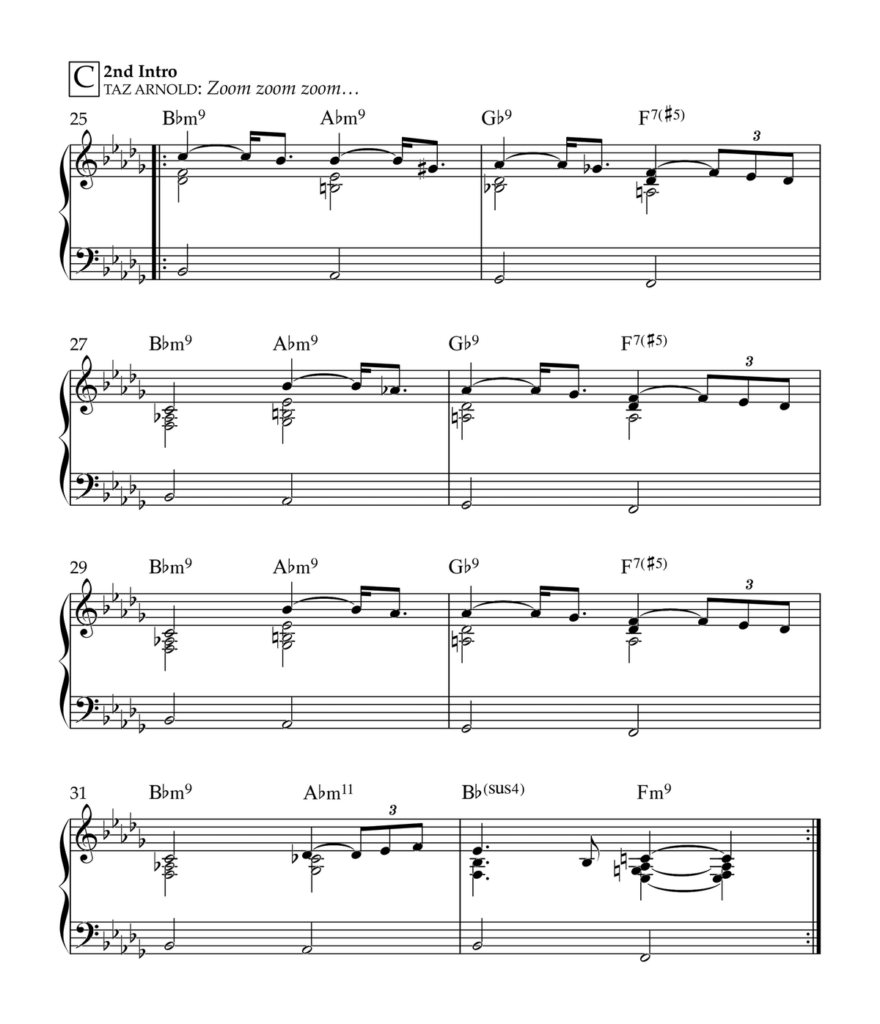
To begin with, the tonic chord of B♭min9 starts us off in the key of B♭ minor. However, it’s followed by A♭min9, introducing a non-diatonic B♮. This acts as a substitution for the diatonic A♭maj chord, turning the expected ♭VII to a ♭vii. Since the next chord of the Andalusian cadence is a G♭maj, our mind interprets this unusual A♭min9 as a tonicisation of G♭major, since the V of G♭major is D♭maj (the V/♭VI), which would make A♭min the ii. In Roman numeral analysis, we can either spell this A ♭ min9 as ♭vii or ii/♭VI, but I’m going to opt for the latter since it clarifies for an improviser how the tonality is temporarily shifted from the main key of B♭ minor to G♭ major.
Our expectations are subverted again when Barsh goes from playing A♭min9 to G♭9, since this introduces another non-diatonic tension in the form of the chord’s ♭7th, which is an E — the tritone of B♭. While this chord feels just as out of place as the A ♭ min9, the rule of secondary dominants again applies in this case: since the next chord will be F7(#5), let’s imagine that F major is the target key for a moment. In that case, the V/V would be C7. Since G♭ is the tritone for C, the tritone substitution for C 7 would be G♭7 (spelled in Roman numerals as♭II/V). In other words, Barsh treats us to two substitutions that establish two new temporary tonal centres, from I – ii/♭VI – ♭II/V.
Interestingly, the other times that Barsh repeats this G♭9 chord in the progression, he lowers the 3rd to create a G♭min9 instead. While this shouldn’t work in theory, in practice it means that the A and D♭ of the chord get to remain static across the whole bar, since they form both the ♭3rd and 5th of G♭min9 and the 3rd and #5th of F7(#5). As a result, we do feel a sense of resolution once the chords reach a perfect cadence by landing on F7(#5), the V of B♭ minor. Moreover, Barsh reinforces this by leaning into the harmonic minor, since the 3rd of F7(#5) is A, which forms the ♮7th of that scale.
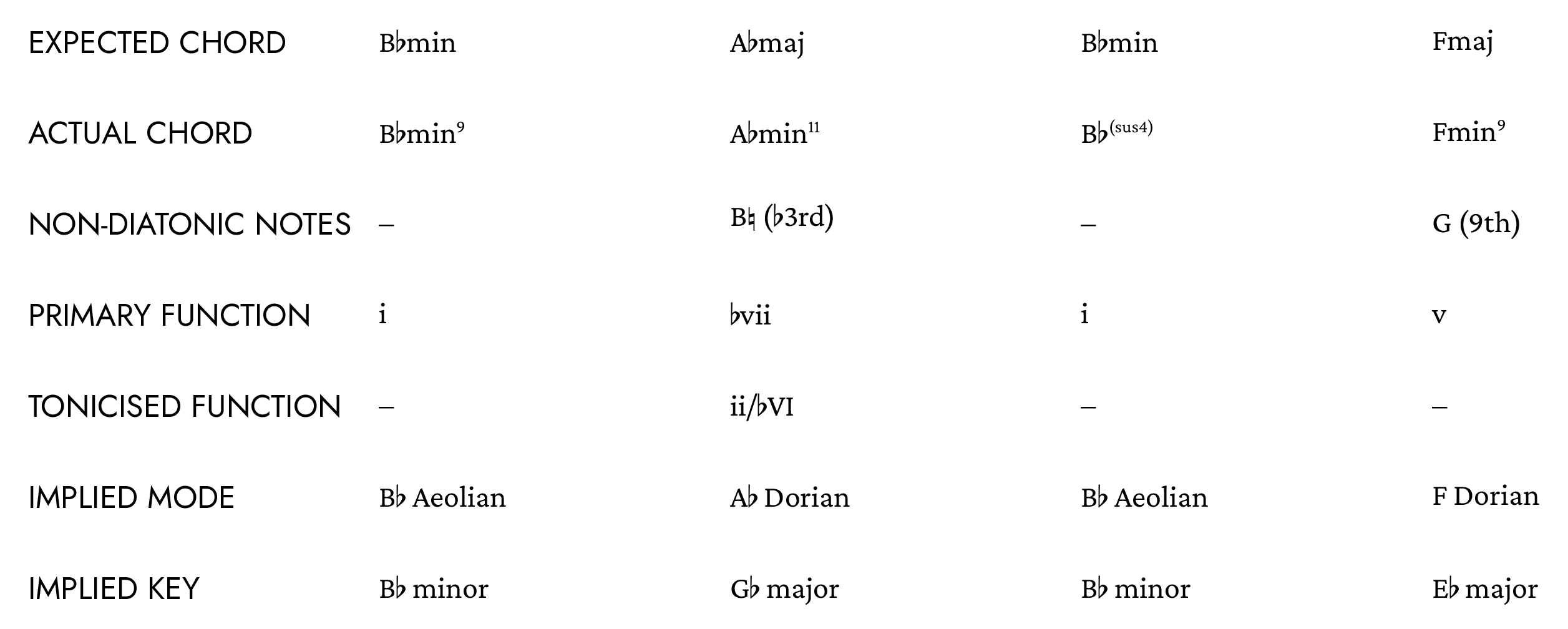
Since it’s easy to become lost in the woods with all these implied tonicisations, here’s a table laying out all the above info, including what we expect from the Andalusian cadence versus what we get in “Institutionalized”, how to interpret the function of the chords in terms of Roman numeral analysis, and how an improviser using the chord-scale system might highlight the modes or relative major and minor keys that are implied by these changes.

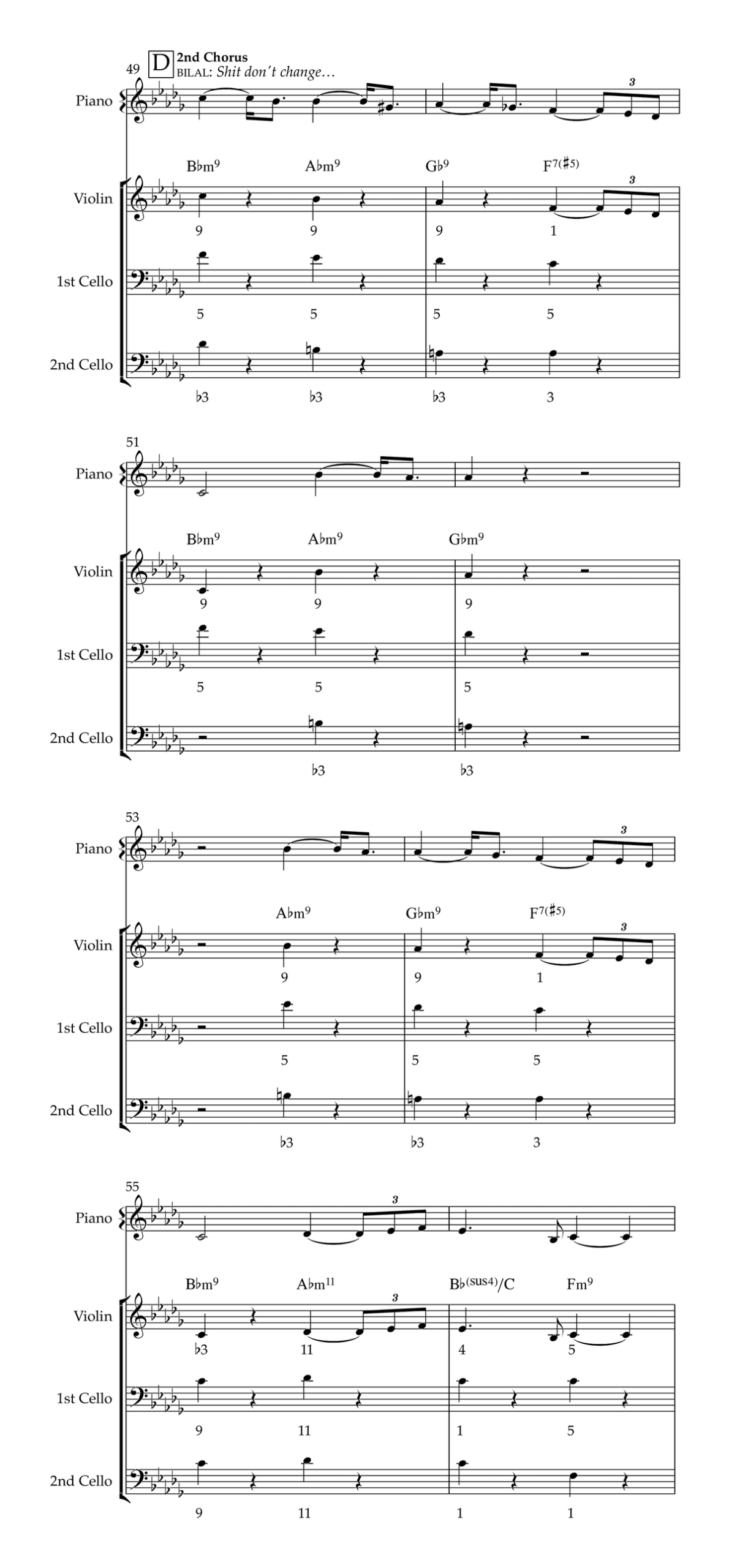
Within the 8-bar piano loop, this descending four-chord progression is repeated three times. The final two bars, by comparison, take a further left-turn, starting with third beat of the penultimate bar, where the ii/♭VI becomes an A ♭ min11, providing us with another tension against the home key of B♭ minor since the 11th of A ♭ is D♭. This adds to the sense of A ♭ min functioning as a secondary dominant, since the D♭ is the dominant tone of G♭, which is the next chord in the sequence. However, instead of going directly to G♭maj — or even the G♭9 we’ve had before — Barsh instead plays a B♭(sus4) with a quartal right-hand voicing of F–B♭–E♭ (5–1–4). This break from the established pattern (and from tertian harmony) has the effect of creating a little moment of uncertainty before we land on the final chord of the 8-bar progression. We know from the established pattern that we’re expecting F7(#5), and if Barsh really wanted to round things off in a familiar way, he could play something with strong voice leading back to B♭ minor like F7(♭9). Instead, he ends the progression with an Fmin9, voiced as 1–♭7–9–♭3–5. This is an outlier, since it introduces yet another tension with the interval of the 9th , which is a G. Unlike the harmonic minor tonality created by F7(#5), the Fmin9 doesn’t naturally lead us back to the home key of B♭ minor. Instead, it introduces the colours of melodic minor to the key, which means that we’ve now cycled through all three types of minor scale while also hinting at A♭ major and G♭ major too. Again, here’s a table like the one above laying it out a bit more systematically:
Consciously or not, Barsh seems to be drawing on flashes of Bill Evans‘s idiosyncratic approach to harmony here, achieving the same melancholic mood that the pianist did on tunes like “Blue in Green”. Evans often favoured stepwise movement and smooth voice leading, which led to him often adding tensions and alterations to the underlying chord progressions. This approach helped to make his playing sound highly melodic even when he was comping. In this way, he took the locked hands style of George Shearing, where the pianist emphasises the melody in the top and bottom notes, and made the sound less sweet but just as smooth with further extensions and dissonances.
While Barsh’s playing isn’t as virtuosic as Evans, he shows Evans’s penchant for unusual chord voicings in the quartal structure that he employs for Bb(sus4) and the close tension of the 2nd/9th and ♭3rd/10th (G and A♭) in Fmin9. The former shares some of the DNA of the famous So What chord that Evans used on the song of the same name, while the tension in the latter is similar to the close voicing of the 7th just below the tonic note in the chord that begins “Peace Piece”. The latter is a sound which Evans liked so much that he recycled it as the introduction of “Flamenco Sketches” and “Some Other Time”, so it’s fair to say the voicing conjures up his spirit in the same way that people can’t hear an E7#9 without thinking of Jimi Hendrix.
The piano melody of “Institutionalized” also invites a locked hands approach since the top line of the melody descends at the same time as the bass and chords. Given the repetitive, looping nature of hip hop production, one of the neat tricks with this melody is the way that it loops — we start off on the 9th interval of the home key, a high C, playing over a B♭min7. The melody descends down to the same interval an octave below, but we land on the lower C at the start of the next bar, which means the melody doesn’t have time to get back to that high C; instead, it repeats all the other descending notes twice over before finally finishing off the progression with a different phrase. While this feels like an acceptance of defeat, it is followed by the whole 8-bar progression repeating, placing us back at the high C, ready to experience the futility all over again.
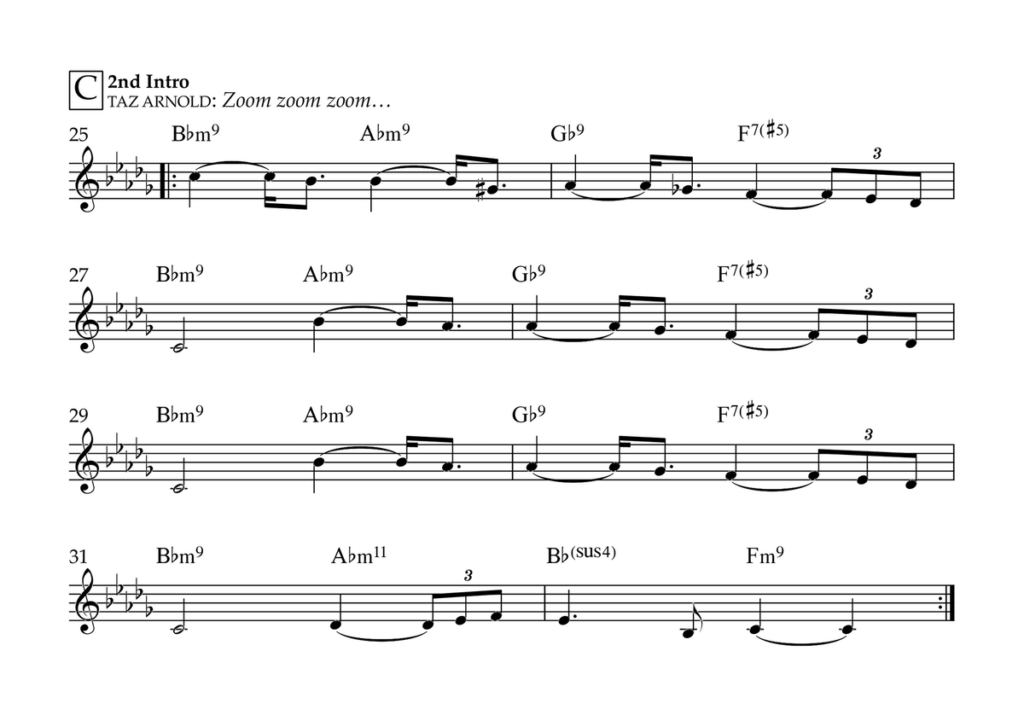
It’s a melody that neatly dovetails with the song’s theme of being trapped inside a mindset and realising that there are still limits to what you can achieve, since the melody itself is caught in a downward spiral. Moreover, the addition of Paul J. Cartwright on violin and Gabe Noel on cello in the chorus adds to the melancholic sound, since the soft attack and release of bowed strings can leads to their crochets sounding like little plaintive sighs. Moreover, the way the cello highlights the 3rds while the violin emphasises the upper extensions helps to further colour the mood, since they’re both drawing attention to the notes that specifically give the harmony its Bill Evans-esque flavour.
Some other time
Despite the song’s keyboards sounding like some combination of a Rhodes piano with a baby grand doubling the melody in the chorus, Barsh notes in this TikTok clip that he actually played the piano part on a MIDI controller at a studio Rahki shared with DJ Dahi and Brocky Marciano. Rahki then fleshed it out by dialling in an effects-laden electric piano sound, while also adding drums and a synth bass line. Both of these elements perfectly complement Barsh’s electric piano because it’s a familiar sonic template — one that became synonymous with a producer who casts a long shadow over all post-2000s hip hop: J Dilla.
As one of the Soulquarians, Dilla inspired people like Questlove and D’Angelo to play around with different time-feels the way a jazz drummer might, thinking about how to rush or drag against the pulse and how to mix swung and straight rhythms. By comparison, most hip hop producers in the 90s were relying on quantisation, where instruments are locked into an even division of notes, so that the kick, snare and hi-hat all land at the same time. And while this sound was originally the result of technological innovations in the form of digital sequencers and multitrack recording, by the 90s it had spread into the sound of live performances too — even Questlove admits that he was trying to play like a quantised drum machine at one point, believing it would make The Roots sound “more hip-hop”.
Dilla, on the other hand, was the inverse: a machine-based artist who was trying to break away from sounding like a machine as much as possible. He taught himself to manipulate the tiny subdivisions in the sequencing grid of his Akai MPC 3000 (which is now in the Smithsonian) to create a distinctly off-kilter approach to time-feel that his biographer, Dan Charnas, calls “Dilla time”. As Charnas succinctly puts it:
Before J Dilla, our popular music essentially had two common “time-feels”—straight time and swing time—meaning that musicians felt and expressed time as either even or uneven pulses. What Dilla created was a third path of rhythm, juxtaposing those two time-feels, even and uneven simultaneously, creating a new, pleasurable, disorienting rhythmic friction and a new time-feel: Dilla Time.
—DAN CHARNAS, Dilla Time
Grasping Dilla time requires a basic understanding of sequencers — digital devices that allow you to sync up all the parts of a musical arrangement and play them together, like a conductor cueing the orchestra. Technically, the main screen of any modern digital audio workstations (DAW) is a sequencer that also hides a mixing desk and effects, like this:
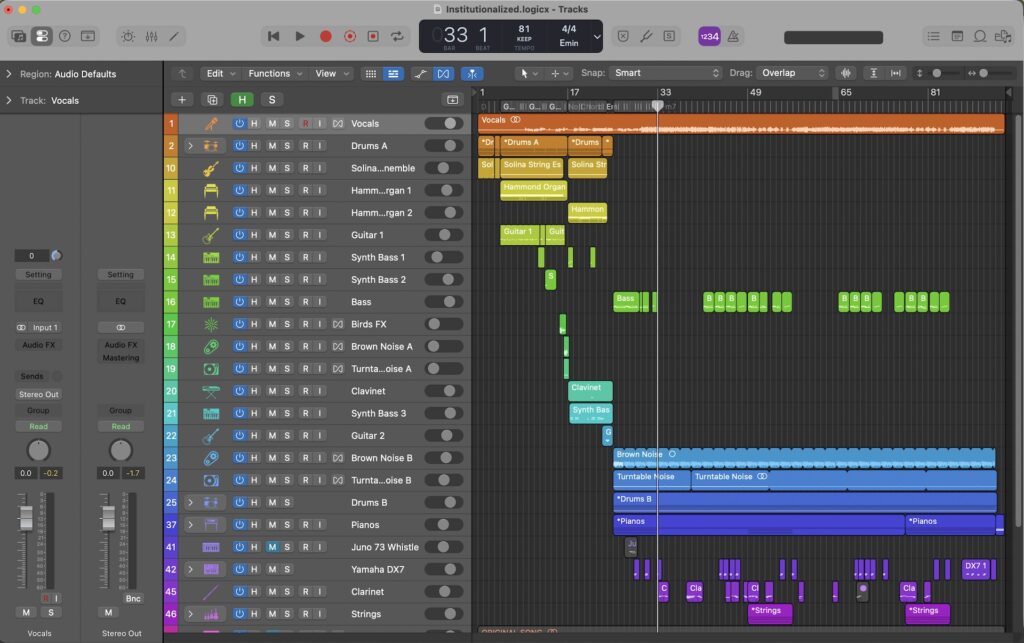
However, calling this a sequencer can be confusing for younger people since the definition of the word has narrowed down to mean something that visually imitates older sequencers, which looked like this:
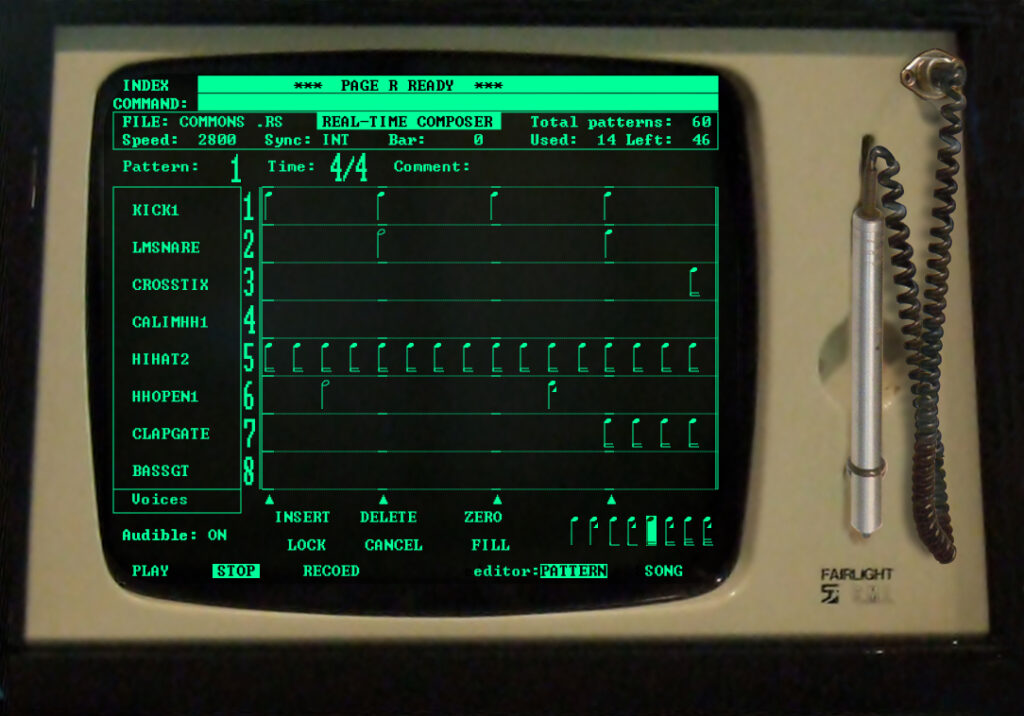
Or this:
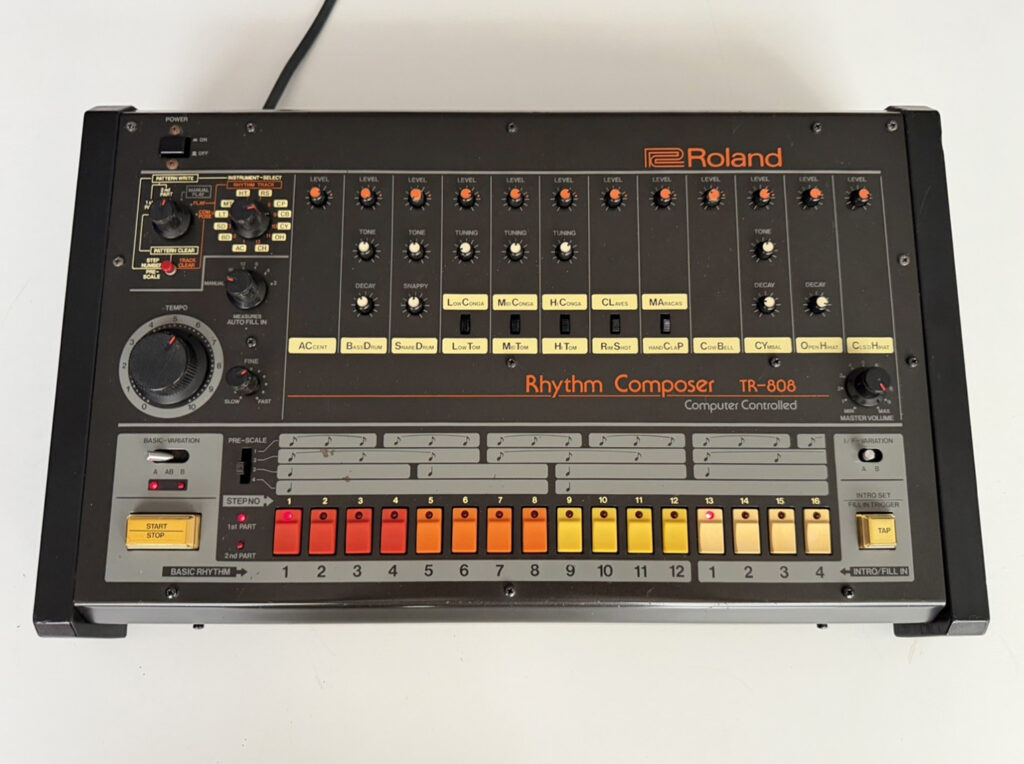
In a modern DAW, the more direct descendant of these sequencers is the basic grid that pops up when you’re programming a particular instrument — a section otherwise known as the MIDI Editor or Piano Roll. Here’s how it looks in Logic:
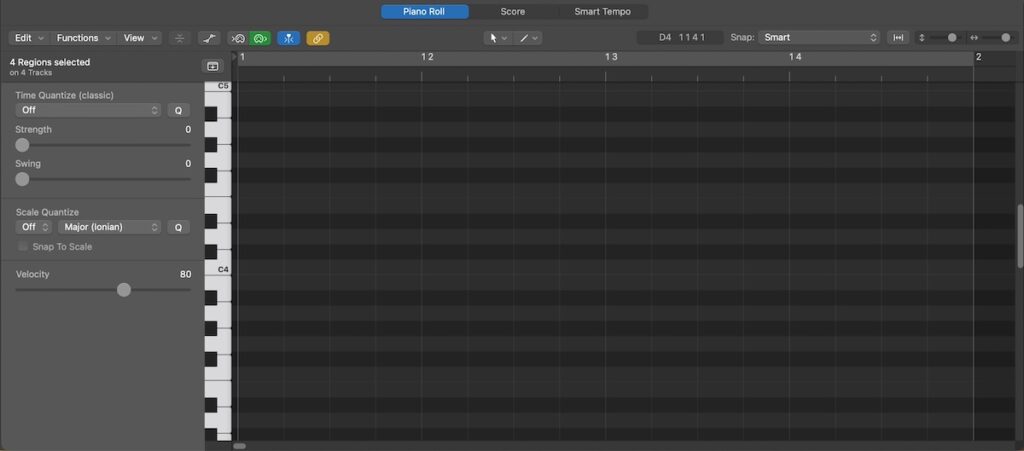
The grid is divided up into columns of semiquavers and rows of piano keys. A standard backbeat, with the kick drum on the on-beats and a snare on the off-beats, would look like this:
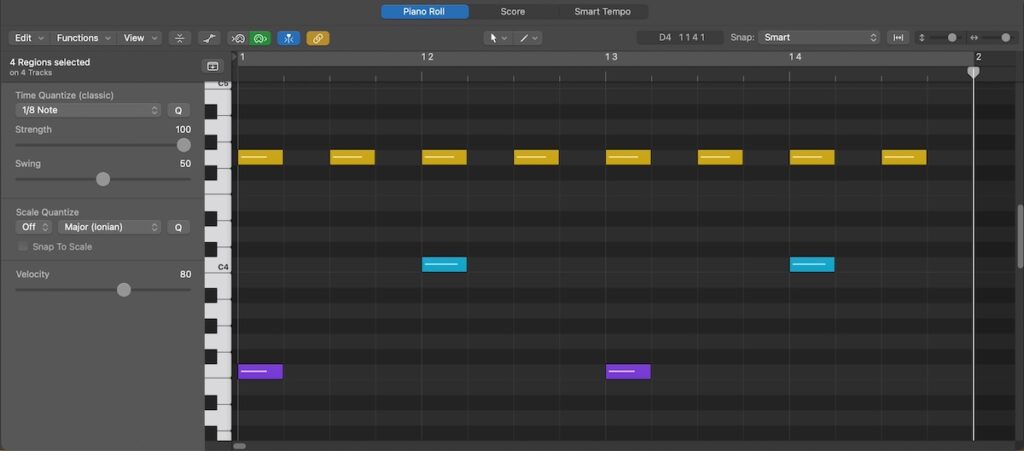

Hi-Hat

Tambourine

Snare

Kick
N.B. Colours are usually used in Logic to indicate the velocity (dynamics) of the notes in MIDI programming, but I’ve highlighted the instruments based on their parts to make it easier to see what each drum is doing.
Against this grid, swing is achieved by displacing every other column of notes in a sequential pattern. For example, a backbeat with swung quavers on the hi-hat would look like this:
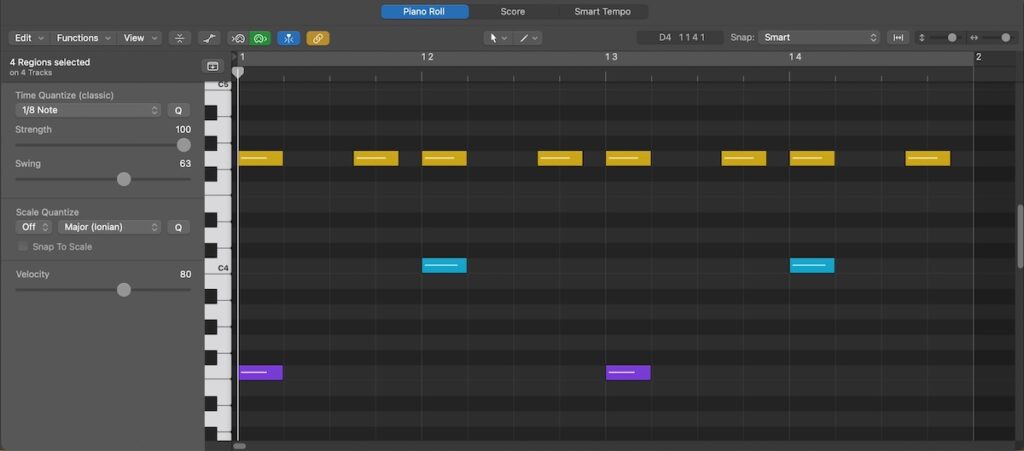
All of this can be achieved through quantisation or manually, since this kind of metrical swing involves simply selecting every other column of notes and shifting them an equal distance from the note that comes before it. But Dilla’s innovation involved shifting individual notes instead of whole columns, and placing each one tiny subdivisions either ahead or behind their rectilinear place in the grid. By doing this, each drum part (and often other song elements too) gains a different sense of straight or swung rhythm, and the friction between them creates a distinct groove — one that’s neither straight or swung but somewhere in between.
We can illustrate this further by breaking down Rahki’s drums on “Institutionalized”. Here’s how the first bar of the second half would look if it was quantised:
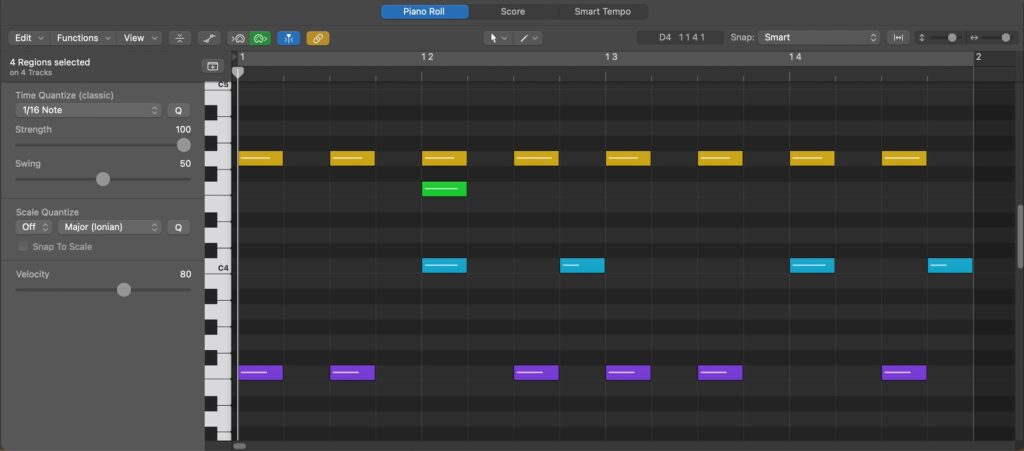
And here’s how it looks in reality:
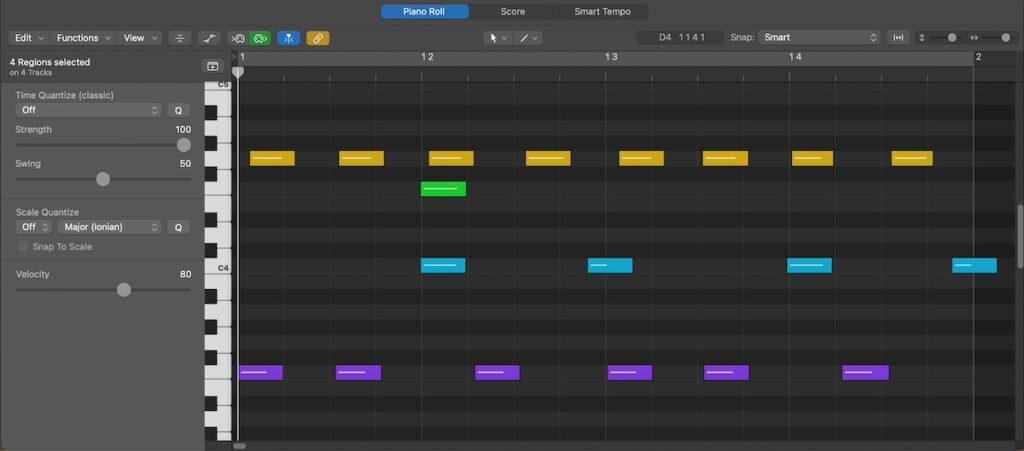
It’s as if he’s intentionally colouring just a little bit outside of the lines. The time isn’t just rushing or dragging against the pulse — it’s doing both. As Charnas points out in his book, it’s an approach to rhythm that is simultaneously human and programmed, drawing on advances in technology that have allowed producers to imitate the microtiming that drummers naturally add to their own beats.
If I had to guess — and I do, for now — Rakhi probably achieved this by simply turning off quantisation and playing the entire beat live into his DAW, since it fluctuates from bar to bar in terms of microtiming. But that doesn’t mean the Dilla time-feel is a product of human error; it’s also clear from this key moment in his episode of Rhythm Roulette that Rahki is able to shift from a straight time-feel into Dilla time using just a drum pad controller, so it’s easy enough to imagine him doing the same on “Institutionalized”.
One for the treble, two for the bass
The synth bassline owes a lot to Dilla’s sound too. The typical Dilla bassline is syncopated and melodic, yet it rarely struggles for space in the mix since it locks in with the kick drum and occupies a distinct low range in the frequency spectrum. You can hear some examples of this on the remix of “Sometimes” by The Brand New Heavies or “The Light” by Common. It’s such a distinct sound that there’s even examples of other producers biting his style like Janet Jackson‘s “Got ’til It’s Gone”, produced by Jimmy Jam and Terry Lewis, or 2Pac‘s “Do for Love”, produced by Soulshock and Karlin. The hip hop producer Nonjuror did a brilliant job of recreating one of the more experimental ways that Dilla achieved this sound by sampling and pitch-shifting turntable noise, but Mixdown Mag accurately notes that he was also known for sampling and filtering basslines from existing songs along with using more conventional synths like the Minimoog Voyager and microKORG. The key element all three approaches have in common is that Dilla liked to use a low pass filter on his basslines, cutting out all the frequencies above 200hz so that they could be occupied by the other instruments. This led to the distinct timbre of Dilla’s basslines, where it feels as if it’s throbbing from somewhere deep within the speakers rather than being played by an instrument; and since the kick drum sits just above it in terms of frequencies, whenever the two instruments sync up on the downbeat of a bar, it provides that emphasis “on the one” that gets to the heart of the rhythm that James Brown brought into black music.
On “Institutionalized”, Rahki channels the Dilla sound by having the bassline follow the syncopation of the kick drum with staccato notes while accentuating a longer quaver whenever there’s space. To avoid monotony across the 8-bar loop, there are little variations too, such as when it provides a descending arpeggio over the A♭min9 in the second and third instances, and Rahki highlights the turnaround at the end of the chord progression by playing nothing over the first B♭min9 before switching to minims over the last three chords. The bass also temporarily locks in with the kick on the on-beats here to emphasise that this is the end of the 8-bar phrase.
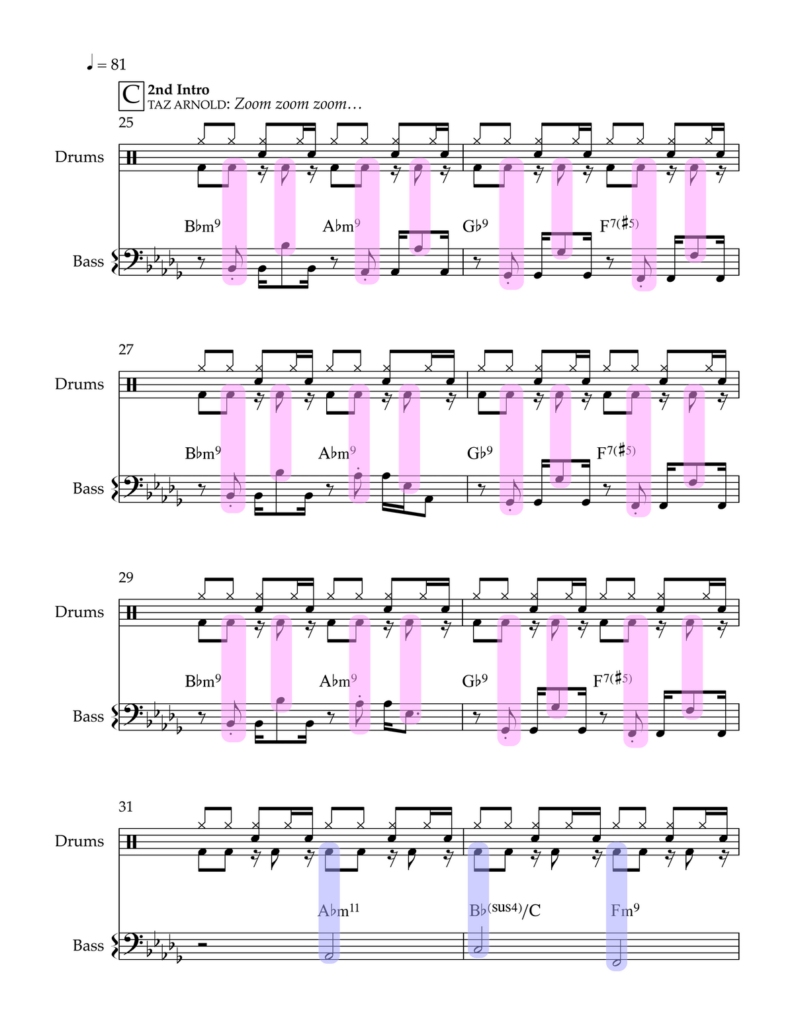
The harmony subtly shifts here too: while Rahki simply plays the root over the A♭min11 and Fmin9, he makes the interesting choice to play a C over the B♭(sus4) chord. As a result, we can interpret that chord as either a simple B♭(sus4)/C, or a Cmin11 chord, since Sam Barsh plays F–B♭–E♭, which would be 4–b7–b3 over C. The timbral differences between the bass and electric piano make them distinct enough that I’m going to opt for the former, but it’s clear regardless that Rahki creates more of a perfect cadence between C and F, reinforcing the feeling in the listener’s subconscious that the progression is about to loop back around again.
Lamar’s use of this Dilla-influenced sound for the second half of the song contrasts with the quantised drums and lack of bass in the opening section, highlighting the shift from the juvenile Kendrick feeling “trapped inside the ghetto” to the adult version of him finding that life outside the ghetto is still full of conflict. More specifically, there’s a tension in the first section between the clean-sounding quantisation and the avoidance of a backbeat that adds to the idea of a juvenile Kendrick having unfulfilled potential while being stuck within an institutional way of thinking. By comparison, the stuttering Dilla time rhythms in the second section break out of this institutional way of doing things. Yet the presence of a backbeat introduces a different kind of tension, reflecting the idea that Kendrick’s problems aren’t solved just because he’s succeeded as a rapper and been able to travel around the world.
It’s interesting to note, then, that Lamar didn’t choose the beat — Rakhi actually sent it to him. After creating the initial skeleton of it with Barsh’s piano lines, Rahki didn’t give it much further thought, simply adding it to the surfeit of stuff he produces all the time. It wasn’t till he was driving through West Hollywood, listening to his own playlist, that he heard it shuffle onto something he’d forgotten about. He sent it to Lamar, who began writing lyrics and thinking about where could go in the album’s sequence.
Reed between the lines
In return, Rahki added further flourishes to make the song cohere with the overall sound that the rapper was going for on To Pimp a Butterfly. In his comments on WhoSampled, he notes: “We added the crazy clarinet to it — I added that afterwards because I wanted the same feel of To Pimp a Butterfly, but I didn’t want sax. You know, I talked to Terrace Martin and I was like, I don’t want to add sax to it because there’s so much sax on the rest of the album. So I wanted to add something that was still jazzy and it took me a long time to figure it out.” That clarinet part was devised and performed by Pedro Castro, who finished studying at Pasadena City College roughly a year before playing on the album. This is pretty impressive given that he doesn’t seem to be as closely connected to the scene of jazz musicians who contributed to the rest of the album’s live instrumentation, so it would be interesting to know how Rahki ended up finding him. The only time he’s shed light on his performance, as far as I can tell, is in a comment on his YouTube channel. Like any talented millennial, Castro maintained a catalogue of his performances while he was at university, and also, like any talented millennial, he’s let it become dormant since, only uploading one recent clip: a Brady Bunch-style split screen of him playing a four-part arrangement of Koji Kondo‘s “Underwater BGM” from Super Mario Bros. Beneath the video, some enterprising commenter had the gumption to say this:
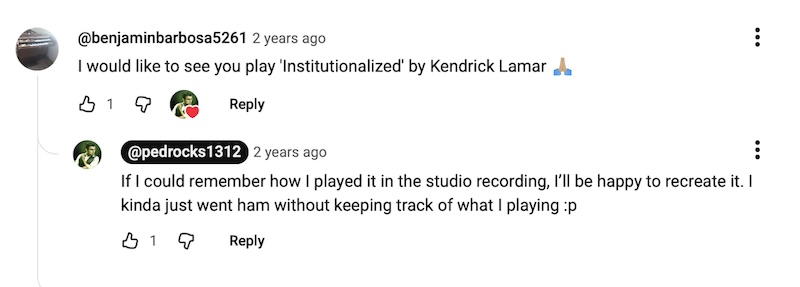
Regardless of how he found him, Rahki made the right choice, since the sound of Castro going ham on the clarinet harkens back to the instrument’s dominance in traditional Dixieland jazz, where it would be one of the three lead instruments playing lines that intertwine around the main melody.4For a demonstration of this style of collective improvisation, check out this video with Evan Christopher for Jazz at the Lincoln Centre. However, Castro’s playing is more sparse and textural than the trad style, often playing swoops, stabs and squiggles that add to the melancholic mood rather than following the tones of the chord progression. The clarinettist begins a few bars into Lamar’s first verse, opening with a glissando as if we’re about to hear George Gershwin‘s Rhapsody in Blue while Kendrick brags about how he’ll “alleviate the rap industry politics”. To some degree, Castro’s slightly tropey use of the glissando goes hand-in-hand with the clichéd nature of Kendrick’s braggadocio, as if they’re both relying on familiar devices rather than trying to find their own voices. By comparison, as the rapper shifts towards exploring the relationship between dreams and work ethic, Castro becomes more playful, skipping through fast demisemiquaver runs that mainly blend the B♭ major and minor hexatonic blue scales to create a nonatonic hybrid of 1–2–♭3–3–4–♭5–5–6–♭7, neither major or minor but exactly halfway between the two. This shift in style and tone dovetails with the way that Lamar’s lyrics move from braggadocio and idealism to a more pessimistic pragmatism, where any individual’s hopes and dreams will remain “only a dream if work don’t follow it”.

Castro also provides the perfect punctuation to Lamar’s lyrics when the rapper shifts into a storytelling mode by describing how “something came over” his friend when he took him to “them fucking BET Awards”; the clarinettist hits a series of choked grace notes near the top of the instrument’s middle clarion register that sound almost like stifled laughter. It reinforces the idea that the cultural experiences of his friend from home are clashing with those of the celebrities at the BET Awards, in the same way that the clarinet — an instrument used in prestigious genres like classical and jazz — ends up sounding distinctly out of place in a hip hop song. Similarly, Castro hits a forte F6 note, close to the top of the instrument’s high altissimo register, right after Kendrick says “you’re looking at artistes like they’re harvestes”, suggesting that Kendrick’s friend has snapped into a dog-eat-dog mentality like an animal responding to the blare of a siren.

Castro hits this note again right in the middle of the chorus: Bilal repeats the advice of Kendrick’s grandma that “shit don’t change until you get up and wash your ass” and the instruments mute halfway through bar 52 while the clarinettist does a chromatic run up to B♭5, followed by a second run up to F6. This creates a moment of suspense at the outset of the next bar, which is only broken when Bilal — now with multitracked harmonies — repeats the proverb again and the rest of the instruments kick back in. By drawing our attention to the squealing clarinet and the idea that “shit don’t change”, Lamar and the album’s mixing engineer, Derek Ali, are highlighting this advice and its importance to Kendrick’s predicament as if it’s a public service announcement.
While the first verse contains many of Castro’s most overt moments of word-painting, he pulls back more from that point onwards, playing just a short motif of descending triplets under Snoop Dogg’s bridge as the rapper describes “a city so divine called West Side Compton”. Since the third repetition of the triplets end with a slight ritardando, it almost sounds as if Castro is imitating the doppler effect of a car going past playing music, or someone whistling.

Similarly, the clarinettist limits his moments on the second verse to three small pieces of punctuation. He begins with a few ascending figures as Kendrick describes “gold bottles, gold models giving up the ass for Instagram flicks”, complementing the rapper’s own syncopation. Then, in the middle of bar 68, he provides another glissando which leads into Bilal’s high tenor “aah” while the bass and kick go mute at the start of the next bar. The wail of Bilal and Castro reaches the upper register of their respective instruments. highlights the lyrics, where Kendrick’s friend is indignant at the idea that a celebrity has the money to go to a famous strip club in the middle of a recession. Finally, Castro the clarinettist ends the verse with a series of falls from the instrument’s altissimo register that sound like sighs, reflecting the feelings of disappointment and self-criticism that Kendrick expresses at the end of the second verse.

Castro enters the final chorus repeating the same two-bar phrase that he played in the previous one before playing a quick figure of triplets. While these are similar to the ones that he played before during Snoop Dogg’s bridge, Castro drops down into the instrument’s chalumeau register, creating a warmer tone. Both of these repetitions match up with Bilal’s repetition of the song’s main proverb, reinforcing the idea that Kendrick is repeating it in his own mind and trying to internalise the message. Finally, we’re treated to one last glissando as the instruments mute behind Bilal singing “boy”. However, instead of matching the high F6 of the previous glissando, this one lands on B♭, mirroring the gliss that Castro played at the beginning of the first verse and bookending his improvisations by starting and ending on the tonic of the key.

While Castro’s improvisations serve Rahki’s intended purpose by giving the song a jazz texture that makes it distinct from the others, they also establish the second instalment in a larger structural motif across the first half of the album. The first act begins with “Wesley’s Theory”, which features Thundercat improvising throughout the song; the second act starts with “Institutionalized”, where Castro provides his own splashes of colour; and the third act takes flight with “Alright”, where Terrace Martin finally has his own moment to shine on alto sax. Each song successfully incorporates jazz-influenced improvisation while remaining firmly rooted in hip hop, highlight the continuum between modern black American music and its ancestral lineage.
Gold rings
In addition to the song’s Dilla-influenced production and the New Orleans patina of Castro’s clarinet, Rahki includes a third unusual element in the form of these 8-bit blip arpeggiandos that occasionally punctuates the lyrics. As far as I can tell, the sound is created by running an FM synthesiser through at least two layers of delay effects, which creates a sharp, glassy sound that immediately dissipates into bouncing echoes.
The effect will be familiar to any Gen X or Millennial listener, since the sound chips that Yamaha developed for their famous Yamaha DX-7 FM synthesiser were also used in many of Sega’s arcade games and consoles. And while it’s probably the case that Rahki included these to simply break up the repetition of the 8-bar loops and the verse-chorus structure, it’s also worth considering the underlying connotations that these sounds create. For example, the connection to early games consoles could be designed to reinforce the sense that Kendrick is reconnecting with friends who he’s known since the early 90s, when these consoles were at the height of their popularity. On the other hand, it could also refer to how he’s trying to “milk the game up” when it comes to pursuing a career in rap music. My preferred interpretation, however, is that the sounds are an homage to what we hear when the titular character in Sonic the Hedgehog runs around collecting gold rings. They’re there to remind us that while Kendrick is just as obsessed as his friend about gaining wealth, but neither of them has stopped to think about what they might do once they actually get it.
Overall, then, the idea of balancing two different lifestyles and cultures is sewn into the music of “Institutionalized”, from its binary structure and different time-feels to its juxtaposition of synthesizers and programmed drums with live strings and improvised clarinet. Ultimately, however, these aspects are all in service to Lamar’s rapping, which is just as rhythmically off-kilter as the music that surrounds it.
1st INTRO
Kendrick Lamar
What money got to do with it
When I don’t know the full definition of a rap image?5What money got  . . .  a rap image?: Having explored the consumerist temptations that face a newly famous black American artist (on “Wesley's Theory” and “For Free?”), along with establishing his bona fides as an authentic rapper from Compton (on “King Kunta”), Lamar uses this song to explore how the mindset that he grew up with — which is a product of modern America — continues to cause issues for him even after he's famous. The rapper makes a pun on the word “definition”, denoting both “the exact meaning of something” and “the distinctness of something”, linking back to the idea that young black men idolise rappers without fully understanding or being able to see the whole lifestyle and responsibilities that come with it.
I’m trapped inside the ghetto and I ain’t proud to admit it
Institutionalized, I keep running back for a visit, hol’ up
Get it back
I said I’m trapped inside the ghetto and I ain’t proud to admit it
Institutionalized, I could still kill me a nigga, so what?6I'm trapped inside  . . .  so what?: In contrast to the braggadocio of “King Kunta”, Kendrick admits that his mindset is still “trapped inside the ghetto”, and he links this to the sociological idea of institutionalisation where an individual becomes reliant on a particular institution once it becomes embedded in the norms and mores of their culture. He mentions that he “keeps running back” to Compton, which subverts the image where he “run[s] the game” in “King Kunta”, suggesting that he hasn't actually overcome his insecurities. It should also be noted that, within the Southern U.S. states that supported slavery, it became common for segregationists to refer to slavery as the South's “peculiar institution”. Along with dog whistle terms like state's rights, this rebranding was part of how segregationists in the South institutionalised a common mindset among Southerners in which they were downtrodden libertarians rather than racists. So when Lamar says he keeps “running back”, it links to the imagery of escaped slaves running away — rather than running away from the institution that places him in mental slavery, Kendrick keeps returning to it. In another link between his younger self and his current mindset, he ends this line by saying “hol' up”, which is a reference to the title of the same song from his debut album, Section 80. In that song, Lamar touched on some of the contradictory views that pull him both towards wanting to be famous and wanting to be a conscious rapper. However, he didn't explore this conflict in the depth that he shows on this album, so his desire to “keep running back” might be part of a larger desire to interrogate his mindset. He ends this section by saying he could still “kill” another black man; it's never clear in Lamar's music exactly how much or how little violence he was involved in during his youth; regardless, Kendrick's homicidal intent makes it clear that he doesn't view himself as morally superior to the gang members who are more clearly institutionalised by lifestyle that he is trying to move beyond.
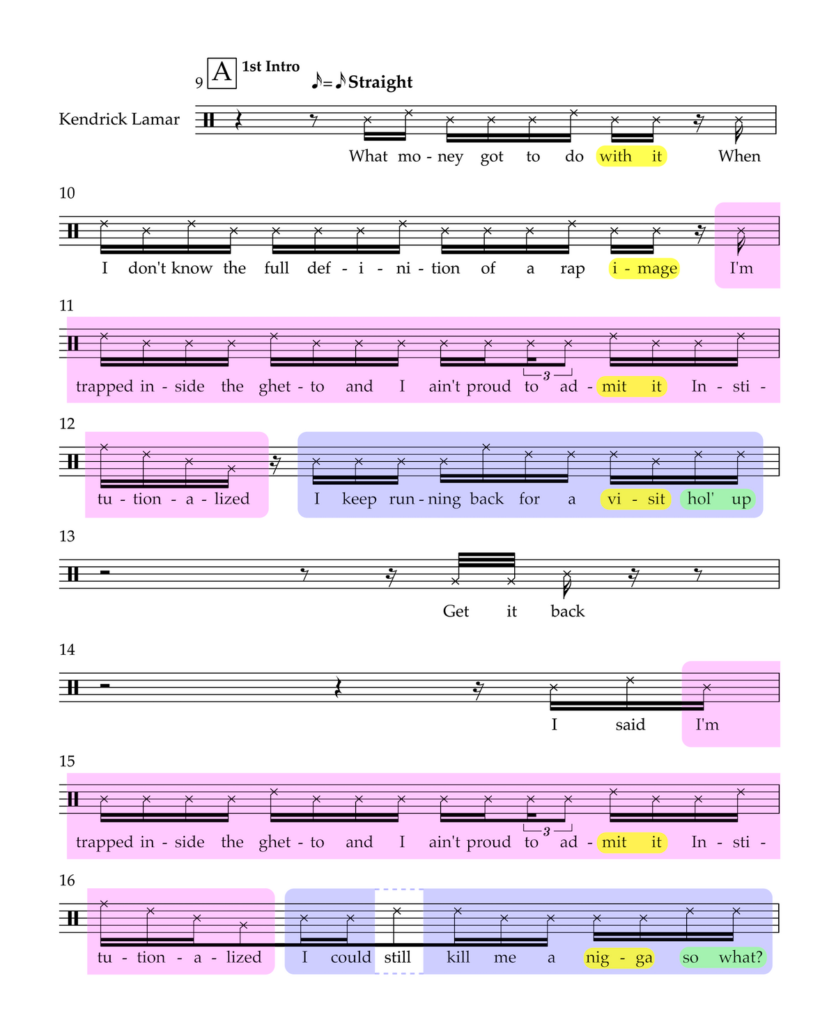
Compared to the James Brown homage of “King Kunta”, Lamar adopts a juvenile, nasal tone for the first half of “Institutionalized”. It’s a timbre very much outside of his natural tessitura, so it implies that he’s rapping from a more naive viewpoint here, with Kendrick wondering why he’s still mentally “trapped inside the ghetto” despite his newfound fame and wealth. This sense of feeling trapped is also reflected in his rapping, where he sticks to rhyming on the fourth beat of the bar as if he’s just learnt to rhyme. At the same time, he establishes a conversational rhythm by mostly relying on semiquavers, only providing brief pauses, and starting his lines at different points in the bar. Overall, there’s a sense that Lamar is completely avoiding the intricacy he’d usually go for, so it comes as a surprise when he ends the first four-bar phrase with “hol’ up”, since it’s a punctual ending compared to everything that sits around it and an allusion to one of the rapper’s more dexterous cuts on Section.80. Similarly, when he rhymes these words at the end of the second phrase with “so what?”, it provides closure for the 8-bar section. Furthermore, these moments of punctuation are reinforced by the track mutes that Derek Ali uses to highlight Kendrick’s lines about “running back” to the ghetto and still feeling like he’s able to kill someone.
1st BRIDGE
Bilal and Anna Wise
If I was the president
I’d pay my mama’s rent
Free my homies and them
Bulletproof my Chevy doors
Lay in the White House and get high, Lord
Whoever thought?7We have a continuation of the White House signifying the ultimate position of power here, since Kendrick previously announced that he will bring the “Compton Swap Meet to the White House” in “Wesley's Theory”, while “King Kunta” includes an allusion to the Clinton–Lewinsky scandal as an example of how absolute power corrupts absolutely. By comparison, this section of “Institutionalized” features Bilal considering the actual implications of this daydream: he starts off by claiming h  would do noble things as the president such as pay his “mama's rent” and free his “homies”. However, these noble desires quickly curdle into paranoia and hedonism, since he will engage in conspicuous consumption by buying a Chevrolet, which will inevitably lead to him feeling he needs to “bulletproof” his door to protect his investment. The idea that he'll end up staying in the White House to “get high”, then, reveals just how quickly things arc from altruism to hedonism. Like Clinton, Kendrick is focusing on having his short-term needs met rather than solving the deeper structural issues that drive inequality for black Americans; and it becomes clear that the promises the persona made to provide financial help once he is in power quickly fall by the wayside once he is actually in power.
Master, take the chains off me!8Master, take the chains off me!: The pronunciation of “master” as “massa” is an example of the type of Black American English pronunciation that would have been common in the South during the 1800s. By harkening back to this manner of speech, Lamar draws a link between this modern “institutionalized” mindset and America's history of black slavery, in the same way “For Free? (interlude)” draws a link between America's past and its present. In both cases, the rapper implies that black Americans are reduced to this master–slave relationship through social, economic and cultural inequalities, and that modern Americans in general aren't as far from the racist viewpoints of their ancestors as they it think they are.
As I said earlier, Bilal’s bridge slyly avoids C and C#, allowing it to float in between the adjacent tonalities of D major and G major without committing to either, which adds to the sense that this section of the song is a daydream that provides a preface to the narrative that follows it. The singer also makes an unconventional choice with his backing vocals on “Institutionalized” by mostly avoiding harmonies altogether. Instead, he sings in octaves above and below his natural tenor while varying the timbres, which leads to the vocals having the texture of a choir singing notes in unison. It’s an effect that provides some continuity between this song and the P–Funk homage of “Wesley’s Theory”, since George Clinton tended to favour a chorus of different voices singing in unison in many of his songs.
By mainly sticking to unisons and octaves rather than other harmonic intervals, it reinforces the idea that Kendrick’s daydream of being president will lead to him being alone and paranoid, as if he’s only able to hear his own voice speaking to him. When the lyrics describe bulletproofing “Chevy doors”, we hear Anna Wise‘s voice split off with a few harmonies a third above the lead, but these disappear just as quickly as they came and we’re left solely with one man and the voices in his head again. This paranoid atmosphere is further highlighted by the way Bilal fades in with a wailing, oboe-like vibrato until the other instruments abruptly drop out on the downbeat and the wall of vocals say “Master take the chains off me!”. It’s an exclamation that comes out of nowhere, like one of those moments where you’re shouting in a nightmare only to wake up and realise that you’re shouting in reality, too.
2nd INTRO
Taz Arnold
A-zoom, zoom, zoom, zoom, zoom
Zoom, zoom, zoom
A-zoom, zoom, zoom, zoom, zoom
Zoom, zoom, zoom
A-zoom, zoom, zoom, zoom, zoom
Zoom, zoom, zoom
Zoom, zoom, zoom, shit9Zoom, zoom, zoom . . . : The repetition of “zoom” here is an interpolation of “Planet Rock” by Afrika Bambaataa and the Soul Sonic Force, an electro hip hop classic that became popular as a party song. On the surface, it appears to be telling us that we will “zoom” in to explore the “institutionalized” mindset that Lamar describes in the song's opening. However, the song transitions here from the introspection of its opening section to a conflicting combination of braggadocio and cynicism in the upcoming verse.
Bilal’s exclamation provides an unexpected yet well-suited stepping stone into the second half of the song, where the tempo drops to 81 BPM and we hear Taz Arnold from Sa-Ra Creative Partners paying homage to “Planet Rock” by Afrika Bambaataa and the Soul Sonic Force. In the original song, the wordless line of “zz-zz” arrives about three-and-a-half minutes into the song and was an ad-lib done by Soul Sonic Force rapper Pow Wow after he couldn’t remember his lines. By comparison, Taz Arnold knows exactly what he’s doing; he takes the moment from the middle of Pow Wow’s ad-lib where he briefly shifts into a triplet rhythm and makes it the main focus of his introduction to this section of “Institutionalized”. In doing so, Arnold disrupts the straight common time semiquavers that we’ve heard throughout the song’s opening section, instead locking in with the polyrhythmic Dilla time beat provided by Rahki. On top of this, his loosely pitched vocals keep moving in contrary motion, again preparing us for the polytonality that will be implied throughout the rest of the song by the chord progression and Pedro Castro’s clarinet improvisations.

Meanwhile, Ali has fun with Arnold’s vocals by panning them back and forth between the left and right channels on each “zoom” (most likely using a stereo tremolo), which only adds to the feeling of being subtly disoriented by the arrival of this new section. As with the other sections that we’ve encountered in the song to this point, Arnold’s cameo ends abruptly — in his case, with an elongated “Shit”, where he drops into a deep chest voice while the other instruments go mute. Then, like a relay runner receiving a baton, Lamar picks up straight after on the final beat of the bar, with the instruments coming back in on his cue.
1st VERSE
Kendrick Lamar
Life, can be like, a box of chocolate
Quid pro quo, something for something, that’s the obvious10Life can be  . . .  that's the obvious: This is an allusion to the famous line that the titular character says in Eric Roth's script for the film Forrest Gump. The original quotation ends with the phrase “You never know what you're going to get”, an optimistic statement that Forrest uses to explain the incredible run of luck that he has experienced in his life. In this song, however, Lamar pessimistically subverts this expectation by instead stating that life doesn't depend on chance and luck; instead, it relies on trade, exchange and opportunity costs — the fundamental concepts of economics — which create the hustle and grind mindset where young black American men living in the “ghetto” men try to escape poverty through whatever means necessary.
Oh shit, flow’s so sick, don’t you swallow it
Biting my style, you’re salmonella poison positive
I can just alleviate the rap industry politics
Milk the game up, never lactose intolerant
The last remainder of real shit, you know the obvious11Oh shit  . . .  know the obvious: The focus of Lamar's rapping abruptly shifts here to the same kind of braggadocio that we previously saw on “King Kunta”. He uses an extended metaphor of sickness and food poisoning to expound on his skills as a rapper, claiming that he can “alleviate the rap industry politics”. We know from the ideas explored in “Wesley's Theory” and “For Free?”, however, that his skills won't resolve the deeper socio-economic issues that face people like him, and this tension between Kendrick's messianic self-belief and his more pragmatic reality is reinforced when he says he will “milk” the game because he isn't “lactose intolerant”; black Americans consume less lactose than other ethnic groups, leading many to assume they cannot have lactose, yet Kendrick assumes he can do what people like him cannot. Lamar then undercuts this by describing himself as “the last remainder of the real shit”; while, on the surface, this might make him sound as if he's emphasising his authenticity, it's also a scatological metaphor that draws on the fact that both excessive lactose consumption or salmonella poisoning can cause diarrhoea. Previously, he's implied in “For Free?” that the American Dream is full of “shit” that will cause “porcelain pipes” to “bust”, so in these lines he might be suggesting that the braggadocio in his own music is the product of an institutionalised mindset that chases after the American Dream through trying to be the greatest rapper, and that this focus on meritocracy and authenticity is part of the problem rather than a solution.
Me, scholarship? No, streets put me through colleges12Me, scholarship?  . . .  through colleges: Despite the fact that Kendrick Lamar was a straight-A student, he boasts that he didn't go to university and that he gained his knowledge from growing up in Compton. On the surface, this boast appears to add to his credibility and authenticity as a rapper; however, it is really still part of his “institutionalized” mindset — not only is it a cliché to claim that you went to the School of Hard Knocks; it's also the case that a straight-A student who grew up on welfare would at least be eligible for a full scholarship to a university. By making a virtue of rejecting higher education, Lamar highlights the way that black Americans have become institutionalised to view formal education as part of “acting white”, a self-sabotaging idea that only serves to keep them institutionalised.
Be all you can be, true, but the problem is
A dream only a dream if work don’t follow it13Be all  . . .  don't follow it: Linking back to the blend of optimism and cynicism expressed at the start of this verse, Lamar repeats another proverb — “be all you can be” — before deconstructing it to point out that this can only be achieved if work “follow[s] it” and people are remunerated for their efforts. Again, the rapper is identifying how the proverbs and platitudes that are used to indoctrinate people into believing in the American Dream don't match up with the economic reality of modern America. He also reinforces this by having the word “dream” ambivalently refer to both the individual meaning of dream, in the sense of hopes and desires, and the institutional construct of the American Dream. In both cases, employment is necessary for long-term survival, and it's important not to confuse ideals with reality.
Remind me of the homies that used to know me, now follow this
I’ll tell you my hypothesis, I’m probably just way too loyal
K Dizzle will do it for you, my niggas think I’m a god
Truthfully all of 'em spoiled,14Remind me of  . . .  all of 'em spoiled: In the remainder of the song, Lamar will explore the tension that came as a result of inviting one of his friends from Compton to a glitzy awards ceremony, and Lamar uses these lines to show how there is a growing separation between who he was and who he is now. Building on the previous line that a “dream [is] only a dream if work don't follow it”, he states that this cynical yet pragmatic mindset reminds him of “homies that used to know” him. Despite providing the inclusive term “homies”, Lamar's use of the past tense paints these people as associates rather than friends, implying there has been a rift since he has become famous. Similarly, he says that he views his friends or fans as “spoiled” while they think he's a “god”, a self-aggrandizing statement that again shows the way that fame can cause someone to lose empathy for the people who helped them become famous in the first place. In addition, Lamar uses illeism to call himself “K Dizzle”, adding the Black American English -izzle suffix (popularised by West Coast rapper Snoop Dogg) to the name K-Dot — the name he previously used as a rapper when he was rapping as a teenager. This detail might suggest that Lamar used to think he could help his friends once he became famous by simply doing them favours, but he now recognizes this as part of a naïve mindset. usually, you’re never charged
But something came over you once I took you to them fucking BET Awards15usually, you're never  . . .  fucking BET awards: The main narrative thread of the song begins here, where Lamar describes how he took a friend to the BET (Black Entertainment Television) Awards, an event that is usually attended by a large number of the most prominent black entertainers in the United States. BET was started as a black-owned television channel, so Lamar might have chosen to take his friends to the BET Awards since it is one of the few awards ceremonies where there will be more black Americans in attendance than any other ethnic group — in other words, he thought his friend would feel at home and wouldn't appear out of place. We can assume Lamar is referring to either the 2012 BET Hip Hop Awards or 2013 BET Awards. The former event saw him becoming a household name, performing his hit singles  “The Recipe” and  “Swimming Pools (Drank)” along with winning Lyricist of the year. By the time of the latter event, he had risen mainstream fame after the release of Good Kid, M.A.A.D City, going on to win both Best New Artist and Best Hip Hop Artist that night.
You looking at artistses like they’re harvestses
So many Rollies around you and you want all of ’em
Somebody told me you thinking ’bout snatching jewellery16You looking at  . . .  ’bout snatching jewellery: It becomes clear that while Lamar simply believed that he had invited his black friend to a black awards ceremony, his friend felt that he was a poor person who had been invited to a ceremony for rich people. Lamar describes, in the present tense, how his friend is looking at artists like they should be harvested. (N.B. “artistes” is a nonstandard pluralisation that appears in Black American English.) In the final lines of “For Free?”, Lamar implies that the inequities of slavery that Lamar have cast a long shadow over how black Americans view their self-worth, and the imagery of a harvest here appears designed to directly echo the statement on that song that black people “picked cotton and made [America] rich”. His friend, seeking to address this endemic inequality, lusts after Rolex watches — an expensive brand that is akin to the other symbols of conspicuous consumption that the persona of the naïve young rapper desires in “Wesley's Theory”.
I should’ve listened when my grandmama said to me:
There’s a real night-and-day difference here between the way that Lamar raps in the introductory section of this song and the way that he raps during his first actual verse. The comparative skill he displays here can definitely be chalked up to the fact that Kendrick spends the first 8 bars bragging about his skills as a rapper, so Lamar feels the need to prove this through the contrast. In this way, it creates a link back to “King Kunta”, where the rapper used the third bridge to flex his ability to build and develop a motif by interpolating Jay-Z’s diss “I was gonna kill a couple rappers, but they did it to themselves”) before using it as a template for further permutations.
Still, there’s something a little self-conscious about Lamar’s approach here too. For example, he stretches a slant rhyme across a series of words, from “chocolate” to “follow this” with two internal rhymes in the form of “scholarship” and the final phrase-ending “hypothesis” (all highlighted in blue below). While this is impressive, it’s also the kind of free-associative puzzle-solving “lyrical miracle” rhyming that some rappers can fall into when they become focused on rhyming to the detriment of everything else (shots fired at Eminem, Canibus and Logic et al). I’m gonna go out on a limb and say that it seems like, to some degree, Lamar knows this: he’s using a nasally timbre with 2Pac-esque double tracking, and the complexity of this section doesn’t come from its thematically meandering rhymes and semantics. Instead, it comes from how he uses rhythm.
Lamar is so adept at switching up his flow in general that it’s easy to miss how the rapper essentially matches the off-kilter nature of Rahki’s beat by shifting into a light swing rhythm, which adds to the multiple time-feels at play in this section of the song. As this lovely primer by Ethan Hein explains, there are many different swing time-feels and many different ways of notating them. Lamar employs a semiquaver swing here, but there’s no way to precisely notate what he’s doing due to the fact that traditional Western musical notation was devised long before the overwhelming modern influence of black American music with its more complex approach to pitch and timing. As Hein puts it:
How do you notate swing? The answer is: you don’t. There is no standard way to even describe swing ratios, much less to represent them on the page. So in practice, you write your swung rhythms the same way you write straight ones, and then you just put the word “swing” at the top of the page. The only way to convey a specific swing feel is to make a recording.
While we can assume Hein means that you have to literally record the sound of someone playing live and listen back to it, it’s also worth noting that a DAW like Logic can allow us to convey those specific time-feels in a more incisive manner. So, just as we did with Rahki’s Dilla time drums, let’s take a moment to look at how the rapper’s semiquavers actually align against the grid. Here are the first few words of his first verse stretched out in first straight then swung time-feels so that you can see the difference:
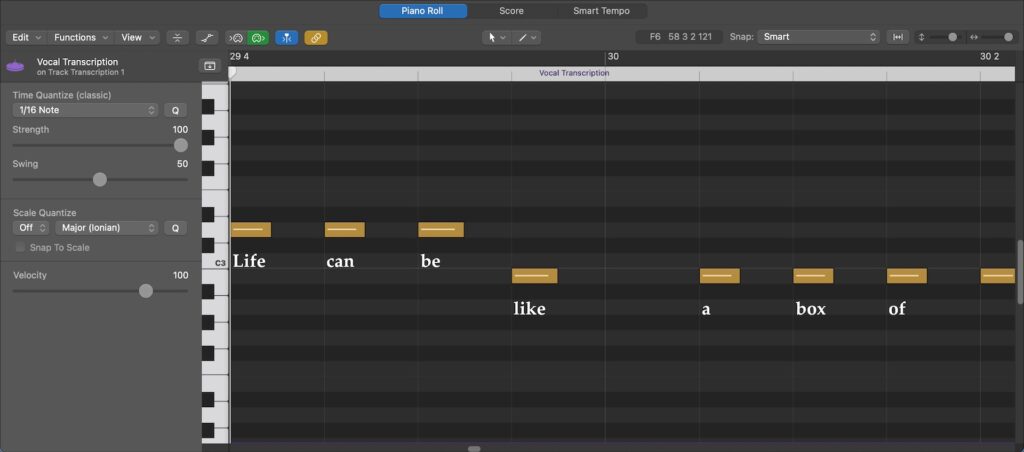
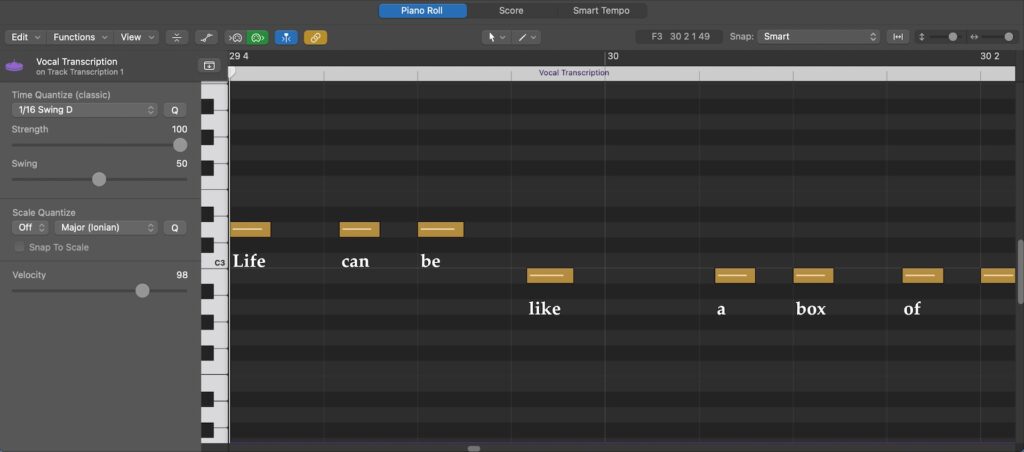
As with the swung quavers, the ratio of the swing comes from displacing every other note. Lamar maintains this underlying time-feel throughout his rapping on the rest of the song while still also using his characteristic syncopation. In the first half of the first verse, this leads to stop-start moments of paired semiquavers and rests, first introduced on the words “oh shit, flow’s so sick”. It’s obvious that the rapper is using this as a metatextual moment, switching up his flow to exemplify how “sick” he can make it. But he doesn’t just stop there; he goes on to highlight this swinging syncopation by starting some of his lines on an anacrusis with “streets” and “true”, along with resting on the odd-numbered semiquavers so that he skips the downbeat of the bar and only raps on the swung notes (seen in bars 36-38). Moreover, he uses monosyllabic words like “put”, “true”, “but” and “when”, which creates a stuttering rhythm by opting for more staccato sounds, and he also creates a strong feeling of rhythmic displacement by using internal rhymes with a perfect vowel match on “me”/“streets” and identical repetition on “be”/“be” and “dream”/“dream”.
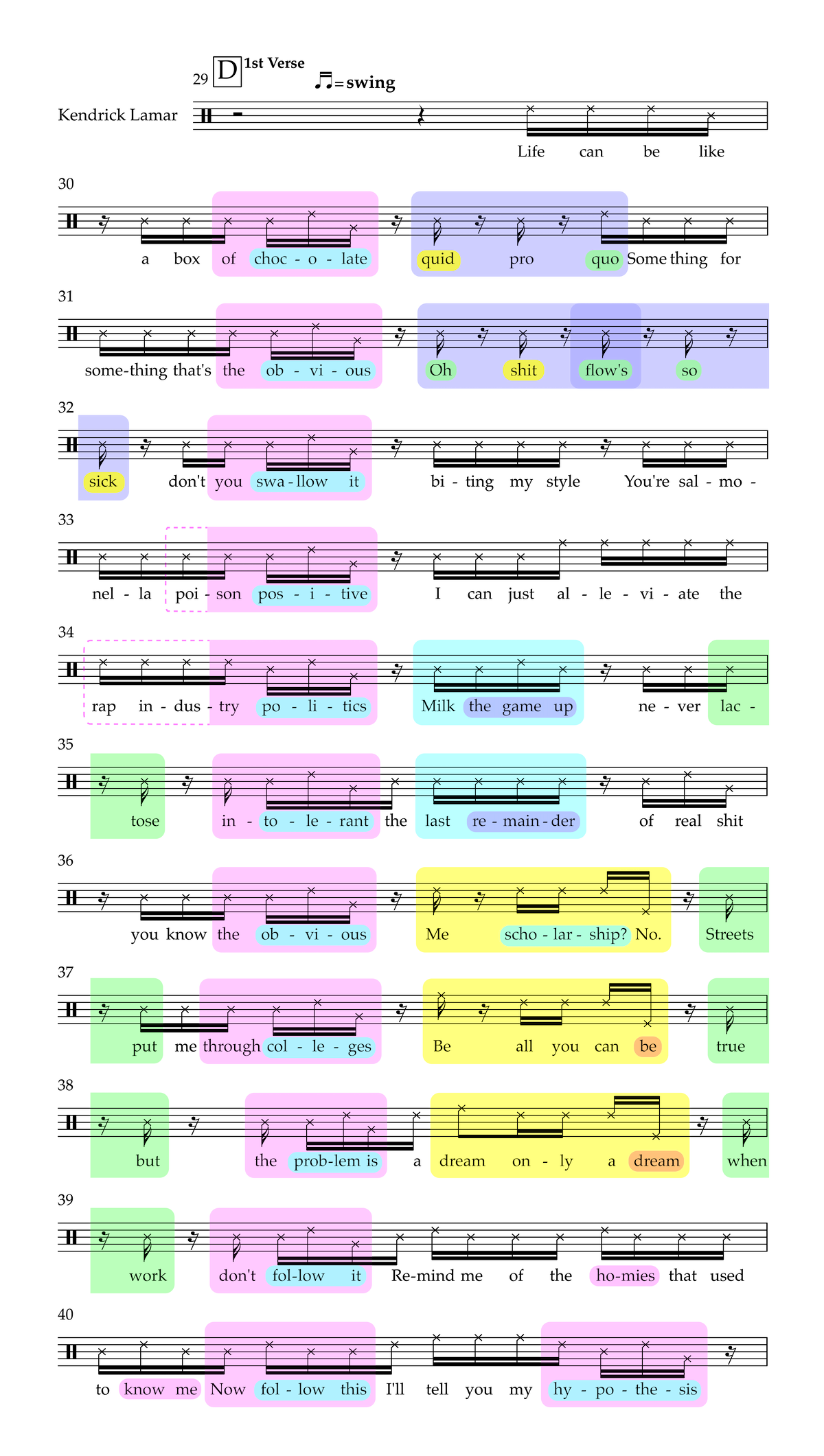
It’s as if the more garden-variety lyrical miracle rhymes on words like “chocolate” and “obvious” are a Trojan horse for the intricate rhythms that Lamar is using, thereby providing a great meta-illustration of the things that Lamar’s detractors miss, since they often go looking for semantic features such as quotables, punchlines, wordplay and metaphors while ignoring what he does with rhythm, rhyme and structure. In turn, the friction between these two features suggests that there’s something slightly off about the braggadocious façade that he’s presenting — and, sure enough, by the time we get to the end of these initial twelve bars, we begin to hear Kendrick shift into a different mode, moving from empty braggadocio back to the kind of morally ambivalent storytelling that he displayed throughout Good Kid, M.A.A.D City.
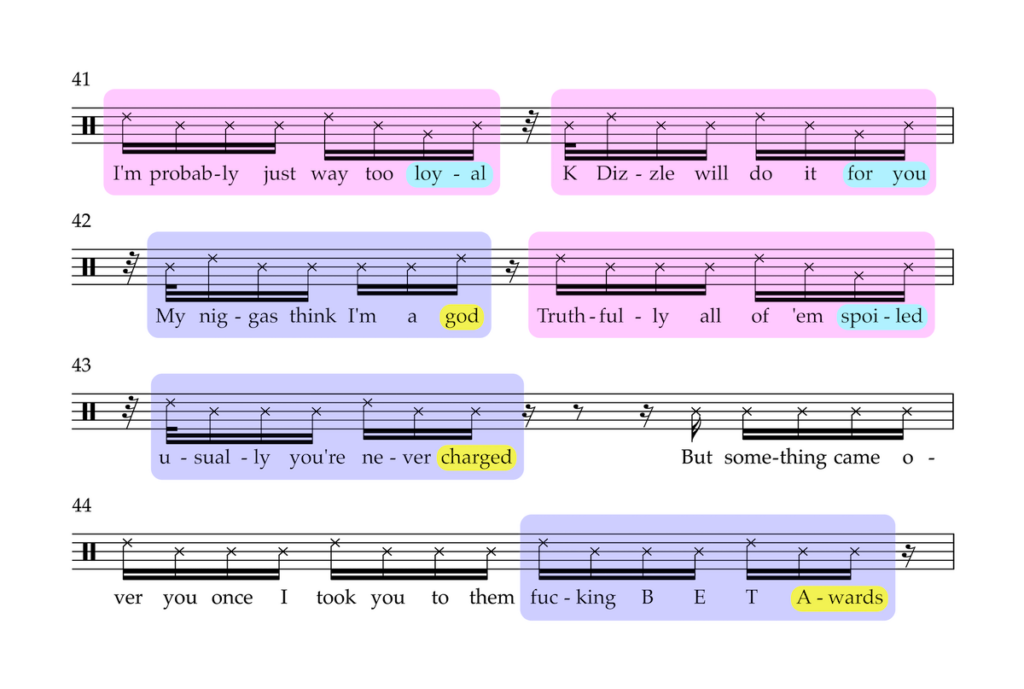
As he moves away from self-referentiality, the motifs within Lamar’s bars become less intertwined and slightly easier to follow, with the emphasis on the first syllable in “loyal”, “for you” and “spoiled” along with “god” and “charged” all arriving equidistant from each other, which creates a sense of release from the tension of the syncopation that precedes it. Still, there’s a playful sense of setting up expectations and subverting them here, since the polysyllabic half-rhymes of “loyal” and “for you” establish a pattern that is then broken by the non-rhyming monosyllable of “god”, only to be picked back up by “spoiled” and then subverted again with “charged”. It creates an asymmetric AABAB rhyme scheme, which in turn means that we’re not sure what to expect next.
This is another example of Lamar using rhyme and rhythm to build towards a tonal shift in the content of his lyrics, since he follows these two braided motifs by pausing straight after describing how his friend isn’t usually “charged” (i.e. pissed off). The pause here literally demarcates the shift from bragging to storytelling, so it’s worth noting that it’s not only mid-bar but also longer than a semiquaver — the first pause of this length on the track. This caesura creates a little moment of tension which is only resolved when Kendrick begins to recount what happened at the BET Awards. He also he emphasises this turning point by structuring the line both grammatically and rhythmically like a periodic sentence, so that “fucking BET Awards” not only ends the four-bar phrase, but also provides a final rhyme for “charged”, creating musical closure while simultaneously providing a lead-in to the narrative that will follow it.
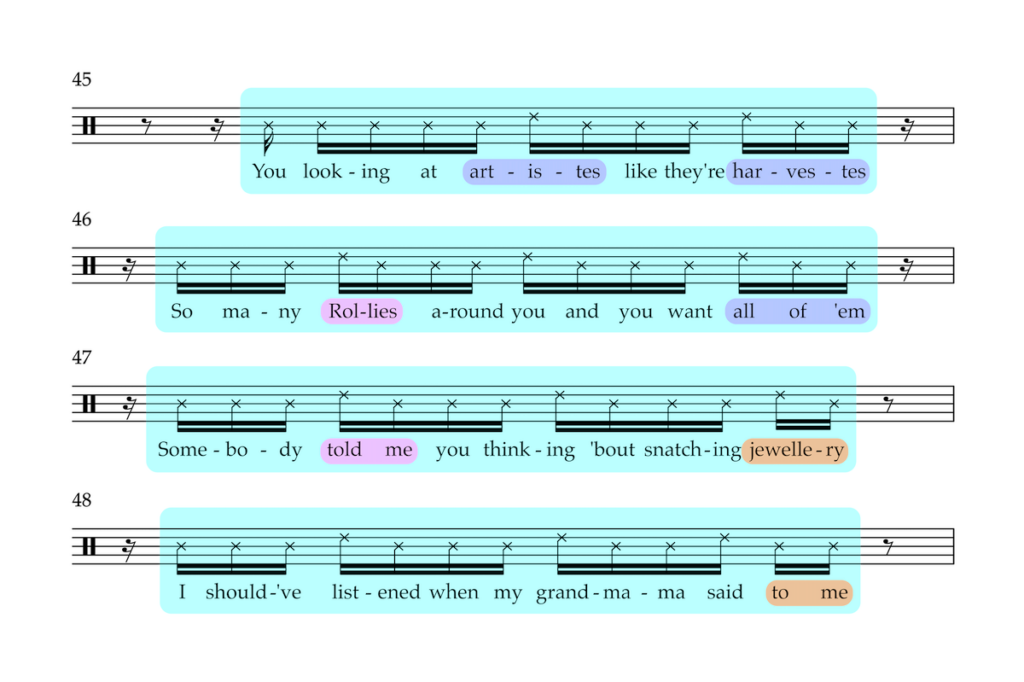
Lamar opts for the historical present to set the scene at the BET Awards, implying the event continues to weigh on his psyche as if it’s still happening. Although Kendrick is our focaliser at this point, he describes his friend’s view of the celebrities as if he has direct insight into his mind, paving the way for the next verse, where he will adopt his friend’s viewpoint as the focaliser entirely. While the song gains new layers here, the rhythm and rhyming becomes more straightforward, with each line occupying a single bar where the final syllables land provide the end-rhymes. This simpler structure effectively provides a bit of breathing space between the rhythmic complexity of the rest of the first verse and the bluesy sound of Bilal’s chorus.
CHORUS
Bilal
Shit don’t change until you get up and wash your ass, nigga
Shit don’t change until you get up and wash your ass, boy
Shit don’t change until you get up and wash your ass, nigga
Oh now, slow down17I should've listened  . . .  slow down: Continuing the scatological semantic field that began on “For Free?”, Lamar contrasts the innocent and childlike proverb that Forrest Gump's “mama used to say” to him about life being like “a box of chocolate” with the idea that his grandmama” told him that “shit don't change until you get up and wash your ass”. The incongruity between the maternal figure and the foulmouthed proverb suggests that it is information that we cannot afford to ignore or write off as a platitude; where the other proverbs that Lamar subverts are optimistic and philosophical, this is a cynical and visceral statement that suggests larger changes in life can only happen if we begin by focusing on the basics. In the context of the song, it implies that Lamar recognizes he shouldn't have thought he could improve his friend's life simply by temporarily putting him a different setting, since this doesn't change the experiences that have informed his friend's habits and his mindset. The admonition of “wash your ass” is likely an ironic allusion to a stand-up routine by the comedian Redd Foxx, where he explains that doing it is the foundation of a good sexual relationship; like Wesley Snipes, Foxx ended up owing the IRS a large amount in back taxes, which he failed to pay back by the end of his life. Moreover, the use of “shit” links back to the way that Kendrick describes himself as “the real shit” in the first verse of the song and the “more shit” that the American Dream brings in “For Free?”, suggesting that both he and America need to change.
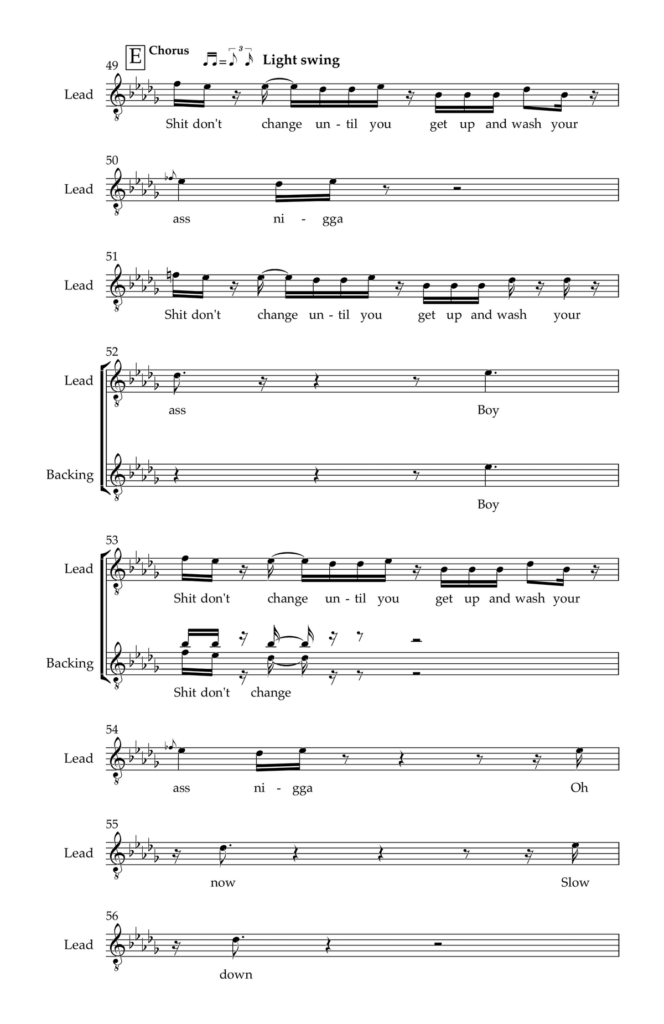
While Lamar’s rapping in the verse swings in an uptight, stop-start manner, Bilal’s is funkier, using the same staccato phrasing, semiquaver swing and syncopation that Lamar employs in his verses but to a different end. This partly comes from the fact that he’s singing instead of rapping, which means he’s able to do things like using a blue grace note on the word “ass”, sliding from the tritone into the E♭. The singer’s slightly pinched, raspy tone suggests that we’re receiving this advice from some kind of no-bullshit voice of reason — an idea that is reinforced by the plethora of dysphemisms contained in the phrasing.
After the first half of the chorus, we hear the instruments mute, leaving just the clarinet for accompaniment while Bilal’s multitracked vocals join in on the word “boy”. Since the arrangement highlights this word, it’s worth thinking about its connotations. On the one hand, it infantilises Kendrick and implies that he’s being naive in thinking that he can blend his newfound fame and fortune with his more humble roots in Compton. On the other hand, it has a specifically pejorative connotation for black men in the United States thanks to the long shadow of slavery, implying that they’re less masculine than white men and subservient to them. In this sense, hearing it being used to refer to Kendrick on the chorus draws attention to the idea that he’s both internally and externally in a master–slave relationship with America, being mentally “trapped inside the ghetto”. Similarly, Bilal uses some word-painting towards the end of the chorus when he tells Kendrick to “slow down”, with the pace of that imperative being stretched across the barline in comparison to the faster timing of the words that precede it.
2nd BRIDGE
Snoop Dogg
And once upon a time, in a city so divine
Called West Side Compton, there stood a little nigga
He was five-foot something, God bless the kid
Took his homies to the show and this is what they said:18And once upon a time  . . .  what they said: The opening of “once upon a time” is generally used to fairy tales, but Snoop Dogg's melodic style of rapping here makes it clear that this is a direct allusion to “Children's Story” by Slick Rick, a hip hop classic that is framed like a bedtime story and tells the tale of a boy who is drawn into a life of crime before eventually being killed by the police. Slick Rick was a huge influence on Snoop Dogg, who covered his song “La Di Da Di” on his album Doggystyle, and Snoop in turn was an influence on Kendrick Lamar. The rapper uses this lineage and these allusions to imply that the “bedtime stories” both he and his friends grew up on were G-funk hip hop songs while living in an area of Los Angeles where black men were disproportionately subject to police brutality.
Bilal’s admonition to “slow down” leads us to yet another sage figure in the form of Snoop Dogg — a rapper whose entire M.O. is that you should roll a blunt and chill out. As Paul Edwards points out in How to Rap, Snoop sometimes raps behind the beat to give his lines “a non-chalant, relaxed feel”, yet he achieves that effect here simply by rapping in straight time, providing a subtle contrast to Lamar’s syncopated swing. Snoop raps in loosely pitched melodic arcs, paying homage to Slick Rick with his initial interpolation of “Children’s Story” before branching off with his own lyrics and melodies. In his book Kool Moe Dee’s book There’s a God on the Mic, the rapper notes that Snoop’s ability to craft melodies and hooks meant that he “figured out how to do what New York emcees were trying to figure out for about a decade: how to make radio records while keeping the records street”. In this sense, then, Snoop’s idiosyncratic voice appearing on this song’s bridge is a reminder to Kendrick that there actually are rappers who have been able to find a middle ground between fame and acclaim, between Compton and Hollywood.
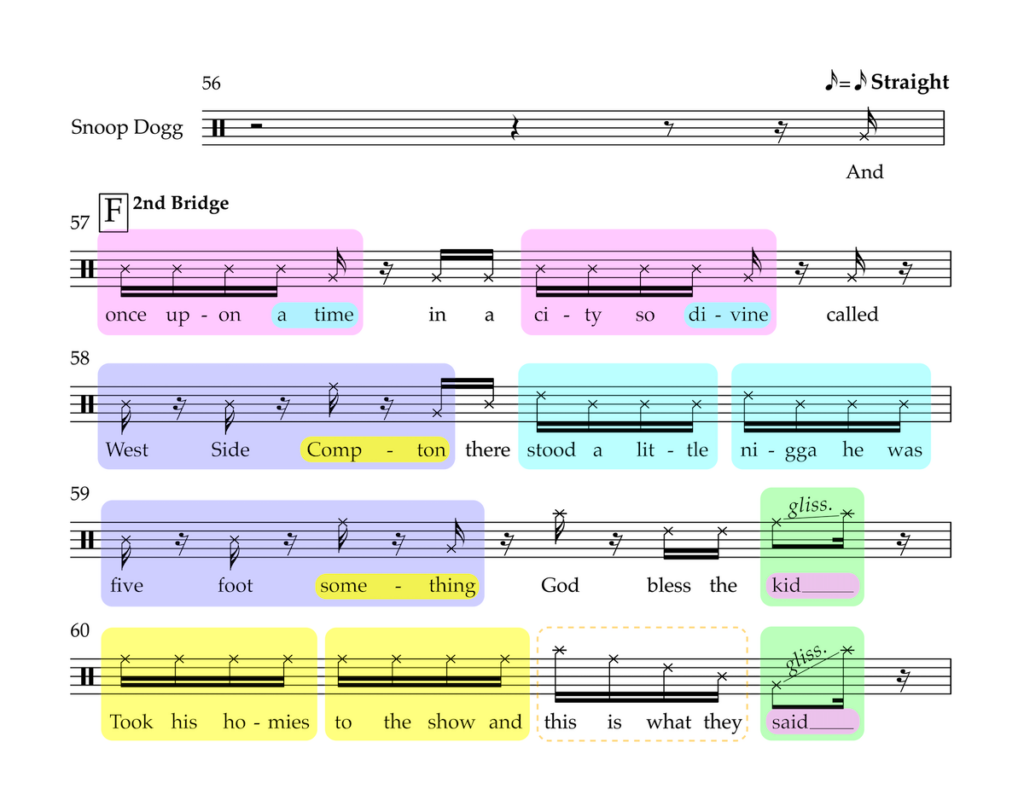
Near the end of this bridge, we hear Snoop combine two devices that have been used to create transitions elsewhere in the song: he bends his final note upwards in pitch, similar to how Bilal does at the end of the song’s first half; and he ends with a reported clauses and a dialogue tag that introduces a different speaker, which is the same trick that Lamar pulls at the end of the verse when he says he should have listened to what his “grandmama said to [him]”. In terms of the song’s narrative structure, Snoop Dogg’s bridge takes place in between acts, setting the scene for Kendrick’s friend from home to present his argument.
2nd VERSE
Kendrick Lamar
 “Fuck am I ’posed to do when I’m looking at walking licks?
The constant big money talk ’bout the mansion and foreign whips19Fuck am I  . . .  foreign whips: The slang term “walking licks” refers to people who are unintentionally making it easy for someone else to rob them, usually because they are showing off their wealth. The term again indicates the difference between how Lamar might have viewed these people when he was younger and how he views them now; while he perceives the BET Awards as a safe space for black celebrities, his friend (who becomes the speaker in this verse) believes that these people deserve to be robbed precisely because they believe they're in a safe space.
The private jets and passport,20The private jets and passport: It's worth remembering that since the U.S. is a huge nation with two non-contiguous states in Alaska and Hawaii, the majority of Americans do not own a passport and international travel is less common among the working class than it is in Europe. presidential glass floor21presidential glass floor: Lamar uses this image to represent the way his friend feels that the celebrities view him as inferior, since a presidential suite is the highest luxury room that a hotel will offer, while glass floors are an extravagance due to the amount they cost to make. A glass ceiling is a metaphor for the invisible barrier that keeps certain groups from rising up in a hierarchy, which would mean that a glass floor might be a metaphor for how that barrier appears to those in power higher up in the hierarchy — they look down on others, knowing that the barrier is there to protect them.
Gold bottles, gold models,22Gold bottles, gold models: The first part of this is an allusion to Jay-Z and Kanye West's “Niggas in Paris”, a song that entirely focuses on the rappers' ability to flaunt their wealth in a country that has historically been associated with old money wealth. In addition, the phrase “gold models” (twisting Jay-Z's “scold models”) takes on a biblical resonance, since Moses becomes enraged upon seeing that the Israelites have stopped praying to God and started worshipping a golden calf. In this sense, the “gold models” represent yet another temptation that comes with celebrity for both men. In the case of Lamar's friend, they lead him to break the Christian prohibition against theft. For Kendrick, they cause him to feel lust that will lead to him admitting that he committed adultery on “These Walls”. giving up the ass for
Instagram flicks, sucking dick, fuck is this?23giving up the ass  . . .  fuck is this: Lamar's friend is outraged to realise that there are models who are having sex with people at the BET Awards just so that they can tag a photo with them on Instagram, linking back to Lamar's point that life isn't about luck or chance but  instead relies on “quid pro quo”.
One more sucker waving with a flashy wrist
My defense mechanism tell me to get him
Quickly because he got it24One more sucker  . . .  he got it: Lamar's friend tries to justify his desire to rob these celebrities as a “defense mechanism”, linking to the idea that he is stealing to protect himself — a mindset that comes from being institutionalised growing up in the ghetto amidst the 1990s economic boom, leading to him viewing these black celebrities as the “haves” while he is one of the “have-nots”.
It’s a recession, then why the fuck he at King of Diamonds?25It's a recession  . . .  King of Diamonds: King of Diamonds is a strip club chain in the U.S., and strip clubs (along with other forms of sex work) generally symbolise financial excess — a place where people literally throw their money away. Lamar's friend is angry because this is happening in the midst of the Great Recession, when people like him would be struggling to survive.
No more living poor, meet my four-four
When I see ’em, put the per diem on the floor
Now Kendrick, know they’re your co-workers
But it’s gon’ take a lot ’fore this pistol go cold turkey26No more living poor  . . .  cold turkey: Lamar's friend plans to rob people at gunpoint using a .44 Magnum, and he implies that this will allow him to stop “living poor” -- an argument that the larger album argues is not the case, since escaping poverty is just as much about leaving behind a particular mindset as it is about gaining financial wealth. The idea that the pistol would have to “go cold turkey” if he doesn't use it draws an analogy between drug addiction (which disproportionately affected black American neighbourhoods in the 1990s and 2000s due to historical ghettoisation and the crack epidemic) and gang violence (which was also driven by the same factors).
Now I can watch his watch on the TV and be okay
But see I’m on the clock once that watch landing in LA27Now I can watch  . . .  LA: As part of his penchant for wordplay, Lamar makes a homonymic pun on “watch”, in the sense of looking at something, and “watch”, in the sense of the object with a wrist strap and a clockface. He then builds on this wordplay when, in the persona of his friend, he says that he will be “on the clock” when the celebrities arrive in Los Angeles; this links back to the way that his friend calls these celebrities Kendrick's “co-workers”, implying that they are both simply doing jobs as part of the “quid pro quo” nature of life.
Remember steal from the rich and giving it back to the poor?
Well, that’s me at these awards.”28Remember steal  . . .  these awards: The friend ends his argument by invoking the legendary figure of Robin Hood, an outlaw whose actions we view as morally just. However, it's not clear who the “poor” are that this friend will help — whether it's friends, family members or, more selfishly, just him. Lamar leaves this outcome ambiguous, in the same way that he doesn't confirm whether or not his friend actually robbed anyone. Like an ethical dilemma, we are given a problem without a definite solution so that we can explore philosophical ideas around it rather than making absolute moral judgments.
I guess my grandmama was warning a boy
She said
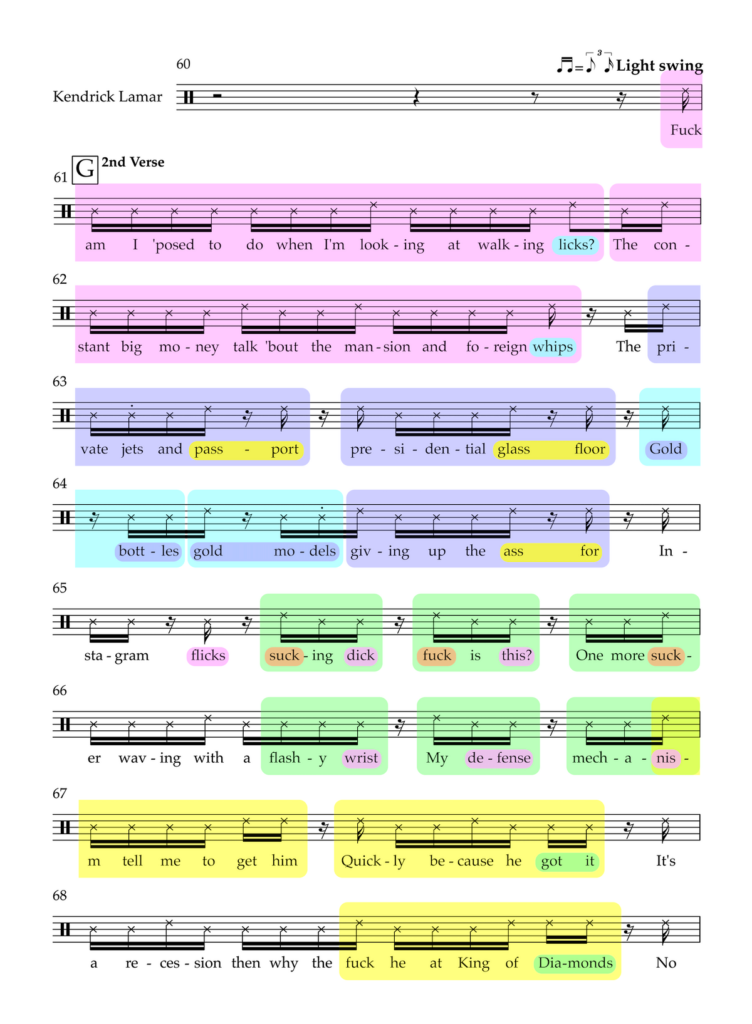
In the second verse, Lamar raps from the perspective of his friend, a device that he has previously employed on “Sing About Me, I’m Dying of Thirst” from Good Kid, M.A.A.D City. This use of secondary focalisers always raises a question about whether we’re really exploring a separate consciousness or just another compartment of Kendrick’s psyche. While he engages with those layers of self-consciousness on “Sing About Me”, he uses the voice of his friend here to criticise aspects of celebrity culture — something that might otherwise seem hypocritical if it came directly from Kendrick’s own persona.
Near the end of the first verse, Kendrick describes how his friend is “charged” up at the BET Awards, and this is reflected in the style Lamar adopts, where he leans heavily on the swung off-beats, starting almost every line on an anacrusis. The first two lines fire out like an uzi, providing semiquavers without rests as the rapper begins to list signifiers of conspicuous consumption, but Lamar recognises that this rhythm will quickly grow stale and switches his flow every two bars, establishing a series of motifs that group particular themes together. For example, he rhymes “passport”, “glass floor” and “models / giving up the ass for”, implying that there’s a link between sex and power that ultimately still relies on the subjugation of women. Similarly, Lamar uses monosyllabic words to create a violent chain of consonance when his friend goes from listing “Instagram flicks” and describing women “sucking dick” to asking “fuck is this?” As with the first verse, the rapper balances the density of these moments with some breathing space, in this case by shifting back to a less syncopated pattern of semiquavers after his friend tries to justify his desire to steal from celebrities as a “defence mechanism”.
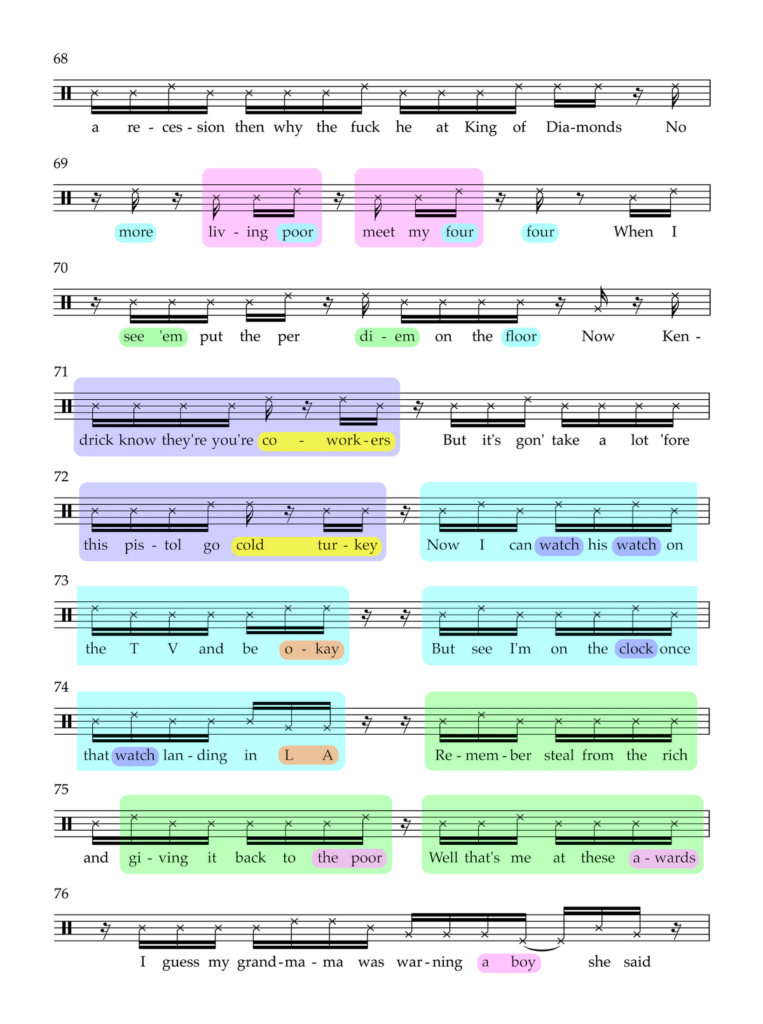
In a song that already features a number of strategically placed track mutes, we hear all the instruments drop out as hear Bilal scream while Kendrick’s friend announces that he’ll be “no more living poor” once they see his .44 Magnum, as if Bilal’s one of the celebrities being robbed at gunpoint. The monosyllabic perfect rhyme between “poor” and “four” reflects how Kendrick’s friend is getting down to brass tacks: while it can be easy for celebrities to assume that they’re safe because they have money, raw power is the ability to decide who gets to live or die. Lamar also shifts his emphasis to the swung off-beat semiquavers here, which amplifies the bellicose nature of his friend’s tone, as if he’s about to start throwing punches at anyone who comes near him.
By comparison, when the friend goes back to directly addressing Kendrick, the rapper slips into a less of syncopated rhythm, starting and ending his lines in the middle of the bar with the emphasis arriving on the final one or two words. In one of his useful rap analysis videos, Mazbou Q makes the point that that this is a subtle feature of 2Pac’s confident and charismatic style that can be heard on songs like “How Do U Want It?”, so it’s interesting to see that Lamar shifts into it here, since the verbal energy and confidence feels like a slight mask for the feelings of insecurity and jealous that the friend expresses. Lamar also provides a neat cadence to the sequence by breaking away from the established pattern of rhymes arriving in the middle of the bar, instead rhyming “poor” mid-bar with “awards” at the end of it. This deviation not only provides a clear ending; it also leaves room for him to follow up with another speech tag when he tells us that his “grandmama was warning a boy”, transitioning smoothly into the final chorus.
CHORUS
Bilal
Shit don’t change until you get up and wash your ass, nigga
Shit don’t change until you get up and wash your ass, boy
Shit don’t change until you get up and wash your ass, nigga
Oh now, slow down
OUTRO
Snoop Dogg
And once upon a time, in a city so divine
Called West Side Compton, there stood a little nigga
He was five-foot something, dazed and confused
Talented but still under the neighborhood ruse
You can take your boy out the hood
But you can’t take the hood out the homie29Talented but still  . . .  hood out the homie: Snoop Dogg reinforces the song's central theme by adapting the proverb “You can take the boy out of the country, but you can't take the country out of the boy”. However, the slight shift in diminutives here makes all the difference: while Snoop initially refers to “the boy”, in the second half of the proverb he refers to “the homie”. We are given two options here: we can either conflate Kendrick and his friend as the same type of person — implying that anyone raised in a life like this will struggle to stop thinking in an institutionalised way — or we can separate Kendrick, the “boy”, from his friend, the “homie”, thereby implying that while Lamar has managed to transcend thinking in this way, his friend hasn't. Again, we're intentionally not given a definitive answer.
Took his show money, stashed it in the mozey wozey
Hollywood’s nervous
Fuck you, goodnight, thank you much for your service30Took his show money  . . .  for your service: Continuing the conflation of Kendrick and his friend, Snoop implies either that Kendrick held onto his money from the performance by stashing it in a motel (using a similar form of slang affix to the -izzle suffix), or that the friend stole Kendrick's money and hid it in a motel. In either case, the friend's avarice has led to “Hollywood” — a metonym for the entertainment industry — feeling “nervous”.
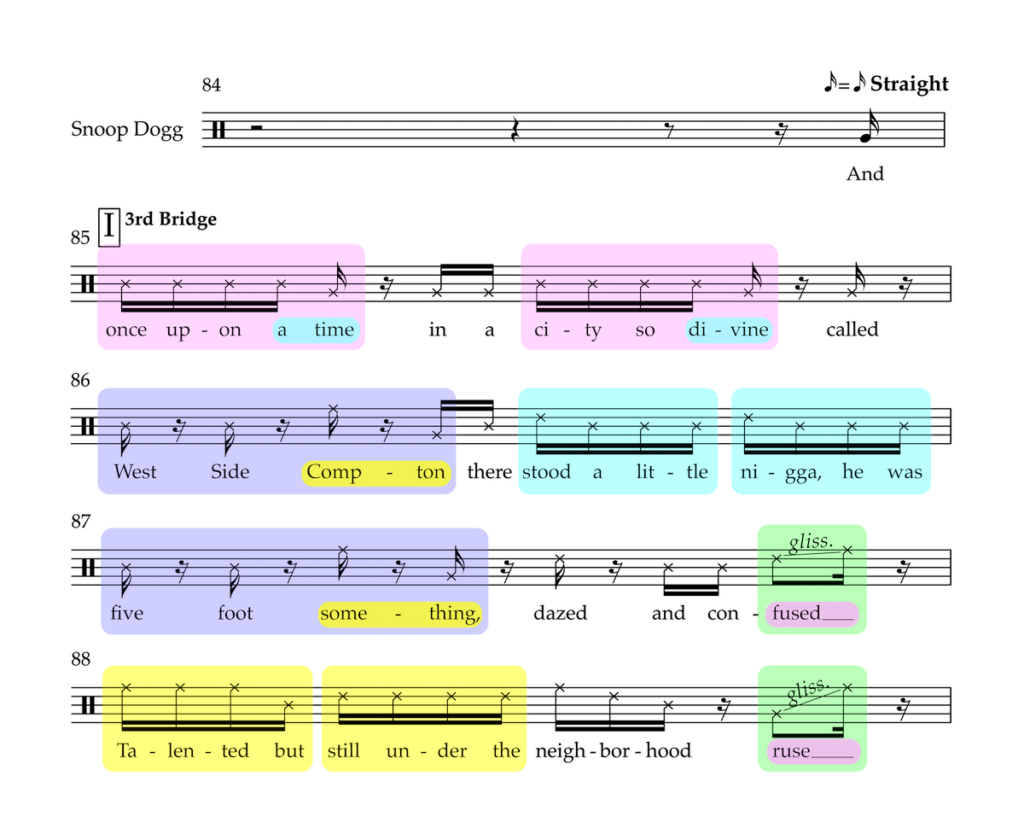
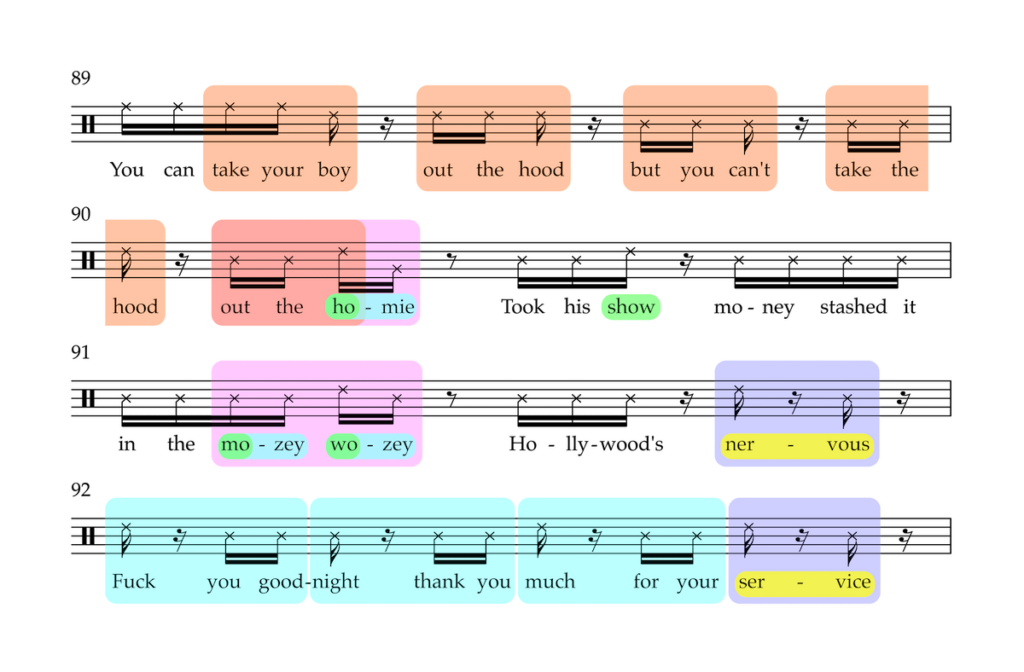
Snoop’s final bridge begins the same way as his previous one, with an interpolation from Slick Rick’s “Children’s Story”, but diverges after that. While this could suggest that we’re about to go back into another verse, there’s no reporting clause or speech tag this time implying that the dialectic between Kendrick, his friend, his grandmother’s advice and Snoop’s wisdom is about to be resolved. Sure enough, Snoop then drops the song’s second moral takeaway: “You can take your boy out the hood but you can’t take the hood out the homie.”
While most of Snoop’s rapping in this bridge maintains its melodic sing-song sound and laidback rhythm, there’s a moment in the final line where he breaks from his approach of starting and ending mid-bar to land the word “fuck” on the downbeat of the last bar. It’s as if he’s momentarily stepping to someone mid-conversation, channeling the combative no-fucks-given nature of Kendrick’s friend, before returning to his melodic style for the final phatic phrases of “goodnight” and “thank you much for your service”. These formulaic expressions are obviously delivered tongue-in-cheek, creating an unexpectedly dark ending to the song since it implies Kendrick entirely failed to convince his friend to make a different decision.
This darkness is reinforced by the final chord, which is built off the tonic B♭min9 that marks the start of the progression throughout the song. However, it contains an added 6th, leading to a spread voicing of 5–1–5–6 in the left hand and ♭7–♭3–5–9 in the right. The closeness of the 5th, 6th and ♭7th notes (F–G–A♭, respectively) creates a gloomy dissonance that reflects the moral ambivalence we’re left with at the end of the narrative. It’s a moral ambivalence that won’t be resolved until later in the album. Instead, Lamar will use the next song to delve further into his own moral failings while introducing a brighter R&B style that seems perfectly designed to deceive our ears.
—L.O.E.
Rahki
Producer

Tommy Black
Producer
Kendrick Lamar
Vocals (lead)
Bilal
Vocals (chorus)
Anna Wise
Vocals (background)
Snoop Dogg
Vocals (bridge)
Taz Arnold
a.k.a. TI$A
Vocals (background)

Sam Barsh
Songwriting and Piano

Paul J. Cartwright
Violin

Gabe Noel
Cello

Pedro Castro
Clarinet

Matt Schaeffer
Audio engineer

James Hunt
Audio engineer
Derek Ali
a.k.a. MixedByAli
Mixing

Mike Bozzi
Mastering
Footnotes
- 1For a great list of concept albums that have been created since the inception of hip hop in the 1970s, check out this list created by the team at Shatter the Standards ↩︎
- 2Allow me to expand on this point a little: Spotify owns Dissect, so it’s only a matter of time before a global tech company like that — one that ploughs money into fake musicians and Joe Rogan, that refuses to compensate the artists who are responsible for its existence, and that provides the capital for the militarisation of AI . . . a company like that might not care about their intellectual property enough to prevent a single hyperlink on one of their websites from becoming yet another piece of lost media. And this album map is just a bit too valuable to lose; if Carlo Linati and Valery Larbaud had thrown James Joyce’s schemas for Ulysses in the bin, there’s a good chance we’d still be arguing over the novel’s structure to this day. Besides, when it comes to archiving things for the future, plain text will always win out over images in terms of being able to be stored across multiple devices and file formats. So I figure it’s probably useful to have Cuchna’s schema written down somewhere like this. ↩︎
- 3For a more in-depth exploration of the Hammond Organ, check out the Hammond Organ Co.’s own 50th Anniversary pamphlet. ↩︎
- 4For a demonstration of this style of collective improvisation, check out this video with Evan Christopher for Jazz at the Lincoln Centre. ↩︎
- 5What money got . . . a rap image?: Having explored the consumerist temptations that face a newly famous black American artist (on “Wesley’s Theory” and “For Free?”), along with establishing his bona fides as an authentic rapper from Compton (on “King Kunta”), Lamar uses this song to explore how the mindset that he grew up with — which is a product of modern America — continues to cause issues for him even after he’s famous. The rapper makes a pun on the word “definition”, denoting both “the exact meaning of something” and “the distinctness of something”, linking back to the idea that young black men idolise rappers without fully understanding or being able to see the whole lifestyle and responsibilities that come with it. ↩︎
- 6I’m trapped inside . . . so what?: In contrast to the braggadocio of “King Kunta”, Kendrick admits that his mindset is still “trapped inside the ghetto”, and he links this to the sociological idea of institutionalisation where an individual becomes reliant on a particular institution once it becomes embedded in the norms and mores of their culture. He mentions that he “keeps running back” to Compton, which subverts the image where he “run[s] the game” in “King Kunta”, suggesting that he hasn’t actually overcome his insecurities. It should also be noted that, within the Southern U.S. states that supported slavery, it became common for segregationists to refer to slavery as the South’s “peculiar institution”. Along with dog whistle terms like state’s rights, this rebranding was part of how segregationists in the South institutionalised a common mindset among Southerners in which they were downtrodden libertarians rather than racists. So when Lamar says he keeps “running back”, it links to the imagery of escaped slaves running away — rather than running away from the institution that places him in mental slavery, Kendrick keeps returning to it. In another link between his younger self and his current mindset, he ends this line by saying “hol’ up”, which is a reference to the title of the same song from his debut album, Section 80. In that song, Lamar touched on some of the contradictory views that pull him both towards wanting to be famous and wanting to be a conscious rapper. However, he didn’t explore this conflict in the depth that he shows on this album, so his desire to “keep running back” might be part of a larger desire to interrogate his mindset. He ends this section by saying he could still “kill” another black man; it’s never clear in Lamar’s music exactly how much or how little violence he was involved in during his youth; regardless, Kendrick’s homicidal intent makes it clear that he doesn’t view himself as morally superior to the gang members who are more clearly institutionalised by lifestyle that he is trying to move beyond. ↩︎
- 7We have a continuation of the White House signifying the ultimate position of power here, since Kendrick previously announced that he will bring the “Compton Swap Meet to the White House” in “Wesley’s Theory”, while “King Kunta” includes an allusion to the Clinton–Lewinsky scandal as an example of how absolute power corrupts absolutely. By comparison, this section of “Institutionalized” features Bilal considering the actual implications of this daydream: he starts off by claiming h would do noble things as the president such as pay his “mama’s rent” and free his “homies”. However, these noble desires quickly curdle into paranoia and hedonism, since he will engage in conspicuous consumption by buying a Chevrolet, which will inevitably lead to him feeling he needs to “bulletproof” his door to protect his investment. The idea that he’ll end up staying in the White House to “get high”, then, reveals just how quickly things arc from altruism to hedonism. Like Clinton, Kendrick is focusing on having his short-term needs met rather than solving the deeper structural issues that drive inequality for black Americans; and it becomes clear that the promises the persona made to provide financial help once he is in power quickly fall by the wayside once he is actually in power. ↩︎
- 8Master, take the chains off me!: The pronunciation of “master” as “massa” is an example of the type of Black American English pronunciation that would have been common in the South during the 1800s. By harkening back to this manner of speech, Lamar draws a link between this modern “institutionalized” mindset and America’s history of black slavery, in the same way “For Free? (interlude)” draws a link between America’s past and its present. In both cases, the rapper implies that black Americans are reduced to this master–slave relationship through social, economic and cultural inequalities, and that modern Americans in general aren’t as far from the racist viewpoints of their ancestors as they it think they are. ↩︎
- 9Zoom, zoom, zoom . . . : The repetition of “zoom” here is an interpolation of “Planet Rock” by Afrika Bambaataa and the Soul Sonic Force, an electro hip hop classic that became popular as a party song. On the surface, it appears to be telling us that we will “zoom” in to explore the “institutionalized” mindset that Lamar describes in the song’s opening. However, the song transitions here from the introspection of its opening section to a conflicting combination of braggadocio and cynicism in the upcoming verse. ↩︎
- 10Life can be . . . that’s the obvious: This is an allusion to the famous line that the titular character says in Eric Roth‘s script for the film Forrest Gump. The original quotation ends with the phrase “You never know what you’re going to get”, an optimistic statement that Forrest uses to explain the incredible run of luck that he has experienced in his life. In this song, however, Lamar pessimistically subverts this expectation by instead stating that life doesn’t depend on chance and luck; instead, it relies on trade, exchange and opportunity costs — the fundamental concepts of economics — which create the hustle and grind mindset where young black American men living in the “ghetto” men try to escape poverty through whatever means necessary. ↩︎
- 11Oh shit . . . know the obvious: The focus of Lamar’s rapping abruptly shifts here to the same kind of braggadocio that we previously saw on “King Kunta”. He uses an extended metaphor of sickness and food poisoning to expound on his skills as a rapper, claiming that he can “alleviate the rap industry politics”. We know from the ideas explored in “Wesley’s Theory” and “For Free?”, however, that his skills won’t resolve the deeper socio-economic issues that face people like him, and this tension between Kendrick’s messianic self-belief and his more pragmatic reality is reinforced when he says he will “milk” the game because he isn’t “lactose intolerant”; black Americans consume less lactose than other ethnic groups, leading many to assume they cannot have lactose, yet Kendrick assumes he can do what people like him cannot. Lamar then undercuts this by describing himself as “the last remainder of the real shit”; while, on the surface, this might make him sound as if he’s emphasising his authenticity, it’s also a scatological metaphor that draws on the fact that both excessive lactose consumption or salmonella poisoning can cause diarrhoea. Previously, he’s implied in “For Free?” that the American Dream is full of “shit” that will cause “porcelain pipes” to “bust”, so in these lines he might be suggesting that the braggadocio in his own music is the product of an institutionalised mindset that chases after the American Dream through trying to be the greatest rapper, and that this focus on meritocracy and authenticity is part of the problem rather than a solution. ↩︎
- 12Me, scholarship? . . . through colleges: Despite the fact that Kendrick Lamar was a straight-A student, he boasts that he didn’t go to university and that he gained his knowledge from growing up in Compton. On the surface, this boast appears to add to his credibility and authenticity as a rapper; however, it is really still part of his “institutionalized” mindset — not only is it a cliché to claim that you went to the School of Hard Knocks; it’s also the case that a straight-A student who grew up on welfare would at least be eligible for a full scholarship to a university. By making a virtue of rejecting higher education, Lamar highlights the way that black Americans have become institutionalised to view formal education as part of “acting white”, a self-sabotaging idea that only serves to keep them institutionalised. ↩︎
- 13Be all . . . don’t follow it: Linking back to the blend of optimism and cynicism expressed at the start of this verse, Lamar repeats another proverb — “be all you can be” — before deconstructing it to point out that this can only be achieved if work “follow[s] it” and people are remunerated for their efforts. Again, the rapper is identifying how the proverbs and platitudes that are used to indoctrinate people into believing in the American Dream don’t match up with the economic reality of modern America. He also reinforces this by having the word “dream” ambivalently refer to both the individual meaning of dream, in the sense of hopes and desires, and the institutional construct of the American Dream. In both cases, employment is necessary for long-term survival, and it’s important not to confuse ideals with reality. ↩︎
- 14Remind me of . . . all of ’em spoiled: In the remainder of the song, Lamar will explore the tension that came as a result of inviting one of his friends from Compton to a glitzy awards ceremony, and Lamar uses these lines to show how there is a growing separation between who he was and who he is now. Building on the previous line that a “dream [is] only a dream if work don’t follow it”, he states that this cynical yet pragmatic mindset reminds him of “homies that used to know” him. Despite providing the inclusive term “homies”, Lamar’s use of the past tense paints these people as associates rather than friends, implying there has been a rift since he has become famous. Similarly, he says that he views his friends or fans as “spoiled” while they think he’s a “god”, a self-aggrandizing statement that again shows the way that fame can cause someone to lose empathy for the people who helped them become famous in the first place. In addition, Lamar uses illeism to call himself “K Dizzle”, adding the Black American English -izzle suffix (popularised by West Coast rapper Snoop Dogg) to the name K-Dot — the name he previously used as a rapper when he was rapping as a teenager. This detail might suggest that Lamar used to think he could help his friends once he became famous by simply doing them favours, but he now recognizes this as part of a naïve mindset. ↩︎
- 15usually, you’re never . . . fucking BET awards: The main narrative thread of the song begins here, where Lamar describes how he took a friend to the BET (Black Entertainment Television) Awards, an event that is usually attended by a large number of the most prominent black entertainers in the United States. BET was started as a black-owned television channel, so Lamar might have chosen to take his friends to the BET Awards since it is one of the few awards ceremonies where there will be more black Americans in attendance than any other ethnic group — in other words, he thought his friend would feel at home and wouldn’t appear out of place. We can assume Lamar is referring to either the 2012 BET Hip Hop Awards or 2013 BET Awards. The former event saw him becoming a household name, performing his hit singles “The Recipe” and “Swimming Pools (Drank)” along with winning Lyricist of the year. By the time of the latter event, he had risen mainstream fame after the release of Good Kid, M.A.A.D City, going on to win both Best New Artist and Best Hip Hop Artist that night. ↩︎
- 16You looking at . . . ’bout snatching jewellery: It becomes clear that while Lamar simply believed that he had invited his black friend to a black awards ceremony, his friend felt that he was a poor person who had been invited to a ceremony for rich people. Lamar describes, in the present tense, how his friend is looking at artists like they should be harvested. (N.B. “artistes” is a nonstandard pluralisation that appears in Black American English.) In the final lines of “For Free?”, Lamar implies that the inequities of slavery that Lamar have cast a long shadow over how black Americans view their self-worth, and the imagery of a harvest here appears designed to directly echo the statement on that song that black people “picked cotton and made [America] rich”. His friend, seeking to address this endemic inequality, lusts after Rolex watches — an expensive brand that is akin to the other symbols of conspicuous consumption that the persona of the naïve young rapper desires in “Wesley’s Theory”. ↩︎
- 17I should’ve listened . . . slow down: Continuing the scatological semantic field that began on “For Free?”, Lamar contrasts the innocent and childlike proverb that Forrest Gump’s “mama used to say” to him about life being like “a box of chocolate” with the idea that his grandmama” told him that “shit don’t change until you get up and wash your ass”. The incongruity between the maternal figure and the foulmouthed proverb suggests that it is information that we cannot afford to ignore or write off as a platitude; where the other proverbs that Lamar subverts are optimistic and philosophical, this is a cynical and visceral statement that suggests larger changes in life can only happen if we begin by focusing on the basics. In the context of the song, it implies that Lamar recognizes he shouldn’t have thought he could improve his friend’s life simply by temporarily putting him a different setting, since this doesn’t change the experiences that have informed his friend’s habits and his mindset. The admonition of “wash your ass” is likely an ironic allusion to a stand-up routine by the comedian Redd Foxx, where he explains that doing it is the foundation of a good sexual relationship; like Wesley Snipes, Foxx ended up owing the IRS a large amount in back taxes, which he failed to pay back by the end of his life. Moreover, the use of “shit” links back to the way that Kendrick describes himself as “the real shit” in the first verse of the song and the “more shit” that the American Dream brings in “For Free?”, suggesting that both he and America need to change. ↩︎
- 18And once upon a time . . . what they said: The opening of “once upon a time” is generally used to fairy tales, but Snoop Dogg’s melodic style of rapping here makes it clear that this is a direct allusion to “Children’s Story” by Slick Rick, a hip hop classic that is framed like a bedtime story and tells the tale of a boy who is drawn into a life of crime before eventually being killed by the police. Slick Rick was a huge influence on Snoop Dogg, who covered his song “La Di Da Di” on his album Doggystyle, and Snoop in turn was an influence on Kendrick Lamar. The rapper uses this lineage and these allusions to imply that the “bedtime stories” both he and his friends grew up on were G-funk hip hop songs while living in an area of Los Angeles where black men were disproportionately subject to police brutality. ↩︎
- 19Fuck am I . . . foreign whips: The slang term “walking licks” refers to people who are unintentionally making it easy for someone else to rob them, usually because they are showing off their wealth. The term again indicates the difference between how Lamar might have viewed these people when he was younger and how he views them now; while he perceives the BET Awards as a safe space for black celebrities, his friend (who becomes the speaker in this verse) believes that these people deserve to be robbed precisely because they believe they’re in a safe space. ↩︎
- 20The private jets and passport: It’s worth remembering that since the U.S. is a huge nation with two non-contiguous states in Alaska and Hawaii, the majority of Americans do not own a passport and international travel is less common among the working class than it is in Europe. ↩︎
- 21presidential glass floor: Lamar uses this image to represent the way his friend feels that the celebrities view him as inferior, since a presidential suite is the highest luxury room that a hotel will offer, while glass floors are an extravagance due to the amount they cost to make. A glass ceiling is a metaphor for the invisible barrier that keeps certain groups from rising up in a hierarchy, which would mean that a glass floor might be a metaphor for how that barrier appears to those in power higher up in the hierarchy — they look down on others, knowing that the barrier is there to protect them.
↩︎ - 22Gold bottles, gold models: The first part of this is an allusion to Jay-Z and Kanye West’s “Niggas in Paris”, a song that entirely focuses on the rappers’ ability to flaunt their wealth in a country that has historically been associated with old money wealth. In addition, the phrase “gold models” (twisting Jay-Z’s “scold models”) takes on a biblical resonance, since Moses becomes enraged upon seeing that the Israelites have stopped praying to God and started worshipping a golden calf. In this sense, the “gold models” represent yet another temptation that comes with celebrity for both men. In the case of Lamar’s friend, they lead him to break the Christian prohibition against theft. For Kendrick, they cause him to feel lust that will lead to him admitting that he committed adultery on “These Walls”. ↩︎
- 23giving up the ass . . . fuck is this: Lamar’s friend is outraged to realise that there are models who are having sex with people at the BET Awards just so that they can tag a photo with them on Instagram, linking back to Lamar’s point that life isn’t about luck or chance but instead relies on “quid pro quo”. ↩︎
- 24One more sucker . . . he got it: Lamar’s friend tries to justify his desire to rob these celebrities as a “defense mechanism”, linking to the idea that he is stealing to protect himself — a mindset that comes from being institutionalised growing up in the ghetto amidst the 1990s economic boom, leading to him viewing these black celebrities as the “haves” while he is one of the “have-nots”. ↩︎
- 25It’s a recession . . . King of Diamonds: King of Diamonds is a strip club chain in the U.S., and strip clubs (along with other forms of sex work) generally symbolise financial excess — a place where people literally throw their money away. Lamar’s friend is angry because this is happening in the midst of the Great Recession, when people like him would be struggling to survive. ↩︎
- 26No more living poor . . . cold turkey: Lamar’s friend plans to rob people at gunpoint using a .44 Magnum, and he implies that this will allow him to stop “living poor” — an argument that the larger album argues is not the case, since escaping poverty is just as much about leaving behind a particular mindset as it is about gaining financial wealth. The idea that the pistol would have to “go cold turkey” if he doesn’t use it draws an analogy between drug addiction (which disproportionately affected black American neighbourhoods in the 1990s and 2000s due to historical ghettoisation and the crack epidemic) and gang violence (which was also driven by the same factors). ↩︎
- 27Now I can watch . . . LA: As part of his penchant for wordplay, Lamar makes a homonymic pun on “watch”, in the sense of looking at something, and “watch”, in the sense of the object with a wrist strap and a clockface. He then builds on this wordplay when, in the persona of his friend, he says that he will be “on the clock” when the celebrities arrive in Los Angeles; this links back to the way that his friend calls these celebrities Kendrick’s “co-workers”, implying that they are both simply doing jobs as part of the “quid pro quo” nature of life. ↩︎
- 28Remember steal . . . these awards: The friend ends his argument by invoking the legendary figure of Robin Hood, an outlaw whose actions we view as morally just. However, it’s not clear who the “poor” are that this friend will help — whether it’s friends, family members or, more selfishly, just him. Lamar leaves this outcome ambiguous, in the same way that he doesn’t confirm whether or not his friend actually robbed anyone. Like an ethical dilemma, we are given a problem without a definite solution so that we can explore philosophical ideas around it rather than making absolute moral judgments. ↩︎
- 29Talented but still . . . hood out the homie: Snoop Dogg reinforces the song’s central theme by adapting the proverb “You can take the boy out of the country, but you can’t take the country out of the boy”. However, the slight shift in diminutives here makes all the difference: while Snoop initially refers to “the boy”, in the second half of the proverb he refers to “the homie”. We are given two options here: we can either conflate Kendrick and his friend as the same type of person — implying that anyone raised in a life like this will struggle to stop thinking in an institutionalised way — or we can separate Kendrick, the “boy”, from his friend, the “homie”, thereby implying that while Lamar has managed to transcend thinking in this way, his friend hasn’t. Again, we’re intentionally not given a definitive answer. ↩︎
- 30Took his show money . . . for your service: Continuing the conflation of Kendrick and his friend, Snoop implies either that Kendrick held onto his money from the performance by stashing it in a motel (using a similar form of slang affix to the -izzle suffix), or that the friend stole Kendrick’s money and hid it in a motel. In either case, the friend’s avarice has led to “Hollywood” — a metonym for the entertainment industry — feeling “nervous”. ↩︎