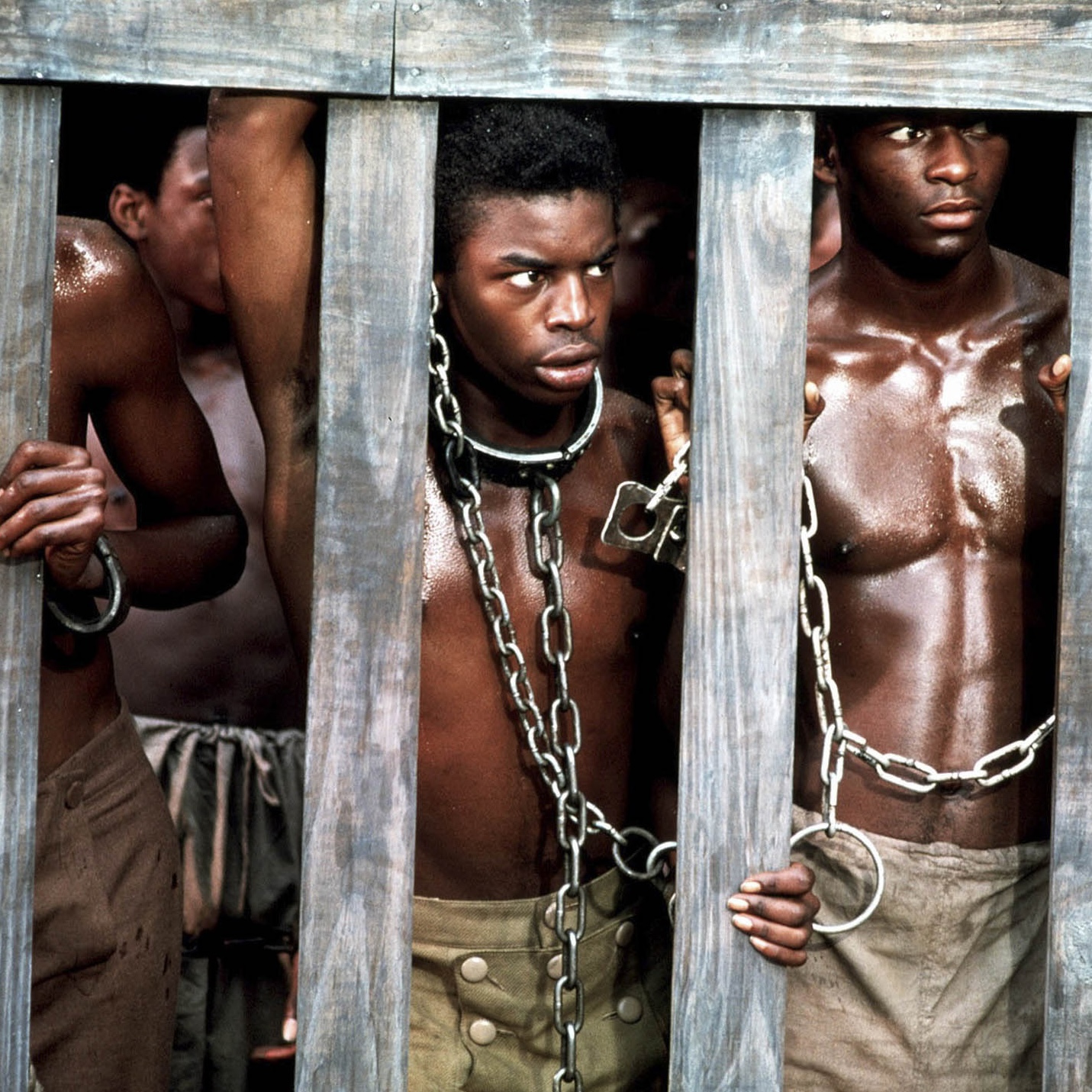
After the left-field jazz experimentation of “For Free? (Interlude)” — a song which, frankly, seems designed to push the envelope and challenge listeners — “King Kunta”1“King Kunta”: Kunta Kinte is a character from the 1976 novel Roots by Alex Haley, which was adapted into a hugely popular TV miniseries in 1977. The show viscerally depicted the brutality of slavery, and was for many viewers their first experience of seeing these horrors depicted in colour from a predominantly black perspective. Despite this, the show’s popularity also led to “Kunta” being used as slur for an African person who seems more culturally African than North American, implying they are acting like a slave fresh off the boat. By adding the appellation of “King”, Lamar is creating an oxymoron, implying that he is both oppressed and dominant, both wholly American and ancestrally African, thereby reappropriating it as a positive term to represent his ability to remain resilient in an oppressive environment. places “K-Dot back in the hood” (as a voice from across the road shouts at the start of the song), with the rapper announcing that he “run[s] the game” as a “motherfucking king”. Depending on your druthers, the song either feels like retrograde or nostalgic at first: the lyrics and the rapper’s tone are firmly in the braggadocious tradition of battle rapping, and the production pays homage to the West Coast G-funk style. But there’s more going on beneath the surface: there are little modulations within the harmony that give the song a slightly anxious rather than buoyant atmosphere, and once the dust settles, we are presented with the snippet of a poem that recasts the lyrics as being the product of a “conflicted” mindset .
Kendrick’s boasting builds on the status Lamar created for himself two years earlier, in 2013, when he appeared on Big Sean’s song “Control”, delivering 66 blistering bars calling out other rappers in a violent, gravelly tone. While barely pausing to breathe, Lamar says he’s “Makaveli’s offspring”, “the King of New York” and “King of the Coast”, then places himself on a pedestal next to Jay-Z, Nas, Eminem and André 3000, before finally naming the “homeboys” that he’s trying to lyrically “murder”: J. Cole, Big K.R.I.T, Wale, Pusha T, Meek Mill, ASAP Rocky, Drake, Big Sean, Jay Electronica, Tyler, the Creator, and Mac Miller. At the time, this seemed like an unusually bellicose approach to a diss track. Since the mid-90s, most mainstream rappers have avoided this kind of all v. one, no-holds-barred approach to beefing after the infamous East–West hip hop rivalry led to the subsequent murders of Tupac and Biggie. Lamar, however, always presented himself as the inheritor of the West Coast’s hip hop lineage, and his full-bodied attack on his peers was in keeping with this tradition. Despite this, his attempt to reignite this rivalry shouldn’t be seen as a call for actual violence; on “Control”, he goes out of his way to tell the nominated rappers that he’s “got love for [them] all” before he bodies them. So the braggadocio that arrives on “King Kunta” can be interpreted in light of Lamar’s desire to rep Compton (and, by extension, South Central L. A. and the entire West Coast) rather than being perceived as a death-wish to destroy the East Coast scene.
“King Kunta” continues this West Coast representation by featuring a classic G-funk beat. It’s the first song on To Pimp a Butterfly that relies on the more standard hip hop mirepoix of samples, loops and braggadocio, and it uses this sound to re-establish Kendrick’s hip hop bona fides.2Despite this — as is often the case with Lamar — we should avoid assuming that he literally believes everything he says, since it’s clear in the song’s final line that he is presenting his hubristic side as one of his many personas he’s adopted on his path to enlightenment. This appeal to authenticity is clear in the song’s bassline, which is played here by L. A. native Thundercat and built around an interpolation of the bassline from Mausberg’s “Get Nekkid” (which engineer Derek Ali implies Lamar used as a scratch track).
Like Lamar, Mausberg hailed from Compton, but he was murdered at the age of 21, making him one of the “dead homies” that the rapper invokes on the album. Throughout To Pimp a Butterfly, Lamar positions these “dead homies” as both ancestral spirits and cautionary tales that a younger rapper like him can learn from, until we eventually reach “Mortal Man”, where it becomes clear that Lamar has threaded this motif to prepare us for the profound moment in the closing interview where 2Pac says, “We ain’t even really rapping; we just letting our dead homies tell stories for us”. Pac’s statement covers two key aspects of hip hop: he alludes to the genre’s role in providing a megaphone for speaking about the social injustice experienced by black Americans (famously causing Chuck D to call it “black America’s TV station”), and he highlights the genre’s intertextual approach to the past, where songs are made from collages of samples and interpolations, while lyrics are filled with quotes, allusions, and references.
This kind of intertextuality is at the heart of “King Kunta”. As previously mentioned, the song borrows its bassline from “Get Nekkid”, with Thundercat essentially adapting it to suit the album’s wider palette of black American musical styles. Here’s a comparison of the two basslines:
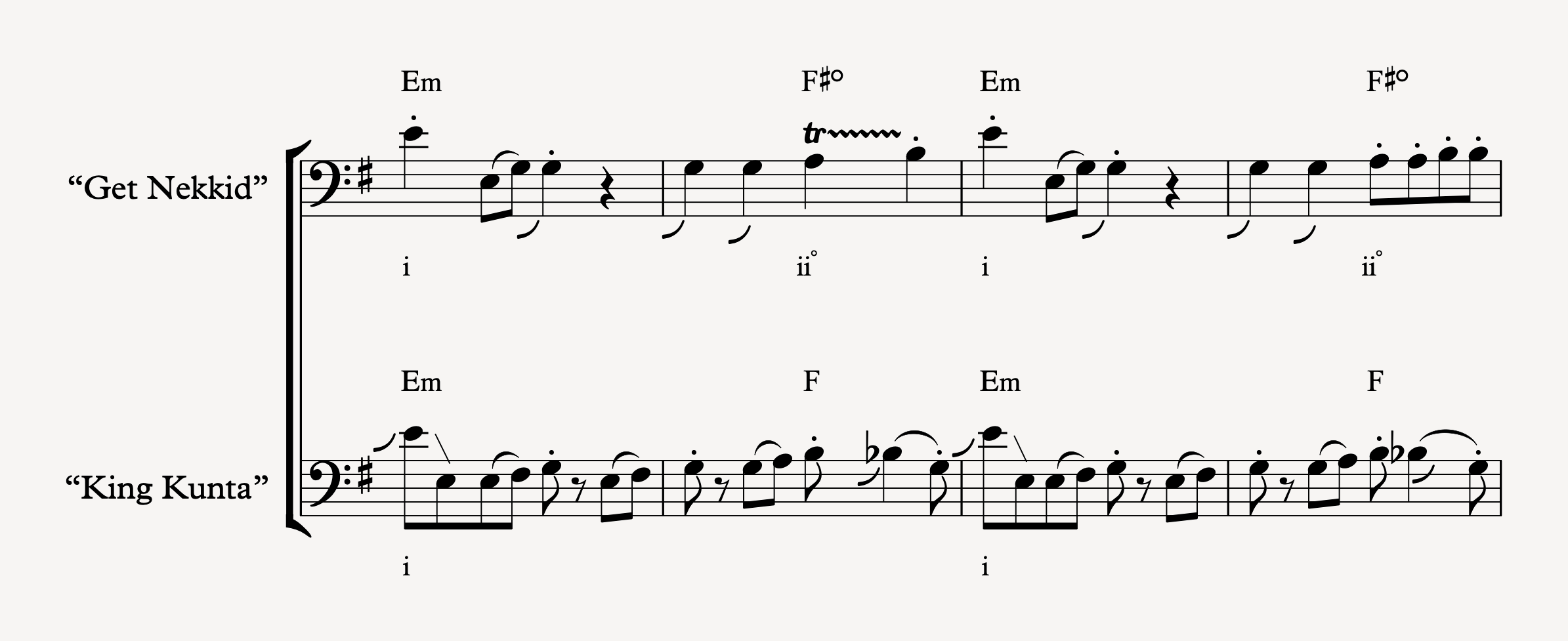
It should be easy enough to see that there are many similarities, with both songs in the same key and featuring the same melodic shape by starting with an octave drop on the tonic note before climbing back up and ending on the dominant. However, this transcription also makes the differences more noticeable: the bassline in “Get Nekkid” is played on a synthesiser with a pitch bend wheel, allowing him to scoop into the notes and provide that 80s-influenced trill at the end of the second bar; Thundercat’s bassline, on the other hand, is played on a bass guitar, which leads to him using more portamento slides and staccato notes for a funkier approach.
“Get Nekkid” was produced by DJ Quik, a man who has arguably done even more than Dr. Dre to hone the G-funk sound and associate it distinctly with Compton.3Dr. Dre is obviously G-funk’s more well-known luminary, but he has diversified his style and approach over the years by working with producers like Mel-Man, Mike Elizondo and Mark Batson, and being a mentor to East Coast rappers like Eminem and 50 Cent. DJ Quik, on the other hand, has kept cultivating his own garden, creating these kind of block party albums every few years with artists from South Central that sound carefree in a way that Dre hasn’t been since 2001. Lamar’s frequent collaborators Sounwave and Terrace Martin include some further nods to Quik’s distinct sound through their use of the flexatone; we hear its wonky, high-pitched twang at the start of every four bars. Quik spoke about his idiosyncratic use of the instrument in detail on the Questlove Supreme podcast:
The producer’s subtle use of other percussion instruments — which he says was influenced by Carl “Butch” Small — is also apparent in Sounwave and Martin’s production on “King Kunta”, with the song featuring a tambourine, güiro, shaker and hi-hat sample that add to the groove without distracting from the earthy funk of the kick drum, bass and snare. Moreover, the second chorus introduces these ghostly vocoder harmonies that seem to be channeling the influence of Roger Troutman and his talkbox; Troutman’s records with Zapp were sampled by so many G-funk artists that he was eventually given his own feature on 2Pac’s hit “California Love”. Overall, then, the song is a pastiche of the G-funk sound. By almost exclusively working with musicians from Compton and Crenshaw in South Central L. A., Lamar is reinforcing the sense that his boasting isn’t just empty gesturing: he’s got “everybody screaming, ‘Compton!’” and “should probably run for mayor” of L. A. because he’s continued to support and be influenced by the community that raised him.
Despite this, there are also divergent elements that prevent the song from strictly sounding like a throwback; instead, they indicate that while Lamar is part of this West Coast lineage, he’s also pushing the culture in a new direction. It’s worth comparing this song with the hard-edged G-funk sound created by Terrace Martin on the second half of “m.A.A.d city” from Lamar’s previous album:
“m.A.A.d city” sets out to capture the violence and chaos of Lamar’s early teenage years with a minor key riff taken from “Chains and Things” by B. B. King where the chords to ascend in a loop over a a tonic pedal; MC Eiht of Compton’s Most Wanted arrives as the sage voice of hood wisdom, telling Kendrick to “wake [his] punk ass up”; and the song ends with a brief solo that uses the “G-funk whistle”: the iconic legato saw wave synthesizer sound that can be heard on 90s West Coast classics like Dr. Dre’s “Nuthin’ But A ‘G’ Thang”.
“King Kunta”, on the other hand, only features Lamar; the beat’s debt to DJ Quik provides an amusing contrast given that he delivered an entire diss track straight to an unamused MC Eiht at the 1995 Source Awards; and the song ends with a series of overlapping distorted electric guitar solos played with delay effects, hinting at the G-funk legato melody sound while also providing something more directly grounded in the blues sound pioneered by earlier black American musicians like, well, B. B. King. It is altogether less anxious and more cocky than “m.A.A.d city”, implying that Kendrick has become bold enough to venture out on his own and battle any other rapper who crosses his path.
But the harmony of the song adds a layer of tension that undercuts this cockiness. The chorus is in E minor, while the second half of the first verse shifts up a semitone to F minor; the second verse is half as long, and takes place entirely in F minor, before going back to E minor again for the chorus and the remainder of the song. This semitone modulation between two neighbouring — and therefore highly dissonant — keys is oddly unsettling; while the song’s G-funk beat sounds like something you might put on at a party, the modulations sound like that moment where you realise there’s a guy lurking around wearing black AF1s who’s not said anything yet.
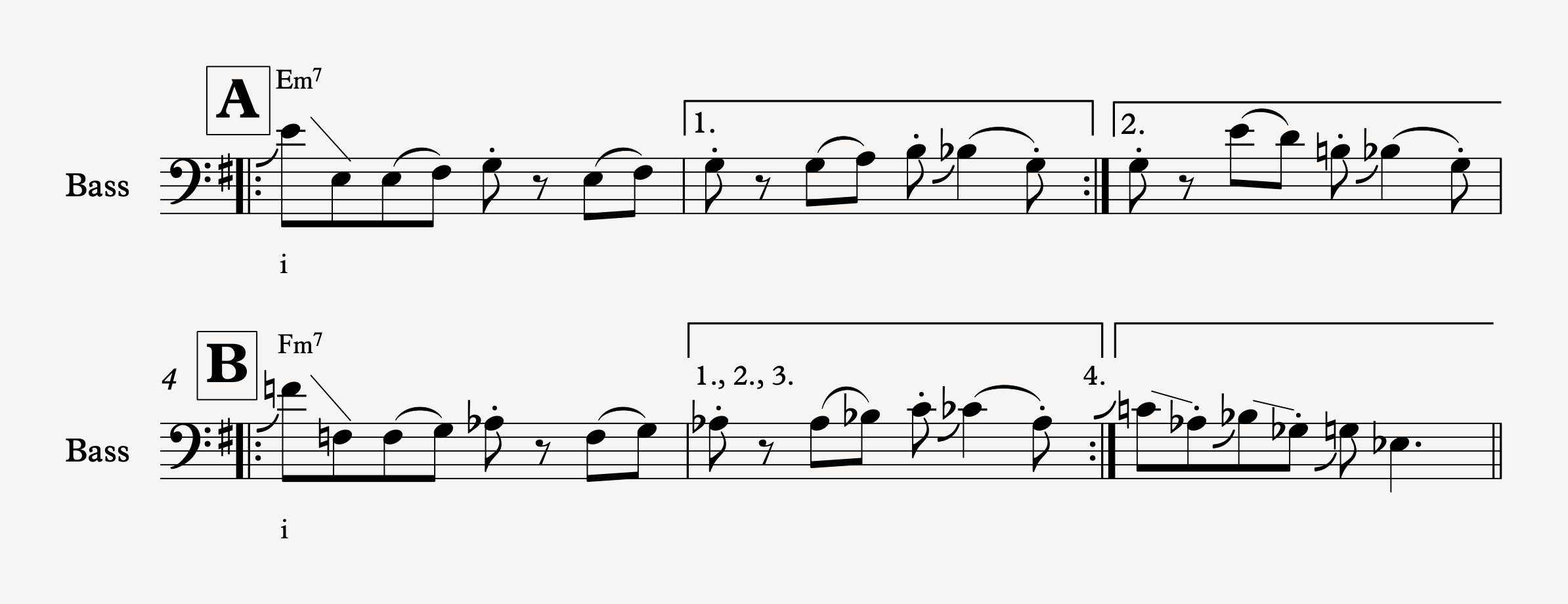
Interestingly, this modulation is not only there in Mausberg’s song — it’s also even more harmonically dissonant, since DJ Quik only has the keyboard part modulate up to F minor while the bassline continues to play in E minor.
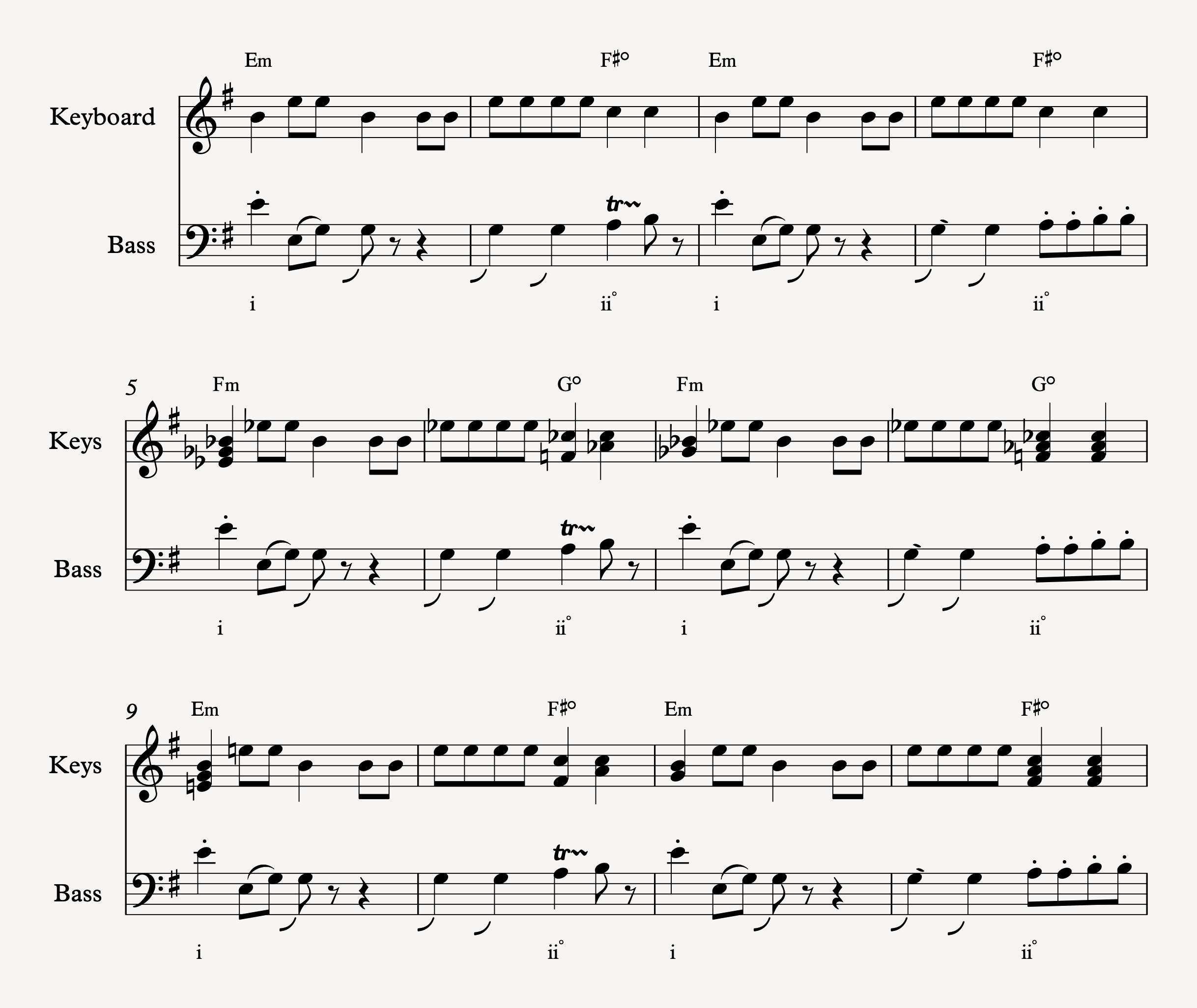
Arguably, Quik gets away with this because the production is so stripped back that these instruments don’t occupy much of the same space in terms of frequencies. While “King Kunta” isn’t exactly a Phil Spector song, it still features other harmonic and melodic instruments that would make this kind of poltytonality sound like nails on a chalkboard. Instead, Sounwave and Terrace Martin create further tension here by introducing a chiming guitar on the second chorus playing a simple two-bar ostinato, with an octave of E for six beats before moving to an octave of F for the final two beats, implying an Emin–Fmaj chord progression.
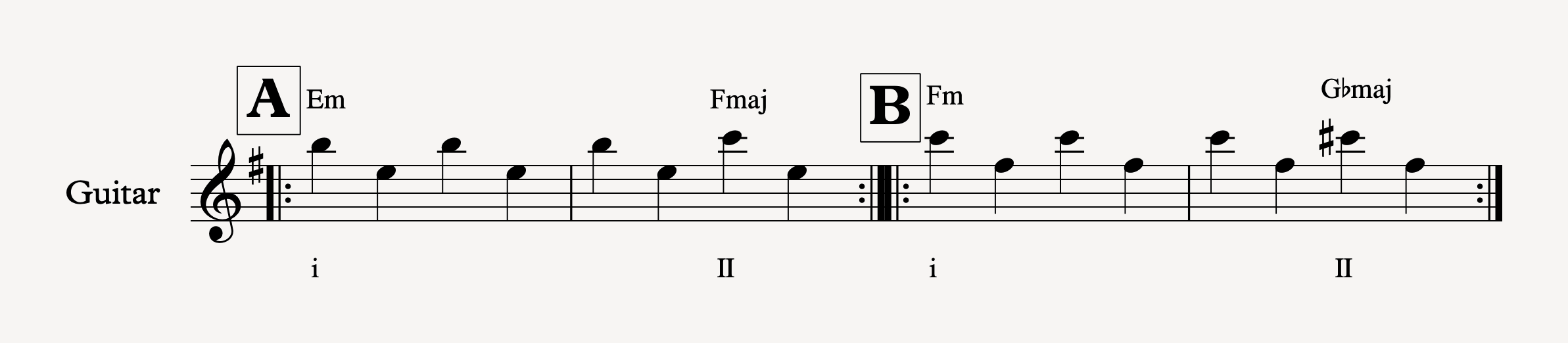
This progression makes it clear that we’re not actually in the familiar mode of E Aeolian but out venturing into the less obvious terrain of E Phrygian.4N.B. When notating this, musicians have two options: they can either use the relative notes of the Ionian or Aeolian mode to find the major or minor key (which for E Phrygian would be C (Ionian) major/A (Aeolian) minor), or they can take the tonic chord of the mode as the key (which would turn E Phrygian into E minor). The first option is more performer-friendly, since it allows the musician to plan for sharps and flats in advance; the second option is more composer-friendly, since it makes it clear on the page how much the modal harmony diverges from our modern expectations of basic major/minor tonality. I’ve opted for E minor without adding a key change simply so that it highlights the unusual nature of this modulation. The E-to-F structure of the ostinato also means that when the second verse moves to F minor, the guitar has already played these notes a bar earlier, as if it’s in trying to jump-start the conflict with the other instruments, which neatly reinforces the bellicose attitude that Kendrick expresses throughout the song.
In other words, while the lyrics of the song are largely about how Kendrick is on top, the music seems to suggest otherwise: there’s an underlying paranoia and insecurity, which is further emphasised through the ghostly vocoder melodies that increase throughout the second verse and third chorus. Even though the song falls back into the key of E minor after the third chorus, the vocoder and the guitar continue to play their Emin–Fmaj Phrygian figure, maintaining this tense atmosphere through to the song’s end. Rather than resolving this tension harmonically, Lamar explores it with his words, which can be seen in the annotations below.
↓
INTRO
Kendrick Lamar
with his Aad-libs
and BWhitney Alford
I got a bone to pick
I don’t want you monkey-mouth motherfuckers
Sitting in my throne again5I got a bone … my throne again: The idiom of having “a bone to pick” comes from the way that two dogs might fight over a bone, while the insult of comparing other people to monkeys links to the history of racist pseudoscience that established black people as lower beings. Both phrases imply that Lamar is not interested in taking the high ground when it comes to establishing his dominance over other rappers.
AAy, ay, nigga, what’s happening?
K-Dot back in the hood, nigga!6Ay, ay, nigga … in the hood, nigga!: This welcoming voice represents the people who Kendrick knew in Compton before he was famous, back when he still used the stage name K-Dot, establishing the song’s setting. The contrasting aggressiveness that Lamar shows in his lyrics and tone of voice suggests that he is is in a combative mood, either as a battle rapper or because he is still processing the anger that he has shown towards modern America in the preceding songs.
I’m mad
BHe mad!7He mad!: The call and response of female and male voices is a stylistic tic that Lamar borrows from1970s funk, particularly the work of Parliament-Funkadelic and Sly and the Family Stone, and the song samples “Get Nekkid”, produced by DJ Quik, making it an overall homage to the G-funk soundof West Coast hip hopthat Quik’s production and P-Funk’s samples helped to establish. While the lyrics depict Kendrick boasting about his rapping ability, these musical flourishes are designed to reinforce his bona fides as the foremost rapper on the West Coast.
But I ain’t stressing8I’m mad / but I ain’t stressing: “I’m mad” is a quotation from the title track to James Brown’s The Payback, a soundtrack for a blaxploitation film. Since blaxploitation films sometimes draw on stereotypical depictions of black Americans, the addition that he “ain’t stressing” links to the album’s overall theme of Kendrick being trapped by the stereotypes that America has historically had of black people; he cannot fully indulge in his anger, since that would cause him to be written off as a violent and primitive “black buck”.
True friends, one question
CHORUS
Kendrick Lamar
and BWhitney Alford
Bitch, were you when I was walking?9True friends, one question ... I was walking?: Uncle Sam tried to establish himself as Kendrick’s friend, and “For Free?” led to Kendrick saying “fuck your friendship” to America. Having returned to Compton, he now appears to be speaking to the only people he considers “true friends”, but the song’s chorus reveals that he views these people as hangers-on too, asking why they didn’t recognise his talent when he was still “walking” around his neighbourhood instead of passing through it in a “limo tinted with the gold plates”.
Now I run the game, got the whole world talking10Now I run … whole world talking: “The game” in this context it appears to refer to “the rap game” — the kind of endleess cold war that rappers engage in to establish who is the best lyricist. It’s worth noting that two years earlier, in 2013, Lamar included an incendiary verse on rapper Big Sean’s song “Control” that saw him call out eleven rappers by name and declare himself as the pre-eminent rapper in hip hop. The song’s release led to many responses, op-eds and diss tracks, causing it to become trending on social media, as if the “whole world” was “talking” about it.
King Kunta, everybody wanna cut the legs off him
Kunta, black man taking no losses, oh yeah11King Kunta … oh yeah: In Roots, Kunta Kinte is made to choose between having his foot cut off or being castrated by slave catchers after they find him trying to escape; he chooses the former. Lamar implies that these people who are trying to befriend him since he’s become famous are like these slave catchers, simply looking to exploit him for their own personal gain. However, he is able to “stay woke” and take “no losses”.
Bitch, where you when I was walking?
Now I run the game, got the whole world talking
King Kunta, everybody wanna cut the legs off him
When you got the yams—
BWhat’s the yams?
1st VERSE
Kendrick Lamar
with his Aad-libs,
BWhitney Alford,
and a Cdeep male voice
The yam is the power that be
You can smell it when I’m walking down the street12When you got the yams … walking down the street: This is an allusion to Ralph Ellison’s Invisible Man, a key novel in black American literature. In one scene, the narrator’s memory of his hometown in the South is triggered by him smelling cooked American yams (sweet potatoes) as he walks down the streets of New York City, leading him to later say “I yam what I am”, making yams a symbol of authenticity in the novel. By comparison, Chinua Achebe’s Things Fall Apartlinks African yams to social status as a staple food for farmers in the Igbo communities (many black Americans descend from enslaved Igbo people). Moreover, the word is also used as a slang term for a large butt on a sexually attractive woman, and for balloons that drug dealers carry filled with smaller baggies. Lamar draws on all these connotations to imply that he has power and prestige while still remaining loyal to the background that he grew up in.
BOh yes, we can, oh yes, we can13Oh yes … we can: “Yes we can” was the slogan of Barack Obama’s successful campaign for President of the United States in 2008, and he was still President at the time of the album’s release. Since Lamar mentions going to the White House in “Wesley’s Theory”, he is drawing a link between his own success and that of Obama, the first black U.S. President.
I can dig rapping
But a rapper with a ghostwriter?
What the fuck happened?
BOh no!
I swore I wouldn’t tell
But most of y’all sharing bars
Like you got the bottom bunk in a two-man cell14I can dig rapping … two-man cell: “I can dig rapping” is another quotation from the title track to James Brown’s The Payback, used Brown’s song to mean “talking” but repurposed here to mean hip hop rapping. It has become increasingly common for modern rappers to use ghostwriters, something which Lamar views as antithetical to the traditions of hip hop (Lamar would notably later get into a feud with the hugely popular rapper Drake who is known for using ghostwriters). Lamar makes a link between the bars, or measures, of music notation and the bars that are used in prison cells, implying that rappers who used ghostwriters are like male prisoners who get dominated by their cellmates.
BA two-man cell
Something’s in the water
CSomething’s in the water
And if I gotta brown-nose for some gold
Then I’d rather be a bum than a motherfucking baller15Something’s in … motherfucking baller: During the California gold rush, people discovered gold in creeks and tributaries, thereby increasing the region’s wealth and leading to it being accepted as a pivotal new state within the greater United States. As someone born in California, Lamar is suggesting that the way that poor people ingratiated themselves with rich gold miners during the gold rush is analogous to the way that new West Coast rappers try to curry favour with established rappers to seem authentic (something that Lamar would later accuse Canadian rapper Drake of doing with rappers from Atlanta). He makes it clear that he isn’t willing to do this and will succeed on his own terms.
AOh yeah!
CHORUS
Kendrick Lamar
and BWhitney Alford
Bitch, where you when I was walking?
Now I run the game, got the whole world talking
King Kunta, everybody wanna cut the legs off him
Kunta, black man taking no losses, oh yeah
Bitch, where you when I was walking?
Now I run the game, got the whole world talking
King Kunta, everybody wanna cut the legs off him
When you got the yams—
BWhat’s the yams?
2nd VERSE
Kendrick Lamar
with his Aad-libs
The yam brought it out of Richard Pryor
Manipulated Bill Clinton with desires16The yam … Bill Clinton with desires: Lamar shifts to the more negative side of the sexual and drug-related connotations of “yams” here, referencing the incident where the black American comedian Richard Pryorset himself on during a bout of cocaine-induced psychosis, and the Clinton-Lewinsky scandal, where then-U.S. President Bill Clinton had an affair with a young intern while still in office. By referring to the “yam” as an outside force that caused these things to happen, Lamar is arguing that both men did something morally contemptible in a position of power because absolute power corrupts absolutely. Although the braggadocio of this song marks a tonal shift from the conflict with America expressed in the first two songs, this focus on the dangers that come with fame shows that Lamar is never too far from thinking about his position as a black figurehead.
Twenty-four-seven, three-sixty-five days times two
I was contemplating getting off stage
Just to go back to the hood, see my enemy, and say…17Twenty-four-seven … and say: In the rough economics of music streaming, touring has become one of the main revenue streams for larger music acts. The fact that Lamar is implying that he is willing to come off a lucrative two-year long tour to re-establish his bona fides in Compton reflects the fact that this focus on authenticity and dominance of the rap game consumes him.
AOh yeah!
CHORUS
Kendrick Lamar,
BWhitney Alford,
and Cdeep male voice
Bitch, where you when I was walking?
Now I run the game, got the whole world talking
King Kunta, everybody wanna cut the legs off him
Kunta, black man taking no losses, oh yeah
Bitch, where you when I was walking?
Now I run the game, got the whole world talking
King Kunta, everybody wanna cut the legs off him
CYou goat-mouth mammy-fucker18You goat-mouth mammyfucker: In Jamaican Patois, saying someone has a “goat mouth” means that they are able to predict things in the future that have then been proven to come true. In addition, being called a “mammyfucker” is more of an insult than “motherfucker”, since it draws on the mammy stereotype of the black slave woman or housemaid who was expected to enjoy looking after white children. Although these terms are insults, their timing in the song and the pitched down voice implies that this represents the envious view that other rappers have of Lamar, since he correctly predicted the success that he rapped about earlier in his career. Lamar’s use of the pitched down voice appears to be influenced by classic funk songs such as Funkadelic’s “Give Up the Funk (Tear the Roof Off the Sucker)”, Kool & The Gang’s “Jungle Boogie” and Manu Dibango’s “Soul Makossa”, all of which feature bass vocals that interact in a call-and-response with the other vocal lines. These homages suggest that the voice might be designed to represent older black American listeners, who are reacting with amusement to Kendrick’s music.
3rd VERSE
Kendrick Lamar
with his Aad-libs
I was gonna kill a couple rappers, but they did it to themselves
Everybody’s suicidal, they ain’t even need my help19I was gonna … need my help: Lamar quotes a line from Jay-Z’s song “Thank You”, implying that he doesn’t need to compete with other rappers. While Jay follows this by saying “they did it with their sales”, Lamar instead implies that they are doing damage to their own careers by trying to engage in any kind of feud with him. If we look at these lines through a retrospective lens, it is worth noting that the emo rap genre was just beginning to increase in popularity at the time To Pimp a Butterfly was released and would go on to become hugely popular. Emo rap focuses on lyrical themes of sadness, often employs imagery of suicide, and focuses more on melodic singing than it does on complex rapping, so Lamar might have been acknowledging that younger rappers don’t even present a challenge to Lamar’s style of rapping. However, it’s also worth noting that Lamar’s vocals are doubled here, with the second recording pitched way down and run through a panning flanger effect, which causes it to sound like someone’s asking for a ransom over the phone while distorting their voice. This adds to the underlying sense of paranoia that creeps into the song through its music and production; while Kendrick is dissing other rappers, we notice how it’s lonely at the top.
This shit is elementary, I’ll probably go to jail
If I shoot at your identity and bounce to the left20This shit is … to the left: The rapper boasts that what he is doing is only basic and “elementary”, then reminds the listener of the school-to-prison pipeline that commonly affects undereducated poor black men in America by implying that he will be incarcerated if he chooses to engage in the kind of gang violence that many of these men make an essential part of their identity. While Lamar’s first album explores how he sought escape this mindset and lifestyle in his youth, the fact that he still draws on this violent and carceral imagery when boasting about his own rapping skills suggests that he is more similar to these gang members than it might seem; in the same way that their identities are defined by the gangster lifestyle, his identity is centred around his rapping skills.
Stuck a flag in my city, everybody’s screaming, “Compton!”
I should probably run for mayor when I’m done, to be honest21Stuck a flag … to be honest: Linking back to the song’s oxymoronic title — where Lamar is both high status and low status — the rapper implies that he will look after the community of his hometown as an elected representative rather than continuing the feudal system that gave birth to American slavery.
And I put that on my momma and my baby boo too22And I put … boo too: The rapper provides another interpolation of a West Coast hip hop song in the form of a quote from Snoop Dogg’s “Murder Was the Case (Death After Visualizing Eternity)” from his 1993 debut Doggystyle, again establishing Lamar’s own bona fides as the preeminent West Coast rapper.
Twenty million walking out the court building, woo-woo!
Aw, yeah, fuck the judge23Twenty million … fuck the judge: The mention of “twenty million” black people appears to be a reference to a number that Malcolm X used to represent the number of black descendants from enslaved people in his speeches, recorded in these transcripts from 1960, 1961, 1963 and 1964. By having this number of people “walking out the court building” — a symbol of America’s judicial system, which has historically disenfranchised black people — Lamar implies that they are finally escaping the shadow of slavery and gaining true social equality.
I made it past twenty-five, and there I was
A little nappy-headed nigga with the world behind him
Life ain’t shit but a fat vagina24I made it past … a fat vagina: As this album will make clear in the interview that ends “Mortal Man”, Lamar considers West Coast rapper Tupac Shakur his biggest influence and spiritual forebear. Pac was murdered at the age of 25, and many other rappers have been killed in their mid-20s, often stemming from gang violence. As a result,  it has become common for young black men in impoverished areas to mordantly say that they can only imagine being either dead or in jail by the time they become an adult. Lamar is acknowledging that he has already outlived his greatest hero, which is why “life ain’t shit but a fat vagina”; he is contrasting his naïve and lascivious desire to get a woman with a “fat-ass monkey” in “Wesley’s Theory” with a recognition of the fact that he should be thankful to even be alive. However, it’s worth noting that he still associates fame and success with sex — a problematic relationship that he has already highlighted in his reference to the Clinton-Lewinsky scandal, and one that he will later self-critique in “These Walls”.
Screaming, “Annie, are you okay? Annie, are you okay?”25Screaming … okay?: Unlike the other interpolations in this song, Lamar draws on pop music here to reference Michael Jackson’s “Smooth Criminal.” Jackson was often given the honorific title of “King of Pop”, so the fact that life is “screaming” the song’s chorus links back to Lamar establishing himself as a “king”. However, Jackson’s rising popularity also saw him both experience physical changes and undergo cosmetic surgery that made his features appear less like those of other African-Americans and more “white”. As a result, Lamar is implying that he still needs to be wary of fame and power, and this is reinforced by the interpolated interrogatives from the chorus of Jackson’s song, which came from a phrase that first-aid trainers would use when delivering CPR to a Resusci Annedoll. Along with these allusions, the interpolation also provides a layered connection to both West Coast hip hop and the previous mention of life being a fat “vagina”, since Ice Cube’s song “Givin Up the Nappy Dugout” samples Jackson’s song, and the phrase “nappy dugout” is vulgar slang for vagina (from the Funkadelic song of the same name). The vulgar sexual imagery of these funk and hip hop songs strongly contrasts with the sanitised crime scene depicted in Jackson’s pop song, again highlighting Lamar’s view that black artists have to play up to certain expectations in order to be viewed as “acceptable” by white Americans — a view that is later echoed by Tupac in the interview that ends “Mortal Man”, where he says that “once you turn thirty it’s like they take the heart and soul […] out of a black man in this country”.
Limo tinted with the gold plates26Limo tinted with the gold plates: Both limos and gold licence plates are symbols of conspicuous consumption, designed to show off someone’s prodigious wealth. On the one hand, Lamar implies that he plans to ride a limo through Compton to show off his success; on the other hand, the fact that the preceding line is “Annie, are you okay?” — a question used while resuscitating someone — suggests that Lamar is so focused on his own success and fame that he is neglecting his own mental and physical wellbeing. Moreover, the focus on having “gold plates” links back to the earlier allusion to the California gold rush with the mention of something “in the water”, suggesting that Californians have been chasing after the empty symbols in pursuit of the American Dream for generations.
Straight from the bottom, this the belly of the beast
From a peasant to a prince to a motherfucking king27Straight from … motherfucking king: As a Christian, Lamar alludes to the story of Jonah in the whale while outlining his predicament — while some artists would state that they’ve started “from the bottom” and made it to the top, Lamar recognises that even though he has gone from living amongst economic deprivation to achieving global success, this trajectory has only presented him with a new set of problems to deal with. Although he ends this part of the song by praising himself as a “motherfucking king” (strongly emphasising the latter word by making an identical rhyme with the final syllable of the preceding word), the gunshot that follows it reminds us of how this desire to be the “king” of the rap game is no different than wanting to be the “king” of drug dealers — both achievements are ultimately fleeting since they’re born out of the same aggressive competition that undoes them.
AOh yeah!
CHORUS
Kendrick Lamar
and Cdeep male voice
Bitch, where you when I was walking?
[gunshot]
By the time you hear the next pop
The funk shall be within you
[gunshot]28By the time … within you: Instead of surprising us with blood, bullet wounds and an early death (of the type that ended 2Pac’s life even as he “[ran] the game”), the sound of the gunshot instead positively opens up a hole that allows “funk” to enter in. Arguably, the explicit entry of this music genre represents the importance of authenticity in black music — an idea which is reinforced in the next section of the song.
Now I run the game, got the whole world talking
King Kunta, everybody wanna cut the legs off him
Kunta, black man taking no losses, oh yeah
Bitch, where you when I was walking?
Now I run the game, got the whole world talking
King Kunta, everybody wanna cut the legs off him
OUTRO
CDeep male voice
and BWhitney Alford
CFunk, funk, funk, funk, funk, funk, funk, funk, funk, funk, funk
BWe want the funk
We want the funk
CNow if I give you the funk, you gon’ take it?
BWe want the funk
CNow if I give you the funk, you gon’ take it?
BWe want the funk
CNow if I give you the funk, you gon’ take it?
BWe want the funk
CDo you want the funk?
BWe want the funk
CDo you want the funk?
BWe want the funk
CNow if I give you the funk, you gon’ take it?
BWe want the funk29Funk …We want the funk: “We want the funk” is quoted from the song of the same name by West Coast rapper Ahmad from his debut album. On the song, Ahmad similarly engages in braggadocio about his abilities as a rapper, reinforcing the link between Lamar’s contemporary popularity and critical acclaim and the longer history of West Coast hip hop. The call-and-response about funk is also an allusion to “Give Up the Funk (Tear the Roof off the Sucker)” by Parliament. Since P-Funk was often sampled in West Coast G-funk records, this draws a further link between Lamar’s rapping and the history of black American music — and call-and-response itself harkens back to African musical traditions. As a result, “we want the funk” should arguably be interpreted as meaning “We want authentic black music”, and the male voice questioning the women implies that the album will shift in tone from hereon — something that is reinforced by the first appearance of the poem immediately after this coda.
POEM EXCERPT
Kendrick Lamar
I remember you was conflicted, misusing your influence30I remember … your influence: This is the first snippet of the poem that will be slowly revealed across the album on the songs “These Walls”, “Alright”, “For Sale (Interlude)” and “Hood Politics”, before eventually being spoken in full on “Mortal Man”. Lamar’s voice arrives without any music behind it, and we can hear his mouth is close to the microphone, creating a feeling of intimacy. As a result, it’s clear — even before we hear any other lines — that this is a poem rather than a song or a story. Removed from the context of the larger poem, it sharply reframes and problematises the rest of this song, implying that Kendrick’s boasting throughout the song arises out of an unresolved internal conflict, and that the person who is now speaking to us is aware that he was misguided in how he used his status as a rapper. Lamar will go on to explore why he feels this internal conflict in the next song, “Institutionalised”, and he will allude to how he misused his “influence” for sexual gratification in the song that follows that one, entitled “These Walls”.
Footnotes
- 1“King Kunta”: Kunta Kinte is a character from the 1976 novel Roots by Alex Haley, which was adapted into a hugely popular TV miniseries in 1977. The show viscerally depicted the brutality of slavery, and was for many viewers their first experience of seeing these horrors depicted in colour from a predominantly black perspective. Despite this, the show’s popularity also led to “Kunta” being used as slur for an African person who seems more culturally African than North American, implying they are acting like a slave fresh off the boat. By adding the appellation of “King”, Lamar is creating an oxymoron, implying that he is both oppressed and dominant, both wholly American and ancestrally African, thereby reappropriating it as a positive term to represent his ability to remain resilient in an oppressive environment.
- 2Despite this — as is often the case with Lamar — we should avoid assuming that he literally believes everything he says, since it’s clear in the song’s final line that he is presenting his hubristic side as one of his many personas he’s adopted on his path to enlightenment.
- 3Dr. Dre is obviously G-funk’s more well-known luminary, but he has diversified his style and approach over the years by working with producers like Mel-Man, Mike Elizondo and Mark Batson, and being a mentor to East Coast rappers like Eminem and 50 Cent. DJ Quik, on the other hand, has kept cultivating his own garden, creating these kind of block party albums every few years with artists from South Central that sound carefree in a way that Dre hasn’t been since 2001.
- 4N.B. When notating this, musicians have two options: they can either use the relative notes of the Ionian or Aeolian mode to find the major or minor key (which for E Phrygian would be C (Ionian) major/A (Aeolian) minor), or they can take the tonic chord of the mode as the key (which would turn E Phrygian into E minor). The first option is more performer-friendly, since it allows the musician to plan for sharps and flats in advance; the second option is more composer-friendly, since it makes it clear on the page how much the modal harmony diverges from our modern expectations of basic major/minor tonality. I’ve opted for E minor without adding a key change simply so that it highlights the unusual nature of this modulation.
- 5I got a bone … my throne again: The idiom of having “a bone to pick” comes from the way that two dogs might fight over a bone, while the insult of comparing other people to monkeys links to the history of racist pseudoscience that established black people as lower beings. Both phrases imply that Lamar is not interested in taking the high ground when it comes to establishing his dominance over other rappers.
- 6Ay, ay, nigga … in the hood, nigga!: This welcoming voice represents the people who Kendrick knew in Compton before he was famous, back when he still used the stage name K-Dot, establishing the song’s setting. The contrasting aggressiveness that Lamar shows in his lyrics and tone of voice suggests that he is is in a combative mood, either as a battle rapper or because he is still processing the anger that he has shown towards modern America in the preceding songs.
- 7He mad!: The call and response of female and male voices is a stylistic tic that Lamar borrows from1970s funk, particularly the work of Parliament-Funkadelic and Sly and the Family Stone, and the song samples “Get Nekkid”, produced by DJ Quik, making it an overall homage to the G-funk soundof West Coast hip hopthat Quik’s production and P-Funk’s samples helped to establish. While the lyrics depict Kendrick boasting about his rapping ability, these musical flourishes are designed to reinforce his bona fides as the foremost rapper on the West Coast.
- 8I’m mad / but I ain’t stressing: “I’m mad” is a quotation from the title track to James Brown’s The Payback, a soundtrack for a blaxploitation film. Since blaxploitation films sometimes draw on stereotypical depictions of black Americans, the addition that he “ain’t stressing” links to the album’s overall theme of Kendrick being trapped by the stereotypes that America has historically had of black people; he cannot fully indulge in his anger, since that would cause him to be written off as a violent and primitive “black buck”.
- 9True friends, one question … I was walking?: Uncle Sam tried to establish himself as Kendrick’s friend, and “For Free?” led to Kendrick saying “fuck your friendship” to America. Having returned to Compton, he now appears to be speaking to the only people he considers “true friends”, but the song’s chorus reveals that he views these people as hangers-on too, asking why they didn’t recognise his talent when he was still “walking” around his neighbourhood instead of passing through it in a “limo tinted with the gold plates”.
- 10Now I run … whole world talking: “The game” in this context it appears to refer to “the rap game” — the kind of endleess cold war that rappers engage in to establish who is the best lyricist. It’s worth noting that two years earlier, in 2013, Lamar included an incendiary verse on rapper Big Sean’s song “Control” that saw him call out eleven rappers by name and declare himself as the pre-eminent rapper in hip hop. The song’s release led to many responses, op-eds and diss tracks, causing it to become trending on social media, as if the “whole world” was “talking” about it.
- 11King Kunta … oh yeah: In Roots, Kunta Kinte is made to choose between having his foot cut off or being castrated by slave catchers after they find him trying to escape; he chooses the former. Lamar implies that these people who are trying to befriend him since he’s become famous are like these slave catchers, simply looking to exploit him for their own personal gain. However, he is able to “stay woke” and take “no losses”.
- 12When you got the yams … walking down the street: This is an allusion to Ralph Ellison’s Invisible Man, a key novel in black American literature. In one scene, the narrator’s memory of his hometown in the South is triggered by him smelling cooked American yams (sweet potatoes) as he walks down the streets of New York City, leading him to later say “I yam what I am”, making yams a symbol of authenticity in the novel. By comparison, Chinua Achebe’s Things Fall Apartlinks African yams to social status as a staple food for farmers in the Igbo communities (many black Americans descend from enslaved Igbo people). Moreover, the word is also used as a slang term for a large butt on a sexually attractive woman, and for balloons that drug dealers carry filled with smaller baggies. Lamar draws on all these connotations to imply that he has power and prestige while still remaining loyal to the background that he grew up in.
- 13Oh yes … we can: “Yes we can” was the slogan of Barack Obama’s successful campaign for President of the United States in 2008, and he was still President at the time of the album’s release. Since Lamar mentions going to the White House in “Wesley’s Theory”, he is drawing a link between his own success and that of Obama, the first black U.S. President.
- 14I can dig rapping … two-man cell: “I can dig rapping” is another quotation from the title track to James Brown’s The Payback, used Brown’s song to mean “talking” but repurposed here to mean hip hop rapping. It has become increasingly common for modern rappers to use ghostwriters, something which Lamar views as antithetical to the traditions of hip hop (Lamar would notably later get into a feud with the hugely popular rapper Drake who is known for using ghostwriters). Lamar makes a link between the bars, or measures, of music notation and the bars that are used in prison cells, implying that rappers who used ghostwriters are like male prisoners who get dominated by their cellmates.
- 15Something’s in … motherfucking baller: During the California gold rush, people discovered gold in creeks and tributaries, thereby increasing the region’s wealth and leading to it being accepted as a pivotal new state within the greater United States. As someone born in California, Lamar is suggesting that the way that poor people ingratiated themselves with rich gold miners during the gold rush is analogous to the way that new West Coast rappers try to curry favour with established rappers to seem authentic (something that Lamar would later accuse Canadian rapper Drake of doing with rappers from Atlanta). He makes it clear that he isn’t willing to do this and will succeed on his own terms.
- 16The yam … Bill Clinton with desires: Lamar shifts to the more negative side of the sexual and drug-related connotations of “yams” here, referencing the incident where the black American comedian Richard Pryorset himself on during a bout of cocaine-induced psychosis, and the Clinton-Lewinsky scandal, where then-U.S. President Bill Clinton had an affair with a young intern while still in office. By referring to the “yam” as an outside force that caused these things to happen, Lamar is arguing that both men did something morally contemptible in a position of power because absolute power corrupts absolutely. Although the braggadocio of this song marks a tonal shift from the conflict with America expressed in the first two songs, this focus on the dangers that come with fame shows that Lamar is never too far from thinking about his position as a black figurehead.
- 17Twenty-four-seven … and say: In the rough economics of music streaming, touring has become one of the main revenue streams for larger music acts. The fact that Lamar is implying that he is willing to come off a lucrative two-year long tour to re-establish his bona fides in Compton reflects the fact that this focus on authenticity and dominance of the rap game consumes him.
- 18You goat-mouth mammyfucker: In Jamaican Patois, saying someone has a “goat mouth” means that they are able to predict things in the future that have then been proven to come true. In addition, being called a “mammyfucker” is more of an insult than “motherfucker”, since it draws on the mammy stereotype of the black slave woman or housemaid who was expected to enjoy looking after white children. Although these terms are insults, their timing in the song and the pitched down voice implies that this represents the envious view that other rappers have of Lamar, since he correctly predicted the success that he rapped about earlier in his career. Lamar’s use of the pitched down voice appears to be influenced by classic funk songs such as Funkadelic’s “Give Up the Funk (Tear the Roof Off the Sucker)”, Kool & The Gang’s “Jungle Boogie” and Manu Dibango’s “Soul Makossa”, all of which feature bass vocals that interact in a call-and-response with the other vocal lines. These homages suggest that the voice might be designed to represent older black American listeners, who are reacting with amusement to Kendrick’s music.
- 19I was gonna … need my help: Lamar quotes a line from Jay-Z’s song “Thank You”, implying that he doesn’t need to compete with other rappers. While Jay follows this by saying “they did it with their sales”, Lamar instead implies that they are doing damage to their own careers by trying to engage in any kind of feud with him. If we look at these lines through a retrospective lens, it is worth noting that the emo rap genre was just beginning to increase in popularity at the time To Pimp a Butterfly was released and would go on to become hugely popular. Emo rap focuses on lyrical themes of sadness, often employs imagery of suicide, and focuses more on melodic singing than it does on complex rapping, so Lamar might have been acknowledging that younger rappers don’t even present a challenge to Lamar’s style of rapping. However, it’s also worth noting that Lamar’s vocals are doubled here, with the second recording pitched way down and run through a panning flanger effect, which causes it to sound like someone’s asking for a ransom over the phone while distorting their voice. This adds to the underlying sense of paranoia that creeps into the song through its music and production; while Kendrick is dissing other rappers, we notice how it’s lonely at the top.
- 20This shit is … to the left: The rapper boasts that what he is doing is only basic and “elementary”, then reminds the listener of the school-to-prison pipeline that commonly affects undereducated poor black men in America by implying that he will be incarcerated if he chooses to engage in the kind of gang violence that many of these men make an essential part of their identity. While Lamar’s first album explores how he sought escape this mindset and lifestyle in his youth, the fact that he still draws on this violent and carceral imagery when boasting about his own rapping skills suggests that he is more similar to these gang members than it might seem; in the same way that their identities are defined by the gangster lifestyle, his identity is centred around his rapping skills.
- 21Stuck a flag … to be honest: Linking back to the song’s oxymoronic title — where Lamar is both high status and low status — the rapper implies that he will look after the community of his hometown as an elected representative rather than continuing the feudal system that gave birth to American slavery.
- 22And I put … boo too: The rapper provides another interpolation of a West Coast hip hop song in the form of a quote from Snoop Dogg’s “Murder Was the Case (Death After Visualizing Eternity)” from his 1993 debut Doggystyle, again establishing Lamar’s own bona fides as the preeminent West Coast rapper.
- 23Twenty million … fuck the judge: The mention of “twenty million” black people appears to be a reference to a number that Malcolm X used to represent the number of black descendants from enslaved people in his speeches, recorded in these transcripts from 1960, 1961, 1963 and 1964. By having this number of people “walking out the court building” — a symbol of America’s judicial system, which has historically disenfranchised black people — Lamar implies that they are finally escaping the shadow of slavery and gaining true social equality.
- 24I made it past … a fat vagina: As this album will make clear in the interview that ends “Mortal Man”, Lamar considers West Coast rapper Tupac Shakur his biggest influence and spiritual forebear. Pac was murdered at the age of 25, and many other rappers have been killed in their mid-20s, often stemming from gang violence. As a result, it has become common for young black men in impoverished areas to mordantly say that they can only imagine being either dead or in jail by the time they become an adult. Lamar is acknowledging that he has already outlived his greatest hero, which is why “life ain’t shit but a fat vagina”; he is contrasting his naïve and lascivious desire to get a woman with a “fat-ass monkey” in “Wesley’s Theory” with a recognition of the fact that he should be thankful to even be alive. However, it’s worth noting that he still associates fame and success with sex — a problematic relationship that he has already highlighted in his reference to the Clinton-Lewinsky scandal, and one that he will later self-critique in “These Walls”.
- 25Screaming … okay?: Unlike the other interpolations in this song, Lamar draws on pop music here to reference Michael Jackson’s “Smooth Criminal.” Jackson was often given the honorific title of “King of Pop”, so the fact that life is “screaming” the song’s chorus links back to Lamar establishing himself as a “king”. However, Jackson’s rising popularity also saw him both experience physical changes and undergo cosmetic surgery that made his features appear less like those of other African-Americans and more “white”. As a result, Lamar is implying that he still needs to be wary of fame and power, and this is reinforced by the interpolated interrogatives from the chorus of Jackson’s song, which came from a phrase that first-aid trainers would use when delivering CPR to a Resusci Annedoll. Along with these allusions, the interpolation also provides a layered connection to both West Coast hip hop and the previous mention of life being a fat “vagina”, since Ice Cube’s song “Givin Up the Nappy Dugout” samples Jackson’s song, and the phrase “nappy dugout” is vulgar slang for vagina (from the Funkadelic song of the same name). The vulgar sexual imagery of these funk and hip hop songs strongly contrasts with the sanitised crime scene depicted in Jackson’s pop song, again highlighting Lamar’s view that black artists have to play up to certain expectations in order to be viewed as “acceptable” by white Americans — a view that is later echoed by Tupac in the interview that ends “Mortal Man”, where he says that “once you turn thirty it’s like they take the heart and soul […] out of a black man in this country”.
- 26Limo tinted with the gold plates: Both limos and gold licence plates are symbols of conspicuous consumption, designed to show off someone’s prodigious wealth. On the one hand, Lamar implies that he plans to ride a limo through Compton to show off his success; on the other hand, the fact that the preceding line is “Annie, are you okay?” — a question used while resuscitating someone — suggests that Lamar is so focused on his own success and fame that he is neglecting his own mental and physical wellbeing. Moreover, the focus on having “gold plates” links back to the earlier allusion to the California gold rush with the mention of something “in the water”, suggesting that Californians have been chasing after the empty symbols in pursuit of the American Dream for generations.
- 27Straight from … motherfucking king: As a Christian, Lamar alludes to the story of Jonah in the whale while outlining his predicament — while some artists would state that they’ve started “from the bottom” and made it to the top, Lamar recognises that even though he has gone from living amongst economic deprivation to achieving global success, this trajectory has only presented him with a new set of problems to deal with. Although he ends this part of the song by praising himself as a “motherfucking king” (strongly emphasising the latter word by making an identical rhyme with the final syllable of the preceding word), the gunshot that follows it reminds us of how this desire to be the “king” of the rap game is no different than wanting to be the “king” of drug dealers — both achievements are ultimately fleeting since they’re born out of the same aggressive competition that undoes them.
- 28By the time … within you: Instead of surprising us with blood, bullet wounds and an early death (of the type that ended 2Pac’s life even as he “[ran] the game”), the sound of the gunshot instead positively opens up a hole that allows “funk” to enter in. Arguably, the explicit entry of this music genre represents the importance of authenticity in black music — an idea which is reinforced in the next section of the song.
- 29Funk …We want the funk: “We want the funk” is quoted from the song of the same name by West Coast rapper Ahmad from his debut album. On the song, Ahmad similarly engages in braggadocio about his abilities as a rapper, reinforcing the link between Lamar’s contemporary popularity and critical acclaim and the longer history of West Coast hip hop. The call-and-response about funk is also an allusion to “Give Up the Funk (Tear the Roof off the Sucker)” by Parliament. Since P-Funk was often sampled in West Coast G-funk records, this draws a further link between Lamar’s rapping and the history of black American music — and call-and-response itself harkens back to African musical traditions. As a result, “we want the funk” should arguably be interpreted as meaning “We want authentic black music”, and the male voice questioning the women implies that the album will shift in tone from hereon — something that is reinforced by the first appearance of the poem immediately after this coda.
- 30I remember … your influence: This is the first snippet of the poem that will be slowly revealed across the album on the songs “These Walls”, “Alright”, “For Sale (Interlude)” and “Hood Politics”, before eventually being spoken in full on “Mortal Man”. Lamar’s voice arrives without any music behind it, and we can hear his mouth is close to the microphone, creating a feeling of intimacy. As a result, it’s clear — even before we hear any other lines — that this is a poem rather than a song or a story. Removed from the context of the larger poem, it sharply reframes and problematises the rest of this song, implying that Kendrick’s boasting throughout the song arises out of an unresolved internal conflict, and that the person who is now speaking to us is aware that he was misguided in how he used his status as a rapper. Lamar will go on to explore why he feels this internal conflict in the next song, “Institutionalised”, and he will allude to how he misused his “influence” for sexual gratification in the song that follows that one, entitled “These Walls”.