Out of all the songs on To Pimp a Butterfly, “For Free?” is easily the most in-your-face experimental: clocking in at just over two minutes, it features Lamar delivering a frenetic, virtuoso performance where he explores the indignities of living as a black man under American capitalism, while holding his own against the masterful comping of a jazz band that brought together most of the leading lights in L.A.’s burgeoning scene at the time. And he delivers this message through a conceit where the American Dream becomes an annoying girlfriend who is cussing him out.
Luckily, he deflates all this loftiness when he finally gets a chance to respond. He begins with just four words: “This dick ain’t free”.
Unlike, say, Kanye West, Kendrick Lamar isn’t generally thought of as a humorous guy. But the bathetic setup and punchline of this moment makes me wish he would crack jokes more often — because, with just those words, he manages to have his cake and eat it too, presenting us with both the high art of jazz improvisation and the low art of vernacular English. And it’s these two elements that are essential understanding the song.
While Kendrick Lamar is obviously the central element of the song, it could be argued that “For Free?” wouldn’t exist without producer Terrace Martin. On his wonderful podcast The Big Hit Show, journalist Alex Pappedemas uses the episode “Mr. Andrews’s Mercury” to explore the creative and cultural alchemy that led to this song being made. Martin grew up in the Crenshaw neighbourhood of South L.A. as the son of two musicians and started attended an after-school jazz club run by a teacher named Reggie Andrews.
The song opens with an ascending C minor pentatonic scale by Terrace Martin (the song’s producer) on alto saxophone that sounds like someone stretching as the sun rises only to end up pulling a muscle: the sax hits it upper register, bending from the minor 3rd to the major 3rd, and choir kicks in, holding the fermata of a C5 chord as the jazz band fall down the stairs in scales, fills and rolls.
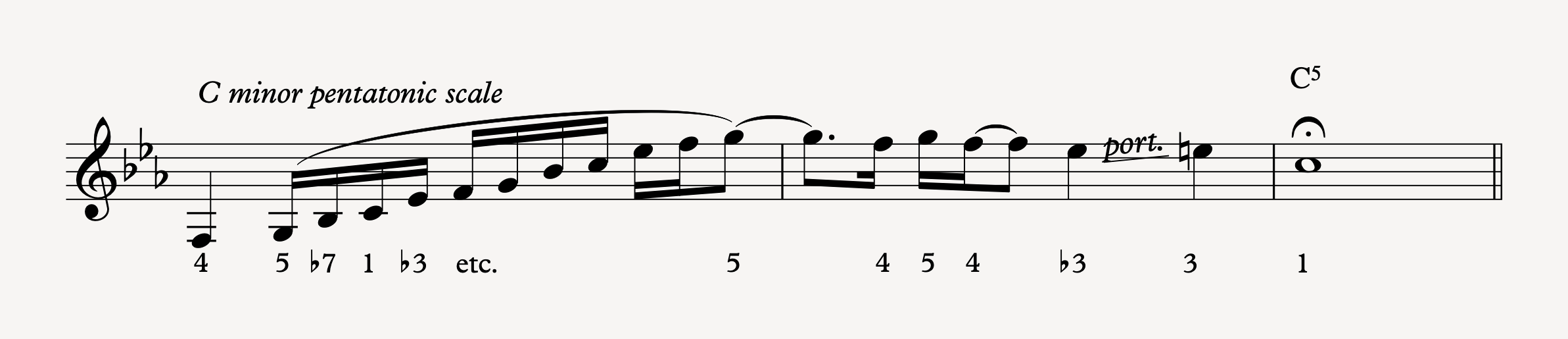
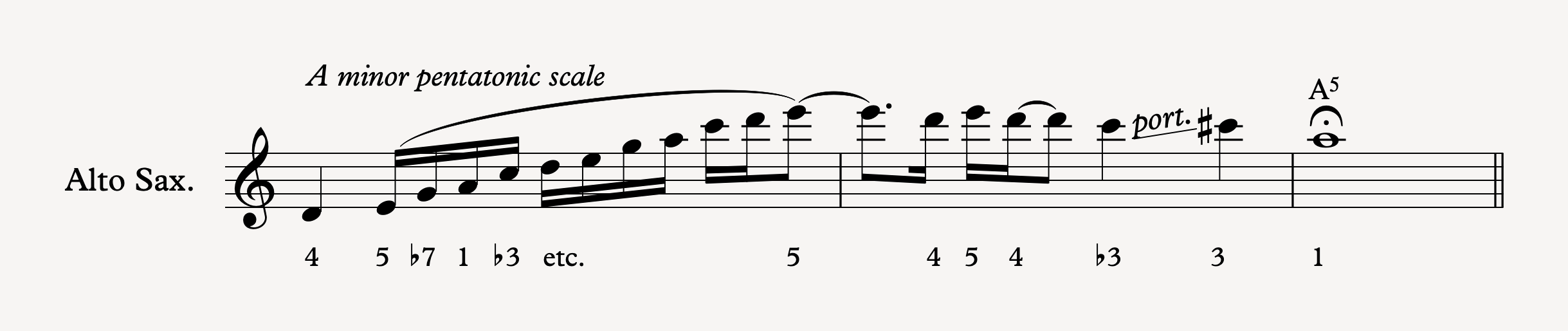
N.B. Since it prominently features alto sax — an E-flat instrument — I’ve provided the dots for this song in both concert pitch C minor and transposed to A minor.
So are we in C major or C minor? Well, exactly. These tune’s head features tensions that suggest neither C major or minor, but something in between, using the composite blues scale (which combines the notes of the minor blues scale with the major pentatonic : 1, 2, b3, 3, 4, b5, 5, 6, b7). This is fitting given the album’s focus on the inheritance of black American culture, since these are some of the blue notes that form the bedrock of American music styles devised by black artists, from blues and ragtime to jazz and gospel. This riff opens each of the choruses for the A section, with Martin (on alto sax) and Marlon Williams (on distorted electric guitar) play a series of tensions and resolutions against that implied bass note of C.
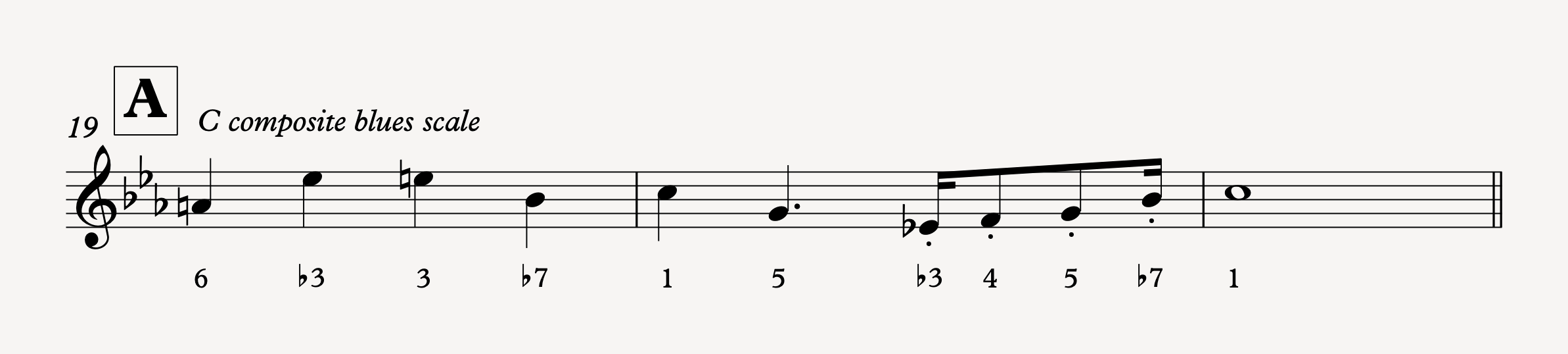
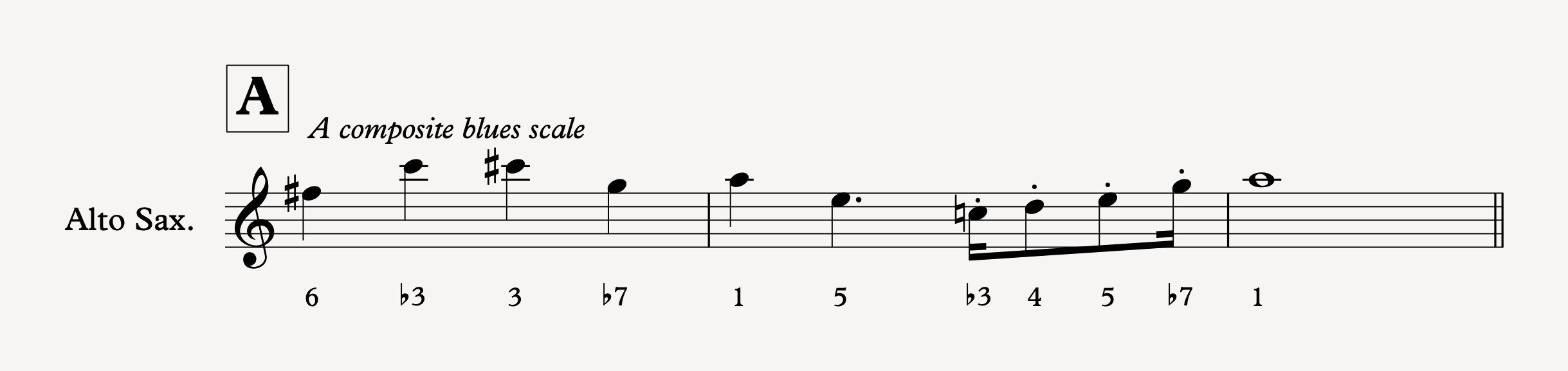
For once, this riff actually looks more straightforward on paper than it sounds. The opening improvised chaos over the C5 chord ends with a snare and hi-hat hit that initially sounds as if it lands on the opening downbeat of the bar. This, in turn, moves everything else a beat later, leading to it sounding like the first note of the head begins on the upbeat, and so on. Even when you try to think about it accurately, with the head beginning on the downbeat rather than the upbeat, the drum hit comes on the last quaver in the bar and keeps throwing you off. It also doesn’t help that the band play fairly loose with their time in this opening A section: the entire song sits somewhere between 115 and 132 BPM, which is an impossible level of variance when trying to pick things apart in minute detail.
Overall, then, it ends up feeling as if everything in this A section is moving a bit too fast, and while both the band and Lamar have it down to a T, we’re galloping along trying to keep up. Whether this was intentional or not isn’t clear, but I’d argue that it clearly chimes with the song’s imagery of matadors, bulls and horsemen in representing how exhausted the speaker feels in his pursuit of the American Dream. On top of this, there seems to be an intentional attempt to make us lose our footing when C note that ends the riff lands us on an Fmin7, and what we expect to be the root of the tonic (I) chord instead becomes the minor fifth of the subdominant (iv) chord. In addition, the structure of the chord progression and head together seem designed to create a sense of asymmetry within the 4/4 rhythm, since we’re used to expecting 4- or 8-bar phrases and are instead treated to a 6-bar pattern where the 2-bar head is followed by four bars of chords:
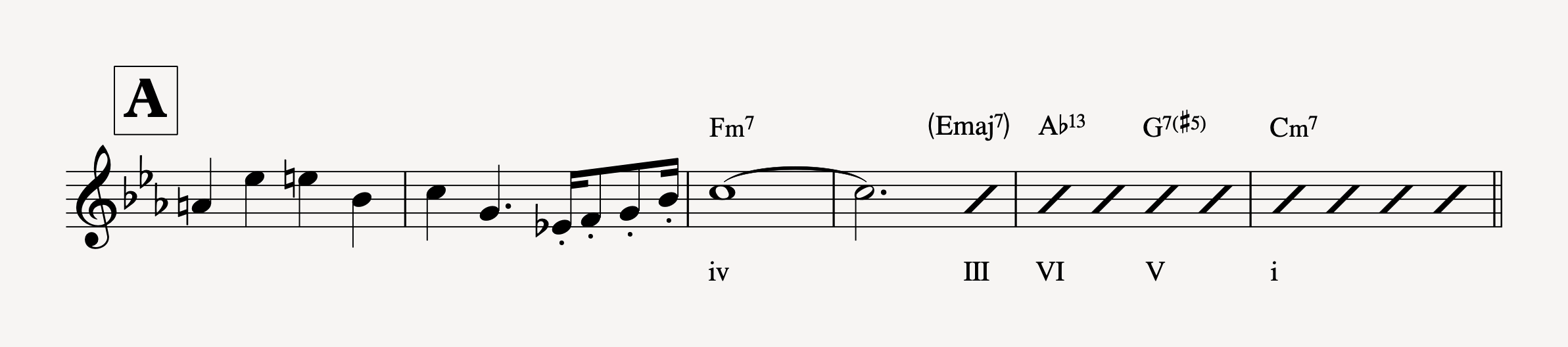
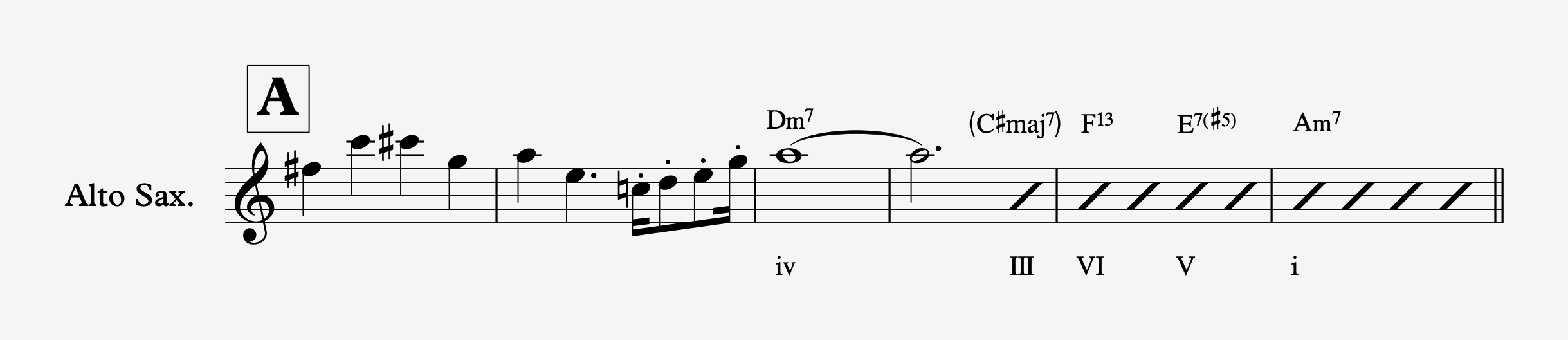
Of course, the listener can only deal with so much complexity, and the band shift into more of a standard structure when Lamar begins rapping, essentially running through a 12-bar minor blues form…
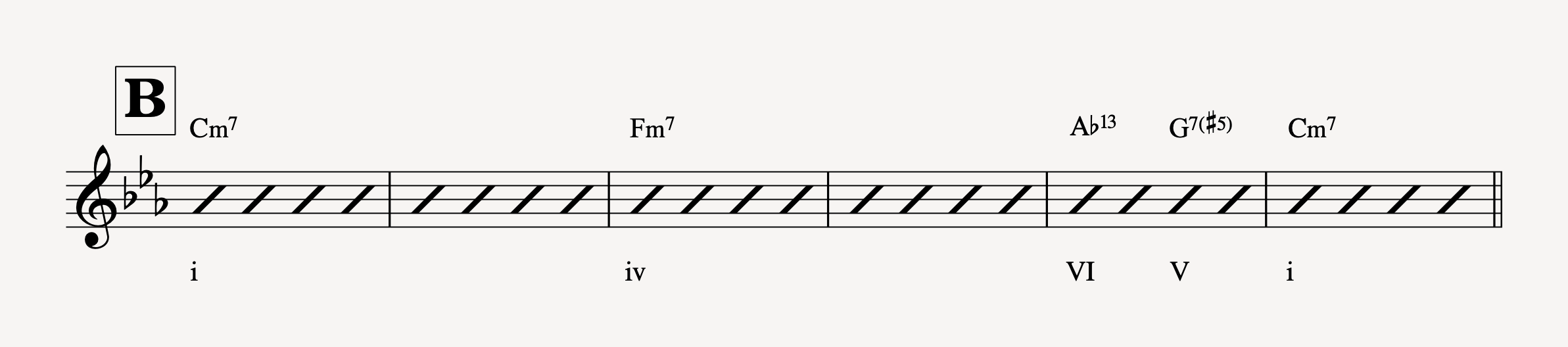
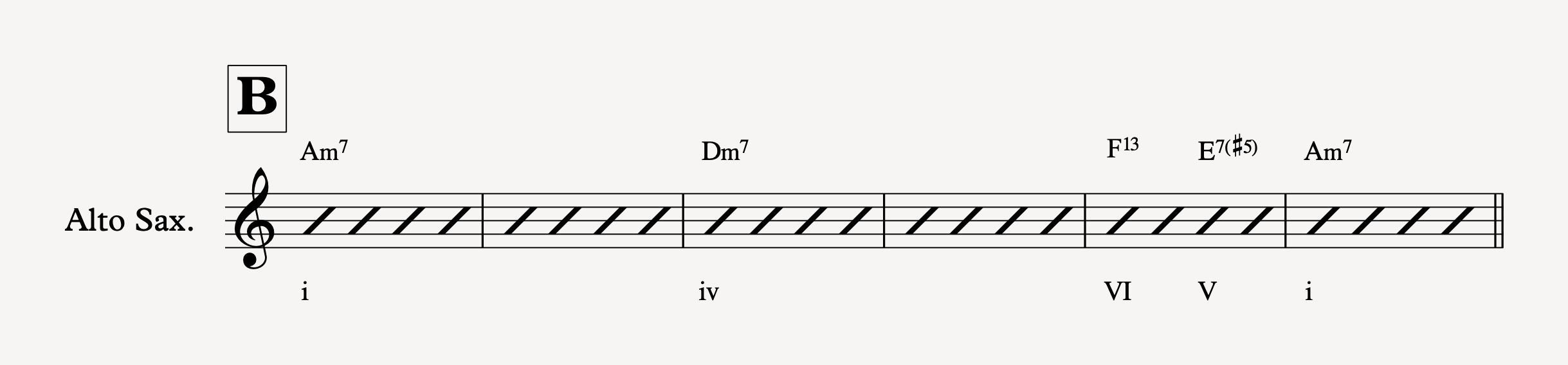
…except it’s only 6 bars long. True to form (or lack thereof) the song again plays with our expectations by providing the usual opening i–iv progression of the blues, only to then end with a 2-bar VI–V-i turnaround. Again, it adds to the sense that the song is moving at a pace too fast for its own good. In fact, if the energy of the song could be summed up in one word, it would be described as restless.
And we haven’t even got to the specifics of the band’s performance, since they naturally approach this complexity with the self-assured gusto of jazz pros: Brandon “Eugene” Owens keeps time by walking on upright bass against the light tap of the ride cymbal, while Robert “Sput” Searight uses the rest of his kit to provide Elvin Jones-style polyrhythmic explosions of snare and kick drum with the occasional floor tom thrown in for good measure, and Robert Glasper does a good imitation of stumbling down the stairs by providing comping and fills that always either arrive a beat ahead or behind of the bar. It’s organised chaos, the type of thing that Charles Mingus would often achieve on his records by doing exactly what Terrace Martin did here: pulling together some of the most talented jazz musicians of the era and throwing music at them that is simultaneously rooted in the past while moving it in a direction that is new and exciting.
As if all this rhythmic complexity isn’t already too much for the listener to take in, the third note of the riff hits at the same time as a woman voice cuts over the din to make an announcement:
“Fuck you, motherfucker. You a ho-ass nigga.”
According to the liner notes, this is the voice of Darlene Tibbs, speaking as the American Dream, reimagined as a ratchet girlfriend1As far as I can see, Tibbs is a complete non-entity online, which is good for her given how weird men can be about women even when they’re merely playing the role of an angry girlfriend. However, it’s a shame there’s nowhere to throw flowers at her feet given the brilliance of her performance.. That opening “fuck you” is perfect in its knife-like precision, falling almost a perfect fifth melodically from one word to the next. Her criticisms seem to come so quickly that it sounds as if she’s split into two women just to talk shit about one guy2I assume either Terrace Martin compiled together different takes to create this effect, or Tibbs just had the material down so well that she was able to rattle it off like a drive-by shooting., and her invective is just as melodic and rhythmically dense as the work of the rhythm section. The fact that this section is spoken instead of being sung or rapped adds to the sense that we’re brushing up against the zero-gravity atmosphere of free or modal jazz, but the song remains tonal despite all the chaos — and this sense of underlying structure leaves room for the persona of Kendrick to chime in with his virtuosic response, explored below.
↓
INTRO
Darlen Tibbs (spoken)
Fuck you, motherfucker, you a ho-ass nigga3Continuing Lamar’s use of personified concepts, this song introduces a new conceit: the American Dream is a stereotypical “gold digger” who views Kendrick as a worthless man. The immediate use of direct address and expletives creates a raucous atmosphere which is matched by the complex uptempo improvisation of the jazz band matching the speakers’ phrasing and energy.
I don’t know why you trying to go big, nigga, you ain’t shit
Walking around like you God’s gift to Earth, nigga, you ain’t shit4The figure of the American Dream is belittling Kendrick’s aspirations, literally arguing he has a messiah complex — a self-criticism that Lamar evaluates throughout the album and eventually rejects on the aptly titled final track, “Mortal Man”.
You ain’t even buy me no outfit for the Fourth5The Fourth of July is a U.S. federal holiday that commemorates the ratification of the Declaration of Independence. There’s an underlying implication here that Kendrick has no interest in celebrating this occasion since people like him are expected to show patriotism towards a country that continues to them as second-class citizens.
I need that Brazilian, wavy, twenty-eight inch, you playing6The personified American Dream wants either an expensive wig or hair extensions. The black hair industry is fraught with issues around racism, aesthetics and capitalism; in the US, black people spend nine times more than their white counterparts on hair products, and there continue to be negative public perceptions around kinky hair; both these factors often lead to women choosing to wear wigs or use extensions, which can arguably have the unintended of perpetuating these issues. As a result, Lamar is using this line to represent the culturally hegemonic expectations that are placed on black people and contribute to their economic inequality — and the fact that “America” is personified as a black woman implies that black Americans should be aware of their own participation in spreading these views.
I shouldn’t be fucking with you anyway
I need a baller-ass, boss-ass nigga7The expectations that the American Dream places on Kendrick link to societal stereotypes of black American men. Over 70% of NBA players are black, making it one of the more visible forms of success to aspire to for black men, leading to the “baller” archetype of someone who lives an extravagant lifestyle. The fact that America expects this of Kendrick is at odds with the fact that black people from low-income backgrounds have lower odds of making it in the NBA, and it symbolises the unreasonable economic expectations placed on young black men living in the United States.
You’s a off-brand-ass nigga, everybody know it8This adjectival phrase is common in Black American English, but it also speaks to the album’s larger focus on how consumerism negatively affects black Americans. Conspicuous consumption — buying things to display your wealth or status — is more common among black and Hispanic Americans, so Lamar’s use of the insult highlights how this is a subtle way that black people become unintentionally complicit in their own oppression.
Your homies know it, everybody fucking know
Fuck you, nigga, don’t call me no more
You won’t know, you gonna lose on a good bitch
My other nigga is on, you off9The fact that the American Dream can easily replace Kendrick with another black man contrasts with the flattery that Uncle Sam shows him in “Wesley’s Theory” and foreshadows the quotation that Lamar includes from Tupac Shakur at the end of the album where he states, “once you turn thirty it’s like they take the heart and soul […] out of a black man in this country”.
What the fuck is really going on?
VERSE
Kendrick Lamar
This dick ain’t free
You looking at me like it ain’t a receipt10In Kill the Messenger, his 2008 stand-up special, Chris Rock makes a joke that “pussy costs money; dick is free”, exaggerating the idea that men spend money on women but the same doesn’t happen in reverse. Lamar paints himself as a man who is standing his ground against the laziness, entitlement and lack of support shown by “America”. Although it might be easy to construe the sexual politics of this as revealing an underlying misogyny in Lamar’s thinking, it’s worth remembering the America has already been personified as a male recruitment officer, Uncle Sam, in the first track of the album; in both cases, Lamar portrays America through archetypical figures who seek to exploit others, and his portrayal of the American Dream as a black woman in particular seems designed to imply that black liberation also requires an awareness of how contemporary black cultural expectations, such as a man always paying for a woman on a date, can unwittingly contribute to the hegemonic power of white culture. Moreover, the refrain of “this dick ain’t free” links to the album’s motif of “pimping” being a skill that the individual needs to wrestle away from those in power in order to escape becoming institutionalised.
Like I never made ends meet
Eating your leftovers and raw meat11Lamar alludes to the fact that the cuisine of soul food was created by enslaved black Americans from the offcuts and leftovers given to them by slaveowners, representing one of the many ways in which black Americans have historically found ways to innovate and succeed in the face of oppression (or, as he puts it in “Mortal Man”, “to pimp it to [their] own benefits”.
This dick ain’t free
Living in captivity raised my cap salary12The “captivity” here could refer to the literal captivity of slavery, the relative captivity of Jim Crow laws, or the ghettoisation of black people in modern America. In all three contexts, however, Lamar implies that these negative aspects have conversely raised the perceived value of black men — for example, by aestheticising these situations through blues music and gangsta rap. Despite this, the specific reference to a salary cap suggests that this increase in how society values black men hasn’t led to their economic liberation, since white culture still defines what is or isn’t valuable, in the same way that predominately white sports associations prevent black players from monopolising the industry by drafting dream teams.
Celery, telling me green is all I need
Evidently, all I seen was Spam and raw sardines13Since money is colloquially referred to in America as “green”, Lamar makes a pun on “salary” and “celery” to compare the way that the American dream tells anyone they can achieve material wealth with the reality, which is that child poverty is higher among black Americans and they are more likely to live in food deserts where the only available goods have a lower overall nutritional value.
This dick ain’t free, I mean, baby
You really think we could make a baby named Mercedes
Without a Mercedes Benz and twenty-four-inch rims
Five percent tint, and air conditioning vents?
Hell fucking naw,14This is an allusion to Kanye West’s “All Falls Down”, a song that explores similar themes and describes someone who “Couldn’t afford a car, so she named her daughter Alexis” — a pun on the luxury car brand Lexus. In both songs, the rappers imply that WASPy names such as “Alexis” and “Mercedes” are a form of cultural capital that aspirational black people give to their children instead of Afrocentric or Muslim names. However, Lamar’s “hell fucking naw” implies that this is naïve, since it doesn’t actually lead to the economic capital that would allow someone to buy a luxury car like a Mercedes Benz. this dick ain’t free
I need forty acres and a mule
Not a forty ounce and a pitbull15This echoes the line where Uncle Sam offers Kendrick “forty acres and a mule” in “Wesley’s Theory”, suggesting that Kendrick can’t be bought off with cheap pleasures since he recognises the need for foundational wealth that would have come from historic reparations. It is also a rejection of gangsta rap stereotypes: forty-ounce malt liquor is commonly sold in poor inner-city neighbourhoods, while pit bull dogs are often bought by drug dealers for protection since they were originally bred for dog-fighting.
Bullshit, matador, matador
Had the door knocking, let ’em in, who’s that?
Genital’s best friend16The wordplay becomes dense here: a mule is an impotent beast of burden, which Lamar rhymes with “bull”, implying that he will instead be virile and dangerous. This leads to the cretic rhythm of “matador”, suggesting the American dream of meritocratic wealth is like a flag being used to deceive Kendrick, leaving him enraged. The cretic forms a triplet rhythm against the underlying common time signature that the band is playing in, adding to the metaphor of a bull charging ahead. The next line uses a coded metaphor to suggest that people are allowing themselves to be tricked by the American dream (“knocking” on the “door”) since they are hoodwinked by the promise of pleasure (“let ’em in”) without realising they are being sold a lie (“genital’s best friend”), and Lamar continues the cretic rhythm across the phrases “had the door”, “let them in” and “genital”, maintaining the momentum and suggesting that Kendrick’s bullish desire to succeed has caused him to run in this direction before.
This dick ain’t free
Pity the fool that made the pretty in you prosper17Black American actor Mr. T is famous for his catchphrase “I pity the fool”, which his character in Rocky III uses to suggest he feels sorry for someone he is about to harm. In this context, Lamar uses it to imply that we should feel sorry for any “fool” who has allowed the “pretty” attractiveness of the American dream to perpetuate it and allow it to “prosper” instead of recognising it for the deceptive sham that he perceives it to be.
Titty juice and pussy lips kept me obnoxious
Kept me up watching pornos in poverty; apology? No18The imagery here intentionally blends childish words with sexual language to create a tension between connotations of child-rearing and lust. On one hand, most children a born through vaginal birth and drink breast milk as infants; on the other hand, referring to these elements as “pussy lips” and “titty juice” suggests that they are being sexualised, which speaks to the perversion of illusion and reality that Lamar sees at the heart of the American Dream. This leads to him “watching pornos in poverty”, which suggests that even though the American Dream gave birth to Kendrick Lamar the rapper, it has also led to him chasing after its signifiers (such as the aforementioned luxury cars) without ever achieving the end-goal of social, economic and cultural capital, in the same way that someone watching porn is being fed an illusion and a temporary form of satisfaction.
Watch you politic with people less fortunate, like myself
Every dog has its day, now doggy style shall help19The proverb “every dog has its day” means “everyone will have good luck or success at some point in their lives”; while this is supposed to soothe the soul, the speaker instead seeks this state out through doggy style, a sexual position that is often favoured by men over women and is sometimes seen as less intimate due to the lack of eye contact and kissing. As with the previous lines, Lamar uses sex as a metaphor to imply that the American Dream leads people to seek out instant gratification at the expense of long-term success. This line might also be an allusion to Snoop Dogg’s Doggystyle, which is a classic gangsta rap album that espouses the kind of lifestyle that Lamar would have looked up to when he was younger.
This dick ain’t free
Matter of fact, it need interest20Lamar puns on both meanings of the noun “interest”: in the same way that poor people become poorer through usury, the debt owed to black Americans since slavery should be adjusted for interest and inflation; moreover, greater equality can only be achieved when white Americans choose to take an interest in the culture, lives and experiences of black people.
Matter of fact, it’s nine inches21There are common stereotypes, emphasised in pornography, around black men having large penises. Since the average size of a penis is around 3.4 inches flaccid and 5.1 inches erect, Kendrick is implying that he fits this stereotype. While this appears to be a boast, it is a pyrrhic victory, since it feeds into the Mandingo stereotype that black men are untamed beasts who can only enact their rage towards white supremacy by sexually dominating white women.
Matter of fact, see our friendship based on business
Pension, more pension, you’re pinching my percents22The consonance begins piling up, with soft plosive consonants appearing between slant-rhymed words on “friendship”, “business”, “pension”, “pinching” and “percents”, reflecting Kendrick’s rising anger as he reflects on the complex web of ways that money is taken from him, alluding to the complexities of recording contracts, where artists often struggle to break even due to percentage deductions from the gross profits.
It’s been relentless, fuck forgiveness, fuck your feelings
Fuck your sources, all distortion, if you fuck it’s more abortion
More divorce courts and portion23The rising anger in the previous lines boils over here with fricatives and harsher plosives appearing, particularly in the repetition of the imperative “fuck”, reflecting the “relentless” mistreatment of black Americans that Lamar is describing in the song. He builds on the extended sexual metaphor, suggesting that these temporary forms of gratification provided by consumerism only lead to further economic and social problems down the line, expressed here through the metaphors of “abortion”, “divorce courts” and the need to “portion” finances, which he links together through a series of slant rhymes.
My check with less endorsement left me dormant
Dusted, doomed, disgusted, forced with
Fuck you think is in more shit?24One way that artists are able to make extra money is through endorsements with brands; if we read this line as coming from Kendrick, then it implies that he has chosen to avoid this, which has led to him having less money. However, if we interpret his voice here as speaking on behalf of black Americans, then the “endorsement” could be considered to be the support of other Americans; without this support, they have become disempowered. Lamar appears to build on this idea by referring to how it leaves Kendrick “dusted”, since being “dusted” means being high on “angel dust”, the street name for PCP. There is a strong correlation between drug use and poverty, and PCP has proliferated in poor neighbourhoods in California much like crack cocaine before it, both through the use of the drug and through young people making money through selling it, so Lamar is highlighting how people who cannot achieve the American dream through legal means often end up either becoming addicted to instant gratification or seek to achieve it through illegal means.
Porcelain pipes pressure, bust ’em twice25This image links directly to the mention of “more shit” in the previous line, implying that the American Dream is “full of shit”. The idea that the pipes will burst open “twice” echoes the line in “Wesley’s Theory” where Kendrick is told by Uncle Sam that he should “cop everything two times” because he’s a Gemini, suggesting that this needless overconsumption again merely leads to his problems being doubled.
Choice is devastated,26One of the main selling points of capitalism is choice, since it encourages the consumer to seek the lowest price for the highest gain. However, these choices are only available for those with money; for example, while a middle-class American can go to Walmart and buy whatever they want, a poor person is limited to food stamps and government cheese. For this reason, Lamar is calling out freedom of choice as one of the illusions of the American dream. decapitated the horseman27The headless horseman is a mythical harbinger of doom, suggesting that the situation described has reached breaking point, emphasised by the fact that “horseman” marks the final slant rhyme in a long chain that builds on other negative words and phrases such as “distortion”, “abortion”, “divorce”, “dormant” and “more shit”.
Oh America, you bad bitch, I picked cotton and made you rich
Now my dick ain’t free28Lamar ends Kendrick’s invective by invoking the ancestral history of enslaved people, who had to pick cotton in fields. The production of this cotton enriched slaveowners, who in turn enriched industrial factory owners, leading to the system of exploitation that still remains in place to this day. By linking this directly back to his “dick”, Lamar is implying he will no longer be “pimped” by a system that is built off white supremacy; he will not give in to the stereotypes that they want him to fit into.
OUTRO
Darlen Tibbs (spoken)
I’ma get my Uncle Sam to fuck you up
You ain’t no king29The fact that the American Dream threatens Kendrick with violence reflects the various methods of manipulation that are used by those in power, contrasting the temptation and love-bombing of Uncle Sam — similar to the way record labels treat rappers — with the violence historically shown towards enslaved black people and currently still taking place in the form of police brutality. The admonition that Kendrick should not half self-worth since he “ain’t no king” directly takes us into the next song, “King Kunta”, which tackles this issue directly, while also foreshadowing the speech around the use of the N-word that takes place at the end of “i”.
Footnotes
- 1As far as I can see, Tibbs is a complete non-entity online, which is good for her given how weird men can be about women even when they’re merely playing the role of an angry girlfriend. However, it’s a shame there’s nowhere to throw flowers at her feet given the brilliance of her performance.
- 2I assume either Terrace Martin compiled together different takes to create this effect, or Tibbs just had the material down so well that she was able to rattle it off like a drive-by shooting.
- 3Continuing Lamar’s use of personified concepts, this song introduces a new conceit: the American Dream is a stereotypical “gold digger” who views Kendrick as a worthless man. The immediate use of direct address and expletives creates a raucous atmosphere which is matched by the complex uptempo improvisation of the jazz band matching the speakers’ phrasing and energy.
- 4The figure of the American Dream is belittling Kendrick’s aspirations, literally arguing he has a messiah complex — a self-criticism that Lamar evaluates throughout the album and eventually rejects on the aptly titled final track, “Mortal Man”.
- 5The Fourth of July is a U.S. federal holiday that commemorates the ratification of the Declaration of Independence. There’s an underlying implication here that Kendrick has no interest in celebrating this occasion since people like him are expected to show patriotism towards a country that continues to them as second-class citizens.
- 6The personified American Dream wants either an expensive wig or hair extensions. The black hair industry is fraught with issues around racism, aesthetics and capitalism; in the US, black people spend nine times more than their white counterparts on hair products, and there continue to be negative public perceptions around kinky hair; both these factors often lead to women choosing to wear wigs or use extensions, which can arguably have the unintended of perpetuating these issues. As a result, Lamar is using this line to represent the culturally hegemonic expectations that are placed on black people and contribute to their economic inequality — and the fact that “America” is personified as a black woman implies that black Americans should be aware of their own participation in spreading these views.
- 7The expectations that the American Dream places on Kendrick link to societal stereotypes of black American men. Over 70% of NBA players are black, making it one of the more visible forms of success to aspire to for black men, leading to the “baller” archetype of someone who lives an extravagant lifestyle. The fact that America expects this of Kendrick is at odds with the fact that black people from low-income backgrounds have lower odds of making it in the NBA, and it symbolises the unreasonable economic expectations placed on young black men living in the United States.
- 8This adjectival phrase is common in Black American English, but it also speaks to the album’s larger focus on how consumerism negatively affects black Americans. Conspicuous consumption — buying things to display your wealth or status — is more common among black and Hispanic Americans, so Lamar’s use of the insult highlights how this is a subtle way that black people become unintentionally complicit in their own oppression.
- 9The fact that the American Dream can easily replace Kendrick with another black man contrasts with the flattery that Uncle Sam shows him in “Wesley’s Theory” and foreshadows the quotation that Lamar includes from Tupac Shakur at the end of the album where he states, “once you turn thirty it’s like they take the heart and soul […] out of a black man in this country”.
- 10In Kill the Messenger, his 2008 stand-up special, Chris Rock makes a joke that “pussy costs money; dick is free”, exaggerating the idea that men spend money on women but the same doesn’t happen in reverse. Lamar paints himself as a man who is standing his ground against the laziness, entitlement and lack of support shown by “America”. Although it might be easy to construe the sexual politics of this as revealing an underlying misogyny in Lamar’s thinking, it’s worth remembering the America has already been personified as a male recruitment officer, Uncle Sam, in the first track of the album; in both cases, Lamar portrays America through archetypical figures who seek to exploit others, and his portrayal of the American Dream as a black woman in particular seems designed to imply that black liberation also requires an awareness of how contemporary black cultural expectations, such as a man always paying for a woman on a date, can unwittingly contribute to the hegemonic power of white culture. Moreover, the refrain of “this dick ain’t free” links to the album’s motif of “pimping” being a skill that the individual needs to wrestle away from those in power in order to escape becoming institutionalised.
- 11Lamar alludes to the fact that the cuisine of soul food was created by enslaved black Americans from the offcuts and leftovers given to them by slaveowners, representing one of the many ways in which black Americans have historically found ways to innovate and succeed in the face of oppression (or, as he puts it in “Mortal Man”, “to pimp it to [their] own benefits”.
- 12The “captivity” here could refer to the literal captivity of slavery, the relative captivity of Jim Crow laws, or the ghettoisation of black people in modern America. In all three contexts, however, Lamar implies that these negative aspects have conversely raised the perceived value of black men — for example, by aestheticising these situations through blues music and gangsta rap. Despite this, the specific reference to a salary cap suggests that this increase in how society values black men hasn’t led to their economic liberation, since white culture still defines what is or isn’t valuable, in the same way that predominately white sports associations prevent black players from monopolising the industry by drafting dream teams.
- 13Since money is colloquially referred to in America as “green”, Lamar makes a pun on “salary” and “celery” to compare the way that the American dream tells anyone they can achieve material wealth with the reality, which is that child poverty is higher among black Americans and they are more likely to live in food deserts where the only available goods have a lower overall nutritional value.
- 14This is an allusion to Kanye West’s “All Falls Down”, a song that explores similar themes and describes someone who “Couldn’t afford a car, so she named her daughter Alexis” — a pun on the luxury car brand Lexus. In both songs, the rappers imply that WASPy names such as “Alexis” and “Mercedes” are a form of cultural capital that aspirational black people give to their children instead of Afrocentric or Muslim names. However, Lamar’s “hell fucking naw” implies that this is naïve, since it doesn’t actually lead to the economic capital that would allow someone to buy a luxury car like a Mercedes Benz.
- 15This echoes the line where Uncle Sam offers Kendrick “forty acres and a mule” in “Wesley’s Theory”, suggesting that Kendrick can’t be bought off with cheap pleasures since he recognises the need for foundational wealth that would have come from historic reparations. It is also a rejection of gangsta rap stereotypes: forty-ounce malt liquor is commonly sold in poor inner-city neighbourhoods, while pit bull dogs are often bought by drug dealers for protection since they were originally bred for dog-fighting.
- 16The wordplay becomes dense here: a mule is an impotent beast of burden, which Lamar rhymes with “bull”, implying that he will instead be virile and dangerous. This leads to the cretic rhythm of “matador”, suggesting the American dream of meritocratic wealth is like a flag being used to deceive Kendrick, leaving him enraged. The cretic forms a triplet rhythm against the underlying common time signature that the band is playing in, adding to the metaphor of a bull charging ahead. The next line uses a coded metaphor to suggest that people are allowing themselves to be tricked by the American dream (“knocking” on the “door”) since they are hoodwinked by the promise of pleasure (“let ’em in”) without realising they are being sold a lie (“genital’s best friend”), and Lamar continues the cretic rhythm across the phrases “had the door”, “let them in” and “genital”, maintaining the momentum and suggesting that Kendrick’s bullish desire to succeed has caused him to run in this direction before.
- 17Black American actor Mr. T is famous for his catchphrase “I pity the fool”, which his character in Rocky III uses to suggest he feels sorry for someone he is about to harm. In this context, Lamar uses it to imply that we should feel sorry for any “fool” who has allowed the “pretty” attractiveness of the American dream to perpetuate it and allow it to “prosper” instead of recognising it for the deceptive sham that he perceives it to be.
- 18The imagery here intentionally blends childish words with sexual language to create a tension between connotations of child-rearing and lust. On one hand, most children a born through vaginal birth and drink breast milk as infants; on the other hand, referring to these elements as “pussy lips” and “titty juice” suggests that they are being sexualised, which speaks to the perversion of illusion and reality that Lamar sees at the heart of the American Dream. This leads to him “watching pornos in poverty”, which suggests that even though the American Dream gave birth to Kendrick Lamar the rapper, it has also led to him chasing after its signifiers (such as the aforementioned luxury cars) without ever achieving the end-goal of social, economic and cultural capital, in the same way that someone watching porn is being fed an illusion and a temporary form of satisfaction.
- 19The proverb “every dog has its day” means “everyone will have good luck or success at some point in their lives”; while this is supposed to soothe the soul, the speaker instead seeks this state out through doggy style, a sexual position that is often favoured by men over women and is sometimes seen as less intimate due to the lack of eye contact and kissing. As with the previous lines, Lamar uses sex as a metaphor to imply that the American Dream leads people to seek out instant gratification at the expense of long-term success. This line might also be an allusion to Snoop Dogg’s Doggystyle, which is a classic gangsta rap album that espouses the kind of lifestyle that Lamar would have looked up to when he was younger.
- 20Lamar puns on both meanings of the noun “interest”: in the same way that poor people become poorer through usury, the debt owed to black Americans since slavery should be adjusted for interest and inflation; moreover, greater equality can only be achieved when white Americans choose to take an interest in the culture, lives and experiences of black people.
- 21There are common stereotypes, emphasised in pornography, around black men having large penises. Since the average size of a penis is around 3.4 inches flaccid and 5.1 inches erect, Kendrick is implying that he fits this stereotype. While this appears to be a boast, it is a pyrrhic victory, since it feeds into the Mandingo stereotype that black men are untamed beasts who can only enact their rage towards white supremacy by sexually dominating white women.
- 22The consonance begins piling up, with soft plosive consonants appearing between slant-rhymed words on “friendship”, “business”, “pension”, “pinching” and “percents”, reflecting Kendrick’s rising anger as he reflects on the complex web of ways that money is taken from him, alluding to the complexities of recording contracts, where artists often struggle to break even due to percentage deductions from the gross profits.
- 23The rising anger in the previous lines boils over here with fricatives and harsher plosives appearing, particularly in the repetition of the imperative “fuck”, reflecting the “relentless” mistreatment of black Americans that Lamar is describing in the song. He builds on the extended sexual metaphor, suggesting that these temporary forms of gratification provided by consumerism only lead to further economic and social problems down the line, expressed here through the metaphors of “abortion”, “divorce courts” and the need to “portion” finances, which he links together through a series of slant rhymes.
- 24One way that artists are able to make extra money is through endorsements with brands; if we read this line as coming from Kendrick, then it implies that he has chosen to avoid this, which has led to him having less money. However, if we interpret his voice here as speaking on behalf of black Americans, then the “endorsement” could be considered to be the support of other Americans; without this support, they have become disempowered. Lamar appears to build on this idea by referring to how it leaves Kendrick “dusted”, since being “dusted” means being high on “angel dust”, the street name for PCP. There is a strong correlation between drug use and poverty, and PCP has proliferated in poor neighbourhoods in California much like crack cocaine before it, both through the use of the drug and through young people making money through selling it, so Lamar is highlighting how people who cannot achieve the American dream through legal means often end up either becoming addicted to instant gratification or seek to achieve it through illegal means.
- 25This image links directly to the mention of “more shit” in the previous line, implying that the American Dream is “full of shit”. The idea that the pipes will burst open “twice” echoes the line in “Wesley’s Theory” where Kendrick is told by Uncle Sam that he should “cop everything two times” because he’s a Gemini, suggesting that this needless overconsumption again merely leads to his problems being doubled.
- 26One of the main selling points of capitalism is choice, since it encourages the consumer to seek the lowest price for the highest gain. However, these choices are only available for those with money; for example, while a middle-class American can go to Walmart and buy whatever they want, a poor person is limited to food stamps and government cheese. For this reason, Lamar is calling out freedom of choice as one of the illusions of the American dream.
- 27The headless horseman is a mythical harbinger of doom, suggesting that the situation described has reached breaking point, emphasised by the fact that “horseman” marks the final slant rhyme in a long chain that builds on other negative words and phrases such as “distortion”, “abortion”, “divorce”, “dormant” and “more shit”.
- 28Lamar ends Kendrick’s invective by invoking the ancestral history of enslaved people, who had to pick cotton in fields. The production of this cotton enriched slaveowners, who in turn enriched industrial factory owners, leading to the system of exploitation that still remains in place to this day. By linking this directly back to his “dick”, Lamar is implying he will no longer be “pimped” by a system that is built off white supremacy; he will not give in to the stereotypes that they want him to fit into.
- 29The fact that the American Dream threatens Kendrick with violence reflects the various methods of manipulation that are used by those in power, contrasting the temptation and love-bombing of Uncle Sam — similar to the way record labels treat rappers — with the violence historically shown towards enslaved black people and currently still taking place in the form of police brutality. The admonition that Kendrick should not half self-worth since he “ain’t no king” directly takes us into the next song, “King Kunta”, which tackles this issue directly, while also foreshadowing the speech around the use of the N-word that takes place at the end of “i”.