We could talk all day about how “Alright” is the best modern protest song. We could talk about how it captures the simple complexity the lies at the heart of saying “Black Lives Matter”. We could talk about how it proves that the best political statements are always — regrettably — timeless.
And we will talk about that stuff, eventually. But there’s something worth mentioning about first — something that people usually ignore when they think about this song on its own. Because, as the seventh track on To Pimp a Butterfly, “Alright” is a masterful example of album sequencing.
Holy orders
If the first three songs on the album see Kendrick chasing fame and clout, then the next three see him struggling to reconcile this with his relationships back home. By the time we get to “u” — the sixth song on the album — we hear Kendrick implode, calling himself out for being a self-absorbed celebrity who wasn’t around enough when his friend’s younger brother died. Halfway through the song, the tempo drops, going from 93 to 72 BPM in its excoriating second half, which finds Kendrick continuing this psychodrama by drinking and “screaming in the hotel room” at himself.
In theory, this should be a form of catharsis, a session of primal therapy that brings the first third of the album to a close. In practice, it stops somewhere just sort of this, highlighting the contradictions that plague Kendrick’s conscience without presenting any solutions. So the effervescent doo-wop harmonies that kick off “Alright” at 110 BPM feel like a shot in the arm. As Cole Cuchna points out in his schema for To Pimp a Butterfly, “Alright” is the album’s midpoint, providing a resolution to the first half. But it’s not a resolution in the transitive sense of the word, where we discover a solution to a problem. Instead, it’s a resolution in the intransitive sense, where an individual shows determination and shows resolve by deciding to step up and act.
Picture the subtext
For now, this resolution involves going back out into the world and trying to reconnect with other black Americans. While the second half of “u” takes place in the claustrophobic interior of a hotel room and sounds like it’s being played through an AM radio, “Alright” is crisp and clear, calibrated for booming out of speakers at parties. The video for the song takes this idea and amplifies it: Lamar’s not just outside — he’s literally floating through the air, perching on lampposts and drifting along like a superhero. And while we should ultimately read any music video as paratext (since it’s been devised separately from the music itself), I do think it’s worth focusing on the imagery that Lamar and his co-directors Dave Free and Colin Tilley employ fo “Alright” to help us analyse some of the song’s themes and ideas.
In an interview with MTV, Tilley discussed the imagery of the video. It begins with a tableaux of urban areas, shot in beautiful high-contrast black and white by cinematographers Rob Witt and Corey Jennings and edited by Vinnie Hobbs. After the setting has been established, we start to see people hanging out, drinking, partying, rioting, and intimidating each other, before we cut to a handheld close-up where a man is shoved to the ground. Then the camera rotates, revealing that what we thought was the ground is actually a wall. The man starts to run away, but rather than chasing him, the arresting officer opens fire. Time slows to a crawl; we watch the bullet fly forward, the gun kick back. And then — right as it feels like we’re about to be exposed to more scenes of police brutality — we cut to the song’s title card.
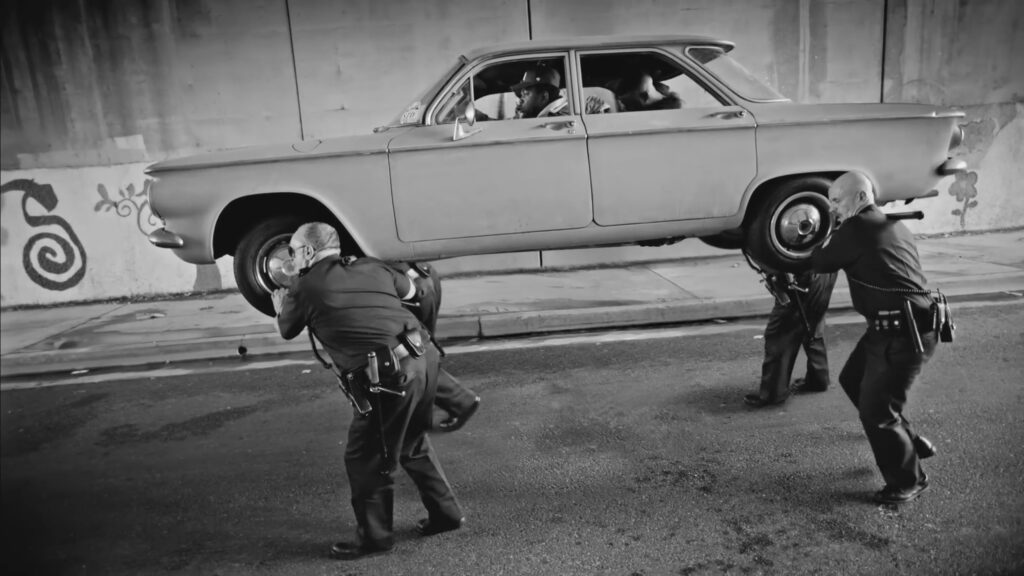
A moment later, sunlight bleaches the screen and the camera tracks around from the passenger side of a car to the driver’s seat, where Kendrick is rapping, surrounded by the members of his Black Hippy supergroup. They’re bopping to the music in a way that makes it looks like they’re in a lowrider, and the shutter speed is so fast that it lends the whole thing a jittery quality. Jay Rock begins to pour his brown-bagged 40 oz onto the ground, and the camera finally pulls back to reveal that Kendrick isn’t driving the car at all: it’s being carried by four police officers straining beneath it like pallbearers at a funeral.
The main body of the video depicts Kendrick floating through California, rapping with a crowd of people and doing doughnuts in a car. But it reaches a conclusion that seems inevitable in retrospect. As the final minute approaches, we see a balding moustachioed police officer pull up in his car. Kendrick stands on top of a lamppost, looking like he’s going to ascend to heaven. The officer steps out of the vehicle, aims a finger gun at him, and fires — but the sound of a real gunshot rings out. Blood spurts out of Kendrick’s body, and over a silent mid shot of him falling like Icarus, we hear a snippet from “Another Nigga”, the poem that he recites throughout the album, until he hits the ground. The screen cuts to black for two seconds. And finally — for a brief, fleeting moment — we see a close-up of his face as it breaks into a smile.
Like Donald Glover and Hiro Murai’s stellar work o “This is America”, the video for “Alright” presents a series of symbols and motifs that are easy enough to decode on their own while juxtaposing them in such a way that it manages to avoid seeming trite or cliché.1Visually speaking “This is America” is a cut abov “Alright” when it comes to using symbolism, choreography and cinematography to explore what it means to be black in America under late capitalism. Lyrically, however, it’s like comparing apples to oranges: Lamar is rapping in the tradition of wordsmiths like 2Pac, whil “This is America” favours the stripped-down approach used by trap artists like Playboi Carti, where the rapper freestyles and repeats short phrases until they start to sound like aphorisms. The video presents us with two arguments: Sure, black citizens have fun and drink and party and protest and riot and focus on material wealth, but does that make them different from any other citizens? And police officers are supposed to support the community and hold up society through the arm of the law, but does that give them the right to harass people? Ultimately, the high-contrast photography of urban areas helps to highlight why we need rallying cries like “We gon’ be alright” an “Black Lives Matter” in the first place: things aren’t alright; black people are being murdered. So Kendrick’s death at the end of the video is a stark reminder that there is no model minority; as Tilley puts it “no matter what you do or who you are, it could happen to anybody”.
Role model
Of course, this interpretation frames the video against the Black Lives Matter movement while ignoring its placement within the larger Künstlerroman arc of To Pimp a Butterfly. If we look at it through this other lens, then the imagery of Lamar floating through California seems a little less straightforward. In the MTV interview, Tilley says “That’s him being like a superhero to these kids, him being something these kids can aspire towards”. But the Kendrick presented so far on the album is pretty far from the moral rectitude and selflessness of superheroes like Superman or Batman; he’s a conflicted, braggadocious, self-absorbed celebrity who’s beginning to reckon with the fact that it’s lonely at the top.
The idea that there are kids looking up to Kendrick is also something that he — at this point in the album — has yet to reckon with, despite his mother reminding him at the end of the Bildungsroman narrative of Good Kid, M.A.A.D City t “tell your story to these black and brown kids in Compton” an “give back with your words of encouragement”. One of Lamar’s abiding memories (which he recounts in this radio interview) comes from sitting on his father’s shoulders and seeing Dr. Dre and 2Pac record the house party video for the remix of “California Love” outside the Compton Swap Meet. So it must have been something of a full-circle moment when he was standing on top of a lamppost while filming a video in front of the Staples Center in downtown L.A. surrounded by locals. But Tilley points out that Lamar didn’t register that this was his shooting set at first; he recalls the rapper saying “I drove by set thinking it was a movie. I was like, ‘What fucking movie are they filming?’”. Maybe, then, this is more indicative of Lamar’s precarious position at the time of To Pimp a Butterfly: he has the respect and admiration of everyone — all the fame and the popularity — but he’s still not sure if he’s the right person to lead the next Million Man March.
Dah, dah, dah
This underlying dilemma is also underscored by the song’s sparse arrangement and unusual harmony. Initially produced by Pharrell, “Alright” features the kind of non-functional jazziness that has been Pharrell’s metier since his he received his first co-credit at the age of 23 (with Chad Hugo as The Neptunes) on SWV’ “Use Your Heart”. Despite his other accolades, Pharrell’s harmonic experimentations are, frankly, underrated; if you ask most people to identify his sound, they might point to the four-count starts, or the Korg Triton keyboard presets, or the minimalist arrangements — but all that stuff can also be found in your average trap song. Instead, as his surrogate son Tyler, the Creator has identified, Pharrell’s distinct fingerprint comes from the way that he wraps these colder digital elements in a warm blanket of jazzy chord progressions, creating the kind of unexpected harmonic left-turns that were introduced to modern pop music by earlier luminaries like Stevie Wonder and Earth, Wind & Fire.
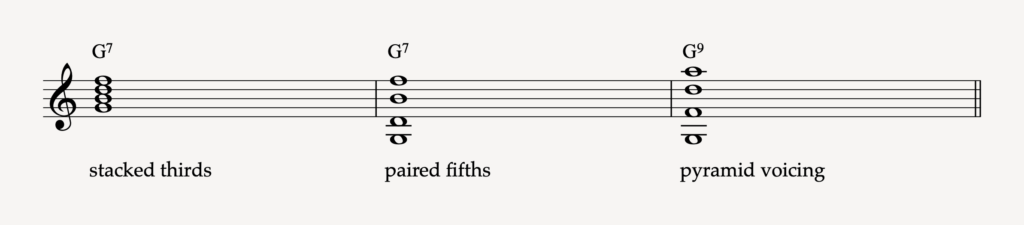
To give you an idea of what I mean, let’s go back to those opening doo-wop vocal samples. The doo-wop sound evolved when singers began blending barbershop vocal harmonies with the simplified song structures and heavy backbeat of rhythm and blues.2For more on the history of doo-wop, see Lawrence Pitilli’s book Doo-Wop Acappella: A Story of Street Corners, Echoes, and Three-Part Harmonies As this invaluable resource from Sweet Adelines outlines, the intervals of barbershop harmonies are often stacked differently to other vocal arrangements. While a basic seventh chord voicing on piano contains stacked thirds in a structure of 1–3–5–7 (G–B–D–F for G7), a barbershop voicing is spread out in two paired fifths, with the 1–5 in the bass and 3–7 in the treble (G–D–B–F for G7). But the vocal samples fo “Alright” are spread out even further, with the stacked intervals decreasing in distance as we go from bottom to top by a seventh, sixth and fifth (1–♭7–5–9, or G–F–D–A for G9).
As far as I’m aware, there’s no particular name for this type of voicing, so I’m going to take the opportunity to create a neologism here and call them pyramid voicings, since there’s something striking about their structure when they’re placed among the usual skyline of evenly stacked thirds, fourths and fifths.
While some people have made misguided assumptions that these harmonies were created from Pharrell’s own voice,3Here’s a bum steer from an otherwise passable NPR news piece on the song: “The dah dah dahs that make up those chords are Williams’ own disembodied voice, running constantly through the song”. this Music Radar article clearly outlines the reality: the harmonies are built from a sample pack created by Spectrasonics, a Los Angeles-based virtual instrument company. Specifically, the samples were taken from a series of CDs released by Spectrasonics in the mid-90s called Vocal Planet, which features a wide range of vocal samples created by audio engineer Eric Persing and singer Roby Duke. Duke was a Christian musician who straddled the line between sacred and secular work, and there’s something of an adult choirboy sound to these samples; you can imagine Duke being told to do take after take until the notes were as pure-toned as possible, without any wavering in pitch or timbre. Taken together, the quartet of voices that make up each chord provide the same kind of sanitised texture that took over jazz in the 80s and 90s as multitrack recording became cleaner and more widely available.4For an example of this sanitised vocal sound, check out Vocalese by The Manhattan Transfer.
It’s not clear whether Pharrell owned the original Vocal Planet CDs, whether he found them in the huge library of samples for Spectrasonics’s modern Omnisphere virtual instrument, or if he already had them loaded as patches in some other sampler instrument. And it doesn’t matter, really; the noteworthy thing is that something about their schmaltzy texture inspired him to make a beat that is anything but kitsch.
Suspension and stasis
On the original Vocal Planet CD, the samples are labelled as “Dah Minor 7”, which is a bit of a misnomer: as the 1–♭7–5–9 pyramid voicing above indicates, the chords feature a 9th and lack a 3rd, which means they’re actually closer to suspended chords — sus2 chords, to be exact, since you can’t traditionall “spell” a 9th interval in a chord without a 3rd below it. This is a pretty unusual chord voicing for a hip hop song, since suspended chords have a tendency to hang in the air without resolving to a particular key. For this reason, Pharrell’s use of them places him in a small club with other lovers of suspended chord progressions like Joni Mitchell, McCoy Tyner and Herbie Hancock. Mitchell famously called the “chords of inquiry”, and she has identified the way that building a progression from them creates a lack of resolution which goes against the traditional rules of harmonic tension; by breaking these rules, she says, it highlights the way life itself often feels unresolved.
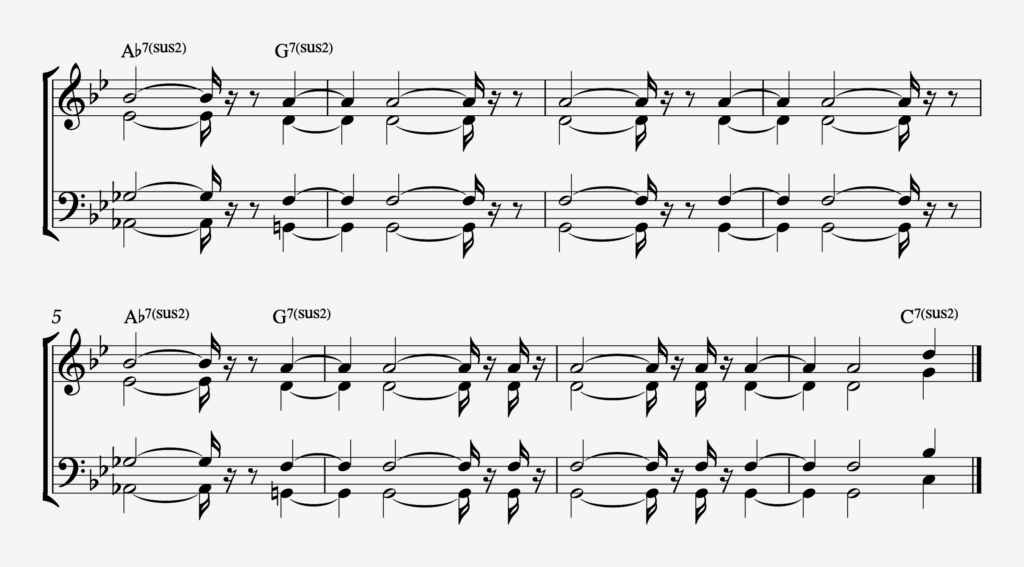
The stasis created by these suspended chords makes a great deal of difference in terms of how we interpret the harmony of “Alright”; while all the minor, dominant and diminished chords in a functional key can turned into seventh chords with a ♭7th, only the i, ii, iv and VII in a minor key can be turned into ninth chords.5The minor, dominant and diminished chords in a natural minor key are i, ii, iv, v and VII, while the relative chords in a major key are vi, vii, ii, iii and V, respectively. Like most composers who enjoy the sound of suspended chords, Pharrell chooses to ignore this: he simply goes from playing an A♭7(sus2) chord to a G7(sus2). Based on how often we hear this G7(sus2) chord, it’s clear that it provides the song’s centre of gravity, and the melodic lines sung by Thundercat in the coda outline the scale tones for the key of G minor. On top of this, every 8-bar progression ends with an unexpected C7(sus2) chord in the same voicing; since C, B♭, G, D are diatonic scale tones, there’s no doubt about it: we’re in the key of G minor.
So how does that A♭7(sus2) fit into all of this?
Well, it doesn’t, exactly. It’s a tritone substitution, replacing the V chord with the far more dissonant ♭ii. While tritone subs are common in post-bop jazz, they’re pretty rare in hip hop, and a suspended tritone substitution is basically a unicorn. In other words, this is one of those harmonic left-turns that I mentioned earlier — the kind of thing that Pharrell likes to throw at his listeners to prevent them from getting too comfortable. Of course, since this chord is an outlier, the dissonance it creates feels like it needs to be resolved as quickly as possible, which explains why the tonic chord occupies more of the loop. Yet the fact that the loop always begins with A♭7(sus2) before landing on G7(sus2) creates this odd sense of vertigo, as if you’re falling off the edge of a building only to somehow end up back on the roof again.
In terms of what this all means emotionally, it’s again worth separating the song’s place in the narrative of To Pimp a Butterfly from its status as a protest anthem: while the chorus reassures us, the brief dissonance of the tritone reminds us that the clipped “gonna” is a future utterance, promising something that hasn’t happened yet. As Lamar puts it, “we been hurt been down before” and “we hate po-po” for killing black Americans but — one day — “we gon’ be alright.”
Polytonal piano
The truly odd thing about the tonality of this song, however, lies in the Rhodes electric piano that sits just beneath the surface of it all, playing chords that refuse to fit in with everything else.
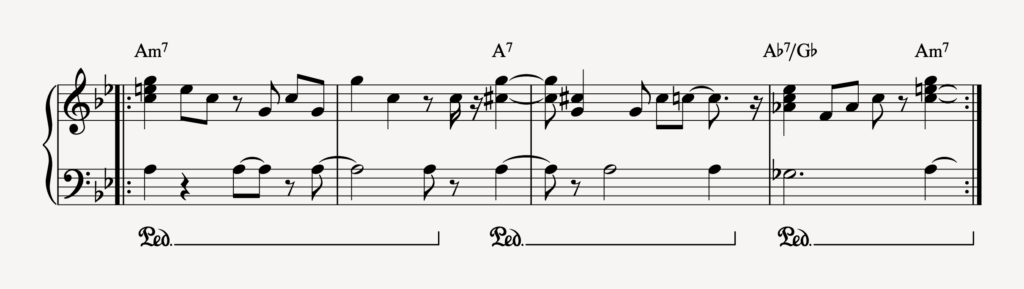
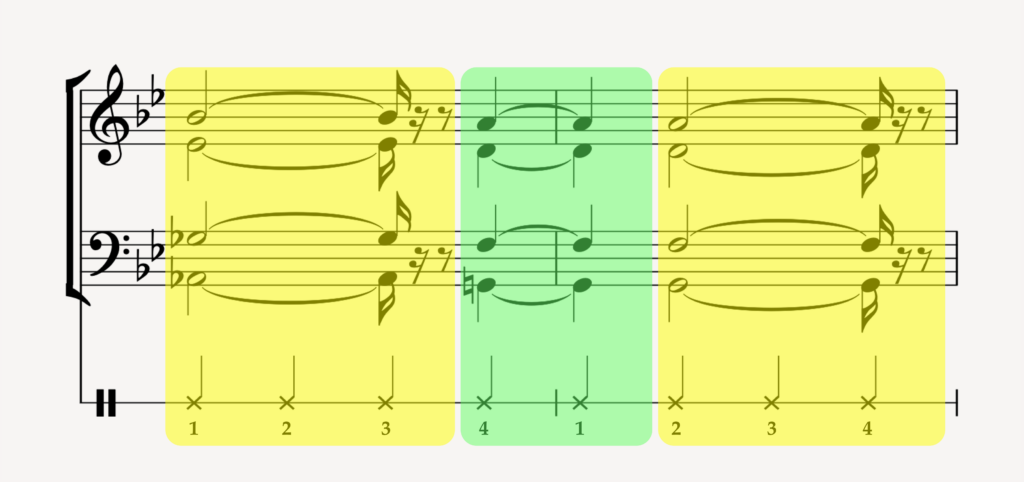
For starters, the chord progression is rhythmically off-kilter: the A7 and Am7 changes happen on the fourth beat of the bar, which causes the whole thing to feel as if it’s not syncing correctly. By comparison, if we shift the downbeat so that those two chords start on the one, then the arc of the progression becomes a bit clearer:
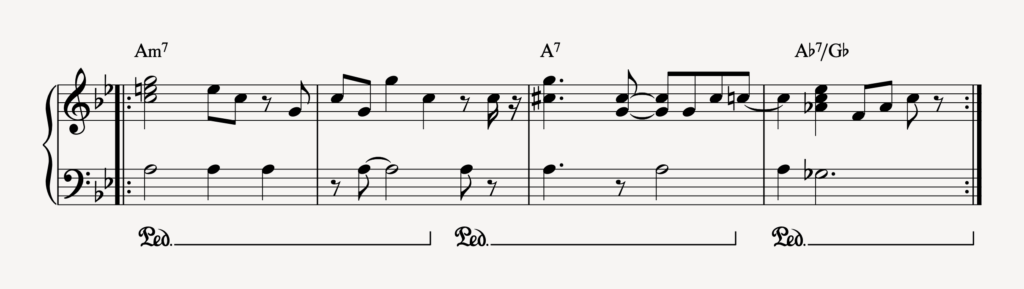
But it’s still an unusually jazzy chord progression, providing no diatonic sense of resolution: where we might usually expect the A7 to resolve to D7, it instead moves down a semitone to A♭7, and this A♭7 doesn’t resolve to D♭7 but seems to act as a substitution for A♭dim, leading us back to Am7. In other words, the chords don’t fit at all with the G minor tonality of the rest of the song; if anything, they create a series of deceptive cadences that keep leading us back to the key of A minor. Despite this, the chords do appear to mirror the downward semitonal shift in the vocal harmonies that begin the song; while those fall from A♭7(sus2) to a G7(sus2), the chord tones on the Rhodes piano go in contrary motion, rising from C to C# (in Am7→A7). Similarly, when the vocal harmonies swoop up in the opposite direction from G7(sus2) to C7(sus2), the chord tones on piano shift downwards from A to A♭(for A7→A♭7/G♭).
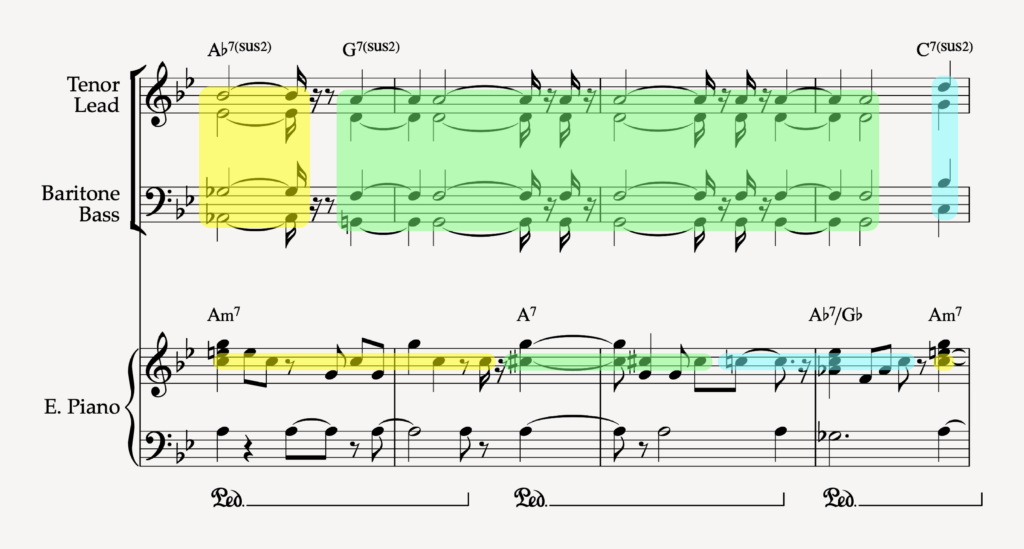
These chords are so at odds with the rest of the song that it wouldn’t be too far fetched to assume Pharrell dug them up from a different demo and pasted them straight in to “Alright”. Maybe he enjoyed the way they sound a little out-of-place amidst the rest of the song’s bombast. Given how easy it is to make what Bob Ross would call happy accidents when recording music, there’s even a good chance that the off-kilter rhythm was initially a mistake, with Pharrell dropping the chords in the wrong place before deciding just to embrace the weirdness.
All of this is notional, of course. Because this is where we get to challenge one of the prevailing notions around artistic analysis: the idea that everything is meaningful and intentional — or, to put it more simply, that everything is significant. For this school of thought, Krzysztof Penderecki isn’t just making noise in his Threnody to the Victims of Hiroshima; he’s capturing the horror of the atomic bomb. And that’s an easy argument to make when it comes to someone as overt as Penderecki. But it’s a more tenuous argument to make when you’re breaking down something like PinkPantheress’ “Boy’s a Liar” and linking the lovely lo-fi garage ringtone sound (concocted by her and Mura Masa) to her lyrical depiction of a one-sided relationship.
The idea that everything is significant is easy for us, as listeners, to buy into because we spend our lives inferring meaning based on what we see and hear around us, and the process of reflecting positively on our own lives involves going back over things and crafting a narrative of intention and causality rather than coincidence. But there are three things that this approach to analysis overlooks:
- The act of creation is a bit like the Big Bang: sometimes, ideas appear out of nowhere, and our desire to rationalise how they came into existence bumps up against the fact that we’ll never know when, exactly, they began to exist.
- Artistic collaboration is more like making marks on a blank page than building the Sistine Chapel. As a group, you try to find things that work rather than worrying about what they mean, and the creative breakthroughs often come in moments of synergy and synchronicity, rather than planning and deliberation.
- As Roland Barthes famously argued, the reader brings just as much to the table as the author does when it comes to deciding what a work of art means.
So both options are available to us: maybe Pharrell chose to include the sound of an electric piano playing in a different key as a way to encapsulate the cognitive dissonance the comes with being born in a country that gained its status by exploiting your people. Or maybe — just maybe — he decided to include it because he thought it sounded kind of goofy and fun.
Marsalis whine
Speaking of intentionality, it’s worth asserting that that Terrace Martin’s alto saxophone improvisations must be a shout-out to Public Enemy’ “Fight the Power”. Despite sounding as if it was commissioned by the Nation of Islam as entrance music for Muhammad Ali, “Fight the Power” was originally created for Spike Lee’s 1989 film Do the Right Thing. The song acts as the film’s overture: after some smooth soulful notes from Branford Marsalis on tenor sax, we hear a sample loop and a series of record scratches skate towards the speakers; then, right on cue, the beat kicks in and we open to the sight of Rosie Perez, who’s dancing like somebody’s challenged her to a fight and she’s ready to beat the shit out of them.
The film version of “Fight the Power” features improvised solos by Branford Marsalis on alto sax that were intentionally displaced by production team The Bomb Squad. The result is a kind of polytonal squall where his improvisations in D minor are played over a B♭7 tonic and vice-versa. By comparison, Martin and the producers are a bit less chaotic in their approach to “Alright”, opting instead to have his alto sax sitting in the mid-range of the frequency spectrum. Martin starts out playing mostly pentatonic notes in the home key of G minor during the intro, first chorus and initial pre-chorus:
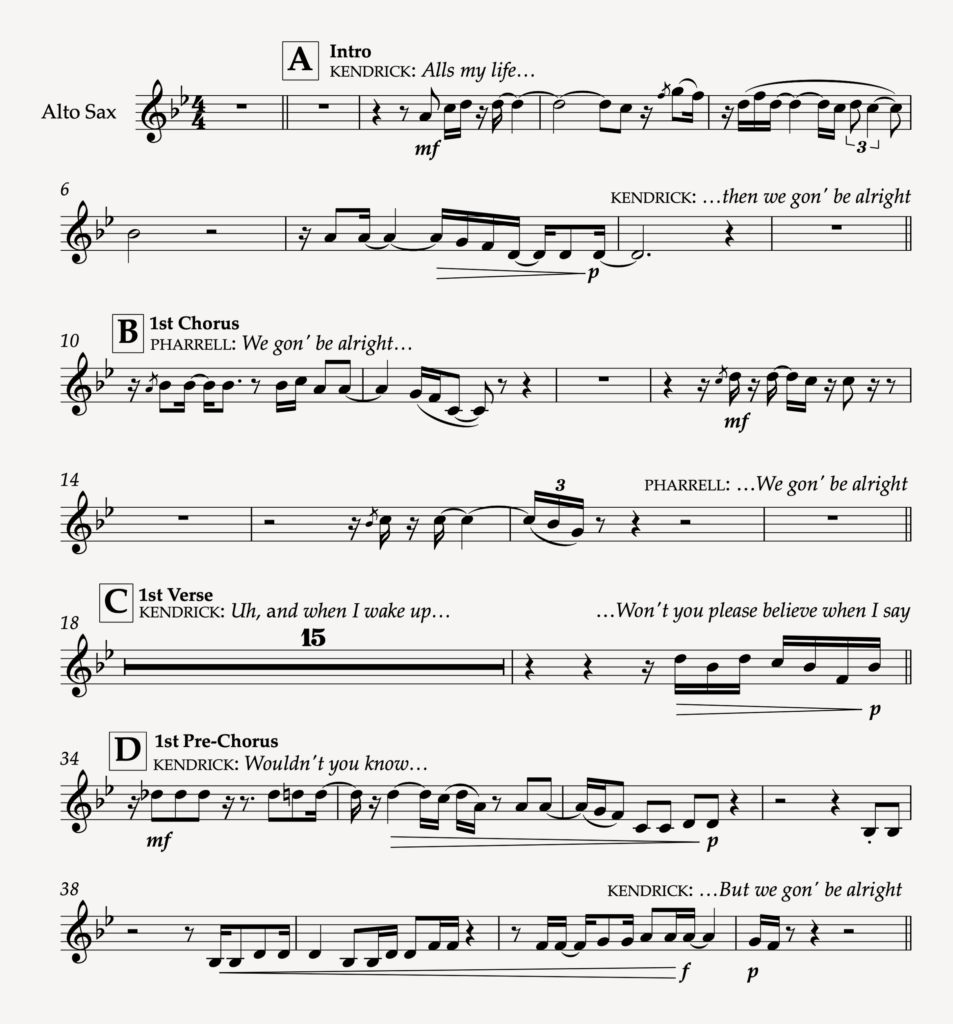
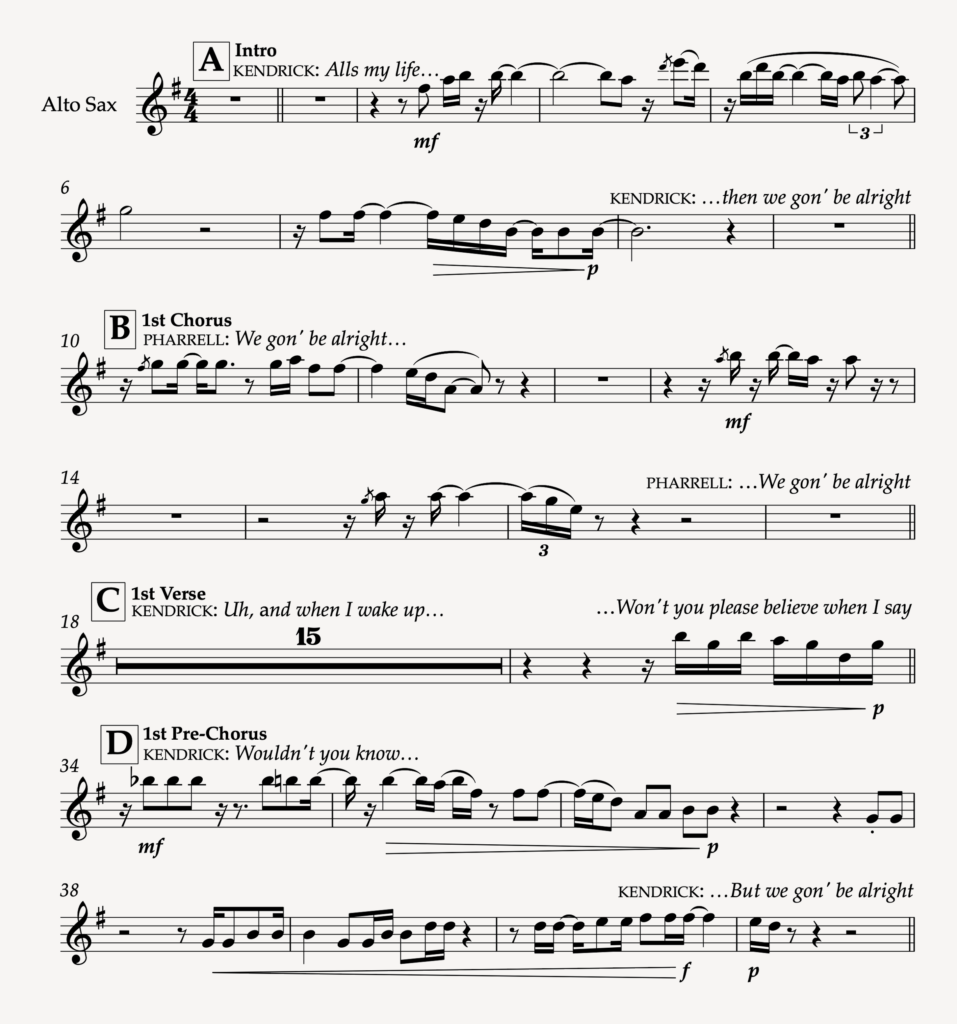
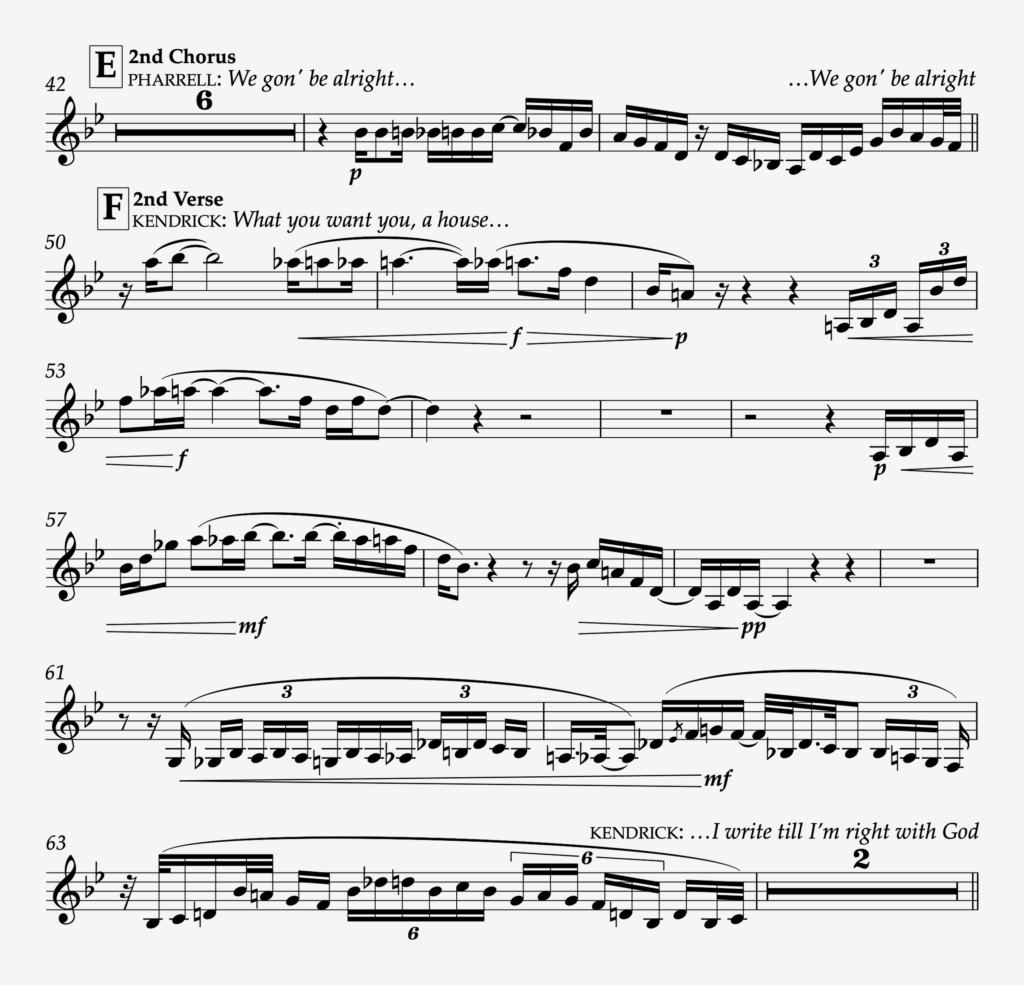
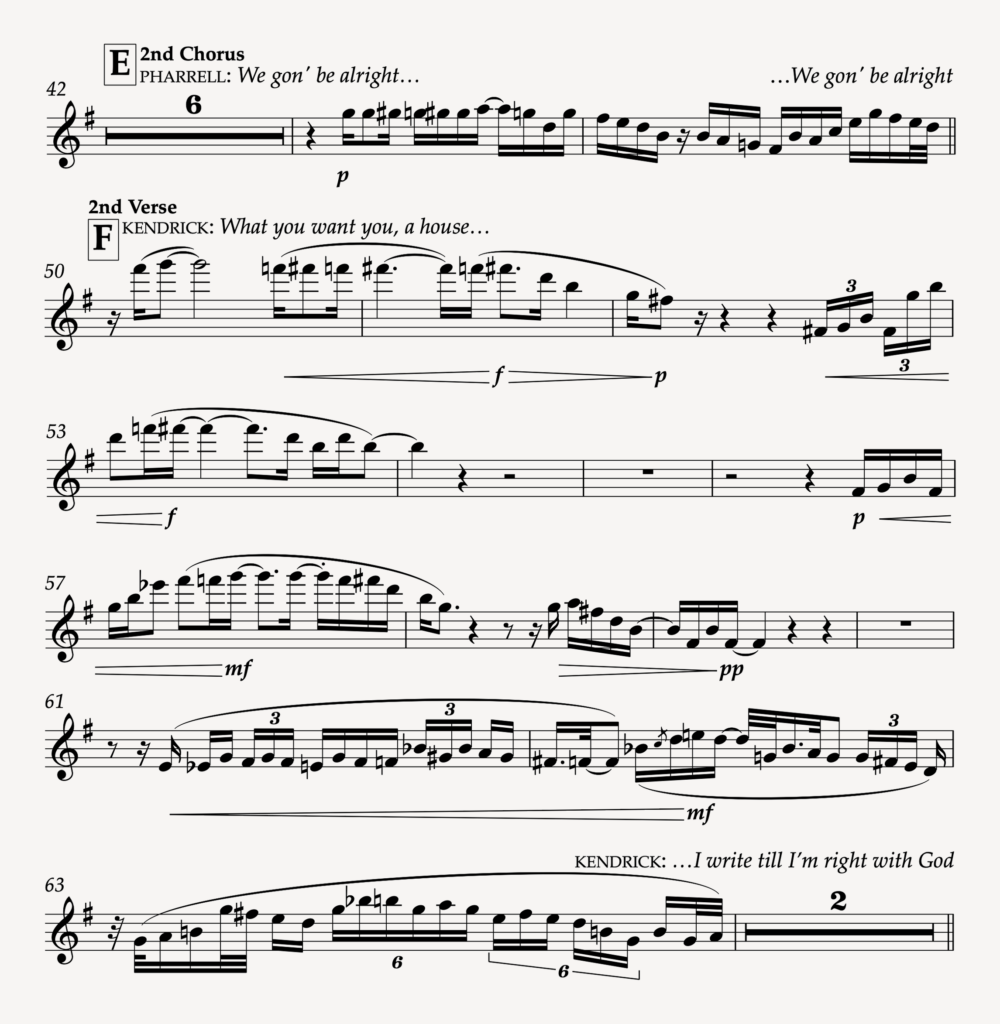
Transcribing jazz music is hard enough with all the ghost notes and swung rhythms, but writing out sheet music for improvised horn parts is about as easy as rollerskating through a funeral. Traditional music notation only gets halfway towards capturing what horn players do with their breathing, embouchure and fingering — how they subtly bend notes, alter the speed of their vibrato, increase and decrease their velocity, and shift the timbre from breathy to bright. Any transcription will always be a rough approximation, relying on expression markings and symbols to represent stuff that is largely intuitive.
Things don’t stay this way for long, however. By the end of the second chorus, Martin begins comping against Lamar’s voice, and his lines increase in rhythmic and harmonic complexity right as Lamar launches into his own virtuosic motifs in the second verse:
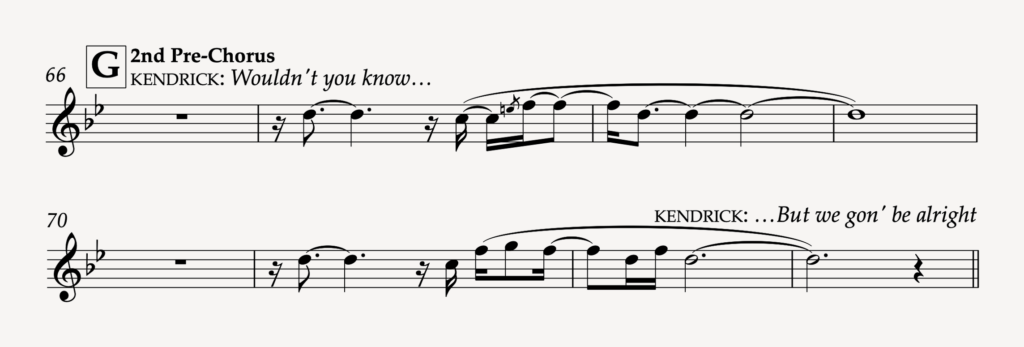
When the pre-chorus returns for a second time, Martin responds to Lamar’s message of perseverance with notes that sound like a plaintive cry, filling up the empty space left behind by the muted drums and bass:
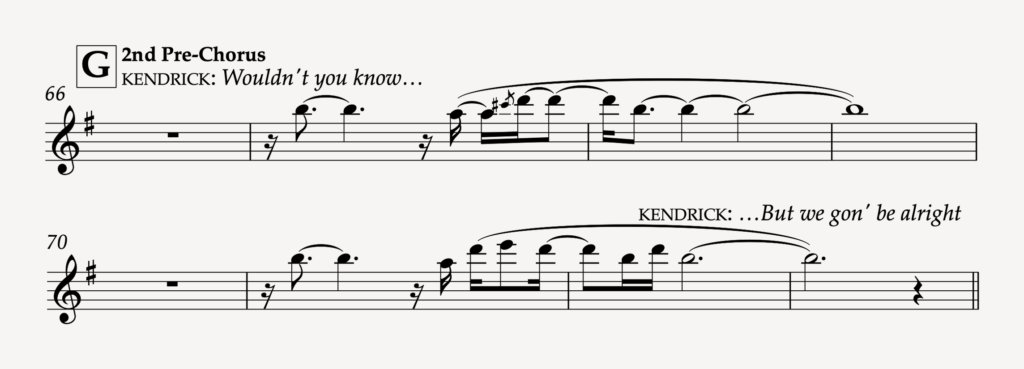
Eventually, by the final chorus, Martin is imitating the melodies and rhythms played by the other instruments and quoting his own earlier improvisations, creating the same feeling of closure you’d get from a quodlibet as the song reaches its conclusion.
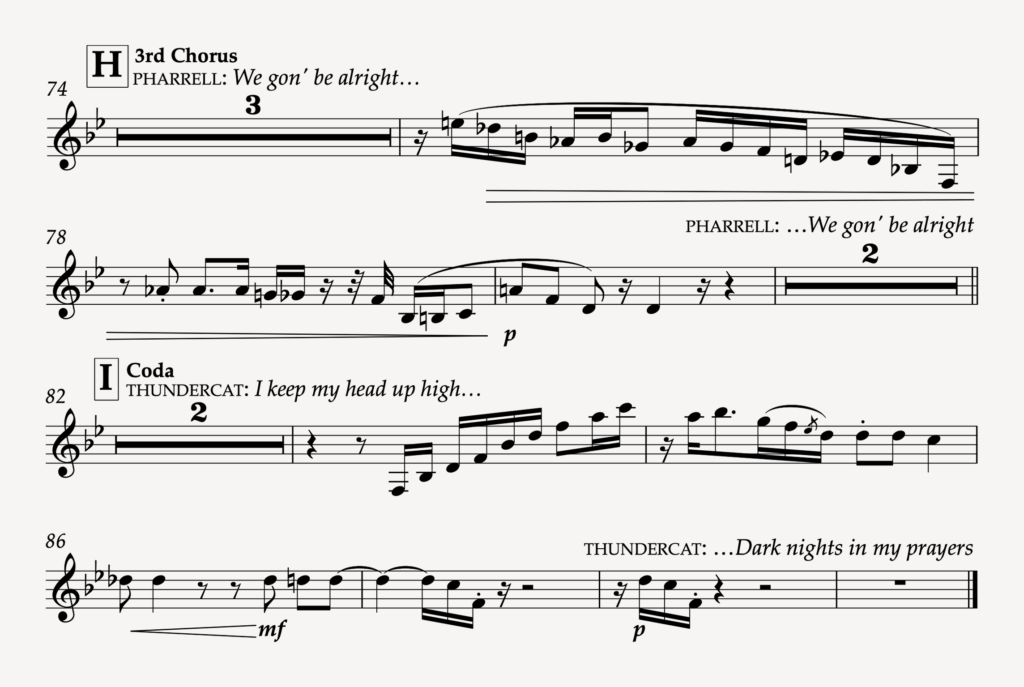
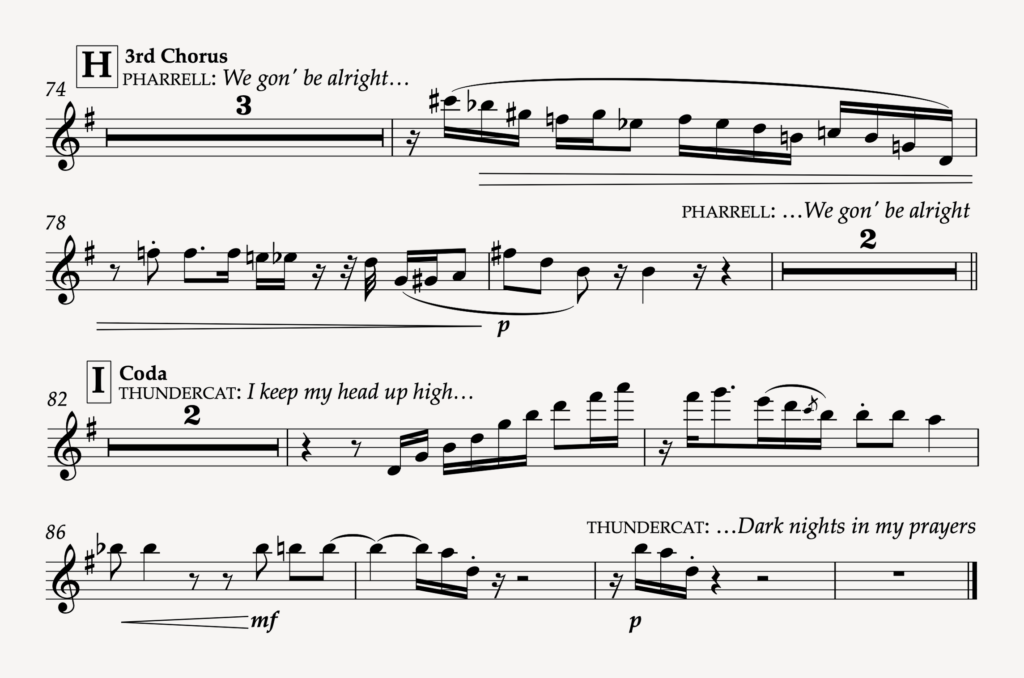
As with the sense of falling created by the vocal samples, there’s something about Martin’s alto sax playing here that places shackles on the song’s message of positivity. The two notes he keeps returning to on those longer passages of held notes (in the intro, second verse and both pre-choruses) are D and D♭, the 5th and ♭5th in the key of G minor. Since D♭ is both a tritone and the primary blue note in the minor blues scale, it keeps dragging the song back into dissonance and reminding us of those aforementioned tritone subs. And if we can engage in a bit of undergrad-level dot-connecting for a second, it could be argued that this use of the blue note acts as a subtle harmonic reminder of the blues genre and all the joy and suffering that comes with it — which is only fitting, given the way the album explores the debt current black American performers owe to the rich historical and cultural heritage created by their ancestors.
White noise and sub bass
Of course, the feature that really connects black music across the world isn’t harmonic at all; it’s percussion. And while “Alright” might not display the textural experimentation of Neptunes productions like “Drop It Like It’s Hot”, “Milkshake” or “Wamp Wamp (What It Do)”, it still shows the subtle rhythmic complexity that you’d expect from a former high school marching band drummer like Pharrell.
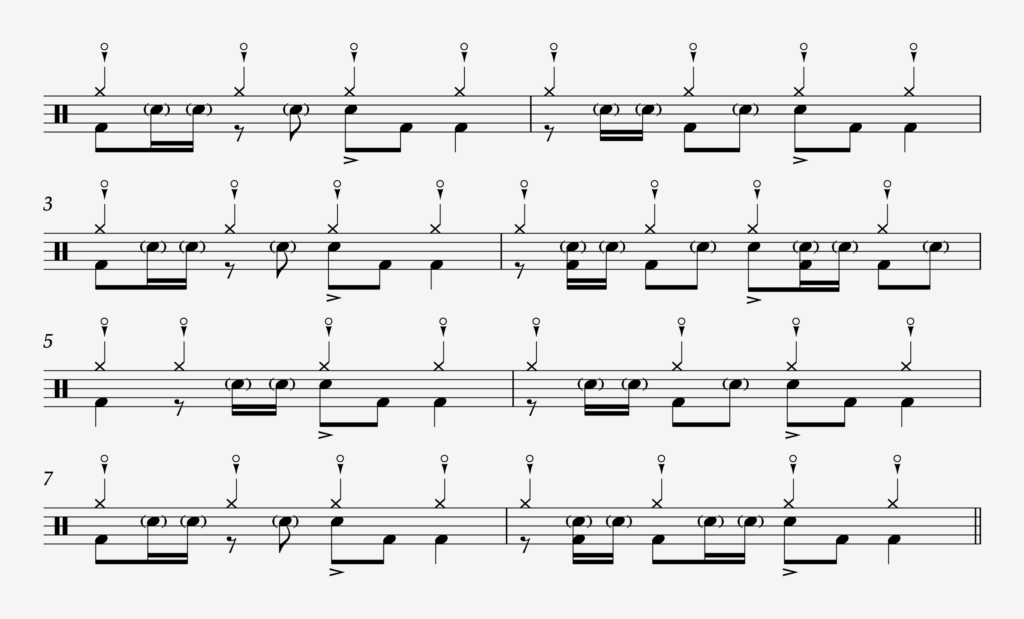
As Darren King (co-founder of Mutemath) points out on this episode of the Dead Wax show, Pharrell uses the familiar white noise of the hi-hat on the Roland TR-808 drum machine to anchor the rhythm, playing it in staccatissimo quarter notes and placing it up front in the mix while everything else around it is highly syncopated.6This kind of drum programming is one of the key features that makes hip-hop drumming distinct from other black American genres like disco and house, where the kick drum is usually played four-on-the-floor while the hi-hat is accented on the off-beats. The kick drum mirrors the syncopation of the Vocal Planet samples, only landing on the downbeat every two bars, and Pharrell relies on that classic trap music trick where the 808’s sine bass and kick drum double each other, so that every note from the bass attacks with a heavy thump. This is another thing that makes the song anthemic in a distinctly black and urban way: unlike Oasis’ “Wonderwall” or Toby Keith’ “Courtesy of the Red, White, & Blue (The Angry American)” “Alright” isn’t a song to belt out at the top of your lungs; instead, it’s perfectly calibrated for rumbling out of car speakers and sound systems during block parties and protests.
The snares, meanwhile, fill the space with ghost notes while only accenting every third beat of the bar, creating a rhythm than finds its pulse on the on-beats (i.e. the 1st and 3rd beats) instead of the traditional backbeat used in rock and R&B (which emphasises the 2nd and 4th beats). The snare sound on the 808 is famously high-pitched and spiky, and it became even higher on later versions of the drum machine; Pharrell makes use of both sounds in the pattern for “Alright”, playing the ghost notes on the higher snare before hitting the lower one on the 3rd beat of every bar. That accented note is also emphasised by having a shorter decay and release so that the note snaps, along with panning the sound across both ears and layering it with something that sounds like a rim click.
Dead precedents
Instead of sounding synthetic, all this programmed syncopation adds an element of swing and funk to what might otherwise be some bog-standard trap drums. But a big part of the song’s success comes from the production team simply ensuring that everything is well-balanced. Based on interviews, we can assume this is the handiwork of in-studio co-producer Sounwave and audio engineer James Hunt, given that they were working day-to-day on the album while Pharrell only delivered this one track. By comparison, if you listen to Fabolous’s original demo for the beat, title “Awwright”, it’s pretty notable just how thin and odd it all sounds when the drums aren’t high enough in the mix. In fact, Fabolous’s demo fo “Awwright” provides an interesting Bizarro World contrast to Lamar’s own song, since it’s evidence of how much the process of collaboration can lead people to think outside the box. While the bones of the song are there, it’s clear that the direction Fabolous takes it in is pretty pedestrian compared to what Lamar does with it.
Based on the fact that Fabolous doesn’t get songwriter credits on “Alright”, we can assume that Pharrell came up with the lyrical elements that are common to both songs, such as ending every other line in the pre-chorus with “nigga” and makin “we gon’ be alright” the refrain. It also justifies why Pharrell raps the refrain hinmself on the finished track, since it’s his most extensive contribution other than beat. Fabolous’s rapping, by comparison, simply can’t hold a candle to Kendrick Lamar’s. The Brooklyn rapper’s lyrics focus on getting rich and seeing the people who used to hate on you “acting like you owe” them. It’s the kind of crabs-in-a-bucket mentality that Lamar explores with more philosophical nuance on “Institutionalized” (the fourth track on To Pimp a Butterfly).
By comparison, Fabolous’s quickie video for “Awwright” simply reinforces the shallowness of this theme: it’s shot in black and white at an expensive apartment; he’s sitting on a white sofa in white clothes while wearing two gold chains, a heavy bracelet and an iced-out watch; and halfway through, the obligatory beautiful woman in a white dressing gown starts draping herself over him like he’s Caligula. You don’t need a degree in cultural studies to read the symbolism: he’s a rich dude who doesn’t have to worry about the cost of laundry or dry cleaning and can afford a cleaner, so why not get everything in white? After all, he’s made it. Of course, this symbolism has the unintended effect of creating an uneasy correlation between success and whiteness — the polar opposite of the blackness that Lamar emphasises in the lyrics and video for “Alright”. Frankly, it’s embarrassing that Fabolous ever released the demo; watching him piggyback off the success of “Alright” with “Awwright” is a bit like seeing an overenthusiastic kid seeing Steph Curry shoot a three-pointer, trying to copy him, and failing to throw the basketball anywhere even near the hoop.
The other precursor to “Alright” is Rick Ross’ “Presidential”. We can spare Ross from the same degree of criticism since he actually released his song before Lamar. In addition, the songs come from the same factory rather than being cut from the same exact cloth; to be exact, Pharrell employed an adjacent set of samples in the Vocal Planet collection, labelled “Dah-Dat Guys”, to produce “Presidential”. In fact, he’s clearly so enamoured with their unadorned sound that he begins both songs in a similar fashion.
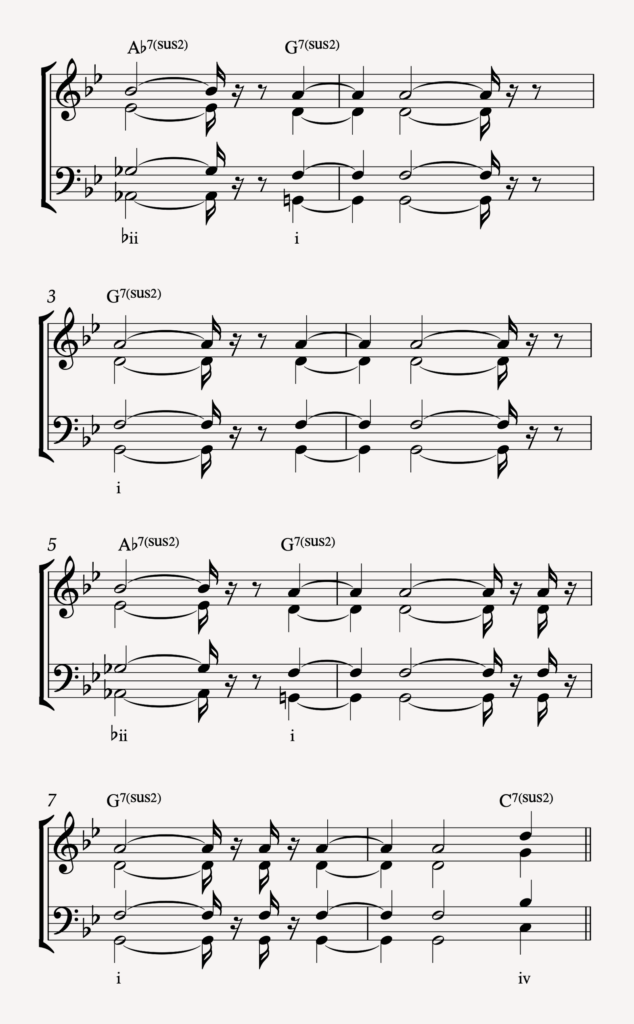
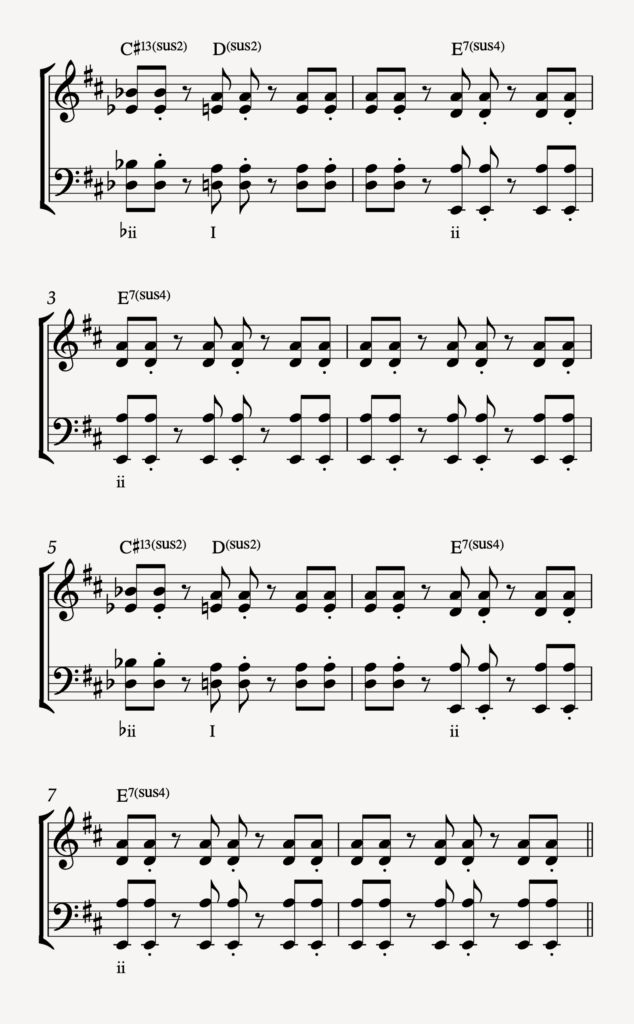
“Presidential” was on Ross’s 2012 album, the beautifully titled God Forgives, I Don’t; you can see a behind-the-scenes video of Pharrell playing it for Ross here. In between all their blunted cod-philosophy, there’s a moment where Ross specifically decides that the song needs to start with the vocal sample played acapella, exactly as Pharrell played it to him. This is, essentially, the common allele between “Alright” and “Presidential”. But while they’re texturally similar, if we place the progressions of these vocal harmonies side-by-side, it should be clear that they have less in common than it might appear at first.
Alright
Presidential
Just for fun, here’s a clip of both of them being played simultaneously; I’ve created a temporal détente at 97 BPM by dragging “Alright” down from 110BPM in the left ear and pulling “Presidential” up from 85 BPM in the right ear:
Some aspects that they do share include:
- consisting entirely of suspended chords
- opening with a tritone substitution that resolves to the tonic chord
- lingering on a single chord for most of the progression
- creating syncopation through additive rhythm (i.e. shifting around our sense of the downbeat by grouping different beats together)
On that last point: the rhythmic groupings in “Alright” are in quarter notes over the course of two bars of 4/4 time in a configuration of 3 + 2 +3 (giving us 8 quarter notes against 8 beats), while the groupings in “Presidential” are in eighth notes over just one bar of 3 + 3 + 2 (giving us 8 eighth notes against 4 beats).
Alright
Presidential
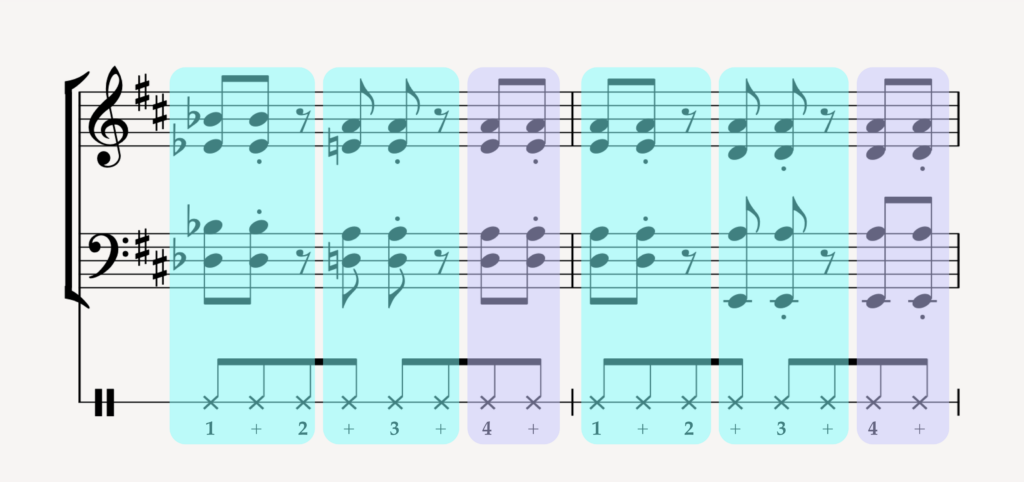
For more information on the use of additive rhythm in this song, take a look at Noriko Manabe’s exhaustive essay, where she spends almost 5,000 words in one section arguing that the song ambivalently uses an additive rhythm of either 3 + 5 or 3 + 2 + 3, and that this is representative of the song’s ambivalent themes as a whole. While I generally agree with Manabe’s analysis, the mixed metre of her sheet music and diagrams ends up feeling completely adrift from the pulse that beats beneath hip hop culture, so I’ve chosen not to entertain those ideas here. Still, game recognise game when it comes to being a nerd standing at the nexus of musicology and linguistics.
Once the other instruments kick in after those opening four bars of acapella, it’s clear how much of a different beast “Presidential” is, full of bass guitar, muted drums, ad-libs and vocables creating a funky syncopated rhythm. Even though they probably feature a similar number of instruments “Alright” feels almost minimalist by comparison, with the sub bass and vocal samples providing plenty of room for Lamar’s intricate patterns.
Ambient ambiance
Given the continuity betwee “Presidential” “Awwright” an “Alright”, it’s worth noting that Pharrell doesn’t get sole producer credit on the song; Sounwave (Mark Anthony Spears) is also listed in the liner notes. On Alex Pappademas’s podcast “The Big Hit Show”, Sounwave acknowledged that when they first heard the demo for “Alright”, it sounded out of step with the jazz-influenced sound of rest of the album: “But we loved that record so much that I said, okay I’m not letting this record die”. The crew’s initial hesitation towards “Alright” highlights the fact that To Pimp a Butterfly was clearly devised as a cohesive artwork, yet their willingness to keep working on it reflects the way that Lamar and his contributors were willing to push the boundaries of black American music rather than treating each genre as a distant island.
To make the song more congruent with the rest of the album, the producer asked Terrace Martin to put together his saxophone part while Sounwave slipped in three elements that almost feel subconscious on the first few listens. The first and easiest one to hear is the synth brass patch, playing two-eighth note phrases a semitone apart and leaving plenty of space in between for the notes to echo in the distance. The second, less obvious one would be the synth effect that marks the final two measures of every eight-bar loop by sweeping up into the high frequencies as if it’s the sky opening up to inhale everything. And the third, least audible element is the vox patch that plays three notes with such a slow attack and release that they seem to drift in and out of everything else.
If you listen to these elements on their own, they sound like a demo for a piece of ambient music. But in the context of the song, they add the illusion of depth and space, contrasting with the dry, compressed sounds of the other instruments.
Fill in the blank
Despite this, Sounwave’s most prominent and memorable addition to the song, comes in the form of a simple drum fill, sampled from the first bar of “Flowers of the Night” by Jefferson Airplane members Grace Slick, Paul Kantner, and David Freiberg.
It’s a simple yet transformative decision. Throughout the song, Lamar uses his voice like a drummer, often crafting motifs and emphasising phrases by raising his volume and pitch in a style that’s exactly halfway between percussive and melodic. The sample from “Flowers in the Night” often highlights this fact, seeming to mimic his rhythm — so it’s worth breaking down the song section-by-section to get a sense of how this interplay between lyrics and music works.
↓
The song starts out deceptively, as if Lamar is still lagging behind at the slower tempo of “u” while the vocal samples of “Alright” come rushing in at 110 BPM. He achieves this effect by repeating a motif of hemiolas, creating a polyrhythm of 3:2 (three notes played in the space of two quarter notes) that feels as if it’s dragging against the beat and tempo.
INTRO
Kendrick Lamar
Alls my life, I has to fight, nigga
Alls my life, I—7Alls my life, I has to fight, nigga Alls my life, I—: These opening lines are an allusion to Alice Walker’s The Color Purple, a novel set in the Jim Crow era. They come from a speech given by Sofia who explains to the protagonist, Celie, that she has put up with abuse from men throughout her childhood and refuses to allow her new husband, Harpo, to beat her. The speech deeply affects Celie, who is herself being abused by her husband, Mister — who is also Harpo’s father and the man who advised him to beat Sofia in the first place. The rest of the novel explores the journey of both women as they face the impact of these experiences over the rest of their lives. Lamar’s allusion is designed to draw a link between the experiences of these fictional women and the historical adversity experienced by black Americans, in the same way that Walker wrote the novel to draw wider attention to these underrepresented stories in American culture. However, it’s worth noting that Lamar adds a more archaic nonstandard conjugation to the novel’s use of Black American English (BAE), since the original statement is “All my life, I had to fight”. There are two possible reasons for this: maybe he simply misremembered the phrasing from the book or the film; however, it could also be an intentional choice to highlight the nonstandard nature of BAE, since the real quotation would be entirely in standard English if the key words aren’t conjugated a “alls” an “has”. Either way, it is a confrontational statement, and his addition of “nigga” at the end of it turns it into a hybrid utterance, where the antiquated BAE brushes up against the modern BAE, reinforcing the link between the historical experiences of black Americans and the present.
Hard times like, “Yah!”
Bad trips like, “Yah!”8Hard times like, “Yah!” / Bad trips like, “Yah!”: “Bad trips” is being used in a polysemic way here, since it is literally used to refer to bad journeys while colloquially referring to bad drug experiences. In the former sense, it could refer to the mass migrations experienced by black Americans in the form of the Altantic slave trade (from West Africa to the United States), or the Great Migration (from rural Southern states to cities in the urban Northeast, Midwest, and West). By comparison, in the latter sense, it might refer to the proliferation of drugs like heroin and crack cocaine which have disproportionately affected black Americans. In both cases, these are negative experiences in the history of black America that Lamar seeks acknowledge while forging a more positive path forward.
Nazareth9Nazareth: Nazareth was the hometown of Jesus, and we briefly get a sense of its reputation in John 1:46 when a man named Nathanael asks “Can anything good be from Nazareth?” before he meets Jesus and eventually becomes one of his early disciples. The use of the place-name here is intentionally ambivalent; through the context of this Bible verse, it implies there is a similarity between Nazareth and Compton in terms of being places that outsiders view negatively based on reputation rather than first-hand experience. It also draws another parallel between Kendrick and Jesus, suggesting that the rapper continues to see himself as a Messianic figure at this point. If we choose to interpret this positively, we could see the song as an attempt to return to his hometown and reassure them that things will work out well in the end despite the cultural and socio-economic pressures they face. However, if we ignore the Messianic imagery, it could also be seen as a kind of invocation by Kendrick, who is attempting to overcome the self-destruction he experienced in “u” by focusing on the teachings of Jesus and using his Christianity as a foundation for resilience, charity and empathy.
I’m fucked up, homie, you fucked up10I’m fucked up, homie, you fucked up: This is a callback to the state that Kendrick is in at the end o “u”. On that song, Lamar projects the image of a drunk and depressed Kendrick by rapping in a tearful tone, while we occasionally hear Foley effects of clinking bottles and liquor being poured. Much like the sinner’s prayer that appears at the end of Good Kid, M.A.A.D City, the mention of being “fucked up” sees Kendrick finding empathy with others by recognising how we are all in a bad state.
But if God got us, then we gon’ be alright11But if God got us, then we gon’ be alright: Notably, the pronouns in this intro shift from the first and second-person singular (“I” and “you”) to first-person plural (“we”). This grammatical shift also marks a shift in discourse, moving away from the self-criticism of “u”, where Kendrick uses direct address to attack himself. In contrast, the plural pronouns of “Alright” indicate that he’s found a temporary solution by choosing to focus on what he can do for black Americans as a whole. This is also reflected in how the audience of these utterances changes too; unlike “u”, almost every second-person pronoun in the song from this point onwards is direct outwards, often towards a generic “you” or plural “y’all”.
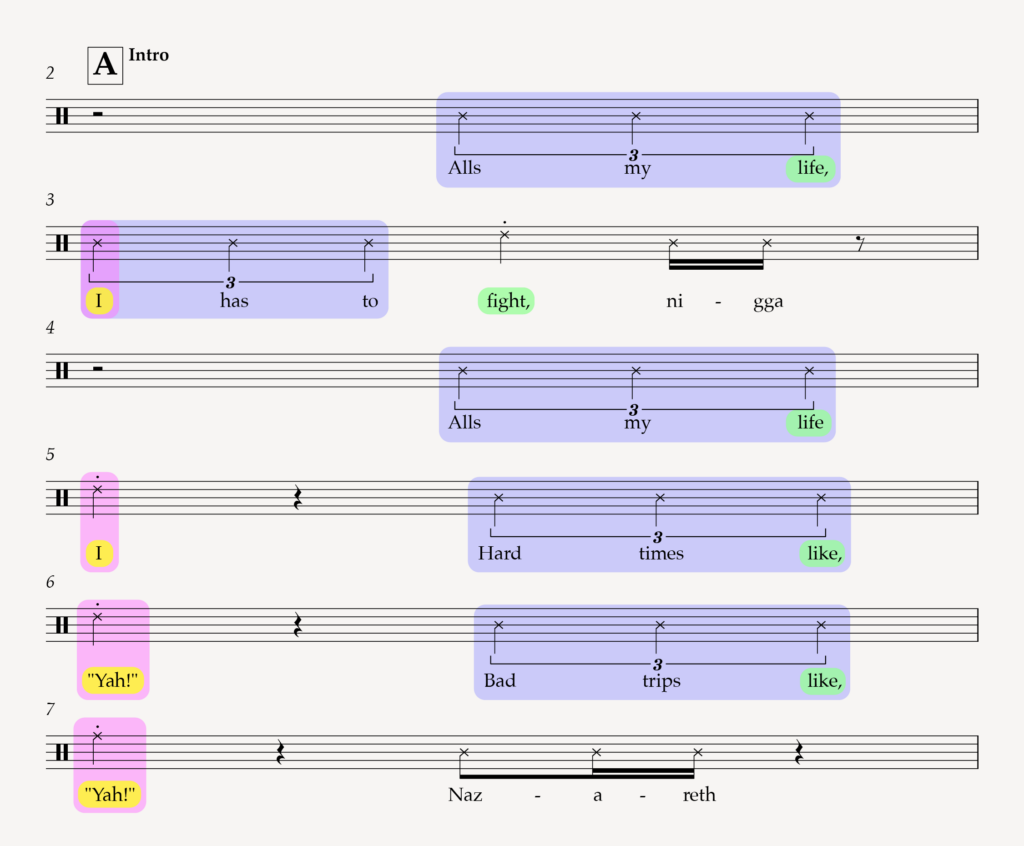
This polyrhythm dovetails with the album’s focus on the ancestral heritage of black Americans, since both Sub-Saharan African music and jazz use cross-rhythms as their basic pulse. But it’s clear that he won’t stay at this pace for long, since Lamar lands on each downbeat an exclamation, connecting them the oblique rhymes of “I” with “Yah!”. Finally, on the symbolically significant shout-out to “Nazareth”, he drops the hemiola and switches up the flow in lock-step with the song’s common time using metric eighth notes.
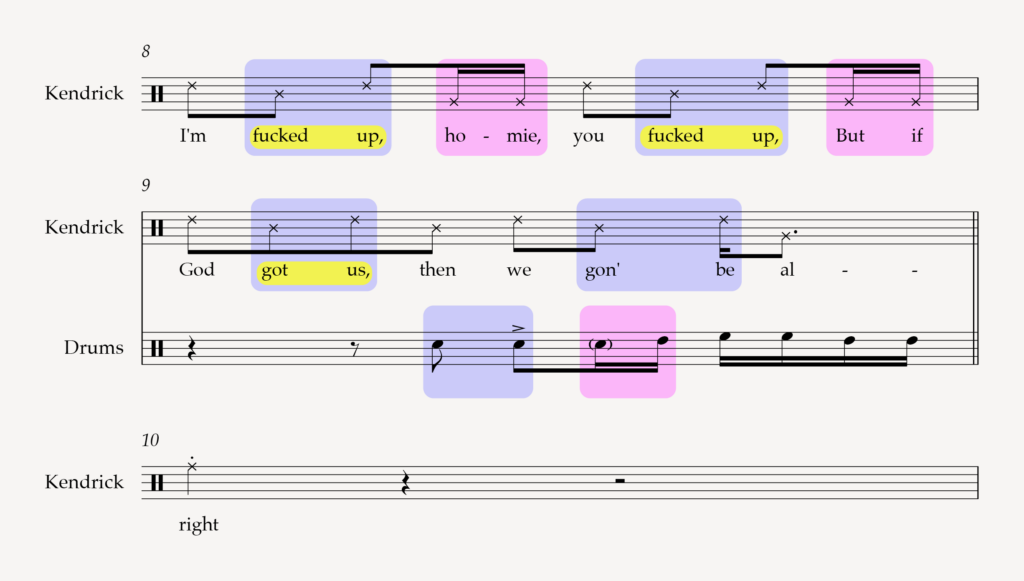
As part of this acceleration, Lamar shifts the emphasis to the first offbeat and second onbeat of each bar with a repeated motif of “I’m fucked up”, “You fucked up” and “God got us”. This motif only takes up two beats rather than the four-beat motif that preceded it (“All my life I”, “Hard times like ’Yah!’”, “Bad trips like ’Yah!’”), adding to the sense that he’s picking up the pace. The rhythmic symmetry between the three phrases also highlights the way his pronouns shift from the personal “I” and “you” to the communal “us”, suggesting that this song — with its faster tempo and community focus — will see him moving on from the self-destruction o “u”.
However, once this motif has been established, he subverts it: where we might expect a fourth rhyme that matches “up” and “us”, the rhythmic motif instead repeats on “we gon’ be”, leaving an incomplete phrase and a hanging tension. This feeling of suspense is also emphasised in the way that Lamar copies the opening snare hits in the drum fill from “Flowers of the Night” by imitating their pitch and rhythm, providing the kind of call-and-response commonly used by jazz drummers when comping beneath melodic improvisation. Of course, it’s probably the case that Lamar reverse-engineered this moment of synergy after hearing Sounwave add the drum sample by working out the rhythm then writing his lyrics to match it, but the result’s the same: it highlights the way that Lamar weaves his voice into the fabric of the music by writing for it like another instrument.
Still, we don’t have to wait long for the cadence, since the word “alright” falls on both sides of the bar-line, with the second syllable landing on the downbeat, forming a delayed perfect rhyme with “fight” and locking in with the arrival of all the other instruments. This naturally throws us into the chorus, where the rest of the bar is picked up by Pharrell, like a basketball finally being passed after two pump fakes. Honestly, it’s a masterclass in how to write an intro. On one hand, it pulls the same trick as classics like Meek Mill’s “Dreams and Nightmares” and UGK’s “International Players Anthem (I Choose You)”, opening with Lamar rapping over a trebly backing while we wait for the beat to drop. But Lamar’s off to the races in the time it takes for those songs to just rev their engines, and by the time the beat kicks in, we’re ready for it.
CHORUS
Pharrell Williams
Nigga, we gon’ be alright
Nigga, we gon’ be alright
We gon’ be alright
Do you hear me, do you feel me? We gon’ be alright
Nigga, we gon’ be alright
Huh? We gon’ be alright
Nigga, we gon’ be alright
Do you hear me, do you feel me? We gon’ be alright
As the hip hop artist and educator Mazbou Q points out in this lecture, rappers tend to work in four-bar phrases,12Mazbou Q’s preferred term for this is a four-bar cadence, but he appears to be referring to a phrase — a combination of smaller melodic or rhythmic motifs that add up to form a distinct unit. The problem with stretching the definition of cadence is that, in music theory, it specifically refers to the sense of closure that comes from the arc of a rhythmic, melodic or harmonic phrase. In other words, a phrase can contain a cadence, but a cadence can’t contain a phrase. While some books on rap theory (like Paul Edwards’s How to Rap or Adam Bradley’s Book of Rhymes) seem to diplomatically conflate flow, rhythm and cadence in the same way that rappers do, I’d rather restrict the meaning of these terms to ensure that we always know what we’re pointing at when it comes to analysing something as complex as To Pimp a Butterfly. and it’s no exception here: Lamar’s rhythms and rhymes on “Alright” naturally break each 16-bar verse into quadrants.
1st VERSE
Kendrick Lamar
Uh, and when I wake up
I recognize you’re looking at me for the pay cut13Uh, and when I wake up  . . .  for the pay cut: Lamar connects his own experiences as a commercially successful rapper with those of other black Americans by implying that the institutional figures above them are only interested in receiving a “cut” of their profits in the form of penalties, fees, taxes and so on. However, the phrase is also applied in a polysemic way, since black workers are more likely to receive a “pay cut” by being first in the firing line for unemployment. Moreover, people engage in conspicuous consumption, spending a “cut” of their “pay” on products that only enrich corporations and those in power, thereby continuing the cycle of poverty.
But Homicide be looking at you from the face down14But Homicide  . . .  the face down: “Homicide” here refers to detectives in the police force who investigate murders. The pronou “you” shifts from denoting to those in power to being directed towards black Americans. The symbolic image of a person lying “face down” and unidentified while detectives look at their body is a reminder of just how often the murder of black Americans is underrepresented and how crime in these communities is reported in a way that dehumanises black people.
What MAC-11 even boom with the bass down?15What MAC-11 even boom with the bass down?: A MAC-11 is a submachine gun. While the stereotypical image of violence in South Central L.A. (as depicted in Grand Theft Auto: San Andreas) is one of rival gangs delivering drive-by shootings with submachine guns, the reality is that it is a largely ineffective form of attack, often used by gangs for intimidation rather than targeting individuals, and it usually leads to innocent bystanders getting shot as collateral damage. The MAC-11 in particular has a highly inefficient rate of fire, and is so loud that it’s often fitted with its own specific suppressor. Lamar uses this irony to ask a rhetorical question that roughly means, What gun still makes a loud noise even when it’s being suppressed? This question can be seen as signifying the extent of police brutality, since the suppressive blue wall of silence among police officers just serves to amplify their antagonistic relationship with black Americans. However, the line could also be interpreted to mean: Does a gun still make a loud noise if it’s suppressed? While this sounds similar, it has different implications, asking whether the murders of innocent black civilians still have an effect on America’s psyche if white people already disregard or deny the reality of their experiences.
Scheming,16Scheming: The brief interjection of this word is a reminder that there has historically been collusion between different institutions and individuals throughout American history to perpetuate unfair advantages for white Americans, including things like redlining, Jim Crow laws, voter suppression and gerrymandering. and let me tell you ’bout my life
Painkillers only put me in the twilight
Where pretty pussy and Benjamin is the highlight17and let me tell you  . . .  Benjamin is the highlight: One-hundred-dollar bills are colloquially referred to as Benjamins because each note features Founding Father Benjamin Franklin on its obverse side. Kendrick acknowledges that — despite the social issues outlined in the first four bars of the verse — he has sought out drugs, women and money as a form of escapism. Since Lamar is teetotal, it’s hard to read this biographically: he’s more likely either narrating from the generic viewpoint of a heterosexual black American man here (alluding to the countrywide opioid epidemic), or referring to his younger self, as depicted on Good Kid, M.A.A.D City.
Now tell my momma I love her, but this what I like, Lord knows18Now tell my momma  . . .  Lord knows: While this might seem like a throwaway line, the mention of “momma” links to the song of the same name which appears two tracks later on the album and sees Kendrick beginning his journey of self-actualisation by returning to the black motherland of Africa. It could also link to Good Kid, M.A.A.D City, where the main narrative ends with the character of Kendrick’s mother telling him to “tell your story to these black and brown kids from Compton” and “give back with your words of encouragement” on the son “Real”. The line in “Alright”, by comparison, suggests that he is too hedonistic at this point to engage with the wisdom of these maternal figures, and the addition of the idiom “Lord knows” at the end of the line reinforces this idea by implying that while Kendrick has retained his faith in God, he isn’t yet ready to account for his sins. Yet it also implies that God knows all about his sins; as it states in Hebrews 4:13 “there is no creature hidden from His sight, but all things are open and laid bare to the eyes of Him to whom we must answer”. “Lord knows” also appears to be an allusion to the 2Pac song of the same name, where Pac explains how he's self-soothing with drugs, money and women, reinforcing the affinity between Lamar and Shakur as young rappers struggling to make sense of their fame — a theme that will be made more explicit at the end of the album on "Mortal Man".
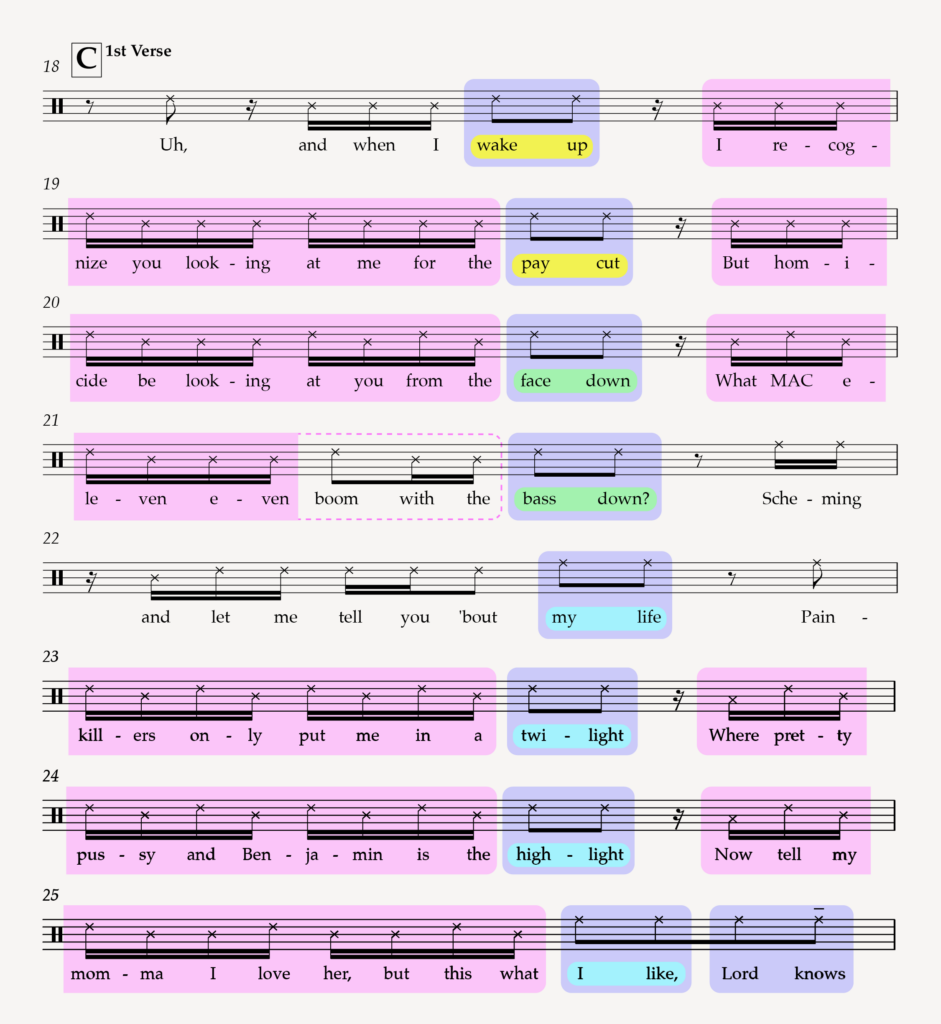
The first half of the verse features a flow that is unmistakably indebted to 2Pac — Kendrick’s father figure in the family tree of black American icons that Lamar alludes to throughout To Pimp a Butterfly. Like Pac, Lamar emphasises the metronomic pulse of each bar in the first quarter of this verse by stressing those syllables as if he’s playing four-on-the-flooor (I recognize you looking at me for the pay cut). But the real genetic marker of Pac comes in the way that Lamar places the cadence of each line in the middle of the measure with a spondee — an effect that he doubles down on by choosing to end with consonant sounds,19I’m using the linguistic definition of consonant here, which refers to a speech sound that involves closing the vocal tract. Try to forget about the silly definition that we were all taught in primary school, where it’s used to refer to letters that aren’t a, e, i, o or u — it’s one of those heuristics that makes less sense the longer you look at it. which makes it feel as if you’re being hit with a one-two combo.20In one of his short-form videos, Mazbou Q highlights the way Lamar consciously borrows this flow from 2Pac on “reincarnated”, his homage to the rapper from the album GNX. Since nothing exists in a vacuum, it’s worth remembering that GNX was part of Lamar’s victory lap at the tail end of his feud with Drake, and that Drake inadvertently made it clear just how distinct Pac’s flow is when he masked his own voice with AI to sound like Pac on his “Taylor Made Freestyle”. The Toronto rapper’s asymmetrical cadences fit Tupac’s voice about as well as a two pairs of gloves fit on O. J.’s hands. Lamar, by comparison, sometimes sounds like Pac even without the use of AI. And while “reincarnated” is more overtly intertextual about the debt Lamar owes to Pac — being built off a sample from his own “Made Niggaz” — the rapper’s influence is so deep in Lamar’s bones that there’s a good chance he didn’t even consciously invoke it here. This sense of Kendrick being a boxer is further emphasised in the way he switches from an AABB rhyme scheme in the first quarter to a CCCC rhyme scheme in the second quarter, as if he’s landing successive jabs in the same place. All of this neatly reinforces the idea that Lamar expresses in the song’s intro: that he — and Sofia from The Color Purple (who the line alludes to) and all black people (metonymically speaking) — have to “fight” to get by in America.
The third quarter, by comparison, sees Lamar employing the same kind of motific approach used by choppers like Eminem and Twista, creating a rhythmic propulsion that will be echoed in the poem that plays after the song, where Kendrick tells us that he wen “running for answers”. While the first half of the verse feature rhymes that uniformly land on the third beat (see above), Lamar uses these four bars to introduce a more complex approach to rhythm and rhyme.
1st VERSE
Kendrick Lamar
Twenty of ’em in my Chevy
Tell ’em all to come and get me21Twenty of ’em  . . .  come and get me: Based on the lines that come before and after it, the contracted pronoun “’em” here appears to refer to the demons that are metaphysically following Kendrick for his materialism, and the imperative command for them to “come and get” him is an example of how this unsustainable hedonistic path will lead towards self-destruction. By comparison, in the poem excerpt at the end of the song, a more mature Kendrick, speaking in the past tense, acknowledges that he actually “didn’t want to self-destruct”. The “Chevy” is also important, since the Chevrolet Impala has an iconic status in the lowrider culture that originated in Southern California, where Lamar grew up. Kendrick implies that he’s driving around in the car, suggesting that he is stunting — engaging in self-serving conspicuous consumption that only highlights his privilege compared to the kind of people he grew up with (such as the friend from back home who planned to steal from celebrities at the BET Awards in “Institutionalized”). By extension, the imperative for the unnamed them to “come and get” him could alternatively suggest that this is an immature version of Kendrick acting ostentatious and taunting people to carjack him, since he just sees these people as haters rather than victims of intergenerational and institutional inequality.
Reaping everything I sow
So my karma coming heavy22Reaping everything I sow / So my karma coming heavy: Lamar alludes to Galatians 6:7 here: “Do not be deceived, God is not mocked; for whatever a person sows, this he will also reap.” This adds another layer to the interjection of “Lord knows” at the end of the lines about “pretty pussy and Benjamin”, since it suggests that Kendrick will experience divine retribution for his hedonism if he doesn’t change his ways. The idea of a sinful soul bein “heavy” links to the imagery of souls being weighed by the Archangel Michael upon entering Heaven, implying that Kendrick has committed many sins. He draws an analogy between this Christian concept and the similar Indian concept of karma, which is often presented in Western culture a “what goes around comes around” — a proverb that seems to have originated in black American churches. The homophonic pun between “sow” an “so” reinforces this link by linking a verb that denotes planting seeds to a subordinator that implies causality. Finally, the pace of Lamar’s rapping on the phrase “my karma coming heavy / no” leads to what linguists call an ambiguous juncture, since the word “heavy” joins onto the next consonant and ends up sounding like “heaven”. While this might merely be a mondegreen, it reinforces the sense of Kendrick as a sinner even further, since the concept of karma is then directly related to the notion that people will be judged for their sins in the afterlife. The definition of karma as "reaping everything I sow" might also be a subtle reference to the band Karma, whose song of the same features the chorus "Karma means reap what you sow". The keyboardist for the band, Reggie Andrews, created the Multi-School Jazz Band that provided the breeding ground for many of the L.A. jazz musicians who feature on To Pimp a Butterfly, including Terrace Martin, Kamasi Washington and Thundercat.
No preliminary hearings on my record
I’m a motherfucking gangster in silence for the record, uh23No preliminary hearings  . . .  silence for the record, uh: Under the American legal system, a preliminary hearing is sometimes required for a judge to determine whether there is enough evidence for the case to go to trial. However, in the state of California, preliminary hearings are only required for felony cases. Kendrick calls himself “a motherfucking gangster”, so the fact that he has “no preliminary hearings” implies that he’s chosen to waive this right when being tried for felony crimes, since doing this prevents the prosecution from discovering further evidence that could lead to other charges; in other words, he’s avoiding incriminating anyone else and maintaining the traditional code of silence among gangsters. This idea is reinforced by the mention of “silence for the record”, since avoiding a preliminary hearing means other criminals involved won’t have to testify. It also suggests that Kendrick himself is pleading the fifth — declining to answer questions as a defendant since the answers might incriminate him or others. Again, this isn't necessarily biographical: although Lamar grew up around Pirus and other gang members, he doesn’t appear to have any adult criminal record, so these lines can be interpreted either as a form of kayfabe within the album’s narrative or as another example of Lamar writing from the generic viewpoint of a black rapper who cares about his reputation in the hood.
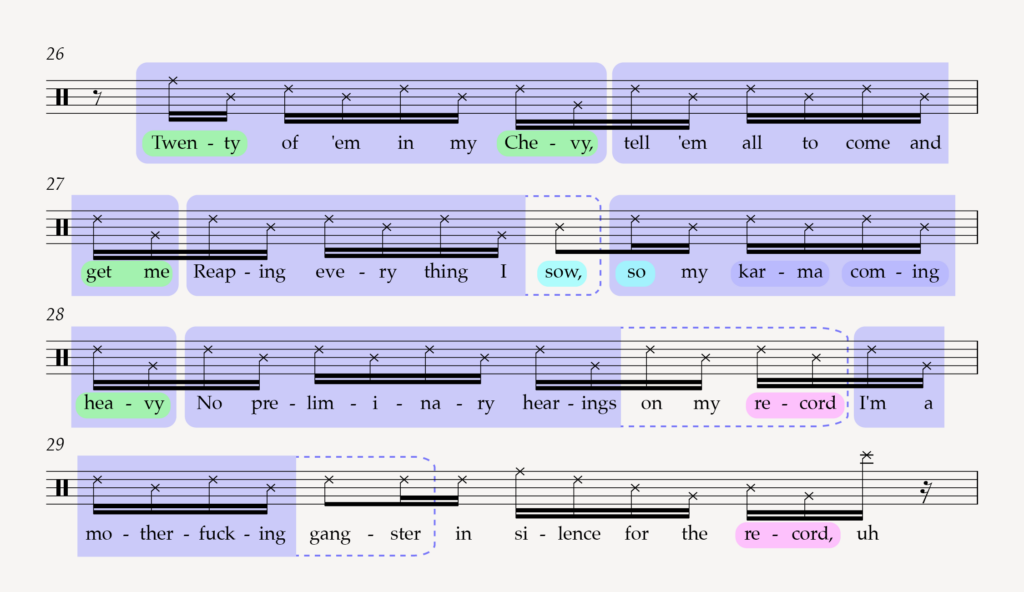
He leads into this section by holding a tenuto on the phrase “lord knows” before opening the bar with a eighth note rest, providing just enough space for the listener to prepare as he launches into a run of sixteenth notes that, through this displacement, leads to him starting each motif on the offbeat and landing his rhymes on the first beat of each bar (with “Chevy” and “get me”). But just as he did in the intro, Lamar subverts this structure as soon the pattern starts to become familiar by substituting the fourth rhyme in the chain. In this case, he switches to an unrelated homophonic rhyme betwee “sow” an “so”, and he highlights this displacement by stressing the word “sow” for an eighth note. This momentarily breaks up the pattern of sixteenth note syllables, and even though he brings it back for the words that follow it, he still continues to delay the fourth rhyme in the chain, instead providing an alliterative rhyme between “karma” an “coming”. Then — after half a bar of deviations — he finally provides us with the fourth rhyme we were expecting by landing on the word “heavy”.
Of course, this only covers two of the four bars. The rapper closes out the remaining measures with two more entwined flourishes: he creates a homonymic rhyme betwee “record” (in the sense of a criminal record of previous convictions) and “record” (in the sense of a song or album), while also punning on the colloquial meaning of “silence for the record” (invoking the right to not answer incriminating questions) by ending the second half of the bar rapping a capella while all the other instruments are temporarily muted — thereby leaving silence on the record. Lamar employs a particularly percussive melodic arc, with his pitch on “silence for the record” sounding like a fill that moves across the toms before, ending on the bell-like interjection of “uh”.
By comparison, in the final quarter of the first verse, Lamar switches into a pitched melodic motif, which provides a kind of palate-cleanser to the rhythmic intensity that precedes it.
1st VERSE
Kendrick Lamar
Tell the world I know it’s too late
Boys and girls, I think I’ve gone cray
Drown inside my vices all day
Won’t you please believe when I say24Tell the world  . . .  believe when I say: By addressing “boys and girls”, Lamar is again linking to the admonition towards the end of Good Kid, M.A.A.D City for Kendrick to “tell your story to these black and brown kids from Compton”. Instead, this song finds Kendrick telling them that he’s lost his mind and turned towards hedonism. The specific lexical choice of “vices” here links to the seven deadly sins, otherwise known as the capital vices. Arguably, the first seven songs on the album explore each of these sins: “Wesley’s Theory” outlines his raw desire and greed; “For Free?” displays his wrath towards America; “King Kunta” documents his hubris as a rapper; “Insitutionalized” tells an unresolved tale about  the envy his friend feels towards his newfound wealth; “These Walls” focuses on his lust (which comes out of his desire for vengeance); “u” criticises what he perceives as his sloth in not being there for his friends; and this verse o “Alright” focuses on his gluttony for “painkillers” “pretty pussy” an “Benjamin”. The imagery of hi “drown[ing]” in these vices seems negative, but it also implies what the obverse solution would be, since water is often symbolically linked to spiritual renewal in the Bible, thereby implying that Kendrick needs to re-engage with the selfless moral teachings of Christianity (expressed in the Sermon on the Mount). Still, despite the sins and societal issues that Kendrick presents in this verse, he ends it by leading into the message of resilience that is expressed in the pre-chorus.
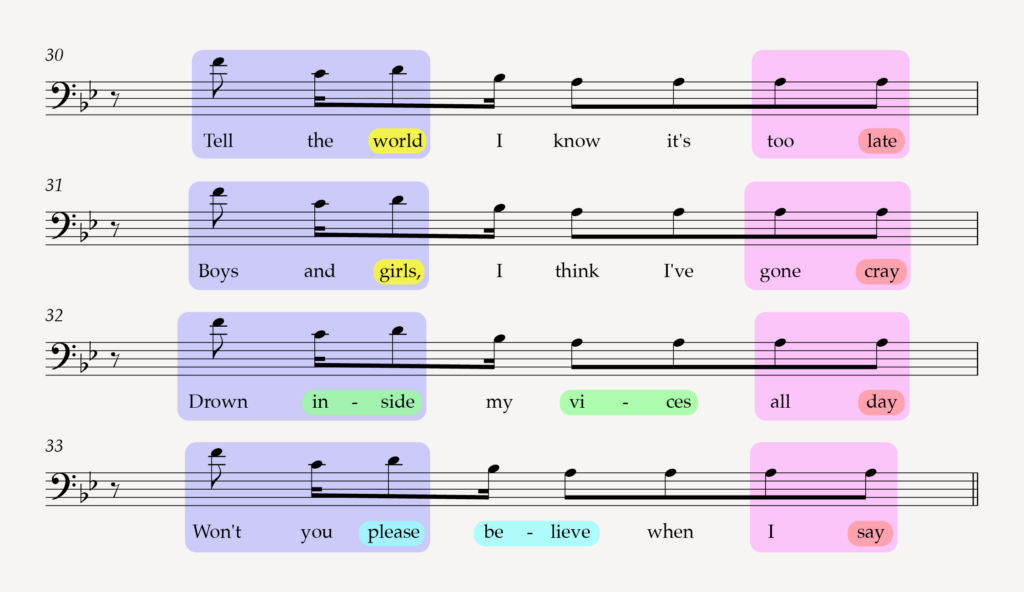
Where the previous motifs start and end mid-bar, these final four lines begin and end within the confines of each bar, like the rapping equivalent of end-stopping. Lamar also switches back to an AAAA rhyme scheme, and even the internal rhymes are metrical (with the /aɪ/ sound for “inside” and “vices” matching up with the placement of the /iː/ sound in “please” and “believe”). The rhythmic simplicity and melodic delivery of this fourth quarter sets us up nicely for the pre-chorus, where Lamar begins to reintroduce some of the elements he used in the more complex bars to prepare us for the chorus and the tornado of shifting cadences that come in the second verse.
PRE-CHORUS
Kendrick Lamar
Wouldn’t you know
We been hurt, been down before25Wouldn’t you know  . . .  been down before: The grammar here plays with the ambiguity that exists around timeframe when the wor “been” is stressed in Black American English (BAE). While the meaning in Standard English is restricted to “we’ve been hurt in the past”, BAE also provides the opportunity for it to be interpreted as “we have been hurt and are still being hurt”, implying a connection between the historical experiences of black Americans and those in the present day. By returning to the first-person plural of “we”, this pre-chorus shifts our focus from the internal conflict of the verse to the external conflict of black Americans living in white America; while Kendrick can’t yet resolve his cognitive dissonance, he can temporarily salve it by recognising the connection between his personal experiences and those of other black Americans.
Nigga, when our pride was low
Looking at the world like, “Where do we go?”26Nigga, when our pride was low  “Where do we go?”: Lamar creates a hybrid utterance here — a phrase that combines different kinds of speech which subtly reveal conflicting belief systems. In this case, the reappropriated word “nigga”, commonly used as a term of endearment by modern black Americans, brushes up against an allusion to the African diaspora, who would have been referred to upon arriving in colonial America by the pejorative -er version of the N-word. Similarly, the first-person plural words “our” and “we” gain a broader referent here; while the first two lines of the pre-chorus appear to refer to black Americans, these lines seem to refer to black people in general, both in the present day and throughout history. The existential question of black people “looking at the world like ‘Where do we go?’” suggests that they were once statelessness. While this could just allude to the historical status of enslaved Africans, it could just as easily be applied to other situations that have historically displaced black people such as segregation, redlining and civil war.
Nigga, and we hate po-po
Wanna kill us dead in the street for sure27Nigga, and we hate po-po  . . .  in the street for sure: Po-po is one of the slang words used by some black Americans to refer to police officers; as a mocking diminutive, it reflects the antagonising presence of police officers in urban areas with high populations of black people. Lamar doesn’t mince his words here, making it clear that this antagonistic relationship comes as a result of police brutality, and he conjures up images of dead bodies lyin “in the street” to reinforce this point. Contrary to what police officers might claim, Lamar states that this brutality is intentional, linguistically doubling down on this view with the pleonasm “kill us dead” and the adverbial intensifier “for sure”. This obviously runs counter to the metaphor of a few bad apples  that many people use to excuse police misconduct, thereby laying down the gauntlet for white listeners to try to understand this viewpoint despite the divisive language. On his follow-up album, Damn, Lamar highlights how people missed the point of this message by sampling and quoting a clip where Fox News pundits discussed his performance of “Alright” at the BET Awards in 2015. In the original segment, Kimberley Guilfoyle described the lyrics a “disrespectful”, and Geraldo Rivera — who’s right up there with Cosby when it comes to brandishing respectability politics — said “This is why I say that hip hop has done more damage to young African-Americans than racism in recent years”. Lamar later responded to these remarks in an interview with TMZ Live, saying “The overall message is ‘we gon’ be alright’. It’s not the message of ‘I want to kill people’”.
Nigga, I’m at the preacher’s door
My knees getting weak, and my gun might blow
But we gon’ be alright28Nigga, I’m at the preacher’s door  . . .  we gon’ be alright: The juxtaposition of religious imagery and gun violence here highlights the current lack of long-term solutions to this ongoing state of police harassment and brutality despite the fact that things have become untenable. Lamar returns to first-person singular pronouns: he’s “at the preacher’s door”, symbolically close to salvation and forgiveness yet unable to enter the church (commonly referred to as the house of God); his “knees” are “getting weak”, creating an oxymoronic image that could either imply a man praying for better days or being put in a stress position by police officers; and we are told that his “gun might blow”, suggesting that the only way to fight police violence might be with the threat of civil violence (a form of protest practiced by the Black Panther Party, who dealt with racial profiling from the Oakland Police Department by exercising their right to openly carry guns). There’s a tension created by these three images: Lamar begins in the present simple with “I’m”, moves to the present progressive with “[are] getting”, and ends in the conditional mood with the modal auxiliary verb “might” Each shift makes the present less concrete and more future-focused. Moreover, the juxtaposition of praying and violence represents the paradigm of violent versus nonviolent resistance, often represented through the Civil Rights movement figures of Malcolm X and Martin Luther King. But the lines could also be related to  “u”, since Kendrick expressed a  “suicidal weakness” at the end of that song.  Either way, he ends by making a declarative statement, but one that is framed by the going-to future — so while “we gon’ be alright” sounds inspiring, it’s also a distant hope when the present moment sees Kendrick on his knees at the preacher’s door. In a similar way, Lamar mirrors the grammatical structure that he uses in the intro, shifting from the first-person singular (“I”) to the first-person plural (“we”). While the intro implies this is a shift from the internal focus of “u” to the more universal “Alright”, the second cycle of this shift suggests that we’re not done with Kendrick’s inner conflict; essentially, the underlying message seems to be I don’t know what I’m going to do, but I do know that we’re gonna be alright.
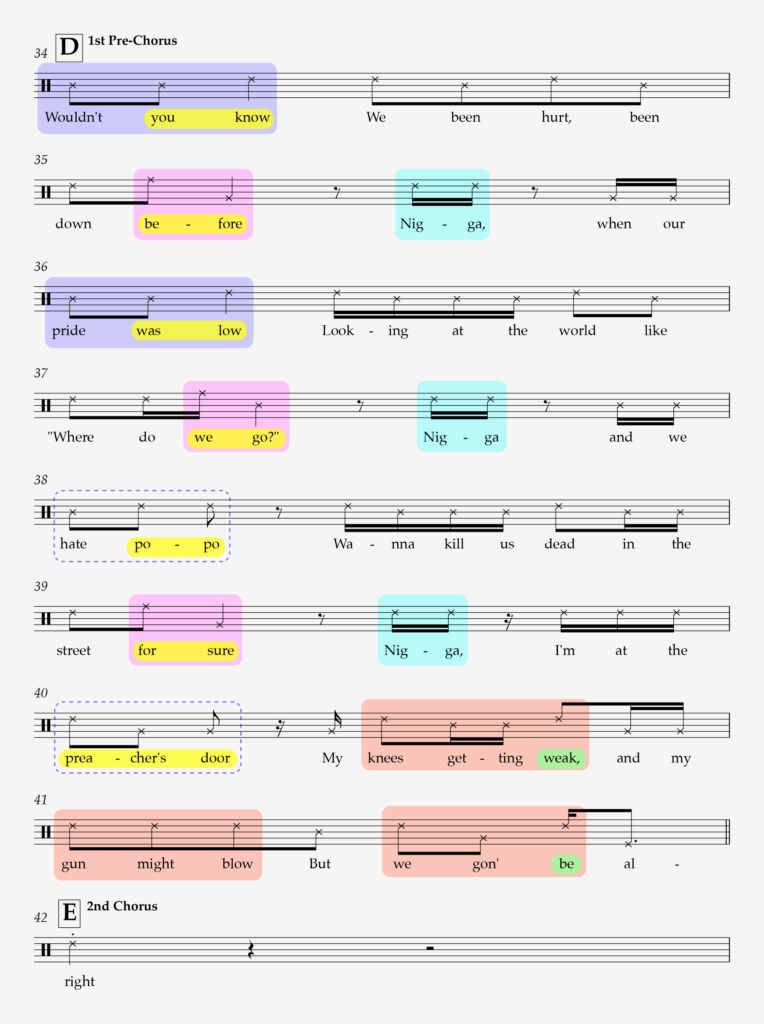
As he does in the intro, Lamar throws us into the chorus by using the pre-chorus to establish a pattern of three subphrases before subverting it in the fourth instance. Each subphrase has a satisfying arc with three main motifs, reinforced through oblique rhymes and repetition: he raises his pitch at the beginning (on “you know”, “was low” and “po-po”), lowers it at the end (on “before”, “we go” and “for sure”), and tags on the word “nigga” to connect one subphrase to the next. This use of the N-word provides a sharp rhythmic contrast to everything else, but it also directly addresses the song’s audience of black Americans with a reappropriated term of endearment that can only be used by black Americans, establishing an exclusive discourse community through this register.
Then, right as we begin to recognise this pattern, he breaks it: while “preacher’s door” forms a semi-rhyme with “for sure”, the unpitched melodic shape of the words separates it from its what comes before it, implying that these six-and-a-half bars are an antecedent phrase that (as with the intro) will be resolved by the time we hit the first beat of the chorus. The consequent phrase holds onto this tension by hitting three stressed syllables in a row on “knees get[ing] weak”, “gun might blow” and “we gon’ be”. Meanwhile, the straight eighth notes provide a contrast to the syncopation that precedes it, until — finally — the syncopation returns with the shift from “be” to “alright”. The low pitch on the first syllable on “alright”, in particular, creates a cadence that finds its sense of closure as we cross the barline and Lamar hits the downbeat on the final syllable of the word.
CHORUS
Pharrell Williams
Nigga, we gon’ be alright
Nigga, we gon’ be alright
We gon’ be alright
Do you hear me, do you feel me? We gon’ be alright
Nigga, we gon’ be alright
Huh? We gon’ be alright
Nigga, we gon’ be alright
Do you hear me, do you feel me? We gon’ be alright
2nd VERSE
Kendrick Lamar
What you want you, a house? You, a car?
Forty acres and a mule? A piano, a guitar?
Anything, see my name is Lucy, I’m your dog29What you want . . . I’m your dog: These lines previously appear in “Wesley’s Theory” with a key difference: while the speaker in that section is “Uncle Sam”, it’s now becom “Lucy”. While this diminutive version of Lucifer (i.e. the Devil) will be introduced more formally on the next track “For Sale? (Interlude)”, her brief appearance on this song suggests that Lamar is arguing that the promises and pitfalls of American capitalism (which Uncle Sam represents) are, at their base, temptations that distract people from living a virtuous life. To repeat some of the details from the page on “Wesley’s Theory”, Lucy’s offers represent some of the basic concerns for black Americans: “a house or a car” were common expectations for black Americans moving from the South to California in the 1950s during the Great Migration; “a piano, a guitar” represent black music, one of the key ways that black Americans have historically been able to have an income even while living under Jim Crow laws; and forty acres and a mule is a promise of land ownership that was infamously made during the American Civil War to many freed black families, before being rescinded by Andrew Johnson once he became U.S. President. The fact that Lucy offers all of these options implies that they don’t hold the same deep social value for white people, and that (like the forty acres and a mule) they are merely bargaining chips. Lamar also puns on the various meanings of “dog” here. The overt slang definition is “trusted friend”, but it also implies that Lucy is deceptively presenting herself as someone who is fiercely loyal to him, when in reality she will attack Kendrick the moment that he views her as a threat. Moreover, the imagery of Lucifer as “dog” could be an allusion to Cerberus, the multi-headed dog that guards the gates of the underworld in Greek mythology; but it might also allude to Johann Wolfgang von Goethe’s Faust, where the devil enters the titular protagonist’s life by taking the form of a stray poodle who follows him home. In the same way that the devil exploits Faust’s desire to become knowledgeable, Lucy is exploiting Kendrick’s desire to be rich.
Motherfucker, you can live at the mall30Motherfucker, you can live at the mall: [N.B. This footnote is repeated from the page on “Wesley’s Theory”] Shopping malls became widespread in the U.S. during the post-war economic boom, representing the abundance of options available to middle-class American consumers. However, the experienced a strong decline after the Great Recession, leading to current phenomenon of abandoned dead malls. As a result,[Lucy’s suggestion that Kendrick can “live at the mall” reflects the fact that materialism ultimately creates an illusory world of empty signifiers, since while a mall does contain things like clothes and furniture, it can’t create the family, safety and wealth that a home provides.
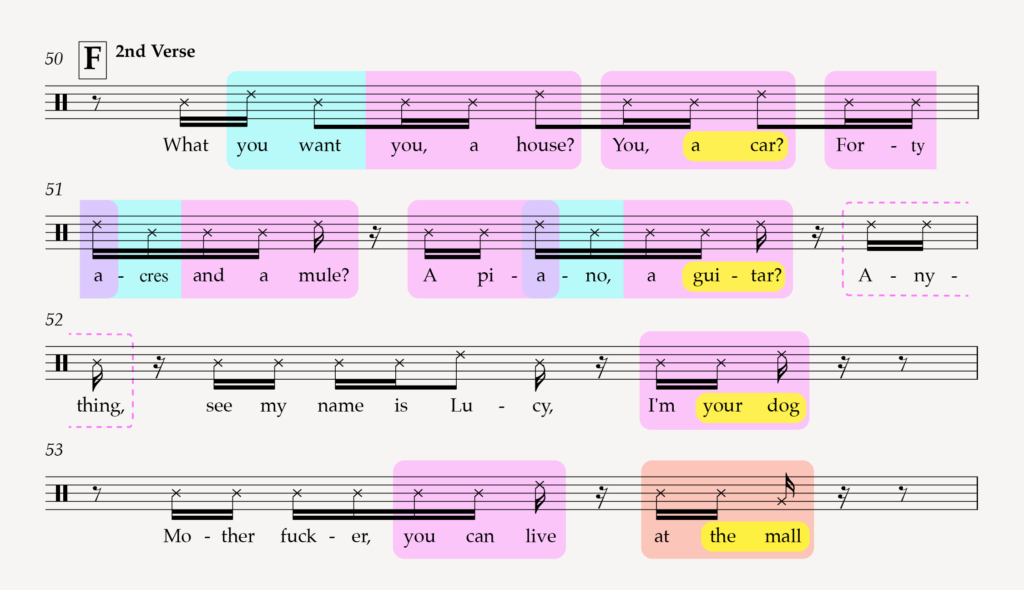
The second verse opens with a quotation from “Wesley’s Theory”, using the same intonation and rhythm that’s established in that song. Lamar raps in anapaests — a poetic foot that features two unstressed syllables followed by a stressed syllable (○○●),31I’m using the system of white circles for unstressed syllables and black circles to stressed syllables that Stephen Fry uses in The Ode Less Travelled, his book on how to write metrical poetry. I don’t know if Fry invented these underused scansion symbols, but I can attest — now that I’ve spent a few decades of teaching poetry — that they’re the only ones that make any kind of intuitive sense. and the stressed syllables line up perfectly with the on-beats of the bar, while the rhymes fall on the fourth beat. Taken together, these elements create a galloping rhythm, like being chased down by someone on horseback, so it’s worth noting that Lamar raps these lines through the persona of Uncle Sam in “Wesley’s Theory” and Lucy in this song. In both cases, we’re introduced to mythological figures who represent temptation, but Uncle Sam personifies the promise and ultimate illusion of the American Dream under late capitalism, while Lucy — a diminutive version of Lucifer (a.k.a. Satan, the Devil) — represents the very concept of temptation itself. As a result, the reappearance of these lines and their galloping rhythm suggests that Lamar has failed to outrun “the evils of Lucy”, again sitting in contrast to the song’s positive chorus.
2nd VERSE
Kendrick Lamar
I can see the evil, I can tell it, I know it’s illegal
I don’t think about it, I deposit every other zero32I can see the evil  . . .  I deposit every other zero: After Lucy’s brief appearance, we return to Kendrick being the speaker here. He outlines his morality by making it clear that he that he knows the difference between good and evil, which jibes with the Christian faith he expresses elsewhere on the album. Similarly, his awareness of what is “illegal” indicates a willingness to recognise the morality of the legal system too. But the question is: What does the neuter pronoun “it” refer to here? Lamar intentionally keeps its referent ambiguous. “It” could refer to any of the things that Lucy tempts Kendrick with, but it could also refer to the immoral actions of the police officers referred to in the song’s pre-chorus. All we do know is that Kendrick consciously chooses to ignore these issues by depositing “every other zero”. The pursuit of wealth becomes a pursuit of money itself rather than merely seeing money as a means to an end, a thing that allows you to get the things you need. Since the “zero[es]” can stretch on to infinity, we know that money has the potential to forever distract Kendrick from dealing with issues of morality. Of course, the Bible explicitly states tha “the love of money is the root of all evil” (1 Timothy 6:10), so this refusal to engage with morality and pursue endless wealth is, in itself, an immoral act.
Thinking of my partner, put the candy, paint it on the Regal33Thinking of my partner  . . .  paint it on the Regal: Like the more well-known Chevy Impala mentioned in the first verse, the vintage Buick Regal is a muscle car that became popular in the luxury car culture of Southern California. With two imperatives, Kendrick demands a candy-coloured paint job, underlining this as an act of conspicuous consumption since this kind of paintwork is purely cosmetic. Lamar highlights the materialism of this desire by turning the second half of the line into a non-sequitur after stating that Kendrick is “thinking of [his] partner”; the ironic distance that we have from Kendrick’s unreliable narration makes it clear that this is a hollow justification, since the Regal is a two-door coupe that moves at a fast speed largely unsuitable for a family, and it would be hard to justify the money spent on a candy paint job under a budget that has to support a family. This is also a callback to “For Free?”, where Kendrick places owning a customised car above having a child, saying “You really think we could make a baby named Mercedes / Without a Mercedes Benz and twenty-four-inch rims / Five percent tint and air conditioning vents? / Hell fucking naw”. For Lamar, this link between expensive cars, rapping and heaving a family is personal; in a 2012 interview with Complex, Lamar said “My pops put me on to rap. When I was born, I came home from the hospital in an ’87 Buick Regal while my pops was bumping Big Daddy Kane”. Sure enough, he would later name his sixth album GNX, after the model of the Regal that his father owned. As a result, the reference to the car represents the need to balance your priorities, commitments and desires.
Digging in my pocket, ain’t a profit big enough to feed you34Digging in my pocket  . . .  enough to feed you: As part of this verse’s shift in speaker from Lucy to Kendrick, we could read these lines as Kendrick addressing Lucy as “you”, implying that that she is taking all his money with the tangible image of her “digging” through his pocket. Yet Lamar puns on the homophone of “profit” and “prophet”: on one hand, it suggests that Kendrick can’t make enough money to please the Devil since her aim is to trap him in a downward spiral of sin and gluttony; on the other hand, if we read it as Lucy speaking to Kendrick, then it implies that there isn’t a Christian prophet like Jesus who can save Kendrick from his own unstoppable desire for wealth.
Every day my logic: get another dollar just to keep you
In the presence of your chico, ah!35Every day my logic  . . .  your chico, ah!: Since chico is Spanish for boy, Kendrick is referring to himself and implying that he is making money just to keep him in the good graces of  Lucy. While chico is a term of endearment in Latino culture, the word boy carries a more pejorative context for black Americans since it was historically used in a derogatory way towards black men. By using it here, then, Lamar is highlighting the slave–master relationship that can arise with being a young rapper in the music industry — a theme that he explores prior to this point in “Wesley’s Theory” (“What you want you? A house or a car? / Forty acres and a mule?”), “For Free?” (“living in captivity raised my cap salary”), “King Kunta” (“everybody wanna cut the legs off him”), and “Institutionalized” (“master, take the chains off me”). Finally, the scream of “ah!” that punctuates the end of this phrase and silences the backing almost sounds like Kendrick pinching himself to wake up from a nightmare, suggesting that the only way to escape these issues is to avoid money altogether.
I don’t talk about it, be about it, every day I sequel
If I got it, then you know you got it, Heaven I can reach you36I don’t talk about it  . . .  Heaven I can reach you: The presentation of Kendrick as a greedy and sinful person begins to shift here, but he’s still overpromising and underdelivering. He insists that he’s a man of action not of words — obviously ironic given how much ink he’s already spilled by this point on what he sees as a failure to help others through his rapping. The use of “sequel” as a verb here (an example of anthimeria) is a boast more than a promise, since To Pimp a Butterfly can be seen as the sequel to Good Kid, M.A.A.D City, so it’s as if Kendrick is saying that he can deliver this everyday — something we know is impossible, since art takes time and effort. Similarly, stating “if I got it, then you know I got it” implies that Kendrick doesn’t feel the need to brag as a rapper because his fame will speak for itself — a clearly ironic statement given that he’s bragging about this by rapping about it. Given the subtly ironic framing of all these other lines, we can interpret Kendrick’s belief that he can reach heaven through hard work and building wealth as an exercise in futility, given that the Christian conception of Heaven is a realm beyond our earthly existence. While his aims are more noble than those outlined in the first half of the verse, he’s still focused on money as the means of liberation and — as the poet Audre Lorde points out  “the master’s tools will never dismantle the master’s house”.
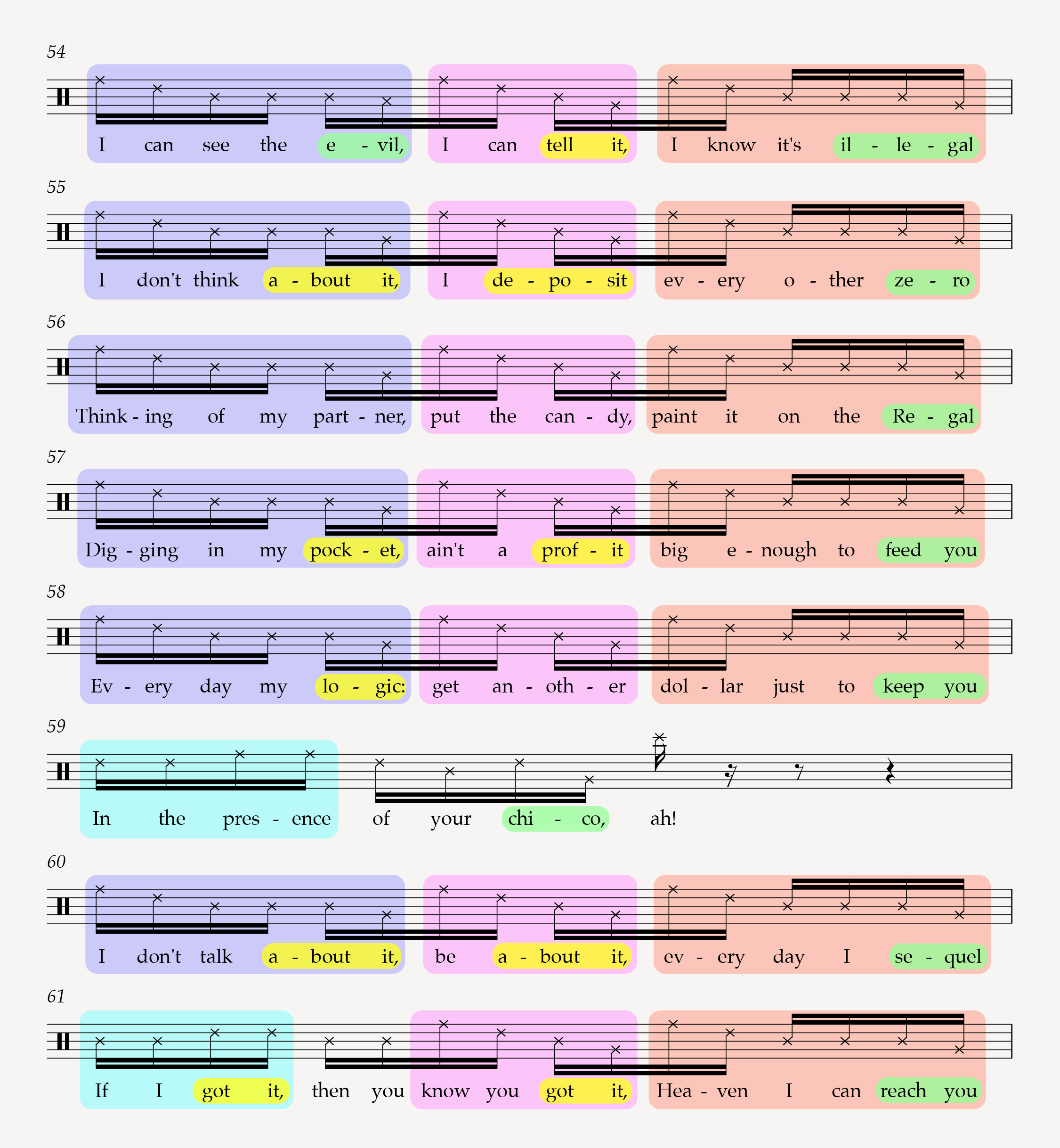
This final bar of this phrase from “Wesley’s Theory” ends with the instruments being muted, which provides a brief moment of breathing space before we’re subjected to a relentless onslaught of sixteenth notes. On the aforementioned episode of the Dead Wax show, co-host Jack Conte points out that this section of the song sounds as if Lamar is doing tom fills with his voice because he employs three motifs within each bar that are also outlined through falling intonation; we can tell when each one begins and ends because he starts back at roughly the same stressed pitch each time.
He splits the sixteen notes of each bar into groupings of 6 + 4 + 6, creating an additive rhythm that feels like eternally falling down a flight of stairs — which is exactly how the heights of the noteheads appear when you try to write it down. The shorter length of the second motif adds to this sense of relentlessness, since the the Sisyphean task of trying to reach the end gets cut short on every other repetition. This feeling of falling and failing is reflected in the content of the lyrics, where Lamar uses dramatic irony to imply that Kendrick’s self-awareness hasn’t actually led to self-actualisation or transcendence, since he’s still trapped in a cycle of materialism.
2nd VERSE
Kendrick Lamar
Pat Dogg, Pat Dogg, Pat Dogg, my dog, that’s all
Bick back and Chad, I trap the bag for y’all37Pat Dogg  . . .  bag for y’all: Pat Dogg was Lamar’s cousin who died while he was making To Pimp a Butterfly, so the mention of “heaven” in the previous line suggests that Lamar feels Pat Dogg has transcended the materialistic life that Kendrick lives. Lamar referred to his “big cousin pat dogg smiling down” on his incognito Instagram account (with the username jojoruski), and he says “RIP Pat Dogg” in a solemn voice near the beginning of the music video fo “Alright”, with the shout out being juxtaposed against the shot of his smiling face rapping about the success of To Pimp a Butterfly. It’s implied that Pat Dogg might be a victim of gang violence, since Kendrick tells him t “kick back” using the slang method of the Bloods, where letters beginning with ‹c› are replaced with ‹b› — though this is a /k/ sound replaced with /b/. This is supported by the fact that Lamar also refers to Chad Keaton, his friend who was wounded in a drive-by shooting and died from complications caused by the injuries according to this GQ profile. In his feature on YG’s “Really Be (Smokin N Drinkin)”, Lamar say “they killed Braze, they killed Chad, my big homie Pupp”, with “they” intentionally being an ambiguous way of not choosing sides in the ongoing Crips–Bloods feud. By saying he’ll “trap the bag” for these “dead homies”, Kendrick is implying that he’ll financially look after their friends and family while they’re in the afterlife. It’s worth noting that these lines tonally mark a shift from the first half of this verse, where Kendrick is still focused on earning money without thinking about what he can positively do with the wealth.
I rap, I black on track so rest assured
My rights, my wrongs; I write till I’m right with God38I rap, I black  . . .  right with God: Lamar’s wordplay reaches its height here: he states he’s “black on track”, highlighting both his race and his positioning as a black artist, suggesting that he isn’t going to sell out to white audiences. However, the phrase also sounds similar to the idiom “back on track”, implying that he is rediscovering his virtues and humility — most likely by engaging with the community spirit and resilience that is expressed in the song’s pre-chorus. Lamar then puns on the homophone of “right” an “write” by stating that regardless of his mora “rights” an “wrongs” he will “write” until he’ “right with God”. These lines appear to be an allusion to “Poetic Justice” from Good Kid, M.A.A.D City, where Lamar says “I could never right my wrongs ’less I write it down for real”. In both cases, it suggests that Kendrick believes his main form of salvation will come from his ability to write about his experiences and represent the lives of people like him — an idea that is reinforced through the third possible meaning of “I black on track”, writing lyrics for the song in black ink. The phrase “right with God” could be interpreted in two senses: the obvious interpretation is that he will become morally good — the same “right” expressed in “rights” and “wrongs; but the more subtle interpretation is that he is will become the “right” hand of God — Jesus’s position as the messiah in a number of Biblical verses. This links to the album’s larger motif of Kendrick’s messiah complex — his belief that he needs to save black Americans and lead them to a brighter future through his rapping. As with the rest of the verse, then, this moment of positivity is still filtered through Kendrick’s hubris; while he is undergoing a metamorphosis, he is still early in the process of change.
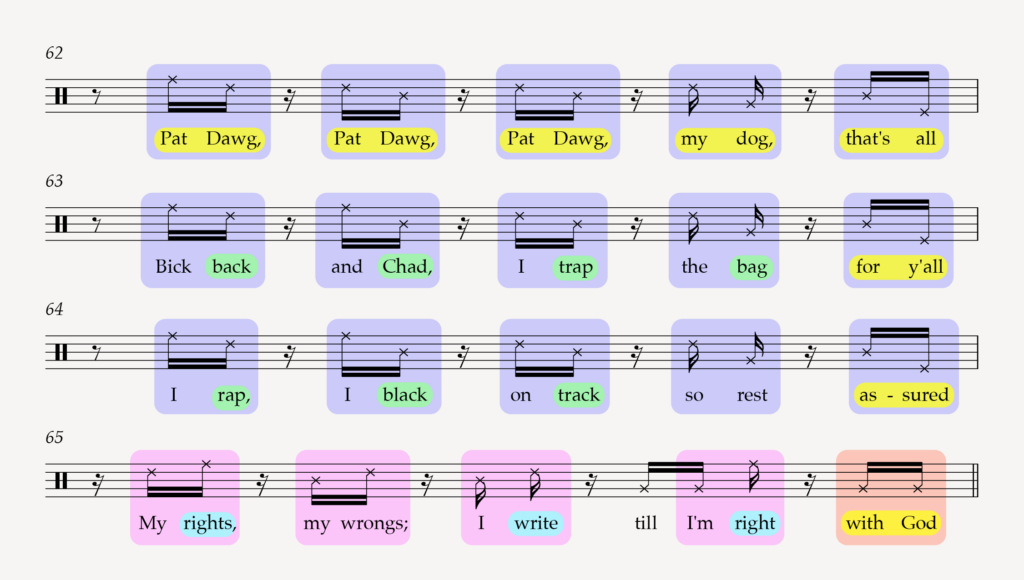
The blistering additive rhythm of these 8 bars is finally broken in the final 4 bars of the verse, but the rhythmic complexity actually increases as Lamar shifts to a flow that creates a polymetric rhythm against the 4/4 pulse of the beat. Polymetre happens when different parts within a piece of music share the same underlying beats but play bars of different lengths; so for example, the drums might play in bars of with four beats (4/4 time) while the piano plays in bars of three beats (3/4 time). Naturally, the downbeats goes out of sync, creating tension until they sync back up with the 1st beat of the bar. The sync point can be easily determined by the number of beats in the polymetric rhythm against the underlying time signature of the music; so if the piano plays in bars of 3/4, it will take 3 bars of 4/4 to sync back up.
The polymetric nature of the rhythm that Lamar uses here isn’t immediately obvious — even when we look at the sheet music — for a few reasons:
- He does it with trios of sixteenth notes, which are smaller units within a bar, making the effect less noticeable.
- He leaves out the last beat of each trio, reducing the sense of counting the rhythm in groupings of three.
- He starts the motif after an eighth note pause, so we don’t think of it as something that has to synchronise with the downbeat.
- Most importantly, he resets the downbeat at the end of each bar.
If he continued the motif without this reset, the polymetric nature of the rhythm would be clearer. To understand what I mean, listen to the recording below, where I’ve edited Lamar’s vocals to extend the polymetric rhythm across multiple bars.*
*While I personally prefer it this way, I’m willing to admit that there’s something about devising raps mathematically that it becomes hard to vibe with the longer it goes on. (Listen to pretty much any album by Tech N9ne if you don’t know what I mean.) So these resets, for me, are a little sliver of what makes Lamar a great rapper. Unlike Logic or Eminem, he understands that good rappers are only as good as the beats they choose — while lyrics and wordplay and rhymes and rhythms can be important, these things are always going to play second fiddle to the beat when it comes to casual hip hop listeners. After all, there’s a reason why trap music became huge, and it ain’t because everybody thinks Travis Scott is a poet.
This second verse ends with another moment of “silence for the record” where all the instruments drop out in the final two bars, leaving Lamar with an opportunity to show off his skills. At first, he simply repeats the rhythm and rhymes he’s already established, continuing his pattern of three repetitions followed by a deviation. Yet the deviation — coming at the end of one of the most virtuosic moments on the album — is more subtle than we might expect: he starts by shifting everything one sixteenth note earlier, creating a moment of rhythmic tension, then pulls some Lil Wayne-style wordplay by alliterating “rights” and “wrongs” before making a series of homonymous puns on legal “rights”, morally “right” actions, using a pen to “write” and being “[al]right”. The repetition of the same /raɪt/ sound across these different meanings provides a clear cadence to the four bars, preparing us for the familiar sounds of the pre-chorus and chorus.
PRE-CHORUS
Kendrick Lamar
Wouldn’t you know
We been hurt, been down before
Nigga, when our pride was low
Looking at the world like, “Where do we go?”
Nigga, and we hate po-po
Wanna kill us dead in the street for sure
Nigga, I’m at the preacher’s door
My knees getting weak, and my gun might blow
But we gon’ be alright
CHORUS
Pharrell Williams
Nigga, we gon’ be alright
Nigga, we gon’ be alright
We gon’ be alright
Do you hear me, do you feel me? We gon’ be alright
Nigga, we gon’ be alright
Huh? We gon’ be alright
Nigga, we gon’ be alright
Do you hear me, do you feel me? We gon’ be alright
In a song that achieves its cohesion through rapping and lyrical repetition, Thundercat’s sung coda provides a clear conclusion by breaking away from what comes before it. In the same way that the opening lyric of “alls my life” felt delayed by starting on the third beat with a hemiola, Thundercat’s first two lines fall entirely on off-beats — something that, as you can see below, is a nightmare in terms of notation, despite being easy enough to understand aurally. Meanwhile, the higher-pitched snare returns to land on every third beat of the bar. Between them, this establishes a gently swaying rhythm that contrasts with the rapid-fire rhyming employed by Lamar throughout the rest of the song.
CODA
Thundercat
I keep my head up high
I cross my heart and hope to die39I keep my head  . . .  hope to die: While the idiom of holding you “head up high” means showing pride and resilience in the face of difficulty, the phrase “cross my heart and hope to die” creates a direct link between vowing to be truthful and leading a Christian life (by making the sign of the cross). However, these idioms could also be interpreted in a negative sense, since getting high refers to the kind of intoxication that caused Kendrick to “self-destruct” on “u”, and the desire to die echoes the “suicidal weakness” that he expresses at the end of that song. Taken together, these ambivalent interpretations reflect Kendrick’s “complicated” state of mind, and the fact that these lines are delivered by Thundercat suggests that he still hasn’t integrated these different drives into a single viewpoint — he is torn between different mindsets and different voices.
Loving me is complicated
Too afraid, a lot of changes
I’m alright, and you’re a favourite40Loving me  . . .  you’re a favourite: When Lamar first raps the sentence “loving me is complicated” in the chorus of “u”, he does it in a hoarse tone, with the fourth syllable of “complicated” amplified by a scream that doubles the word. It’s as if Kendrick is shouting at himself and wondering why he can’t make things more simple for the people around him. By comparison, when Thundercat sings the statement here, he sounds calm, as if there’s a degree of self-acceptance this time, which is reinforced by the stoic and terse statement of “I’m alright”. Despite this, the statement that “you’re a favourite” shows that he’s still lacking in a deeper sense of self-worth at this point; while “King Kunta” was full of braggadocio, it won’t be until the penultimate song on the album “i”, that Kendrick will feel a deeper sense of self-worth that comes from self-actualisation.
Dark nights in my prayers41Dark nights in my prayers: We end the song on a tonally ambivalent note; while Kendrick is praying — a symbol of hope and self-transcendence — he is having “dark nights”. Traditionally, a “dark night of the soul” describes either a crisis of faith or a difficult period in someone’s life, and the next song on the album explores this moment of insecurity by bringing back Lucy (i.e. the Devil), who delivers a kind of sinister love song to Kendrick.
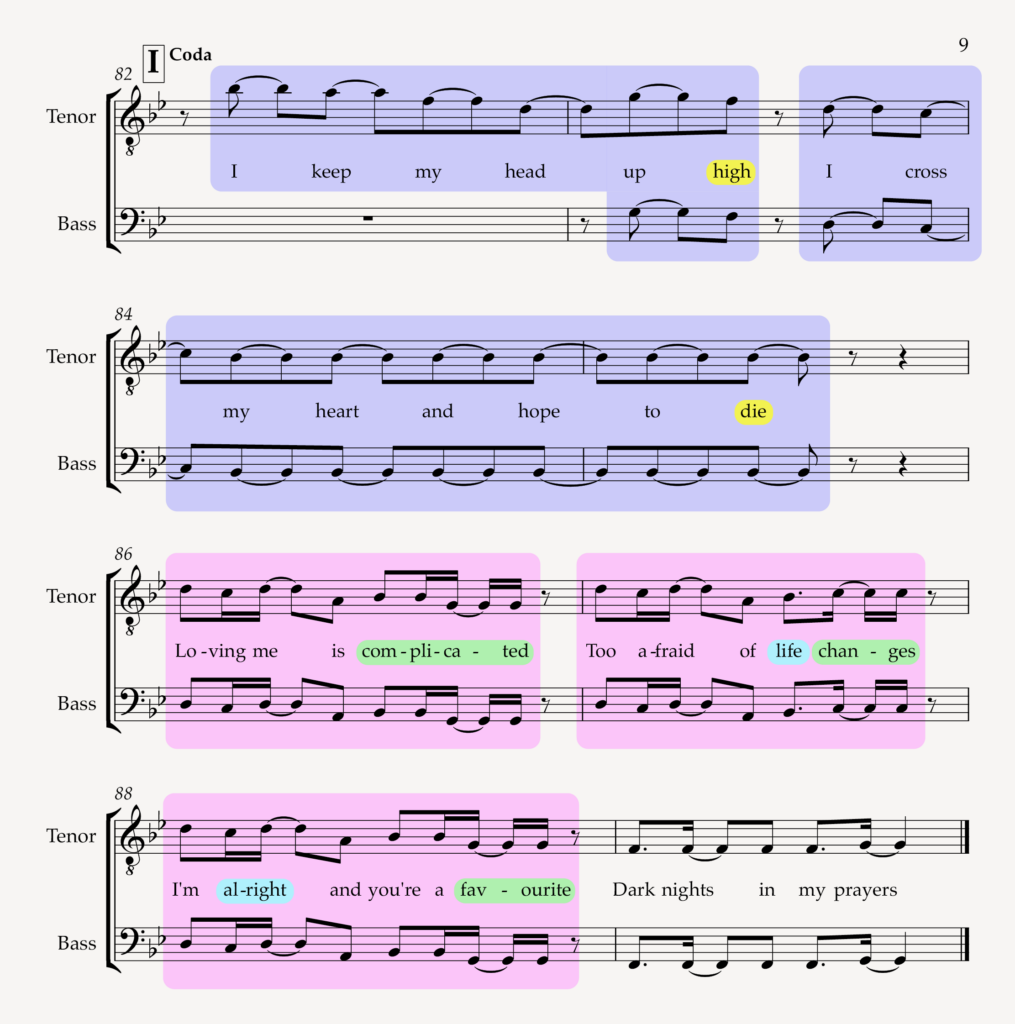
The overall arc of the melody gradually descends in pitch until we reach the final words “Dark nights in my prayers” — and these words are reinforced by Thundercat doubling them an octave lower, right at the bottom of his baritone range. The song harmonically ends on the G minor tonic, and the timbre, pitch and lyrics undercut the overall message of resilience by ending in a moment of darkness, implying that we’re far from finished when it comes to Kendrick’s spiritual journey.
Sure enough, this soul-searching is picked back up by another snippet being introduced in the cumulative poem that’s threaded throughout the album from “Institutionalized” onwards.
POEM EXCERPT
Kendrick Lamar
I remembered you was conflicted
Misusing your influence, sometimes I did the same
Abusing my power, full of resentment
Resentment that turned into a deep depression
Found myself screaming in the hotel room
I didn’t wanna self-destruct
The evils of Lucy was all around me
So I went running for answers
Three more lines have been added since its last appearance o “u”. While the mention of not wanting to “self-destruct” is pretty self-explanatory, the reference to “the evils of Lucy” highlights her brief introduction in this song’s second verse. Meanwhile, Kendrick’s need to go “running for answers” sets us up for the next song on the album, which will introduce us to the devil who’s always pursuing him.
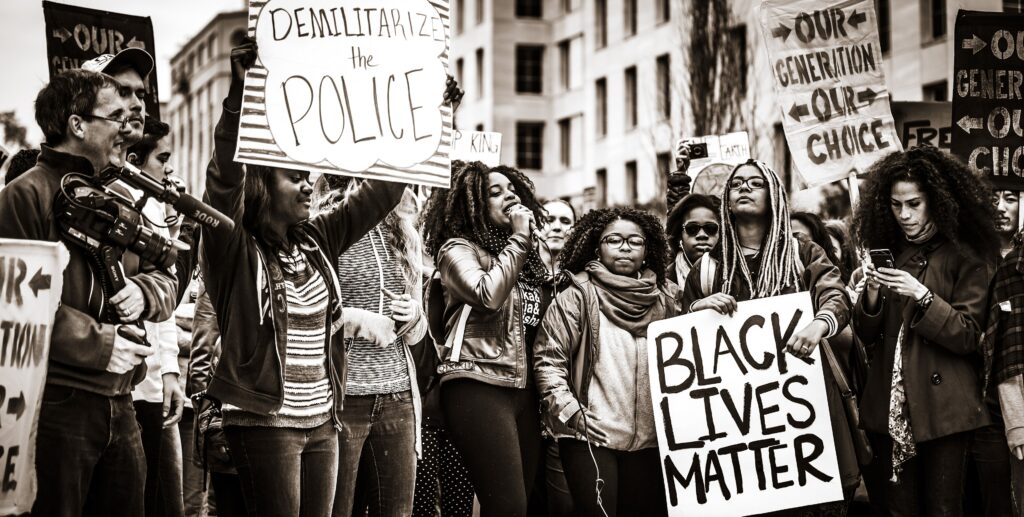
© Johnny Silvercloud, CC BY-SA 2.0
Silence is violence
While our understanding of “Alright” is clearly enriched by its context in the narrative of To Pimp a Butterfly, the song is also unusual among the album’s singles since it’s the only one that’s continued to thrive after being separated from its siblings. In 2013, in the wake of George Zimmerman being acquitted of killing Trayvon Martin, the activists Alicia Garza, Patrisse Cullors, and Ayọ Tometi began to spread the hashtag #BlackLivesMatter. Shortly after, they founded the Black Lives Matter Network. Throughout 2014, supporters of the hashtag began to coalesce into a movement, spurred on by citywide protests after the killings of Michael Brown and Eric Garner. By the time To Pimp a Butterfly was released in the spring of 2015, the movement had grown into a nationwide decentralized machine, with civilians capturing scenes of police brutality on their smartphones and spreading them across social media platforms that would, in turn, provide a virtual space for activists to organise protests and other forms of civil disobedience. And all throughout the summer, protestors kept finding solace in the stoicism of one particular refrain: “we gon’ be alright”.
As Cole Cuchna states in the episode of his podcast devoted to the song, the refrain of “Alright” makes it an ideal chant for protests, since “its simple five syllables lend themselves perfectly to repetition. It can be whispered. It can be shouted. It’s both universal and specific, relevant in any number of settings.” Similarly, Noriko Manabe points out in her musicological analysis tha “the protest-chant version of ‘Alright’ fits the parameters of most protest chants: it is short (making it easy to learn on the spot), it is in 4/4 with accents on Beats 1 and 3 (making it march-friendly), and it invites call-and-response interjections.” Of course, reducing the song down to this one chant inevitably means reducing the complexity of its message. In the original version of “Alright”, the pluralistic refrain is sandwiched between verses full of vices and an ambivalent pre-chorus where Kendrick sits on the precipice between prayers and violence. The protest version, by comparisons, leaves us with just the peroration.
But maybe that’s enough — refrains are made to be repeated, after all, and the song’s avoidance of dogma is arguably what makes it so well-suited to Black Lives Matter. As Alex Pappademas puts it on The Big Hit Show “There’s nothing didactic about it. Nothing about it says, Bump this at your protest. [ . . . ] Its status as an anthem is conferred upon it by people. The same people who are part of this leaderless horizontal movement.” In interviews around the release of To Pimp a Butterfly, Lamar supported this simplified interpretation of the song’s message. For example, during his interview with Rick Rubin for GQ, he agreed with Rubin when the hip hop mogul said tha “Alright” has become “our generation’s protest song”. Lamar said that he aimed to make it “uplifting—but aggressive. Not playing the victim, but still having that We strong”.
And yet, when it came to live performances, the narrative of To Pimp a Butterfly never fully left the rearview mirror. At the 2015 BET Awards, Lamar performed the song while perched on top of police car covered in graffiti tags. Behind him, a tattered U.S. flag waved back and forth; in front of him, a crew of dancers kept swaying in synchronised poses and breaking out into a panoply of freestyle moves. Then, at the end of the third chorus, the beat broke down into a series of stomps and a lone distorted synthesizer line while Lamar rapped about drinking alcohol as a teenager, repping Compton, and bodying other emcees.
He would later use most of this verse for his feature on “Deep Water” from Dr. Dre’s Compton album, but with the notable additions of these lines:
Once upon a time, I shot a nigga on accident
I tried to kill him but I guess I needed more practising
That’s when I realized banging wasn’t for everybody
Switch it up before my enemy or the sheriff got me
They liable to bury him, they nominated six to carry him
They worry him to death, but he no vegetarian
The beef is on his breath
Inheriting the drama better than a great white, nigga
This is life in my aquarium
In other words, Lamar used the“Deep Water” verse to reconcile the “conflicted” version of him who appears in the verses o f“Alright” with the braggadocious teenager that he embodied at the end of the BET Awards performance. While Kendrick is fully capable of violence at the end of “Deep Water”, he recognises that this is a product of him being “trapped in the ghetto” (as he puts it on “Institutionalized”).
Eight months later, Lamar appeared at the 58th Grammy Awards, shuffling onto the stage as part of a chain gang. A jazz horn section, led by Terrace Martin, accompanied him from behind prison bars. Together, they launched into a moody arrangement of “The Blacker the Berry”, with the band hitting dramatic stabs every 8 measures and ramping them up as they approached the chorus. And then — right as the beat kicked in and Assassin’s booming dancehall vocals took over — the bright stage lights cut out, leaving a lone ultraviolet beam that revealed glowing patterns on the bodies of the prisoners. Except they weren’t prisoners anymore; they were dancing, moving freely across the stage in a fluorescent blur, like Maasai warriors let loose in the middle of a neon light race.
At the end of the chorus, a tumult of West African drums kicked in and Lamar moved like a drunken man before finding his feet in front of a large bonfire, where he launched into “Alright”. From behind him, a handful of female dancers began to appear, adorned with red body paint and dreadlocks and skirts — a look that his stylist at the time, Dianna Garcia, says was influenced by the Himba people of Namibia. Then, once Lamar reached the end of the second verse, he stumbled across the stage again, acting like he was trying to shake off a drug-induced state, until he landed in front of a mic stand and delivered yet another previously-unheard rap.
It started with him alluding to the pivotal killing of Trayvon Martin and the empathy he personally felt for Martin, before adopting the voices of tone-deaf detractors by asking “Why didn’t he defend himself? Why couldn’t he throw a punch?”. Lamar spoke for the black community as a whole by saying the killing “set us back another four-hundred years”. Then — right as the audience settled into this eulogy — he instead launched into a revenge fantasy that involved getting high, drinking, and making plans on “creeping through your damn door and blowing out / every piece of your brain / till your son jumps”. He ended this final verse by invoking hi “HiiiPower” concept — a notion that his generation should aspire towards a collective zeitgeist that will eventually lift them out of their current cycle of existence. And, in his words, this was “conversation for the entire nation” that’s “bigger than us”.
Anyone hoping to be given a homily was sorely mistaken. Instead of simplifying the message of “Alright”, Lamar reunited the protest song with it “conflicted” verses while sandwiching the whole thing between two rage-filled critiques that didn’t exactly offer comfort to any white person looking to be an ally. What emerged instead was an ambivalent exploration of a black celebrity dealing with the survivor’s guilt of success while men and women just like him were being murdered by the country meant to protect and serve them.
These two performances encapsulate the way that Lamar was both willing to accept the song’s growing status as the “New Black National Anthem” (as Aisha Harris mused in Slate) while still reinforcing its original meaning too. The performance at the Grammys, in particular, threads in the album’s narrative of discovering self-worth in the motherland by contrasting the issues facing modern black Americans with the strength that lies in the traditions of black Africans. That night, Lamar not only got more nominations and more awards than any other artist; he finally walked away with the Grammy for Best Rap Album, which he had famously lost to the white rapper Macklemore two years earlier. For a second, it seemed like people were willing to, as he put it, right their wrongs.
Then, eight months later, Donald Trump won the Electoral College vote and secured his place as the 45th President of the United States — a feat that he would repeat eight years later.
Since then, the country has seen an insurrection against a democratically elected government, a global pandemic that disproportionately affected black people, coordinated voter suppression, hardline deportation policies, the loss of affirmative action at universities, the overturning of nationwide abortion rights, the rollback of DEI policies, and, of course, many more unarmed black Americans killed by law enforcement officers.
But at least the Democrats kneeled in kente cloth, right?
In the face of these fetters, “we gon’ be alright” works as a protest chant precisely because it doesn’t make any grand promises. Unlike that other famous slogan from 2016, it doesn’t promise a brighter future by papering over the racism of the past. All it can offer is stoicism; and that, for now, will have to do.
—L.O.E.
Pharrell Williams
Producer and vocals (chorus)
Sounwave
Producer
Kendrick Lamar
Vocals (lead)

Terrace Martin
Alto saxophone

Thundercat
Vocals (coda)

Candace Wakefield
Vocals (background)

James Hunt
Audio engineer
MixedByAli
Mixing

Mike Bozzi
Mastering
Footnotes
- 1Visually speaking “This is America” is a cut abov “Alright” when it comes to using symbolism, choreography and cinematography to explore what it means to be black in America under late capitalism. Lyrically, however, it’s like comparing apples to oranges: Lamar is rapping in the tradition of wordsmiths like 2Pac, whil “This is America” favours the stripped-down approach used by trap artists like Playboi Carti, where the rapper freestyles and repeats short phrases until they start to sound like aphorisms. ↩︎
- 2For more on the history of doo-wop, see Lawrence Pitilli’s book Doo-Wop Acappella: A Story of Street Corners, Echoes, and Three-Part Harmonies ↩︎
- 3Here’s a bum steer from an otherwise passable NPR news piece on the song: “The dah dah dahs that make up those chords are Williams’ own disembodied voice, running constantly through the song”. ↩︎
- 4
- 5The minor, dominant and diminished chords in a natural minor key are i, ii, iv, v and VII, while the relative chords in a major key are vi, vii, ii, iii and V, respectively. ↩︎
- 6This kind of drum programming is one of the key features that makes hip-hop drumming distinct from other black American genres like disco and house, where the kick drum is usually played four-on-the-floor while the hi-hat is accented on the off-beats. ↩︎
- 7Alls my life, I has to fight, nigga Alls my life, I—: These opening lines are an allusion to Alice Walker’s The Color Purple, a novel set in the Jim Crow era. They come from a speech given by Sofia who explains to the protagonist, Celie, that she has put up with abuse from men throughout her childhood and refuses to allow her new husband, Harpo, to beat her. The speech deeply affects Celie, who is herself being abused by her husband, Mister — who is also Harpo’s father and the man who advised him to beat Sofia in the first place. The rest of the novel explores the journey of both women as they face the impact of these experiences over the rest of their lives. Lamar’s allusion is designed to draw a link between the experiences of these fictional women and the historical adversity experienced by black Americans, in the same way that Walker wrote the novel to draw wider attention to these underrepresented stories in American culture. However, it’s worth noting that Lamar adds a more archaic nonstandard conjugation to the novel’s use of Black American English (BAE), since the original statement is “All my life, I had to fight”. There are two possible reasons for this: maybe he simply misremembered the phrasing from the book or the film; however, it could also be an intentional choice to highlight the nonstandard nature of BAE, since the real quotation would be entirely in standard English if the key words aren’t conjugated a “alls” an “has”. Either way, it is a confrontational statement, and his addition of “nigga” at the end of it turns it into a hybrid utterance, where the antiquated BAE brushes up against the modern BAE, reinforcing the link between the historical experiences of black Americans and the present. ↩︎
- 8Hard times like, “Yah!” / Bad trips like, “Yah!”: “Bad trips” is being used in a polysemic way here, since it is literally used to refer to bad journeys while colloquially referring to bad drug experiences. In the former sense, it could refer to the mass migrations experienced by black Americans in the form of the Altantic slave trade (from West Africa to the United States), or the Great Migration (from rural Southern states to cities in the urban Northeast, Midwest, and West). By comparison, in the latter sense, it might refer to the proliferation of drugs like heroin and crack cocaine which have disproportionately affected black Americans. In both cases, these are negative experiences in the history of black America that Lamar seeks acknowledge while forging a more positive path forward. ↩︎
- 9Nazareth: Nazareth was the hometown of Jesus, and we briefly get a sense of its reputation in John 1:46 when a man named Nathanael asks “Can anything good be from Nazareth?” before he meets Jesus and eventually becomes one of his early disciples. The use of the place-name here is intentionally ambivalent; through the context of this Bible verse, it implies there is a similarity between Nazareth and Compton in terms of being places that outsiders view negatively based on reputation rather than first-hand experience. It also draws another parallel between Kendrick and Jesus, suggesting that the rapper continues to see himself as a Messianic figure at this point. If we choose to interpret this positively, we could see the song as an attempt to return to his hometown and reassure them that things will work out well in the end despite the cultural and socio-economic pressures they face. However, if we ignore the Messianic imagery, it could also be seen as a kind of invocation by Kendrick, who is attempting to overcome the self-destruction he experienced in “u” by focusing on the teachings of Jesus and using his Christianity as a foundation for resilience, charity and empathy. ↩︎
- 10I’m fucked up, homie, you fucked up: This is a callback to the state that Kendrick is in at the end o “u”. On that song, Lamar projects the image of a drunk and depressed Kendrick by rapping in a tearful tone, while we occasionally hear Foley effects of clinking bottles and liquor being poured. Much like the sinner’s prayer that appears at the end of Good Kid, M.A.A.D City, the mention of being “fucked up” sees Kendrick finding empathy with others by recognising how we are all in a bad state. ↩︎
- 11But if God got us, then we gon’ be alright: Notably, the pronouns in this intro shift from the first and second-person singular (“I” and “you”) to first-person plural (“we”). This grammatical shift also marks a shift in discourse, moving away from the self-criticism of “u”, where Kendrick uses direct address to attack himself. In contrast, the plural pronouns of “Alright” indicate that he’s found a temporary solution by choosing to focus on what he can do for black Americans as a whole. This is also reflected in how the audience of these utterances changes too; unlike “u”, almost every second-person pronoun in the song from this point onwards is direct outwards, often towards a generic “you” or plural “y’all”. ↩︎
- 12Mazbou Q’s preferred term for this is a four-bar cadence, but he appears to be referring to a phrase — a combination of smaller melodic or rhythmic motifs that add up to form a distinct unit. The problem with stretching the definition of cadence is that, in music theory, it specifically refers to the sense of closure that comes from the arc of a rhythmic, melodic or harmonic phrase. In other words, a phrase can contain a cadence, but a cadence can’t contain a phrase. While some books on rap theory (like Paul Edwards’s How to Rap or Adam Bradley’s Book of Rhymes) seem to diplomatically conflate flow, rhythm and cadence in the same way that rappers do, I’d rather restrict the meaning of these terms to ensure that we always know what we’re pointing at when it comes to analysing something as complex as To Pimp a Butterfly. ↩︎
- 13Uh, and when I wake up . . . for the pay cut: Lamar connects his own experiences as a commercially successful rapper with those of other black Americans by implying that the institutional figures above them are only interested in receiving a “cut” of their profits in the form of penalties, fees, taxes and so on. However, the phrase is also applied in a polysemic way, since black workers are more likely to receive a “pay cut” by being first in the firing line for unemployment. Moreover, people engage in conspicuous consumption, spending a “cut” of their “pay” on products that only enrich corporations and those in power, thereby continuing the cycle of poverty. ↩︎
- 14But Homicide . . . the face down: “Homicide” here refers to detectives in the police force who investigate murders. The pronou “you” shifts from denoting to those in power to being directed towards black Americans. The symbolic image of a person lying “face down” and unidentified while detectives look at their body is a reminder of just how often the murder of black Americans is underrepresented and how crime in these communities is reported in a way that dehumanises black people. ↩︎
- 15What MAC-11 even boom with the bass down?: A MAC-11 is a submachine gun. While the stereotypical image of violence in South Central L.A. (as depicted in Grand Theft Auto: San Andreas) is one of rival gangs delivering drive-by shootings with submachine guns, the reality is that it is a largely ineffective form of attack, often used by gangs for intimidation rather than targeting individuals, and it usually leads to innocent bystanders getting shot as collateral damage. The MAC-11 in particular has a highly inefficient rate of fire, and is so loud that it’s often fitted with its own specific suppressor. Lamar uses this irony to ask a rhetorical question that roughly means, What gun still makes a loud noise even when it’s being suppressed? This question can be seen as signifying the extent of police brutality, since the suppressive blue wall of silence among police officers just serves to amplify their antagonistic relationship with black Americans. However, the line could also be interpreted to mean: Does a gun still make a loud noise if it’s suppressed? While this sounds similar, it has different implications, asking whether the murders of innocent black civilians still have an effect on America’s psyche if white people already disregard or deny the reality of their experiences. ↩︎
- 16Scheming: The brief interjection of this word is a reminder that there has historically been collusion between different institutions and individuals throughout American history to perpetuate unfair advantages for white Americans, including things like redlining, Jim Crow laws, voter suppression and gerrymandering. ↩︎
- 17and let me tell you . . . Benjamin is the highlight: One-hundred-dollar bills are colloquially referred to as Benjamins because each note features Founding Father Benjamin Franklin on its obverse side. Kendrick acknowledges that — despite the social issues outlined in the first four bars of the verse — he has sought out drugs, women and money as a form of escapism. Since Lamar is teetotal, it’s hard to read this biographically: he’s more likely either narrating from the generic viewpoint of a heterosexual black American man here (alluding to the countrywide opioid epidemic), or referring to his younger self, as depicted on Good Kid, M.A.A.D City. ↩︎
- 18Now tell my momma . . . Lord knows: While this might seem like a throwaway line, the mention of “momma” links to the song of the same name which appears two tracks later on the album and sees Kendrick beginning his journey of self-actualisation by returning to the black motherland of Africa. It could also link to Good Kid, M.A.A.D City, where the main narrative ends with the character of Kendrick’s mother telling him to “tell your story to these black and brown kids from Compton” and “give back with your words of encouragement” on the son “Real”. The line in “Alright”, by comparison, suggests that he is too hedonistic at this point to engage with the wisdom of these maternal figures, and the addition of the idiom “Lord knows” at the end of the line reinforces this idea by implying that while Kendrick has retained his faith in God, he isn’t yet ready to account for his sins. Yet it also implies that God knows all about his sins; as it states in Hebrews 4:13 “there is no creature hidden from His sight, but all things are open and laid bare to the eyes of Him to whom we must answer”. “Lord knows” also appears to be an allusion to the 2Pac song of the same name, where Pac explains how he’s self-soothing with drugs, money and women, reinforcing the affinity between Lamar and Shakur as young rappers struggling to make sense of their fame — a theme that will be made more explicit at the end of the album on “Mortal Man“. ↩︎
- 19I’m using the linguistic definition of consonant here, which refers to a speech sound that involves closing the vocal tract. Try to forget about the silly definition that we were all taught in primary school, where it’s used to refer to letters that aren’t a, e, i, o or u — it’s one of those heuristics that makes less sense the longer you look at it. ↩︎
- 20In one of his short-form videos, Mazbou Q highlights the way Lamar consciously borrows this flow from 2Pac on “reincarnated”, his homage to the rapper from the album GNX. Since nothing exists in a vacuum, it’s worth remembering that GNX was part of Lamar’s victory lap at the tail end of his feud with Drake, and that Drake inadvertently made it clear just how distinct Pac’s flow is when he masked his own voice with AI to sound like Pac on his “Taylor Made Freestyle”. The Toronto rapper’s asymmetrical cadences fit Tupac’s voice about as well as a two pairs of gloves fit on O. J.’s hands. Lamar, by comparison, sometimes sounds like Pac even without the use of AI. And while “reincarnated” is more overtly intertextual about the debt Lamar owes to Pac — being built off a sample from his own “Made Niggaz” — the rapper’s influence is so deep in Lamar’s bones that there’s a good chance he didn’t even consciously invoke it here. ↩︎
- 21Twenty of ’em . . . come and get me: Based on the lines that come before and after it, the contracted pronoun “’em” here appears to refer to the demons that are metaphysically following Kendrick for his materialism, and the imperative command for them to “come and get” him is an example of how this unsustainable hedonistic path will lead towards self-destruction. By comparison, in the poem excerpt at the end of the song, a more mature Kendrick, speaking in the past tense, acknowledges that he actually “didn’t want to self-destruct”. The “Chevy” is also important, since the Chevrolet Impala has an iconic status in the lowrider culture that originated in Southern California, where Lamar grew up. Kendrick implies that he’s driving around in the car, suggesting that he is stunting — engaging in self-serving conspicuous consumption that only highlights his privilege compared to the kind of people he grew up with (such as the friend from back home who planned to steal from celebrities at the BET Awards in “Institutionalized”). By extension, the imperative for the unnamed them to “come and get” him could alternatively suggest that this is an immature version of Kendrick acting ostentatious and taunting people to carjack him, since he just sees these people as haters rather than victims of intergenerational and institutional inequality. ↩︎
- 22Reaping everything I sow / So my karma coming heavy: Lamar alludes to Galatians 6:7 here: “Do not be deceived, God is not mocked; for whatever a person sows, this he will also reap.” This adds another layer to the interjection of “Lord knows” at the end of the lines about “pretty pussy and Benjamin”, since it suggests that Kendrick will experience divine retribution for his hedonism if he doesn’t change his ways. The idea of a sinful soul bein “heavy” links to the imagery of souls being weighed by the Archangel Michael upon entering Heaven, implying that Kendrick has committed many sins. He draws an analogy between this Christian concept and the similar Indian concept of karma, which is often presented in Western culture a “what goes around comes around” — a proverb that seems to have originated in black American churches. The homophonic pun between “sow” an “so” reinforces this link by linking a verb that denotes planting seeds to a subordinator that implies causality. Finally, the pace of Lamar’s rapping on the phrase “my karma coming heavy / no” leads to what linguists call an ambiguous juncture, since the word “heavy” joins onto the next consonant and ends up sounding like “heaven”. While this might merely be a mondegreen, it reinforces the sense of Kendrick as a sinner even further, since the concept of karma is then directly related to the notion that people will be judged for their sins in the afterlife. The definition of karma as “reaping everything I sow” might also be a subtle reference to the band Karma, whose song of the same features the chorus “Karma means reap what you sow”. The keyboardist for the band, Reggie Andrews, created the Multi-School Jazz Band that provided the breeding ground for many of the L.A. jazz musicians who feature on To Pimp a Butterfly, including Terrace Martin, Kamasi Washington and Thundercat. ↩︎
- 23No preliminary hearings . . . silence for the record, uh: Under the American legal system, a preliminary hearing is sometimes required for a judge to determine whether there is enough evidence for the case to go to trial. However, in the state of California, preliminary hearings are only required for felony cases. Kendrick calls himself “a motherfucking gangster”, so the fact that he has “no preliminary hearings” implies that he’s chosen to waive this right when being tried for felony crimes, since doing this prevents the prosecution from discovering further evidence that could lead to other charges; in other words, he’s avoiding incriminating anyone else and maintaining the traditional code of silence among gangsters. This idea is reinforced by the mention of “silence for the record”, since avoiding a preliminary hearing means other criminals involved won’t have to testify. It also suggests that Kendrick himself is pleading the fifth — declining to answer questions as a defendant since the answers might incriminate him or others. Again, this isn’t necessarily biographical: although Lamar grew up around Pirus and other gang members, he doesn’t appear to have any adult criminal record, so these lines can be interpreted either as a form of kayfabe within the album’s narrative or as another example of Lamar writing from the generic viewpoint of a black rapper who cares about his reputation in the hood. ↩︎
- 24Tell the world . . . believe when I say: By addressing “boys and girls”, Lamar is again linking to the admonition towards the end of Good Kid, M.A.A.D City for Kendrick to “tell your story to these black and brown kids from Compton”. Instead, this song finds Kendrick telling them that he’s lost his mind and turned towards hedonism. The specific lexical choice of “vices” here links to the seven deadly sins, otherwise known as the capital vices. Arguably, the first seven songs on the album explore each of these sins: “Wesley’s Theory” outlines his raw desire and greed; “For Free?” displays his wrath towards America; “King Kunta” documents his hubris as a rapper; “Insitutionalized” tells an unresolved tale about the envy his friend feels towards his newfound wealth; “These Walls” focuses on his lust (which comes out of his desire for vengeance); “u” criticises what he perceives as his sloth in not being there for his friends; and this verse o “Alright” focuses on his gluttony for “painkillers” “pretty pussy” an “Benjamin”. The imagery of hi “drown[ing]” in these vices seems negative, but it also implies what the obverse solution would be, since water is often symbolically linked to spiritual renewal in the Bible, thereby implying that Kendrick needs to re-engage with the selfless moral teachings of Christianity (expressed in the Sermon on the Mount). Still, despite the sins and societal issues that Kendrick presents in this verse, he ends it by leading into the message of resilience that is expressed in the pre-chorus. ↩︎
- 25Wouldn’t you know . . . been down before: The grammar here plays with the ambiguity that exists around timeframe when the wor “been” is stressed in Black American English (BAE). While the meaning in Standard English is restricted to “we’ve been hurt in the past”, BAE also provides the opportunity for it to be interpreted as “we have been hurt and are still being hurt”, implying a connection between the historical experiences of black Americans and those in the present day. By returning to the first-person plural of “we”, this pre-chorus shifts our focus from the internal conflict of the verse to the external conflict of black Americans living in white America; while Kendrick can’t yet resolve his cognitive dissonance, he can temporarily salve it by recognising the connection between his personal experiences and those of other black Americans. ↩︎
- 26Nigga, when our pride was low “Where do we go?”: Lamar creates a hybrid utterance here — a phrase that combines different kinds of speech which subtly reveal conflicting belief systems. In this case, the reappropriated word “nigga”, commonly used as a term of endearment by modern black Americans, brushes up against an allusion to the African diaspora, who would have been referred to upon arriving in colonial America by the pejorative -er version of the N-word. Similarly, the first-person plural words “our” and “we” gain a broader referent here; while the first two lines of the pre-chorus appear to refer to black Americans, these lines seem to refer to black people in general, both in the present day and throughout history. The existential question of black people “looking at the world like ‘Where do we go?’” suggests that they were once statelessness. While this could just allude to the historical status of enslaved Africans, it could just as easily be applied to other situations that have historically displaced black people such as segregation, redlining and civil war. ↩︎
- 27Nigga, and we hate po-po . . . in the street for sure: Po-po is one of the slang words used by some black Americans to refer to police officers; as a mocking diminutive, it reflects the antagonising presence of police officers in urban areas with high populations of black people. Lamar doesn’t mince his words here, making it clear that this antagonistic relationship comes as a result of police brutality, and he conjures up images of dead bodies lyin “in the street” to reinforce this point. Contrary to what police officers might claim, Lamar states that this brutality is intentional, linguistically doubling down on this view with the pleonasm “kill us dead” and the adverbial intensifier “for sure”. This obviously runs counter to the metaphor of a few bad apples that many people use to excuse police misconduct, thereby laying down the gauntlet for white listeners to try to understand this viewpoint despite the divisive language. On his follow-up album, Damn, Lamar highlights how people missed the point of this message by sampling and quoting a clip where Fox News pundits discussed his performance of “Alright” at the BET Awards in 2015. In the original segment, Kimberley Guilfoyle described the lyrics a “disrespectful”, and Geraldo Rivera — who’s right up there with Cosby when it comes to brandishing respectability politics — said “This is why I say that hip hop has done more damage to young African-Americans than racism in recent years”. Lamar later responded to these remarks in an interview with TMZ Live, saying “The overall message is ‘we gon’ be alright’. It’s not the message of ‘I want to kill people’”. ↩︎
- 28Nigga, I’m at the preacher’s door . . . we gon’ be alright: The juxtaposition of religious imagery and gun violence here highlights the current lack of long-term solutions to this ongoing state of police harassment and brutality despite the fact that things have become untenable. Lamar returns to first-person singular pronouns: he’s “at the preacher’s door”, symbolically close to salvation and forgiveness yet unable to enter the church (commonly referred to as the house of God); his “knees” are “getting weak”, creating an oxymoronic image that could either imply a man praying for better days or being put in a stress position by police officers; and we are told that his “gun might blow”, suggesting that the only way to fight police violence might be with the threat of civil violence (a form of protest practiced by the Black Panther Party, who dealt with racial profiling from the Oakland Police Department by exercising their right to openly carry guns). There’s a tension created by these three images: Lamar begins in the present simple with “I’m”, moves to the present progressive with “[are] getting”, and ends in the conditional mood with the modal auxiliary verb “might” Each shift makes the present less concrete and more future-focused. Moreover, the juxtaposition of praying and violence represents the paradigm of violent versus nonviolent resistance, often represented through the Civil Rights movement figures of Malcolm X and Martin Luther King. But the lines could also be related to “u”, since Kendrick expressed a “suicidal weakness” at the end of that song. Either way, he ends by making a declarative statement, but one that is framed by the going-to future — so while “we gon’ be alright” sounds inspiring, it’s also a distant hope when the present moment sees Kendrick on his knees at the preacher’s door. In a similar way, Lamar mirrors the grammatical structure that he uses in the intro, shifting from the first-person singular (“I”) to the first-person plural (“we”). While the intro implies this is a shift from the internal focus of “u” to the more universal “Alright”, the second cycle of this shift suggests that we’re not done with Kendrick’s inner conflict; essentially, the underlying message seems to be I don’t know what I’m going to do, but I do know that we’re gonna be alright. ↩︎
- 29What you want . . . I’m your dog: These lines previously appear in “Wesley’s Theory” with a key difference: while the speaker in that section is “Uncle Sam”, it’s now becom “Lucy”. While this diminutive version of Lucifer (i.e. the Devil) will be introduced more formally on the next track “For Sale? (Interlude)”, her brief appearance on this song suggests that Lamar is arguing that the promises and pitfalls of American capitalism (which Uncle Sam represents) are, at their base, temptations that distract people from living a virtuous life. To repeat some of the details from the page on “Wesley’s Theory”, Lucy’s offers represent some of the basic concerns for black Americans: “a house or a car” were common expectations for black Americans moving from the South to California in the 1950s during the Great Migration; “a piano, a guitar” represent black music, one of the key ways that black Americans have historically been able to have an income even while living under Jim Crow laws; and forty acres and a mule is a promise of land ownership that was infamously made during the American Civil War to many freed black families, before being rescinded by Andrew Johnson once he became U.S. President. The fact that Lucy offers all of these options implies that they don’t hold the same deep social value for white people, and that (like the forty acres and a mule) they are merely bargaining chips. Lamar also puns on the various meanings of “dog” here. The overt slang definition is “trusted friend”, but it also implies that Lucy is deceptively presenting herself as someone who is fiercely loyal to him, when in reality she will attack Kendrick the moment that he views her as a threat. Moreover, the imagery of Lucifer as “dog” could be an allusion to Cerberus, the multi-headed dog that guards the gates of the underworld in Greek mythology; but it might also allude to Johann Wolfgang von Goethe’s Faust, where the devil enters the titular protagonist’s life by taking the form of a stray poodle who follows him home. In the same way that the devil exploits Faust’s desire to become knowledgeable, Lucy is exploiting Kendrick’s desire to be rich. ↩︎
- 30Motherfucker, you can live at the mall: [N.B. This footnote is repeated from the page on “Wesley’s Theory”] Shopping malls became widespread in the U.S. during the post-war economic boom, representing the abundance of options available to middle-class American consumers. However, the experienced a strong decline after the Great Recession, leading to current phenomenon of abandoned dead malls. As a result,[Lucy’s suggestion that Kendrick can “live at the mall” reflects the fact that materialism ultimately creates an illusory world of empty signifiers, since while a mall does contain things like clothes and furniture, it can’t create the family, safety and wealth that a home provides. ↩︎
- 31I’m using the system of white circles for unstressed syllables and black circles to stressed syllables that Stephen Fry uses in The Ode Less Travelled, his book on how to write metrical poetry. I don’t know if Fry invented these underused scansion symbols, but I can attest — now that I’ve spent a few decades of teaching poetry — that they’re the only ones that make any kind of intuitive sense. ↩︎
- 32I can see the evil . . . I deposit every other zero: After Lucy’s brief appearance, we return to Kendrick being the speaker here. He outlines his morality by making it clear that he that he knows the difference between good and evil, which jibes with the Christian faith he expresses elsewhere on the album. Similarly, his awareness of what is “illegal” indicates a willingness to recognise the morality of the legal system too. But the question is: What does the neuter pronoun “it” refer to here? Lamar intentionally keeps its referent ambiguous. “It” could refer to any of the things that Lucy tempts Kendrick with, but it could also refer to the immoral actions of the police officers referred to in the song’s pre-chorus. All we do know is that Kendrick consciously chooses to ignore these issues by depositing “every other zero”. The pursuit of wealth becomes a pursuit of money itself rather than merely seeing money as a means to an end, a thing that allows you to get the things you need. Since the “zero[es]” can stretch on to infinity, we know that money has the potential to forever distract Kendrick from dealing with issues of morality. Of course, the Bible explicitly states tha “the love of money is the root of all evil” (1 Timothy 6:10), so this refusal to engage with morality and pursue endless wealth is, in itself, an immoral act. ↩︎
- 33Thinking of my partner . . . paint it on the Regal: Like the more well-known Chevy Impala mentioned in the first verse, the vintage Buick Regal is a muscle car that became popular in the luxury car culture of Southern California. With two imperatives, Kendrick demands a candy-coloured paint job, underlining this as an act of conspicuous consumption since this kind of paintwork is purely cosmetic. Lamar highlights the materialism of this desire by turning the second half of the line into a non-sequitur after stating that Kendrick is “thinking of [his] partner”; the ironic distance that we have from Kendrick’s unreliable narration makes it clear that this is a hollow justification, since the Regal is a two-door coupe that moves at a fast speed largely unsuitable for a family, and it would be hard to justify the money spent on a candy paint job under a budget that has to support a family. This is also a callback to “For Free?”, where Kendrick places owning a customised car above having a child, saying “You really think we could make a baby named Mercedes / Without a Mercedes Benz and twenty-four-inch rims / Five percent tint and air conditioning vents? / Hell fucking naw”. For Lamar, this link between expensive cars, rapping and heaving a family is personal; in a 2012 interview with Complex, Lamar said “My pops put me on to rap. When I was born, I came home from the hospital in an ’87 Buick Regal while my pops was bumping Big Daddy Kane”. Sure enough, he would later name his sixth album GNX, after the model of the Regal that his father owned. As a result, the reference to the car represents the need to balance your priorities, commitments and desires. ↩︎
- 34Digging in my pocket . . . enough to feed you: As part of this verse’s shift in speaker from Lucy to Kendrick, we could read these lines as Kendrick addressing Lucy as “you”, implying that that she is taking all his money with the tangible image of her “digging” through his pocket. Yet Lamar puns on the homophone of “profit” and “prophet”: on one hand, it suggests that Kendrick can’t make enough money to please the Devil since her aim is to trap him in a downward spiral of sin and gluttony; on the other hand, if we read it as Lucy speaking to Kendrick, then it implies that there isn’t a Christian prophet like Jesus who can save Kendrick from his own unstoppable desire for wealth. ↩︎
- 35Every day my logic . . . your chico, ah!: Since chico is Spanish for boy, Kendrick is referring to himself and implying that he is making money just to keep him in the good graces of Lucy. While chico is a term of endearment in Latino culture, the word boy carries a more pejorative context for black Americans since it was historically used in a derogatory way towards black men. By using it here, then, Lamar is highlighting the slave–master relationship that can arise with being a young rapper in the music industry — a theme that he explores prior to this point in “Wesley’s Theory” (“What you want you? A house or a car? / Forty acres and a mule?”), “For Free?” (“living in captivity raised my cap salary”), “King Kunta” (“everybody wanna cut the legs off him”), and “Institutionalized” (“master, take the chains off me”). Finally, the scream of “ah!” that punctuates the end of this phrase and silences the backing almost sounds like Kendrick pinching himself to wake up from a nightmare, suggesting that the only way to escape these issues is to avoid money altogether. ↩︎
- 36I don’t talk about it . . . Heaven I can reach you: The presentation of Kendrick as a greedy and sinful person begins to shift here, but he’s still overpromising and underdelivering. He insists that he’s a man of action not of words — obviously ironic given how much ink he’s already spilled by this point on what he sees as a failure to help others through his rapping. The use of “sequel” as a verb here (an example of anthimeria) is a boast more than a promise, since To Pimp a Butterfly can be seen as the sequel to Good Kid, M.A.A.D City, so it’s as if Kendrick is saying that he can deliver this everyday — something we know is impossible, since art takes time and effort. Similarly, stating “if I got it, then you know I got it” implies that Kendrick doesn’t feel the need to brag as a rapper because his fame will speak for itself — a clearly ironic statement given that he’s bragging about this by rapping about it. Given the subtly ironic framing of all these other lines, we can interpret Kendrick’s belief that he can reach heaven through hard work and building wealth as an exercise in futility, given that the Christian conception of Heaven is a realm beyond our earthly existence. While his aims are more noble than those outlined in the first half of the verse, he’s still focused on money as the means of liberation and — as the poet Audre Lorde points out “the master’s tools will never dismantle the master’s house”. ↩︎
- 37Pat Dogg . . . bag for y’all: Pat Dogg was Lamar’s cousin who died while he was making To Pimp a Butterfly, so the mention of “heaven” in the previous line suggests that Lamar feels Pat Dogg has transcended the materialistic life that Kendrick lives. Lamar referred to his “big cousin pat dogg smiling down” on his incognito Instagram account (with the username jojoruski), and he says “RIP Pat Dogg” in a solemn voice near the beginning of the music video fo “Alright”, with the shout out being juxtaposed against the shot of his smiling face rapping about the success of To Pimp a Butterfly. It’s implied that Pat Dogg might be a victim of gang violence, since Kendrick tells him t “kick back” using the slang method of the Bloods, where letters beginning with ‹c› are replaced with ‹b› — though this is a /k/ sound replaced with /b/. This is supported by the fact that Lamar also refers to Chad Keaton, his friend who was wounded in a drive-by shooting and died from complications caused by the injuries according to this GQ profile. In his feature on YG’s “Really Be (Smokin N Drinkin)”, Lamar say “they killed Braze, they killed Chad, my big homie Pupp”, with “they” intentionally being an ambiguous way of not choosing sides in the ongoing Crips–Bloods feud. By saying he’ll “trap the bag” for these “dead homies”, Kendrick is implying that he’ll financially look after their friends and family while they’re in the afterlife. It’s worth noting that these lines tonally mark a shift from the first half of this verse, where Kendrick is still focused on earning money without thinking about what he can positively do with the wealth. ↩︎
- 38I rap, I black . . . right with God: Lamar’s wordplay reaches its height here: he states he’s “black on track”, highlighting both his race and his positioning as a black artist, suggesting that he isn’t going to sell out to white audiences. However, the phrase also sounds similar to the idiom “back on track”, implying that he is rediscovering his virtues and humility — most likely by engaging with the community spirit and resilience that is expressed in the song’s pre-chorus. Lamar then puns on the homophone of “right” an “write” by stating that regardless of his mora “rights” an “wrongs” he will “write” until he’ “right with God”. These lines appear to be an allusion to “Poetic Justice” from Good Kid, M.A.A.D City, where Lamar says “I could never right my wrongs ’less I write it down for real”. In both cases, it suggests that Kendrick believes his main form of salvation will come from his ability to write about his experiences and represent the lives of people like him — an idea that is reinforced through the third possible meaning of “I black on track”, writing lyrics for the song in black ink. The phrase “right with God” could be interpreted in two senses: the obvious interpretation is that he will become morally good — the same “right” expressed in “rights” and “wrongs; but the more subtle interpretation is that he is will become the “right” hand of God — Jesus’s position as the messiah in a number of Biblical verses. This links to the album’s larger motif of Kendrick’s messiah complex — his belief that he needs to save black Americans and lead them to a brighter future through his rapping. As with the rest of the verse, then, this moment of positivity is still filtered through Kendrick’s hubris; while he is undergoing a metamorphosis, he is still early in the process of change. ↩︎
- 39I keep my head . . . hope to die: While the idiom of holding you “head up high” means showing pride and resilience in the face of difficulty, the phrase “cross my heart and hope to die” creates a direct link between vowing to be truthful and leading a Christian life (by making the sign of the cross). However, these idioms could also be interpreted in a negative sense, since getting high refers to the kind of intoxication that caused Kendrick to “self-destruct” on “u”, and the desire to die echoes the “suicidal weakness” that he expresses at the end of that song. Taken together, these ambivalent interpretations reflect Kendrick’s “complicated” state of mind, and the fact that these lines are delivered by Thundercat suggests that he still hasn’t integrated these different drives into a single viewpoint — he is torn between different mindsets and different voices. ↩︎
- 40Loving me . . . you’re a favourite: When Lamar first raps the sentence “loving me is complicated” in the chorus of “u”, he does it in a hoarse tone, with the fourth syllable of “complicated” amplified by a scream that doubles the word. It’s as if Kendrick is shouting at himself and wondering why he can’t make things more simple for the people around him. By comparison, when Thundercat sings the statement here, he sounds calm, as if there’s a degree of self-acceptance this time, which is reinforced by the stoic and terse statement of “I’m alright”. Despite this, the statement that “you’re a favourite” shows that he’s still lacking in a deeper sense of self-worth at this point; while “King Kunta” was full of braggadocio, it won’t be until the penultimate song on the album “i”, that Kendrick will feel a deeper sense of self-worth that comes from self-actualisation. ↩︎
- 41Dark nights in my prayers: We end the song on a tonally ambivalent note; while Kendrick is praying — a symbol of hope and self-transcendence — he is having “dark nights”. Traditionally, a “dark night of the soul” describes either a crisis of faith or a difficult period in someone’s life, and the next song on the album explores this moment of insecurity by bringing back Lucy (i.e. the Devil), who delivers a kind of sinister love song to Kendrick. ↩︎
Leave a Reply