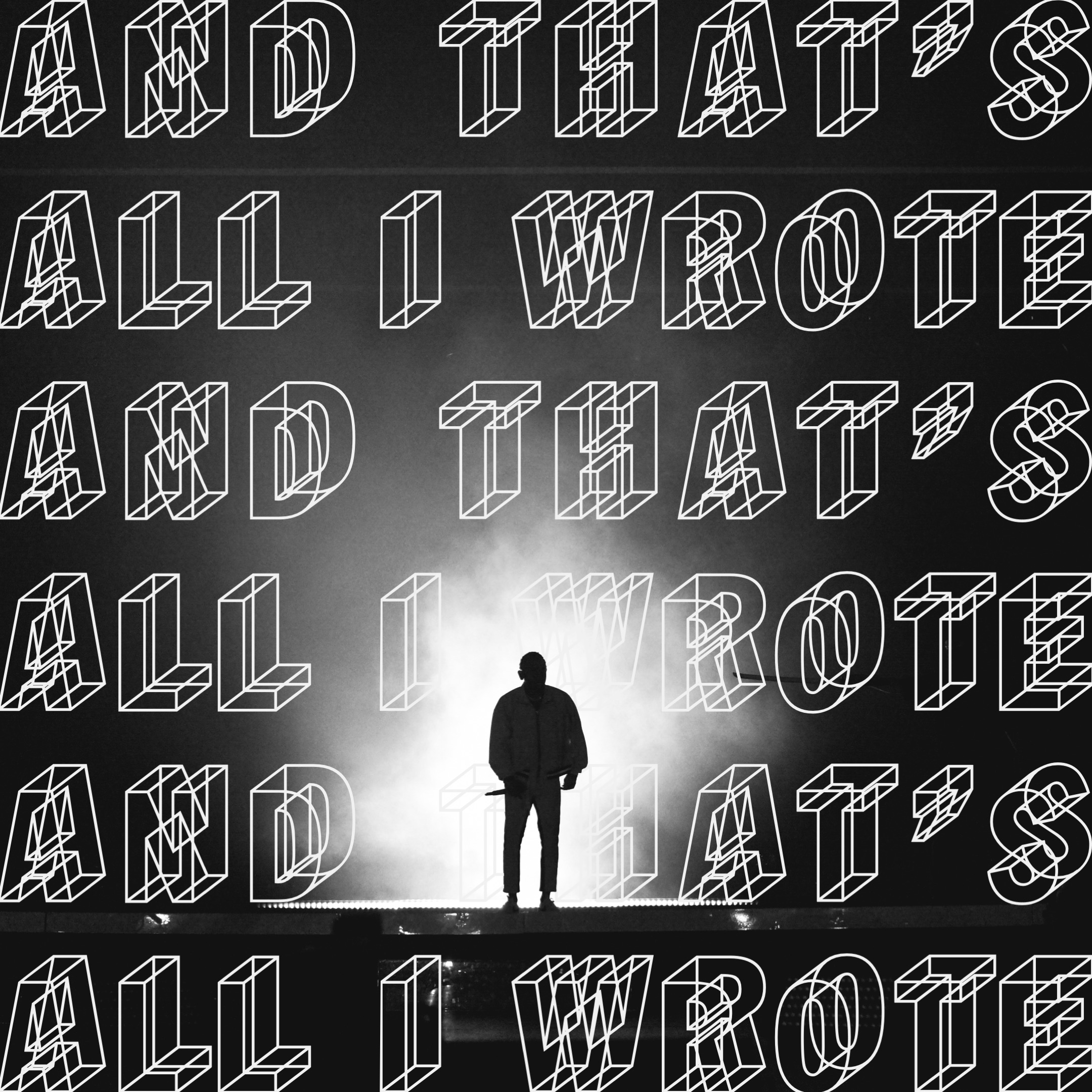
Annotations on
Kendrick Lamar’s To Pimp a Butterfly


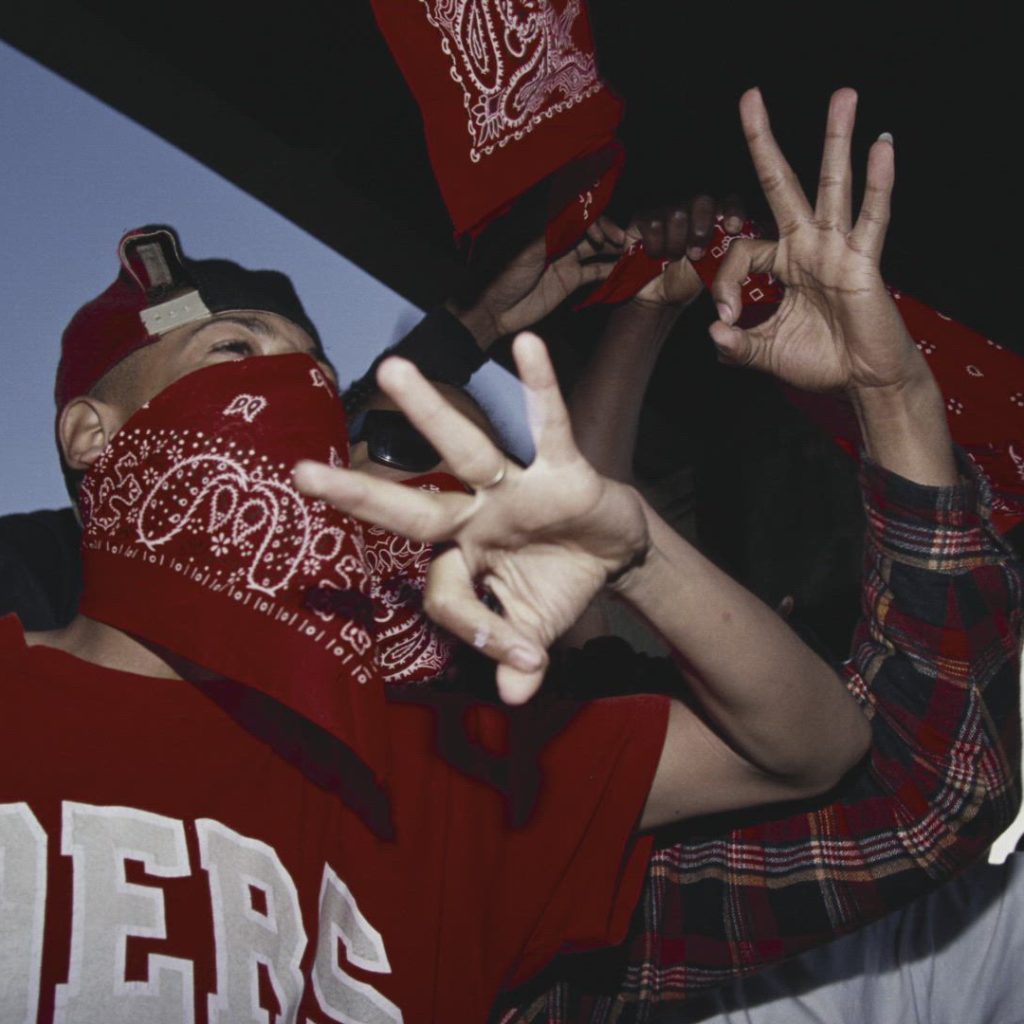
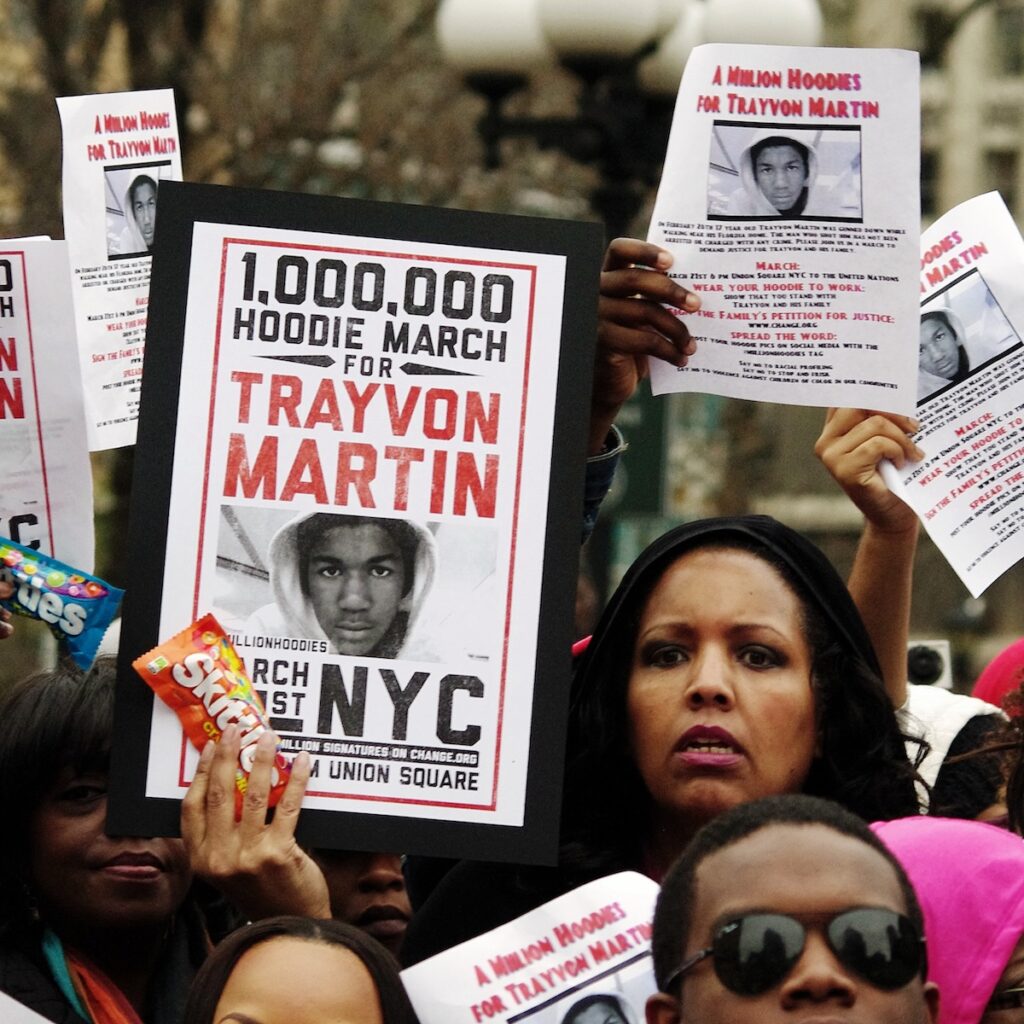
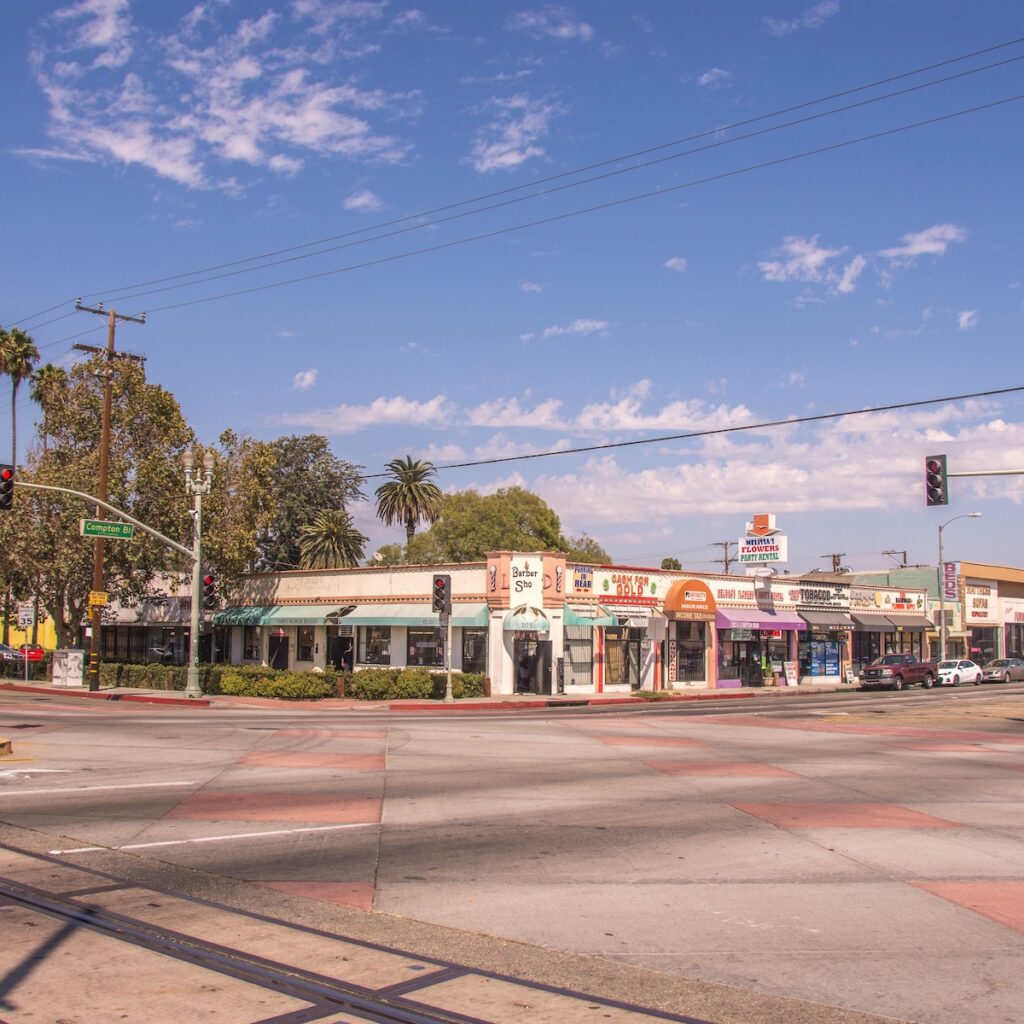
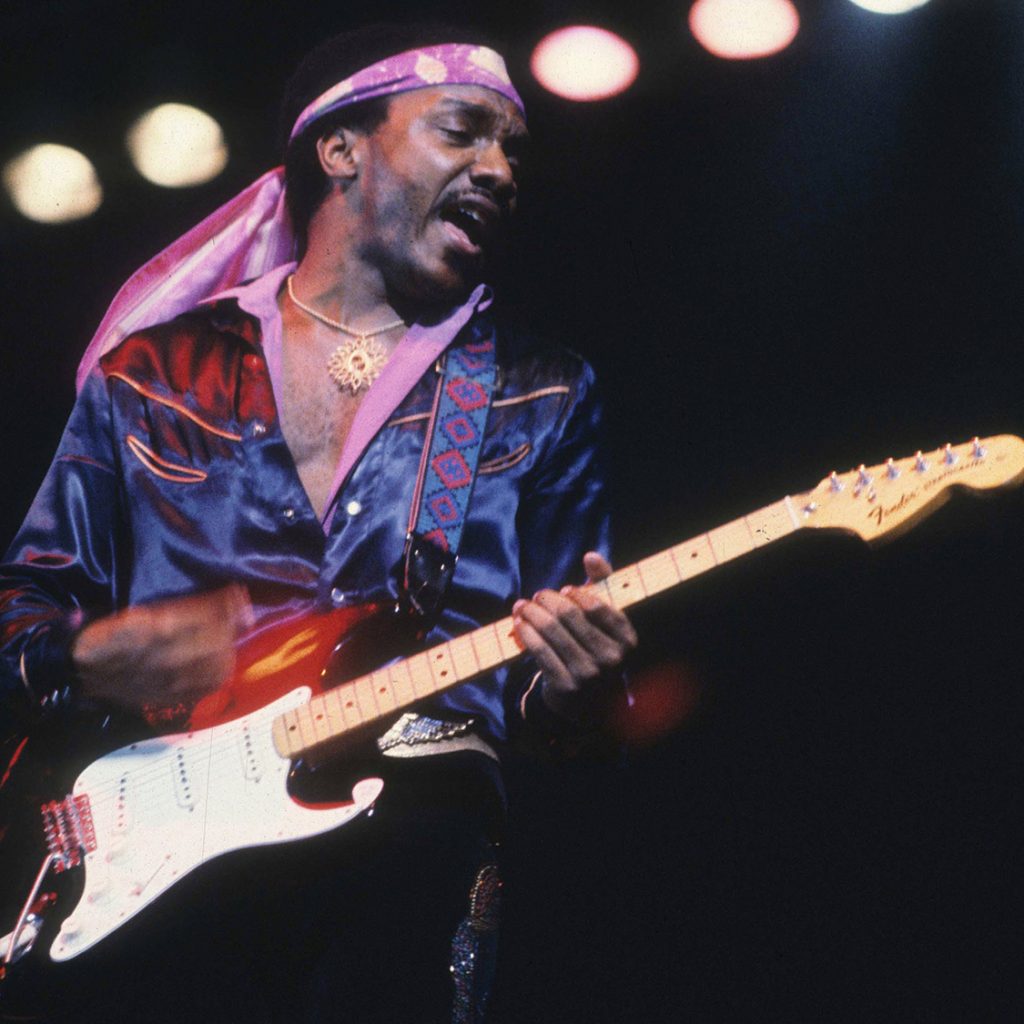
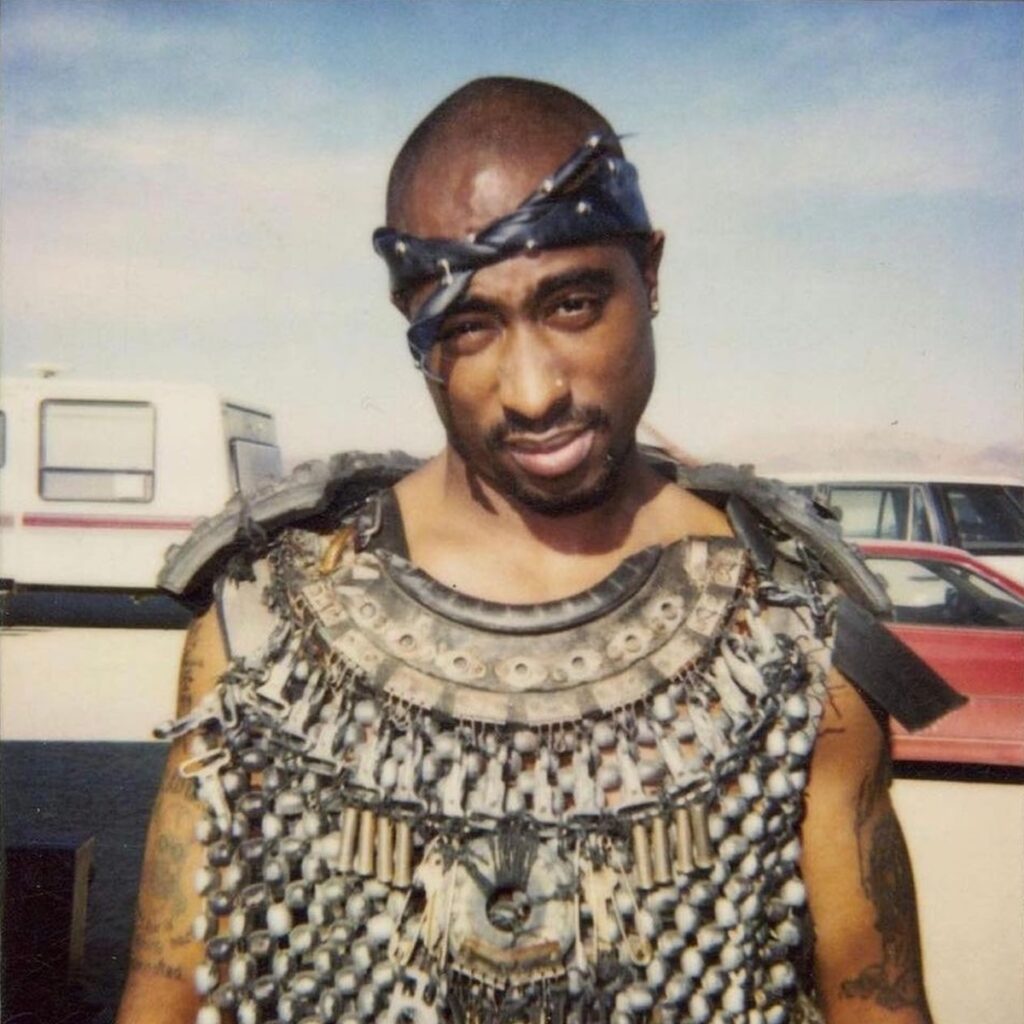
I started this project in the summer of 2024, when I finally put in a request to teach a Higher Level International Baccalaureate (IB) class. This was the last year that my workplace were doing the IB; they had run the numbers and realised that having dwindling class sizes with for it versus too many teachers wasn’t exactly economically viable. So I chose to take on this final class despite the fact that there were teachers in my department who taught the IB for years, because the only reason I’d avoided staking my claim was because I’d spent those years assuming that we’d always teach the IB. Now, with its head on the chopping block, I wanted one final opportunity to feel what it would be like to have an increased level of freedom to plan my own curriculum.
It felt a bit like stealing food out of the mouths of babes. One of the IB’s strengths is that it has a robust list of prescribed texts, taking in stuff from across the world rather than being hemmed in by the narrow-minded focus on English and American literature that defines most A-level English Literature syllabi. This includes stuff off the beaten path, such as essays, comic books, haiku, manga, letters, spoken word, and song lyrics. Still, with one hand the lord giveth, and with the other he puncheth you in the balls: while there are plenty of Spanish lyricists on their list (and a smattering of Portuguese ones too), the English-language songwriters are few and far between: Bob Dylan, Joni Mitchell, Stephen Sondheim, and just one rapper: Kendrick Lamar.1John Lennon’s also in there, but fuck that, right? I mean he’s a brilliant musician, but as a lyricist he’s very much the ragged fifth training wheel on Dylan, Joni, Sondheim and Kendrick’s majestic Canyonero. As we culturally move away from the shadow of the baby boomers (who, like any generation, confuse childhood nostalgia with artistic greatness), it’s reassuring to see more people realise that Lennon’s lyrics are just . . . fine. They have about the same degree of occasionally brilliant wordplay, vaguely leftist virtue signalling and Freudian self-absorption as the rhymes of Kanye West — and I say that as a millennial who’s had the displeasure of watching Kanye West shit all over any childhood nostalgia we had for him.
I mean, if you’re going to only include one rapper, it probably should be Kendrick Lamar. We could argue till the cows come home about other rappers who should be included, like Nas, Tupac, Andre 3000, and Earl Sweatshirt — let alone other songwriters such as Tom Waits, Fiona Apple, Nick Cave and Joanna Newsom (who’s probably the only one that would get in even if you never heard a note of her music). But the reality is that Kendrick Lamar is the only well-known high-level rapper who has — from the jump — devised every single album as individual artworks where all the songs form a singular, cohesive narrative unit.
With that in mind, I knew I wanted to focus on a Kendrick album, and I knew I wanted it to be To Pimp a Butterfly. I know fans have their favourites. In fact, if I’m being honest, my Spotify stats show that I listen to Good Kid, M.A.A.D City more often. But even I recognise that To Pimp a Butterfly is Kendrick Lamar’s masterpiece. It’s his most cohesive statement: an exploration of the American dream by a man who’s not sure if he’s the second coming or a false prophet, set to music that builds on a century of black American artists while also pushing the hip hop in a new and promising direction. And — by arriving during the final year of Obama’s presidency, during the rise of Black Lives Matter and one year before the moral depravity of the Trump era — it has become a political and personal time capsule, just as essential as Marvin Gaye’s What’s Going On or Sly and the Family Stone’s There’s a Riot Goin’ On or Public Enemy’s It Takes a Nation of Millions to Hold Us Back.
It’s also worth noting that I started teaching this class in the same year that Kendrick temporarily became the most important rapper in hip hop. For a few days in the summer of 2024, we all listened in awe as he tore Drake a new asshole by releasing a series of diss tracks released with such shrewd skill that it led F. D. Signifier2Arguably the sharpest video essayist on black American culture to point out that, in a more moral world, we would recognise Kendrick as an evil villain. Instead, he was lifted onto the shoulders of society, performing at the Super Bowl and touring the world with SZA in what felt like a moment of light and levity during the tailspin of the second Trump term.
So, naturally, I felt 2024 was the perfect time to teach a small group of white British middle-class teenagers about the alterity of the black American experience through the lens of a man who has been telling everyone he’s the greatest rapper alive since at least 2009. My syllabus included a playlist I created on the evolution of rapping from Grandmaster Caz to the present day, along with listening to Good Kid, M.A.A.D City and Cole Cuchna’s brilliant Dissect podcast. As I suspected, their ability to engage with the complexity of the album improved as the term went on; as I hoped, it gave them some aesthetic appreciation for the level of lyricism expected in even your journeyman boom-bap rapper versus the excessive praise that gets heaped on songwriters like Taylor Swift and Lana Del Rey. Most of all, however, I hope it highlighted my central thesis, which is that — while the Democrats were virtue signalling with kente cloth and middle-class white people were reading airport books about how to speak to black people as if they’re foreign animals — the easiest way to understand the experiences of black Americans is to engage with black American culture.
Notes on the design
Transcribing lyrics isn’t easy, and transcribing hip hop lyrics comes with unique difficulties. Rapping is a verbal and musical art form, so you end up worrying about all these paratextual elements that don’t come into play when the words begin on the printed page — things like vocables, pace, and the presence of different voices, along with how to mark out pitch, rhyme, rhythm and accents (or metre and stress if you’re more used to using poetic terminology). And that’s not even counting the music beneath the lyrics: there’s an entire branch of musicology that has arguably grown out the fact that standard musical notation can’t capture every element of what you’re hearing when you listen to recorded music. While it’s easy enough to show pitch, duration and dynamics using , there are timbral features such as reverb and echo that either have to be explained through figurative language or images, graphs and equations.
Let me be clear here: in my opinion, analysis isn’t just the process of taking things apart; it also involves laying out the parts in such a way that the reader feels as if they could recreate it from scratch too. In other words, you can’t take apart the TV unless you’re willing to make an IKEA-style instruction manual on how to put it back together. Ideally, analysis is a Promethean task that helps the next generation of artists to make great art.
If we’re going to break down Kendrick Lamar’s music, we need to use whatever methods of communication we have to hand, since inventing some new language just gets us one step closer to dancing about architecture. So — with that in mind — here’s an explanation of the garden tools that I’ve used to write about Kendrick Lamar’s music.
Notation versus text
Working out how to transcribe rapping is slowly becoming its own academic niche, with people like Paul Edwards, Adam Bradley, Martin Connor, and — most recently — Mazbou Q coming up with inventive ways to mark out features of rhythm, rhyme, dynamics and pitch alongside lyrics. However, while these auditory features are incredibly important, they only make up one branch of the linguistic tree; and while Kendrick Lamar is an interesting rappers from a musical perspective, his lyrics are just as interesting when it comes to things like semantics (meaning) and lexis (word choice). Arguably, if we only approach his lyrics as music, it overlooks the degree of craft that he puts into these linguistic elements, along with ignoring the way that most of his audience gain a deeper understanding of his music (since most everyone can interpret meaning in language while even some rappers have to learn to count bars). There’s also an argument to be made that Lamar himself is a words-on-a-page writer; while it’s becoming more common for rappers improvise in the booth and craft their writing by punching in different sections, Lamar mostly focuses on crafting his words and syntax before recording begins while memorising the musical features of his delivery.
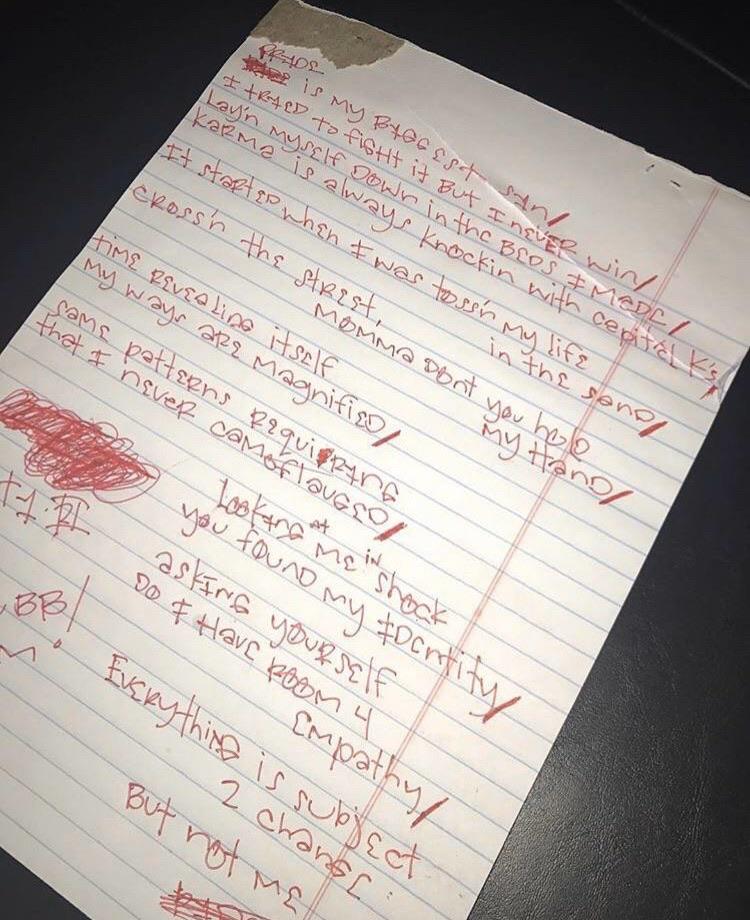
Kendrick Lamar’s handwritten lyrics for an unused third verse for “PRIDE.” from the album DAMN., shared by Top Dawg Entertainment’s president Punch on Instagram.
For this reason, I’ve chosen to break each essay in two parts: the first half focuses on musical elements (such as the beat, the melodies, and so on), while the second half focuses on the linguistic elements (such as the metaphors, allusions and structural motifs that Lamar employs throughout the album). Specifically, the musical half of the essays rely on a blend of evocative language3My decision to use this type of language is primarily influenced by Philip Tagg‘s Music’s Meanings, an exhaustive book that explores how to write about music for people who aren’t familiar with terms used by musicians and musicologists and sheet music (created in Sibelius) to illustrate my points, along with occasionally providing audio clips and screen caps from Logic Pro, my digital audio workstation of choice, where I’ve painstakingly recreated the songs from scratch. In the places where I’ve felt it’s useful to transcribe Lamar’s rapping into sheet music, I’ve colour-coded the rhymes by highlighting both the notes and lyrics. Lamar is a an incredibly versatile rapper — in the span of one album, he can go from sounding like Snoop Dogg to E-40 to DMX4Though even virtuosos have their lane: you can’t really imagine Lamar doing the kind of wild melodic backflips that you’d expect on a Young Thug or Lil Uzi Vert record — but his main mode of rapping uses the same kind of intonation that his hero, 2Pac, used, often bouncing between three or four untuned pitches and volumes to accent particular words like a drummer hitting hi-hats, cymbals and toms against a steady backbeat. For this reason, I’ve mostly chosen to employ the neutral clef for Lamar’s raps while providing however many ledger lines it takes to approximate his changes in pitch. On the other hand, when Lamar employs a more diatonic and melodic style (like on “You Ain’t Gotta Lie [Momma Said]”), I’ve opted for the bass clef, with the different pitches indicated using standard noteheads.5These methods for notating rapping are taken from Robert Komaniecki, whose journal article “Vocal Pitch in Rap Flow” provides a great overview of the strengths and weaknesses of using this kind of approach.
By comparison, the second half of each essay features a lyric sheet that contains annotations in a style similar to the website Genius. Since there are so many annotations, each one is colour-coded, and the annotation itself can be pulled up either as a tooltip or a footnote. On laptops and desktop computers, the tooltips are found by hovering your mouse over the superscript number; on tablet and smartphone devices, they can be found by tapping the number, which will then open the note beneath the paragraph as a collapsible block element.6I want to take a second to thank Sean K Williams here for his brilliant WordPress plugin Modern Footnotes, which allowed me to achieve all of this with excellent user-friendly aesthetics instead of spending days futzing around with CSS and HTML trying to get things to look just slightly not-shit.
In those moments where the musical features of Lamar’s rapping are particularly important, I’ve mentioned them in the first half of the essay and provided some detailed analysis with sheet music and audio examples; in those moments where the features are merely worth noting, I’ve included it the annotations to the lyrics. Ultimately, this two-part essay structure is a bit of a kludge, since it implies that the musical and linguistic elements of rapping can be separated when they’re really inextricable. Such is the nature of analysis, I guess — even the deconstructionists end up imposing their own structures on everything.
Line breaks and punctuation
In any music, there’s an interplay between the hidden heartbeat of the metre, the bounce, snap and clatter of the beat, and the gallup of the vocals that make it almost impossible to accurately transcribe with just words on the page. Of course, the alternative is to notate all of the music including the vocals, which is an equally OTT thing to do when you’re primarily focusing on the lyrics. A kind of hybrid solution, then, can be captured if we partially do away somewhat with the grammatical function of punctuation, and instead turn the line break into the main unit indicating a pause in rhythm. For example, compare these lines:
At first, I did love you, but now I just wanna fuck.
Late nights thinking of you until I get my nut.
Tossed and turned, lesson learned—
you was my first girlfriend.
Bridges burned all across the board—
destroyed. But what for?
At first I did love you
But now I just wanna fuck
Late nights thinking of you
Until I get my nut
Tossed and turned, lesson learned
You was my first girlfriend
Bridges burned, all across the board
Destroyed, but what for?
While the lines on the left are more accurate in terms of delineating the grammatical relationship between the words, the lines on the right are easier to audiate in a similar way to the original song. And you can already see that we’re going to become pretty reliant on dashes if we continue with the heavily punctuated approach, because rappers often use angular poetic syntax when it comes to combining phrases rather than a prosaic one. In other words, they don’t really write in straightforward subject–verb–object sentences; there is no subject to the clause “tossed and turned, lesson learned”, while the clause “bridges burned all across the board” lacks a verb. So it would be disingenuous to punctuate these like sentences. Instead, the line breaks work as terminal marks for rhythm because they can be used anywhere within a series of words, so it reflects the fact that the two primary ways poets create rhythm on the page is through space and the implied stress of a new line.
There are also those smaller pauses, such as between the phrases “tossed and turned” and “lesson learned”. In these cases, I’ve used the comma to indicate these rhythmic pauses. Again, the thinking behind this is descriptive rather than prescriptive; you’ll find thousands of people online and IRL saying that a comma indicates a pause in speech, despite the fact that even open-minded linguistic guides like Rodney Huddleston and Geoffrey K. Pullum’s Cambridge Grammar of the English Language make it pretty clear that this isn’t the case. Because the reality is that people do like to use commas in this way, and not just in text messages and other forms of demotic writing: I’ve always loved the fact that Jane Austen’s famous opening line to Pride and Prejudice says: “It is a truth universally acknowledged, that a single man in possession of a good fortune, must be in want of a wife.” Austen’s commas make no sense in terms of traditional grammar; she’s treating the word “that” as if it introduces a relative clause, like “which”, and she simply puts a comma before “must” because it feels right to her. So I’ve opted to use commas the way Austen uses commas, as an indicator of rhythm.
Grammar and orthography
In terms of grammar and syntax, transcribing Lamar’s lyrics runs into the thorny issue of how to capture Black American English in written Standard English.7For a detailed exploration of why different linguists refer to this language variety by different terminology, check out this post from Language Jones, who’s a shining representation of how you can get invited to the cookout by simply bothering to taking up a lifelong interest in people who don’t look and talk like you When someone speaks in a distinct variety of English, how much do you deviate from the linguistic prescriptivism of Standard English in an attempt to render things like phonology and grammar? Or, to put it differently, how can you make sure you don’t end up writing something that sounds like the characters in Porgy and Bess?
In my view, an easy kludge is to render all the grammar and almost none of the phonology. In other words, when Kendrick says “I remember you was conflicted”, I’m not going to correct that to “were”, since the nonstandard “was” is literally a different word; but I’m also not going to render “misusing your influence” as “misusin’ ya influence” because employing eye dialect creates the implication that everyone except Black Americans pronounce words exactly as they’re written, when in reality most North Americans drop the velar nasal sound at the end of “misusing” when they have to read the word aloud. As any dyslexic person will tell you, English orthography doesn’t really reflect pronunciation, so altering the spellings to reflect Black American English is just another way of othering black people and implying they aren’t normal, which is its own pernicious kind of racism.
Layout and voices
Finally, there are plenty of moments where Lamar relies on a polyphony of voices to to create both rhythm and dialogue within the music. In these moments, it’s not enough to simply lay the words out using the traditional top-to-bottom structure of English typesetting. For example, Anna Wise and Whitney Alford’s chants of “tax man coming!” at the end of “Wesley’s Theory” rise up in volume right as George Clinton and Thundercat singing “money, go back home” tails off. The closest way this can be approximated on the page without resorting to sheet music is to steal a trick from comic books and use a multidirectional column-and-grid layout, since it disrupts our sense of whether to read left-to-right or top-to-bottom first, thereby indicating that there are two things happening at the same time.
REFRAIN
Thundercat & George Clinton
We should never gave niggas money,
OUTRO
Anna Wise & Whitney Alford
Go back home, money, go back home.
Tax man coming, tax man coming
Tax man coming, tax man coming
The pinch being, of course, that this layout is still reliant on the annotations being read on a device that has plenty of screen space. If you’re reading this on a phone, then it will simply place everything in a hierarchical top-to-bottom shape of block elements. Of course, this kind of responsive design is still preferable to constantly scrolling left and right in an attempt to read everything linearly.
Now, let’s get on with the show: hit the arrow to go back to the tracklist at the top of the page.
List of personnel
Ambrose Akinmusire
Trumpet
Anna Wise
Vocals

Adam Turchin
Baritone saxophone

Ash Riser
Background vocals

Bilal
Vocals
Boi-1da
Producer
Bootsy Collins
Drums
Boris Gardiner
Vocals
Brandon Eugene Owens
Double bass

Candace Wakefield
Background vocals
Chris Smith
Bass
Craig Brockman
Hammond organ
Darlene Tibbs
Vocals
Dave Free
Background vocals
Derek Ali
a.k.a. MixedByAli
Mixing

Devon Downing
a.k.a. Yan Yan
Background vocals

Dion Friley
Background vocals
Dr. Dre
Executive producer and background vocals and

Edwin Orellana
Background vocals
Flying Lotus
Producer

Gabe Noel
Cello and double bass
George Clinton
Vocals
Greg Moore
Guitar

James Hunt
Audio engineer

James Fauntleroy
Vocals
JaVonté
Background vocals
Jessica Vielmas
Background vocals
Josef Leimberg
a.k.a. LoveDragon
Producer, trumpet and background vocals
Junius Bervine
Keyboards
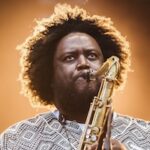
Kamasi Washington
Tenor saxophone and string arrangements
Katalyst
Brent Kolatalo & Ken Lewis
Drum programming and additional engineering
Keith Askey
a.k.a. Kaveman
Guitar
Kendall Lewis
Drums
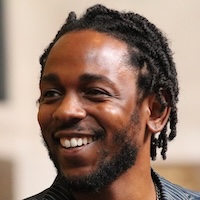
Kendrick Lamar
Vocals
Knxwledge
Producer

Koz
Stephen Kozmeniuk
Producer

Lalah Hathaway
Background vocals
Larrance Dopson
Producer, percussion and keyboards
Marlon M. Williams
Guitar

Mats Nileskär
Interviewer

Matt Schaeffer
Audio engineer and guitar

Mike Bozzi
Mastering
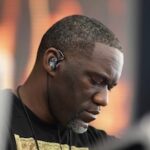
Monte Neuble
Talkbox

Paul J. Cartwright
Violin

Pedro Castro
Clarinet
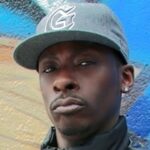
Pete Rock
Background vocals and record scratches
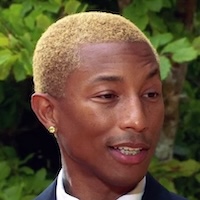
Pharrell Williams
Producer and vocals

Preston Harris
Background vocals
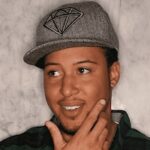
Rahki
Producer and percussion
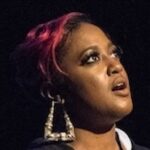
Rapsody
Vocals
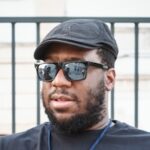
Robert Glasper
Piano and keyboards
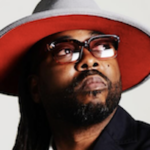
Robert “Sput” Searight
Drums and keyboards

Ronald Bruner Jr.
Drums

Ronald Colson
a.k.a. Flip
Producer
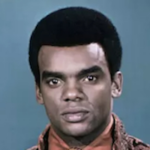
Ronald Isley
Vocals

Sam Barsh
Piano and keyboards
Snoop Dogg
Vocals
Sounwave
Producer, keyboards and string arrangements
SZA
Background vocals

Tae Beast
Producer

Taz Arnold
a.k.a. TI$A
Producer and background vocals

Terrace Martin
a.k.a. LoveDragon
Producer, alto saxophone, keyboards, vocoder, horn and string arrangements

Thundercat
Producer, bass and vocals
Tommy Black
Producer
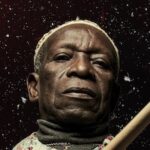
Tony Allen
Drums
Tyran Donaldson
a.k.a. The Antydote
Producer

Whitney Alford
Background vocals
Whoarei
Producer

William Sweat
Background vocals
Wyann Vaughn
Background vocals
Footnotes
- 1John Lennon’s also in there, but fuck that, right? I mean he’s a brilliant musician, but as a lyricist he’s very much the ragged fifth training wheel on Dylan, Joni, Sondheim and Kendrick’s majestic Canyonero. As we culturally move away from the shadow of the baby boomers (who, like any generation, confuse childhood nostalgia with artistic greatness), it’s reassuring to see more people realise that Lennon’s lyrics are just . . . fine. They have about the same degree of occasionally brilliant wordplay, vaguely leftist virtue signalling and Freudian self-absorption as the rhymes of Kanye West — and I say that as a millennial who’s had the displeasure of watching Kanye West shit all over any childhood nostalgia we had for him. ↩︎
- 2Arguably the sharpest video essayist on black American culture ↩︎
- 3My decision to use this type of language is primarily influenced by Philip Tagg‘s Music’s Meanings, an exhaustive book that explores how to write about music for people who aren’t familiar with terms used by musicians and musicologists ↩︎
- 4Though even virtuosos have their lane: you can’t really imagine Lamar doing the kind of wild melodic backflips that you’d expect on a Young Thug or Lil Uzi Vert record ↩︎
- 5These methods for notating rapping are taken from Robert Komaniecki, whose journal article “Vocal Pitch in Rap Flow” provides a great overview of the strengths and weaknesses of using this kind of approach. ↩︎
- 6I want to take a second to thank Sean K Williams here for his brilliant WordPress plugin Modern Footnotes, which allowed me to achieve all of this with excellent user-friendly aesthetics instead of spending days futzing around with CSS and HTML trying to get things to look just slightly not-shit. ↩︎
- 7For a detailed exploration of why different linguists refer to this language variety by different terminology, check out this post from Language Jones, who’s a shining representation of how you can get invited to the cookout by simply bothering to taking up a lifelong interest in people who don’t look and talk like you ↩︎