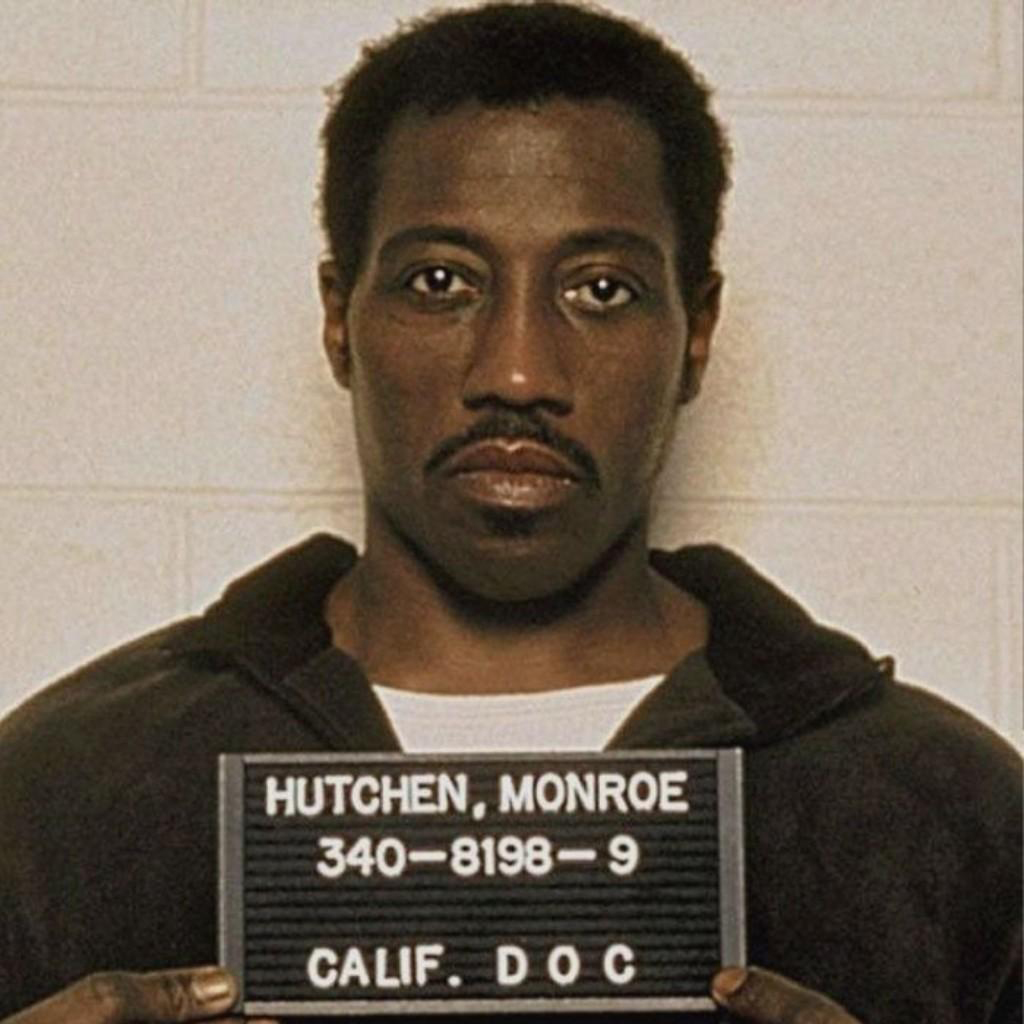
As the first track on the album, “Wesley’s Theory”1The title alludes to the actor Wesley Snipes, who was indicted in 2006 for tax evasion and tried to claim he was a “non-resident alien” of the U.S. By presenting this pseudo-legal defence as a “theory”, Lamar asks us to consider the socio-economic forces that lead black celebrities to struggle with fame and view themselves as outsiders to the country and culture that gave birth to them. has plenty of heavy lifting to do, yet it can’t be overstated just how brilliantly left-field this song is in terms of both breaking our expectations and establishing our framework for understanding the rest of the album.
Introductions
Most classic hip hop albums — particularly those from the Golden Age — feature skits and record samples. In fact, it’s part of the genre’s unwritten rules of conduct that any album that aspires to the status of a hip hop classic usually begin with one or the other or both. Some memorably iconic examples include the Shaw Brothers film sample that kicks off Enter the Wu-Tang (36 Chambers), the huffy professor asking Kanye West to give a valedictorian speech on The College Dropout, and the niche-kink ASMR that is Snoop Dogg in the bath receiving a back rub at the beginning of Doggystyle.
But it’s easy to forget that even a straight-ahead rap album like Nas’s Illmatic begins with the low rattle of the New York Subway, a clip from the 1982 hip hop film Wild Style, and a trebly snippet of the rapper’s iconic debut verse on Main Source’s “Live at the Barbeque“. Arguably, Nas’s opening is one of the few that has stood the test of time since he didn’t treat it as an opportunity to quote his favourite films or write sub-par sketch comedy. Instead, through the magic of intellectual montage, the opening to Illmatic establishes all the key info we need to know about Nas: this is where he comes from, this is where he’s been, and this is where he’s going.
Like Nas, Kendrick Lamar understands that skits and samples can be used as essential narrative units rather than superfluous ornaments. On Section.80, he began braiding short skits throughout his albums, using these brief snippets of speech to act as elliptical scenes from a larger narrative. Through this approach, he found a way to continue the tradition of using skits and samples while avoiding the diminishing returns of toilet humour and scenes of hood violence. Plus it gave him some of those traditional Rolling Stone-reader bona fides too, since offsetting the narrative structure onto spoken word skits allowed him to avoid the indulgent theatrical flourishes that have plagued all good concept albums since the prog rock era.
So it’s natural that anybody listening to To Pimp a Butterfly for the first time might expect this album might open like its predecessors by providing a skit that establishes the first thread of an ongoing narrative. And while Lamar will eventually elevate his skits to a whole new level across this album, that’s not how things begin here at all. Instead, we hear a needle drop, followed by soft record noise and a soul sample emerging from the lower frequencies like buried treasure.
This is familiar enough territory for a hip hop album: sampling has been an integral part of the genre from the jump, so an oldies song like this signifies ancestral authenticity, as if we’re about to listen to something with the mid-90s East Coast boom-bap sound. But the real twist comes when the record begins to skip on the word “star”.2Of course, this is actually an artfully simulated record skip, done by having the producer loop the first beat of the bar. Wisely, Lamar gets us to suspend our disbelief by providing the record noise at the start of the song so that we buy into the skeuomorphic ruse that we are listening to an old, scratchy record. Suddenly, out of nowhere, we hear an unfamiliar voice call out “Hit Me!”, imitating James Brown’s call to action on songs like “Get on the Good Foot” and “I Got a Bag of My Own”, and before you know it we’re being spaghettified into the cosmos: Flying Lotus‘s synths and electric pianos start pinging about inside the reverberated space; Thundercat‘s bass lets out liquid, squelching sounds. It’s like walking around a party with a glass of wine and stumbling across the room where everyone’s doing hard drugs.
FlyLo’s prototypes
A year before the release of To Pimp a Butterfly, FlyLo and Lamar collaborated for the first time on the song “Never Catch Me”. At the time, it seemed like an unparalleled moment of creative synergy, with Lamar rapping at breakneck speed over a beat that opens with three different drum samples falling in and out of sync like runners in a sprint before Thundercat breaks in with a restless, improvised bassline. And the song doesn’t settle from there, either, switching up halfway through into a footwork beat, morphing into jazz drumming, and leading to a middle section where everything fizzles out . . . only to recombine for a frenetic six-string bass solo. Finally, the song ends with a coda where a lone synth melody is eventually wrapped up in a brassy synth pad descends over everything like the comedown from a bad acid trip.
It was and is, quite frankly, nonpareil. The only things that sounded remotely similar were Lotus’s own Cosmogramma — an equally frenetic, omnivorous and boundary-breaking album — and Mac Miller‘s “S.D.S.”, which was the FlyLo’s sole other collaboration with a rapper. So it’s interesting to note that the beat for “Wesley’s Theory” originally belonged to Mac Miller instead of Kendrick Lamar. The Pittsburgh rapper recorded a demo over Flying Lotus and Flippa‘s original production on his unreleased song “Cocaine Is . . . ”:
It’s worth exploring the differences between the two songs to understand what Lamar and his team brought to the table. “Cocaine Is . . . ” lumbers along at 98 BPM, while “Wesley’s Theory” has been sped up to a nimble 114 BPM. Most producers would just do this with the tempo controls in Ableton or Logic or whatever digital audio workstation (DAW) they’re using, allowing all the instruments to remain locked into the same key and pitch without any transposition. But FlyLo appears to have actually just used old-fashioned Alvin and the Chipmunks-style vari-speed to increase the tempo for “Wesley’s Theory”, which gives it this kind of nervy overclocked energy by pushing it 3 semitones higher. While a high-flown critic might assume that FlyLo is paying homage to other artists who have used this vari-speed trick such as Prince (on his Camille songs) and Stevie Wonder (on “Maybe Your Baby” and “Living for the City”), it could just as likely be the case that he made a pragmatic choice if the original stems from “Cocaine Is . . . ” were audio files rather than MIDI notes, since increasing the tempo using vari-speed produces the cleanest sound with the fewest artifacts leftover after you’ve processed the audio.
Heaven and hell
The change in tempo is such a noticeable contribution since so many of the core elements are shared by both “Wesley’s Theory” and “Cocaine Is . . . ”. For example, they are both based around the same ambiguous harmonic structure, where a low pure-toned synth bass (possibly from a Roland TR-808) ascends in half notes up the F# Phrygian Dominant scale (F#→G#→A#→B) while the a Rhodes electric piano falls like warm raindrops in broken chords with two bars of Bmin13 and two of Emin6.
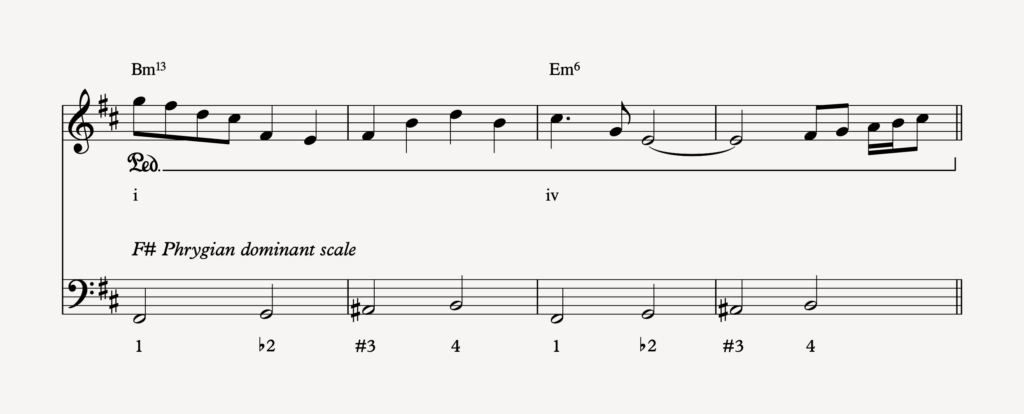
While the bassline invites us to think in terms of modal harmony, the chords encourage a functional interpretation. Modally, the bassline starts on F#, so the first chord voicing could be interpreted as F#sus4(♭6, ♭9) (voiced 7–1–4–5–♭6–1–♭9), followed by F#sus4(♭9) (voiced 4–♭9–5). But breaking down the voicings like this means they both lack a third — and while having one chord without a third is acceptable, if all your chords lack a third, you’re probably thinking in the wrong key.
By comparison, a tonal analysis of the harmony places us in the key of B minor, with the bassline drawing on the B harmonic minor scale. The chords begin on the i (Bmin13) and move to the iv (Emin6), but the bassline begins on the dominant F# and ends on the tonic of B. While the bassline outlines a perfect cadence, the chords do the opposite, creating a tension that never resolves but simply loops over and over again, and this is one of the key factors that contributes to the song’s oddly unsettling mood, where the lyrical speaker of Kendrick is throwing himself into hedonism while clearly being dragged towards an afterlife in hell.
For this reason, it makes an odd kind of sense to interpret “Wesley’s Theory” through the lens of both modal and functional harmonic analysis, since the two centres of tonal gravity are kind of like the way that people always think of heaven and hell as polar realms above and below the Earth, and the album presents itself as an exploration of what happens when a successful artist finds himself torn between these two poles.
Boots on the ground
FlyLo also carries over the steady groove of the drum beat from “Cocaine Is . . . ” while adding some fills that aren’t there in the original song. There’s no drummer listed in the liner notes, so I spent some time debating whether or not they’re played live, since there’s a few details that it can be hard to program unless you’re used to doing high-level drum replacement — which, to be fair, is increasingly common in modern records, but is also kind of anathema to FlyLo’s usual approach (where he avoids quantization by blending samples with programming). For example, the eighth notes on the hi-hat are accented with the shank/tip method, which adds some funk to the groove by giving it some dynamic heft on the downbeats, but this is a trick that relies on you either having a real hi-hat or a sample set (such as Toontrack’s Superior Drummer) with a range of timbres that can approximate the real thing. Similarly, the fills and ghost notes feature the kind of dynamics and micro timing that come with playing real drums. For example, most drummers will hit each drum just a bit quieter and less accurately with their weaker hand, which means on-beats tend to sound slightly louder since the dominant hand usually keeps the pulse. While a producer can “humanise” these elements in a DAW, it’s a different kind of humanisation to the Dilla time rhythms that FlyLo usually employs.
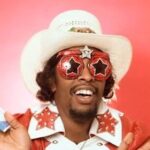
So my initial assumption was that Flying Lotus might have played the drums himself, since he does acknowledge that he has a drum set in his studio in this interview with Ableton. However, something sounded so distinctly familiar about the drums that I still kept digging, since it’s the kind of subtle yet solid playing that you can hear on hundreds of black American throughout the 60s and 70s. And then it hit me: it’s the drum track from Funkadelic’s “(Not Just) Knee Deep” — a song famously sampled by Prince Paul on De La Soul‘s “Me Myself and I“. And the drummer is someone who isn’t actually known for their drumming at all: Bootsy Collins, the legendary bassist for the iconic iterations of James Brown’s J.B.’s and George Clinton’s Parliament-Funkadelic (along with having an amazing solo career of his own).
Bootsy’s influence is obviously all over Thundercat’s bass playing on “Wesley’s Theory” — more on this later — but his drumming on “(Not Just) Knee Deep” is far more subtle and reserved. Still, you don’t even need to listen to all 15 minutes and 21 seconds of the song to catch it’s influence on “Wesley’s Theory”; Bootsy plays all the beats and fills that Flying Lotus uses in the first 3 minutes. And the influence is even clearer when you realise that the songs are only a whisker away from each other in key and tempo: while “(Not Just) Knee Deep” clips along at 115 BPM in A minor, “Wesley’s Theory” is only one step behind it at 114 BPM in B minor.
If we compare both tracks side-by-side, it becomes increasingly hard to deny that FlyLo probably created the drums on “Wesley’s Theory” by chopping up samples of the original stems and layering other single-hit drum samples on top to fill out the kick drum and snare. There are prominent handclaps over the top of the Funkadelic song, but the underlying drumming is the same. Have a listen below to the two main drum beats, along with all the fills, played one-after-the-other:
However, this is just my theory — and the problem with asserting it at all is that there might be a good reason, in terms of sample clearance, for FlyLo not to show his hand. Like most sample-based artists, he’s often secretive about where his samples come from, and that’s only right; as the musician Blake Robin (a.k.a. Luxxury) seems to be arguing in his forthcoming book How to “Steal” Music, the laws around copyrighting songs are shady as fuck, so it makes sense for artists who rely on samples to operate in the shadows. Plus there’s the added issue that while the estates of George Clinton and Philippé Wynne would get the songwriter royalties (based on this data from the American Society of Composers, Authors and Publishers), it’s arguably Bootsy’s writing, so he’s the one who deserves the money. It’s his drumming, after all. So even writing this down is a bit of an ethical quandary for me, and I can only hope — based on the prevalence of P-Funk samples in hip hop — that this doesn’t cause some intellectual property lawyer to become tumescent with glee.
A canyon of synths
But the real jewel in FlyLo’s contributions isn’t a sample; it’s the cavernous spelunking that he creates with all his synthesizers on the song. Here’s an example of where these sounds are at their most prominent in the second chorus, taken from my recreation of it in Logic:
There’s one repeating 8-bar phrase of ascending and descending plinks slathered in so much echo, reverb and pitch-shifting that each note sounds like a needle trying to prick holes in the heavens. Meanwhile, an asymmetrical squiggle of falling notes, trebly burbles, and whistling electric piano tones scatter themselves along the audio spectrum like stones dropped down a canyon. Beneath this, a synth patch that’s halfway in timbre between flutes and brass occasionally doubles the Rhodes piano line. It all somehow creates the sense that Kendrick is about to fall while flying too close to the sun; like Wesley Snipes, he’ll eventually be struck down by institutional forces (which The Wire creator David Simon has pointed out are the postmodern equivalent of Olympian gods) — an idea that is underscored by the doppler effect of a car siren that takes us from the end of the first verse into the refrain .
One final detail present in the “Cocaine Is . . . ” that gets repurposed in an interesting way here is the high-pitched portamento saw wave. It turns up three times: once before the refrain of “we should never gave you niggas money”, once before the voicemail from Dr. Dre, and once before the bridge with George Clinton. In each case, it’s starting G6 note pierces through the canyon of sound like a laser beam, adding to the song’s tense atmosphere.

The sound is a close cousin of the G-funk whistle which appears on songs like “Ain’t Nothing But a G Thang” and was famously employed by Michael Hunter in his theme song for the West Coast pastiche of Grand Theft Auto: San Andreas). Its appearance this early on the album is one of the many reminders that while Kendrick aspires to live the lifestyle of legendary West Coast figures like Eazy-E or Tupac, he needs to be ready for the dangers that lie on the other side of it.
Locking horns
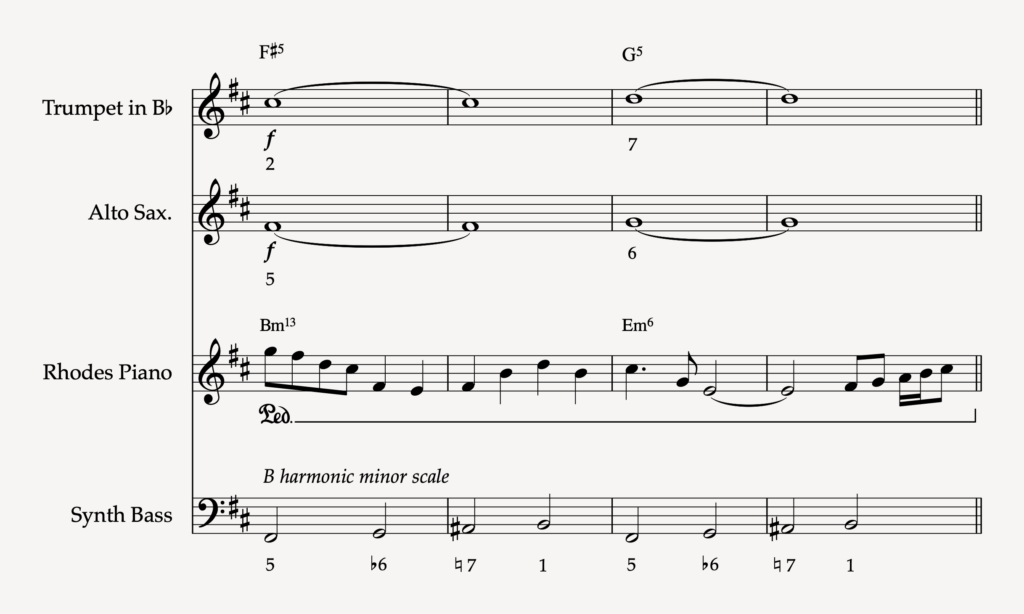
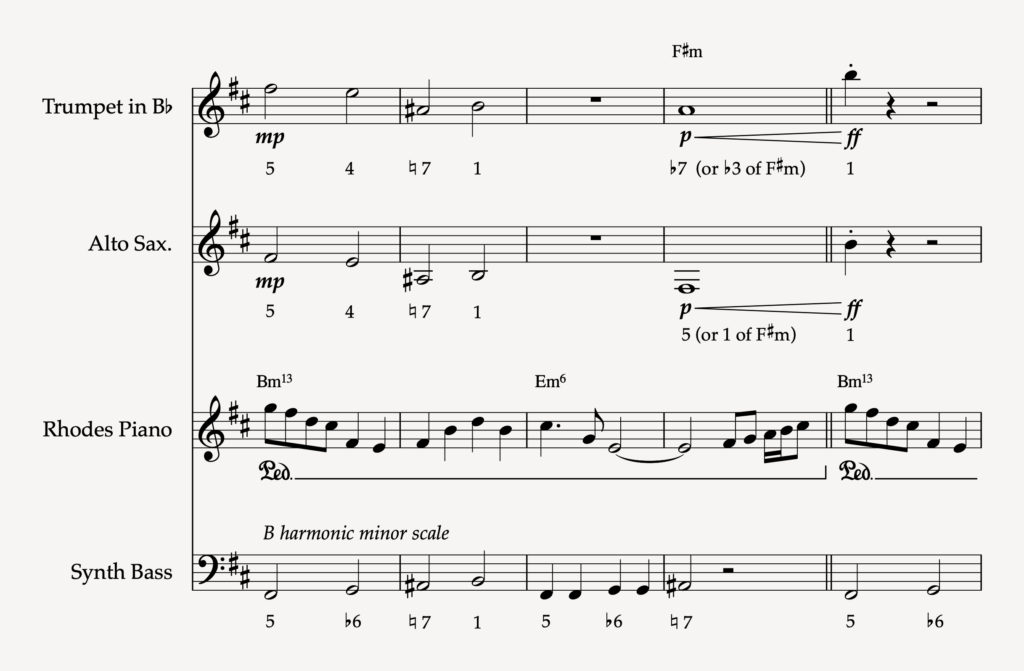
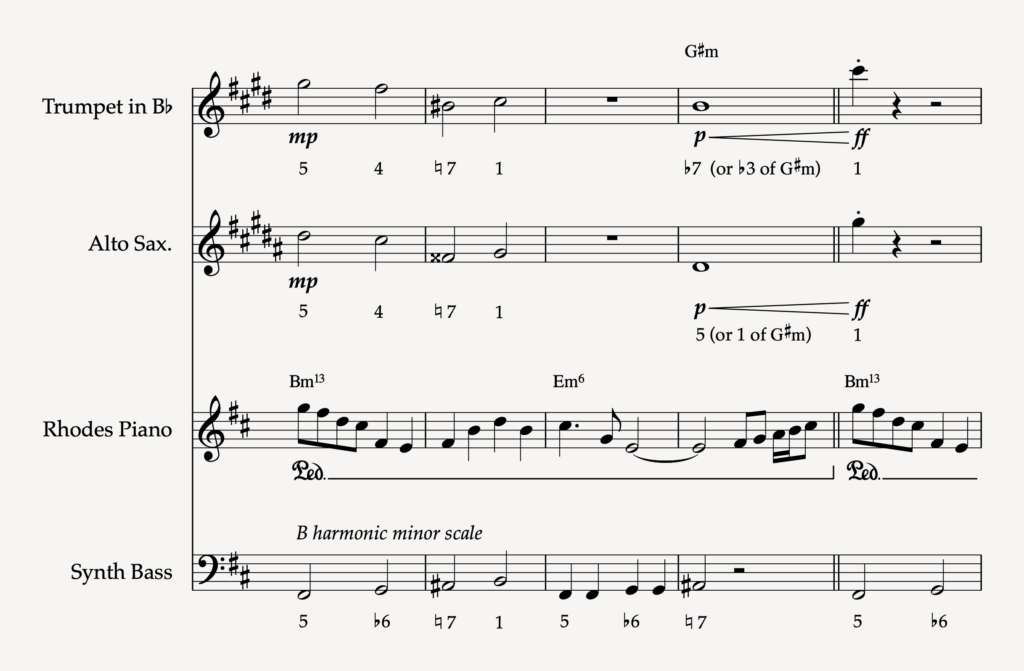
Of course, Flying Lotus and Flippa aren’t the only producers listed on the song; Sounwave and Thundercat have also been given additional producer credits, which means they’ve contributed something elemental to the arrangement or sound. If I had to guess, I would assume that Thundercat gets a credit for his bassline and vocal arrangements while Sounwave arranged the horns and added the 808 handclaps. But this is entirely conjecture; it could also be the case that trumpeter Josef Leimberg and saxophonist Terrace Martin arranged the parts themselves. Either way, the horns are a subtle yet highly effective addition. For example, there’s a moment just before the first refrain (also repeated before George Clinton’s bridge) where they blare out a fortissimo F#5 chord for two bars, rising up to a G5 chord for another two, creating a tension over the looping bassline and electric piano that — as with most tension in this song — doesn’t get resolved but simply abandoned.
N.B. Since trumpet and alto sax are transposing instruments — in B-flat and E-flat respectively — I’ve provided the dots for the horn section in both the concert pitch key B minor and transposed to their relative keys.
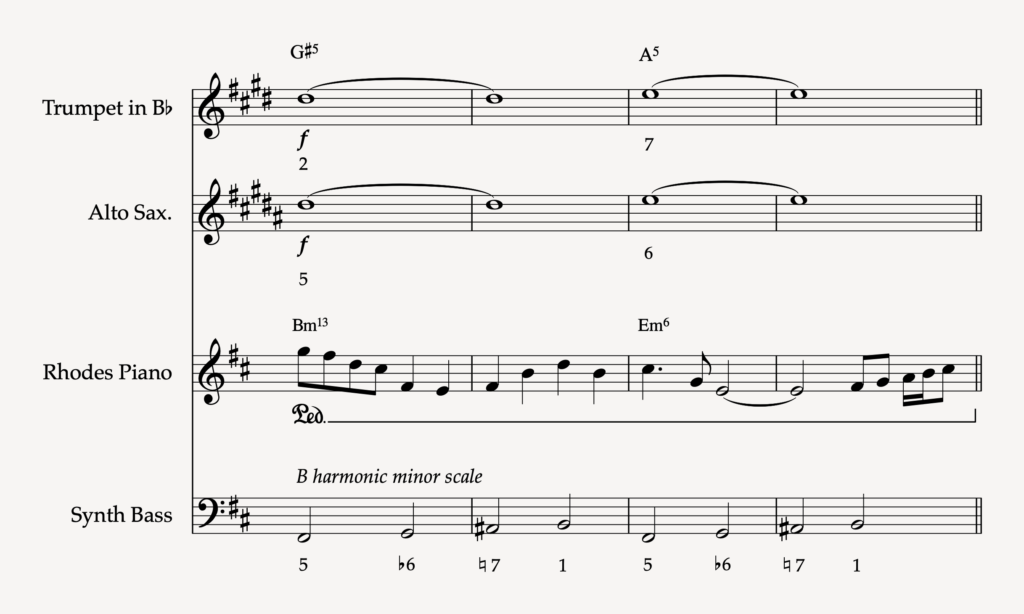
Similarly, the rhythmic tension created as the beat drops out and Lamar raps in the persona of Uncle Sam in the second verse is aided by a bar-long crescendo where the trumpet plays a high A-natural against an A# in the 808 bass, creating a dissonance between the harmonic and natural minor keys that is resolved when they make a James Brown-style stab on the tonic in the first beat of the next bar — right as the drums, bass guitar and backing vocals kick back in.
Carving out space
We can also assume that either Lamar, FlyLo, Flippa, Sounwave or Butterfly engineer Derek Ali (a. k. a. MixedByAli) are to thank for the skilful track mutes where most of the instruments cut out, leaving the spotlight on one element. These moments help to punctuate the song’s sections; for example, Josef Leimberg’s spoken word intro ends with him saying the album’s title over a soloed slide by Thundercat that goes up and down the length of his bass guitar. Similarly, the question of “Destroyed, but what for?” at the end of the second chorus is punctuated by the backing dropping out before the voicemail tone sounds in the last eighth note of the bar. As the persona of Uncle Sam announces “I’ll Wesley Snipe your ass before 35”, the backing cuts out a beat early exactly on “I’ll” to emphasise the song’s message that the house always wins when it comes to thinking you can game the system as a black man in America. Finally, the most fun one happens when George Clinton sings “Look both ways before you cross my mind”, with the vocals crossing over the stereo spectrum from the left to the right ear. This is an allusion to Clinton’s own song “Paradigm“, recorded with the P-Funk All Stars and Prince, making yet another link between Kendrick Lamar as the inheritor of a black American music traditions that stretches back to artists like Prince and P-Funk.
Ali is also responsible for the careful balance of elements in the song’s mix. In an interview with Sound on Sound, he admits that he became a bit obsessive about the mix for “Wesley’s Theory” and spent at least a week on it, with three 18-hour days on the drums alone. While FlyLo at his most maximalist favours squashed compression (such as on Cosmogramma) — creating unexpected moments where a new instrument will suddenly occlude the others in the mix — Ali provides a bit more breathing space on “Wesley’s Theory” by ensuring that each group of instruments has its place in the frequency spectrum.
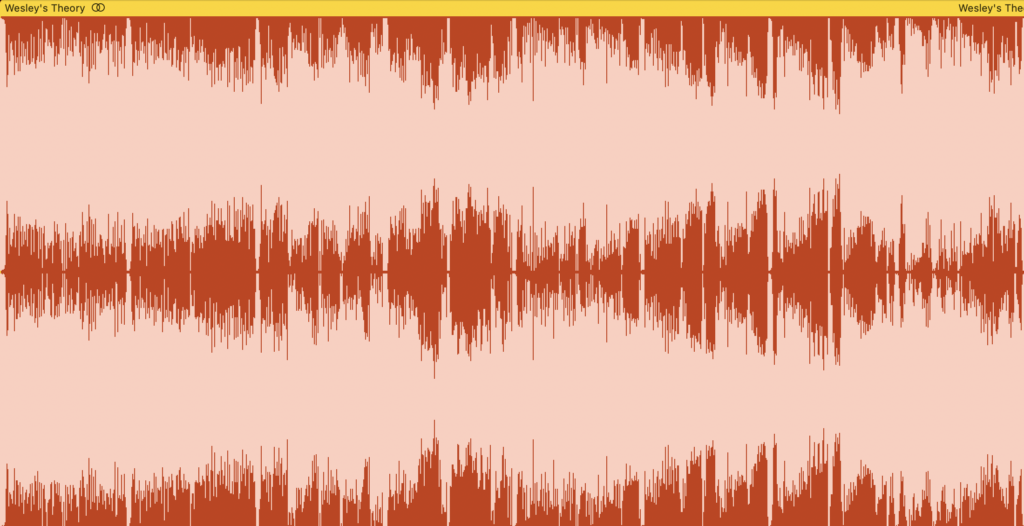
Don’t get me wrong — as the waveforms show, it’s still compressed to be loud enough in the way that most modern recordings have to be as a result of the loudness wars. But there’s teeth to those waveforms, and it’s impressive that Ali manages to make the two different basslines snake around each other in the low and mid-range frequencies (around 50-120hz and 170-500hz respectively) without ever getting in each other’s way while carving out a space for the synths in all the frequencies the sit north of there. By doing this, he elevates Thundercat’s bass to the status of another voice, occupying a similar space to Kendrick’s rough-hewed tone with its honk and growl.
Pushing the envelope
And what a bassline it is. Throughout the whole song, Thundercat squelches out contrapuntal melodies that feel like they’re in conversation with Lamar’s own words. His midrangey tone on this song is clearly indebted to the aforementioned Bootsy Collins, who started playing through an auto-wah envelope filter during his time with P-Funk.3Here’s a video of Bootsy talking about why he likes the Mu-tron III pedal for creating a funky envelope filter sound. The auto-wah provides its distinct quack and growl by quickly shifting the timbre from low and foggy to thin and reedy — and back again —based on how loudly the bassist plays each note.
But there’s another subtle homage in Thundercat’s bassline too: he occasionally slips in ascending or descending staccato eighth notes in a stepwise sequence, just like Bernie Worrell does in his iconic Minimoog bass synth improvisations on “Flash Light” — an element that was present in Flying Lotus’s own bass synth line on “Cocaine Is . . . ”, suggesting that it’s one of the song’s many conscious homages.
Voices in dialogue
FlyLo acknowledged that Lamar’s interest in using the beat was directly connected to Clinton’s music: in the first season of Alex Pappademas’s excellent podcast The Big Hit Show, which explores the process of making and releasing To Pimp a Butterfly, FlyLo says, “I started playing him a lot of the funk inspired stuff from George Clinton. [ . . . ] The next day he was like, ‘Yo, I got this crazy concept.’ And he was super hype about it.”
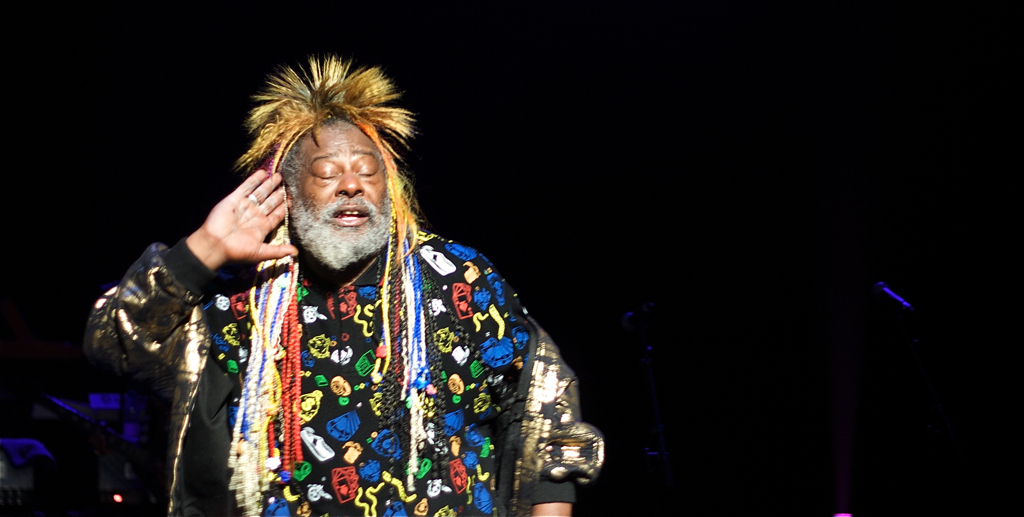
So it should come as no surprise when we suddenly hear Clinton himself on the song’s bridge. If anything, it is a surprise to hear how raspy his voice has become (likely from years of smoking crack and weed) since the song opens with a spoken-word introduction featuring a bass voice that sounds like the Clinton of the 1970s, who would intone absurd statements in an authoritative voice at the start of songs like “Red Hot Momma” and “Maggot Brain”.4It’s also worth noting that Clinton provided the introduction to the song “Can’t C Me” on 2Pac’s album All Eyez on Me, so Lamar’s use of the legendary singer on “Wesley’s Theory” is also another nod to the fact that he is both literally and figuratively in conversation with Pac throughout To Pimp a Butterfly. However, that first voice actually belongs to trumpeter Josef Leimberg. On The Big Hit Show, Leimberg explains that, as a stalwart of the same L.A. jazz scene that birthed Thundercat and Lamar’s frequent collaborator Terrace Martin, he was called in to play trumpet on the album, but he realised that he had left it at another studio, so he told the other musicians he’d come back the following day: “That’s when Kendrick turned around and said, ‘I need that voice’.”
All of these voices together create a polyphonic effect in the literary sense, placing the wisdom of elders like Leimberg and Clinton in dialogue with the maturing mindsets of younger voices like Lamar and Thundercat. Yet Lamar also crafts a dialogue between his own personas in the form of Kendrick and Uncle Sam here, playing out the battle between his desires and temptations. And this essentially prepares us for all the dynamics within the rest of the album, where we will see Kendrick continually coming into conflict with these other voices on his road to self-actualisation as an artist. Overall, then, “Wesley’s Theory” kicks down the door of our expectations, preparing us for an album that will clearly pay homage to the 20th century of black American music, while also crafting something that is inarguably 21st century in its approach.
↓
SAMPLE
“Every Nigger is a Star” (1973) by Boris Gardiner
Every nigga is a star5This repeated declarative establishes the album’s focus on the conflicts of being a black celebrity. Gardiner’s song (which arguably interpolates Sly and the Family Stone's "Everybody is a Star", making this intro a moment of deep intertextuality) came out of the black power movement and aims to counteract the historical racism shown towards black people by dignifying them by reappropriating the slur “nigger”. The repetition of the sample highlights the tension in Gardiner’s mission: Is it ever possible to fully reverse the word’s connotations? By extension, is it possible to reverse the effects of historic racism and achieve a sense of self-worth that is equal to that of white privilege? [N.B. While the word is spelled “nigger” in the song’s official title, I opted for the reappropriated spelling of “nigga” since Boris Gardiner’s pronunciation lacks the hard rhotic R, and the inclusive message at the heart of the song suggests he too would probably spell it without the hard R if it came out today.]
Every nigga is a star
Every nigga is a star
Every nigga is a star
Every nigga is a star
Who will deny that you and I and every nigga is a star?6This final question, sampled from Gardiner’s song, is left unanswered as the song skips on the word “star”. The use of the sample recontextualises the rhetorical question as an open interrogative — in other words, instead of musing "How could anyone deny this?" it accusatorially asks "Who are the people that we will meet who deny this?". The open question implies that the album will explore the mindsets that deny black people this sense of dignity. In addition, the mention of "you" and "I" links to the songs "u" and "i" that will appear later on the album, signalling the inclusive conclusion that Kendrick will reach in the final two tracks on the album: every black person is descended from African royalty, making them "star[s]", yet he is "just another nigga", making him no different from others. In other words, his problem is everyone else's problem; while closing the album by saying he's "just another nigga" could be interpreted as Kendrick shirking the burden of moral rectitude that he's laid out for himself throughout the album, the idea that "every nigga is a star" implies that this burden sits on the back of every black American, so better get on with dealing with it.

While the sample that begins the song sounds like a chorus being played the same way it appears on the original record, it’s actually an artificially elongated version. The original, by comparison, begins at the 10th bar. Instead, the first four bars of this original chorus (running from bar 10–13) have been looped twice, leading to the declarative phrase “every nigga is a star” being said six times in a row. This repetition essentially places a spotlight on Boris Gardiner’s statement, turning it into a mantra that will find its complement in the closing line of Kendrick’s poem at the end of the album, where he says “maybe I’m just another nigga”. in that forces us to consider the different connotations of the words “nigga” and “star” in greater detail.
While the sample is in E♭ major, the rest of the song is in B minor (enharmonic relative to D major), which leads to a slightly jarring effect as we shift down a semitone from one key to the other at the beginning of the song. This reflects the shift in mood from the positive message of black power to the self-serving consumerism of the persona that Lamar adopts. While the key shifts down a semitone, the tempo speeds up on the repetition of “star”, going from 85 BPM to 114, adding to the sense of falling through a black hole while implying that we’re leaving the comfort of listening to oldies and stepping into something more uptempo and modern.
INTRO
Josef Leimberg
Hit me!7This imperative was commonly said by the funk musician James Brown to his horn section. In the 1970s, Brown’s band were led by trombonist Fred Wesley; Wesley went on to play for Parliament-Funkadelic, whose bandleader, George Clinton, makes a cameo later in the song. These allusions to 1970s funk draw a connection between Lamar’s experiences as a black American celebrity in the 2010s and the black celebrities of that era, many of whom were expected to navigate the divide between being famous with white audiences while being viewed as important figureheads by the burgeoning black power movement. It is also an allusion to the opening of Public Enemy's "911 is a Joke", which samples Brown's own voice saying the exhortation. Since Public Enemy are a political hip hop group who explore social issues affecting black Americans, Lamar is subconsciously aligning himself with the lineage of conscious rappers like Public Enemy's Chuck D.
When the four corners of this cocoon collide
You’ll slip through the cracks hoping that you’ll survive
Gather your wit, take a deep look inside
Are you really who they idolize?
To Pimp a Butterfly8The intentionally mixed metaphor of this opening line is the first instance of the album’s overall conceit, which Lamar outlines in his poem on the album’s final song, “Mortal Man”: the caterpillar represents our base desire “to eat or consume everything” in order to survive, while the butterfly represents our “talent [ . . . ] thoughtfulness and [ . . . ] beauty”; meanwhile, “the cocoon which institutionalizes him” is the lifestyle and culture that the caterpillar grows up in. By mixing metaphors and claiming that this “cocoon” has “four corners” which “collide” and form “cracks”, Lamar implies that what initially appears suffocating can eventually be escaped in some way. The reference to “four corners” alludes to street corners, locations where dealers people usually sell heroin and crack in impoverished neighbourhoods — thereby suggesting that the ghetto is just as much a mindset or “cocoon” as it is a physical space. It's also an apocalyptic image, alluding to biblical verses such as Revelation 7:1, where four angels stand on four corners of the earth before the Second Coming of Christ. Lamar will go on to explore his role as a Messianic figure in the rest of the album. This apocalyptic imagery is echoed in the mock-interview with 2Pac in “Mortal Man”, where Pac says “the ground is gonna open up and swallow the evil”. In a similar way, the idiom of slipping “through the cracks” is repurposed here, alluding to the great crack in the Earth mentioned in apocalyptic Biblical passages such as Isaiah 24:20. Through this allusion, Lamar implies that rejecting his celebrity status might only lead to failure, so he will need to “gather [his] wit” so that he can “pimp a butterfly” and become a self-actualised figurehead for black Americans.
CHORUS
Kendrick Lamar
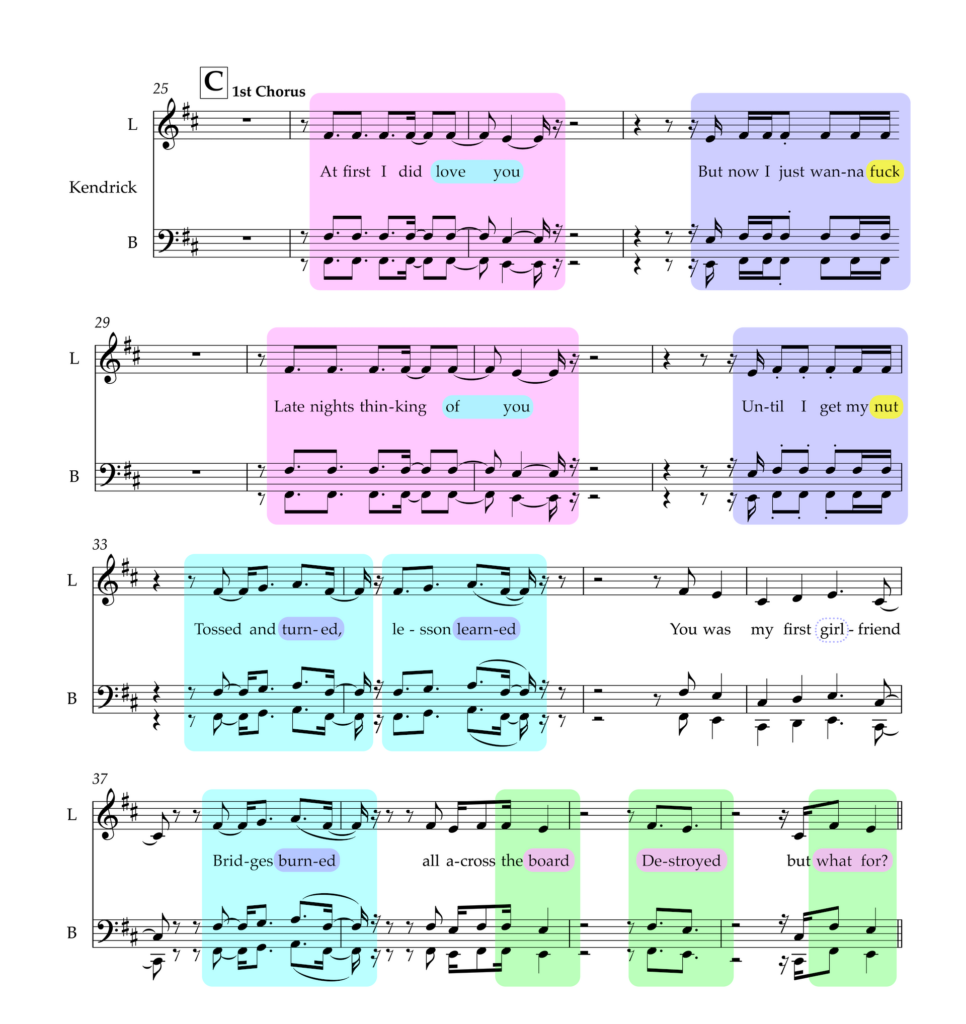
At first, I did love you
But now I just wanna fuck
Late nights thinking of you
Until I get my nut9In the first chorus, Lamar establishes one of his conceits for this song: hip hop is a woman who he mistreats. This conceit is an allusion to the hip hop classic “I Used to Love H.E.R.” by Common, which paints hip hop as a woman who has become less respectable over time, forming an analogy for how the commercialisation of hip hop in the 1990s led to gangsta rap becoming the dominant style. While Common’s song is filtered through an uncomfortably patriarchal lens, judging hip hop for her promiscuity, Lamar subverts this by making himself into the sex-obsessed individual who is only focused on the short-term gratification of commercial success, reinforced in the harsh monosyllabic slap of consonants in the words “fuck” and “nut”.
Tossed and turned, lesson learned
You was my first girlfriend
Bridges burned, all across the board
Destroyed, but what for?10While the relationship is initially presented in the present tense, Lamar shifts to the past tense for the second half, making it seem as if he has already given up. He draws on weasel wording and cliches — for example, saying “bridges burned” without explaining who burned the bridge — a tactic often used by a guilty person to avoid taking responsibility for their actions. Similarly, the usual meaning of tossing and turning is subverted into a sexual metaphor where Lamar deals with his stress and anxiety through sex: hip hop is either metaphorically “tossed” over, or he is “tossed” off (slang for masturbation), and she is “turned” on, then “turned” out of his house without any sense of romance. However, even though Lamar is implying that he has sold out and just wants to “fuck”, the playful density of consonance and assonance in this section reinforces the idea that he still feels some deeper love towards hip hop. We hear /t/, /l/, /b/ and /ae/ phonemes appearing across phrases such as “tossed and turned” and “bridges burned”, and he slants his rhymes, going from “turned”, and “learned” to “first” and “girl”, while somehow making the vowel sound in the middle of “destroyed” rhyme with “board” and “for”.
1st VERSE
Kendrick Lamar
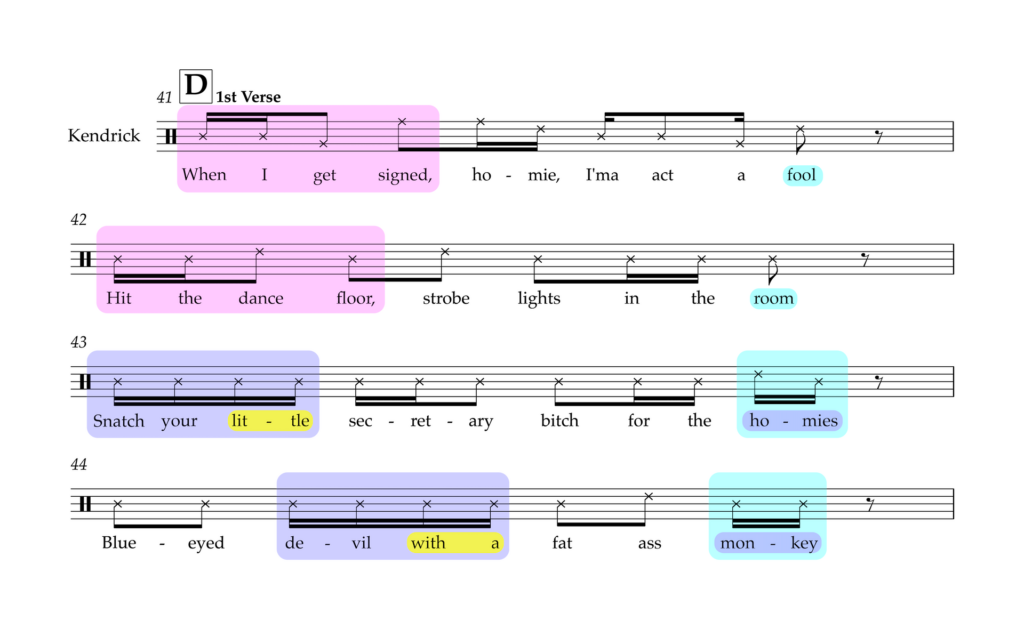
When I get signed, homie, I’ma act a fool
Hit the dance floor, strobe lights in the room11Lamar adopts a nasally, juvenile tone of voice here and satirises the aspirations of naïve rappers by adopting the persona of a sell-out who only imagines the material things that he will gain from signing his contract.
Snatch your little secretary bitch for the homies12The rapper exaggerates the misogyny and promiscuity of this sell-out persona, with the implicit sexual violence reinforced by the plosive consonance on the words “snatch” and “bitch”. The mention of “homies” in a sexual context alludes to Snoop Dogg’s “Ain’t No Fun (If the Homies Can’t Have None)”, an incredibly misogynistic song that appeared on his bestselling album Doggystyle, which would have been hugely popular during Lamar’s youth.
Blue-eyed devil with a fat-ass monkey13“Blue-eyed devil” is a racial epithet for white people, historically used by members of the Nation of Islam. The speaker implies that he is giving in to his temptations by seeking out a seductive white woman (“monkey” is slang for vagina), which foreshadows the coming personification of Lucifer as “Lucy”, a temptress, on “For Sale? (Interlude)”.
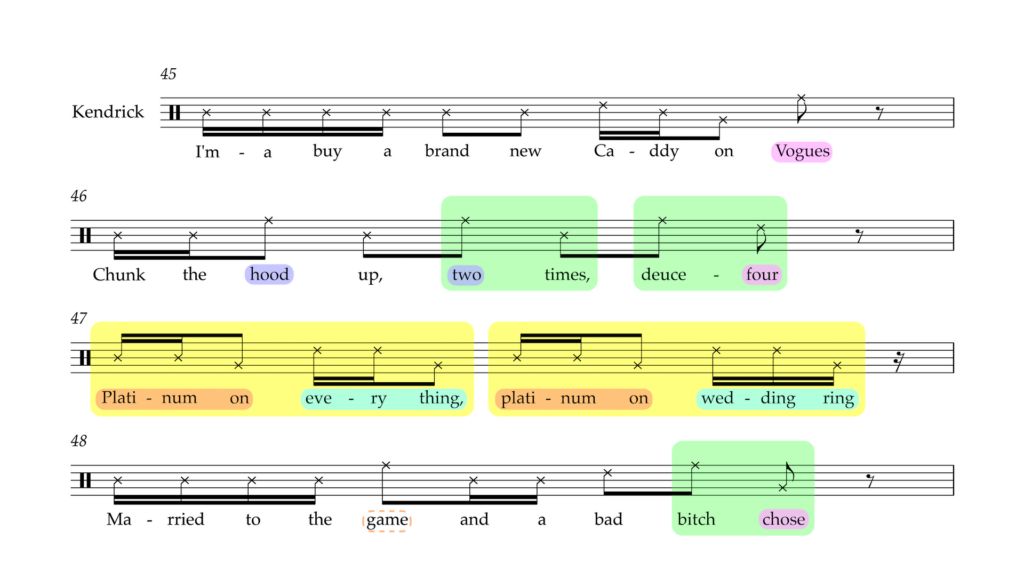
I’ma buy a brand new Caddy on Vogues14Cadillac cars were popular with pimps in the 1970s, became unfairly associated with black people on social welfare in the 1980s, and were intentionally marketed to black people from the 1990s onwards (see this article for more). The speaker seeks to gain social status by emphasising the same misogyny and symbols of wealth that other rappers have, without realising that these signifiers don’t provide any further social capital since they are still seen as “hood” or “ghetto” by the white establishment.
Chunk the hood up, two times,15To throw up gang signs (using your hands) in your neighbourhood. deuce-four16The speaker plans to get huge 24-inch rims on his car; however, the specific phrasing of “deuce-four” draws an ironic parallel between the shallow materialism and violence of the speaker and the deeper history of black Americans, since the 24th Infantry Regiment was a group of black American soldiers who fought in a number of wars throughout the 20th century and were colloquially known as "deuce four".
Platinum on everything, platinum on wedding ring17The speaker associates platinum with wealth since a platinum record represents a high watermark for record sales. The fact that this is then extended to a wedding ring shows that, in both cases, the speaker is more focused on the hollow symbols of wealth than the things they are supposed to signify (musical talent and love).
Married to the game and a bad bitch chose18If someone is “married to the game”, they are dedicated to a life of organised crime, so Lamar is using this as an extension of the misogyny presented elsewhere in this persona -- he is not marrying a person since he doesn’t see women as having any value; instead, he values the hood lifestyle and culture.
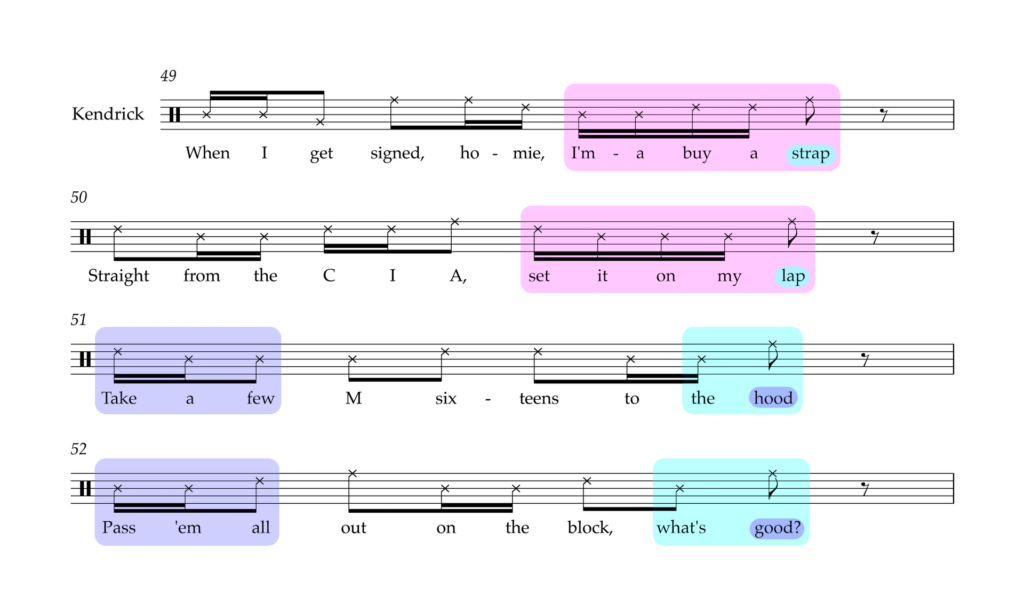
When I get signed, homie, I’ma buy a strap
Straight from the CIA, set it on my lap19Lamar provides some allusions here that add an ironic element to the speaker’s desires: while he just plans to buy a gun, the idea that it will be bought “straight from the CIA” alludes to the agencyvs role in providing arms to terrorist groups such as the Afghan mujahideen and the Syrian opposition, which have often led to those groups later attacking U.S. armed forces. Lamar is implying that there is a correlation between legalised state violence and illegal crime. Moreover, the speaker’s plans to “set it on [his] lap” allude to the self-defence tactics used by the Black Panther Party, a Socialist organisation who sought to exploit gun laws and prevent police brutality by openly carrying loaded guns. Again, Lamar suggests that the complex past of black Americans and their fight for civil rights has been reduced to a hollow symbol, one which can be commodified and sold back to white people for profit, thereby providing short-term economic capital to individuals like himself, rather than providing solutions that will empower black people and create wealth and equality for them in the long-term.
Take a few M-16s to the hood
Pass ’em all out on the block, what’s good?20The M-16 is an automatic rifle; similar to the AK-47, it is used in drive-by shootings, which became the preferred method of attack for gangs in Los Angeles (where Kendrick Lamar is from) in the 1990s due to the state’s permissive gun laws and flat, open suburban spaces.
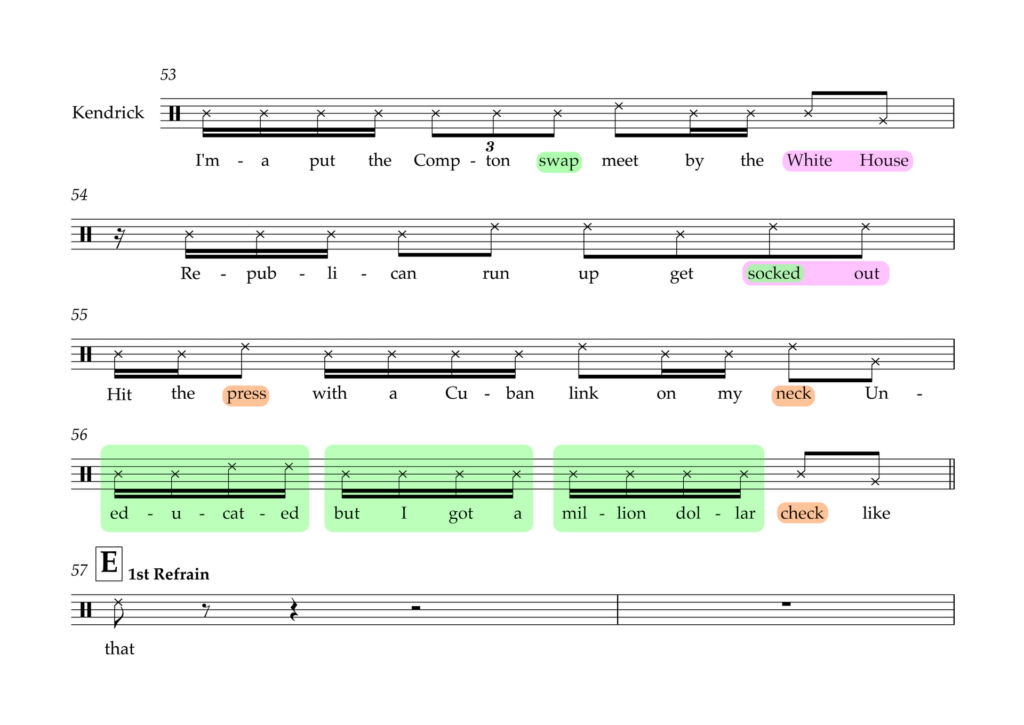
I’ma put the Compton swap meet by the White House
Republican run up, get socked out21The Compton Fashion Center, an indoor flea market, is a landmark in West Coast hip-hop. In this context, it represents the tensions that socially mobile people experience between living in relative poverty and seeking to remain fashionable and stylish. Lamar builds on the implication that the speaker has gained economic capital without social capital; he still chooses to shop at a flea market rather than using his wealth to visit boutique stores. This then leads into the metaphor of a Republican getting “socked out” — a pun that suggests they will either learn how to be stylish like black people from Compton, or get beaten up by them. (N.B. A high majority of black Americans vote for the Democratic Party).
Hit the press with a Cuban link on my neck22Cuban link chains are a popular form of jewellery worn by rappers, as referenced on Raekwon’s album Only Built 4 Cuban Linx . . .
Uneducated, but I got a million-dollar check like that23The national rate of high school graduation for Black teenagers is 59%, compared to 80% for their White peers and there are a number of issues around absenteeism. This is caused by a range of socio-economic factors that aren’t simply solved by becoming rich; as Wesley Snipes exemplifies, people often don’t know what to do with wealth once they gain it, since they were not educated in a way that ever expected them to be rich.
REFRAIN
Thundercat
and George Clinton
with Anna Wise
and Whitney Alford
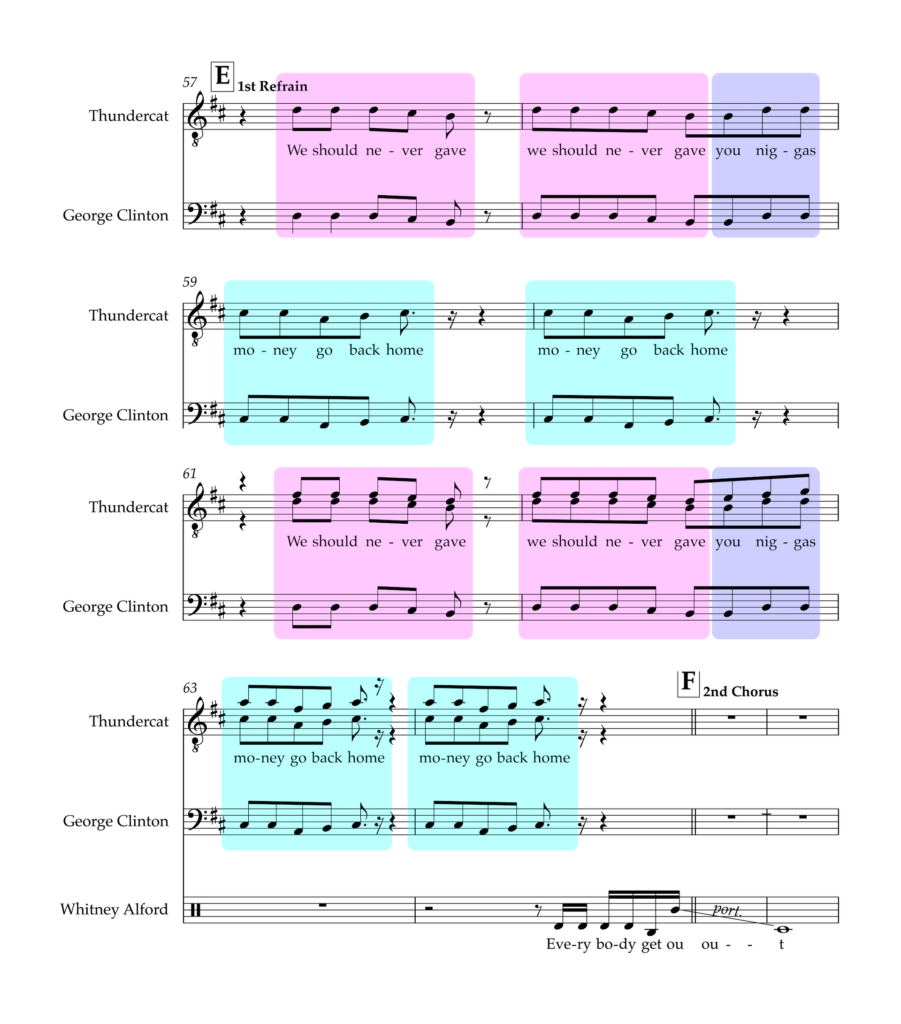
We should never gave
We should never gave niggas money
Go back home,
Money, go back home
We should never gave
We should never gave niggas money
Go back home,
Money, go back home24This is paraphrased from a famous sketch in Chappelle’s Show, where Charlie Murphy recounts his ridiculous encounters with Rick James at the height of the James’s fame and cocaine addiction. Dave Chappelle, playing Rick James, shouts it after being beaten up by Murphy, implying that Murphy is an embarrassing him by acting like a hoodlum. In this song, “they” is changed to “we” and the determinative phrase “you niggas” is shortened to “niggas”, suggesting that the phrase is being said to black people by white people in positions of power, representing the racist view that black people shouldn’t become rich because they won’t be able to spend the money wisely. This argument gains an extra layer of irony since, in both the song and the sketch, it is said by a rich and successful black person, implying that fame and money can separate black people from their own community and cause them to create an artificial distinction between themselves and “niggas”. Moreover, it could be seen as an ironic allusion to the history of slavery, since black people weren’t given money in the form of reparations and the idea of going “back home” to Africa was impossible for many black people who were born as English-speaking citizens of the U.S.
Everybody get out!
CHORUS
Kendrick Lamar
with Thundercat
and George Clinton
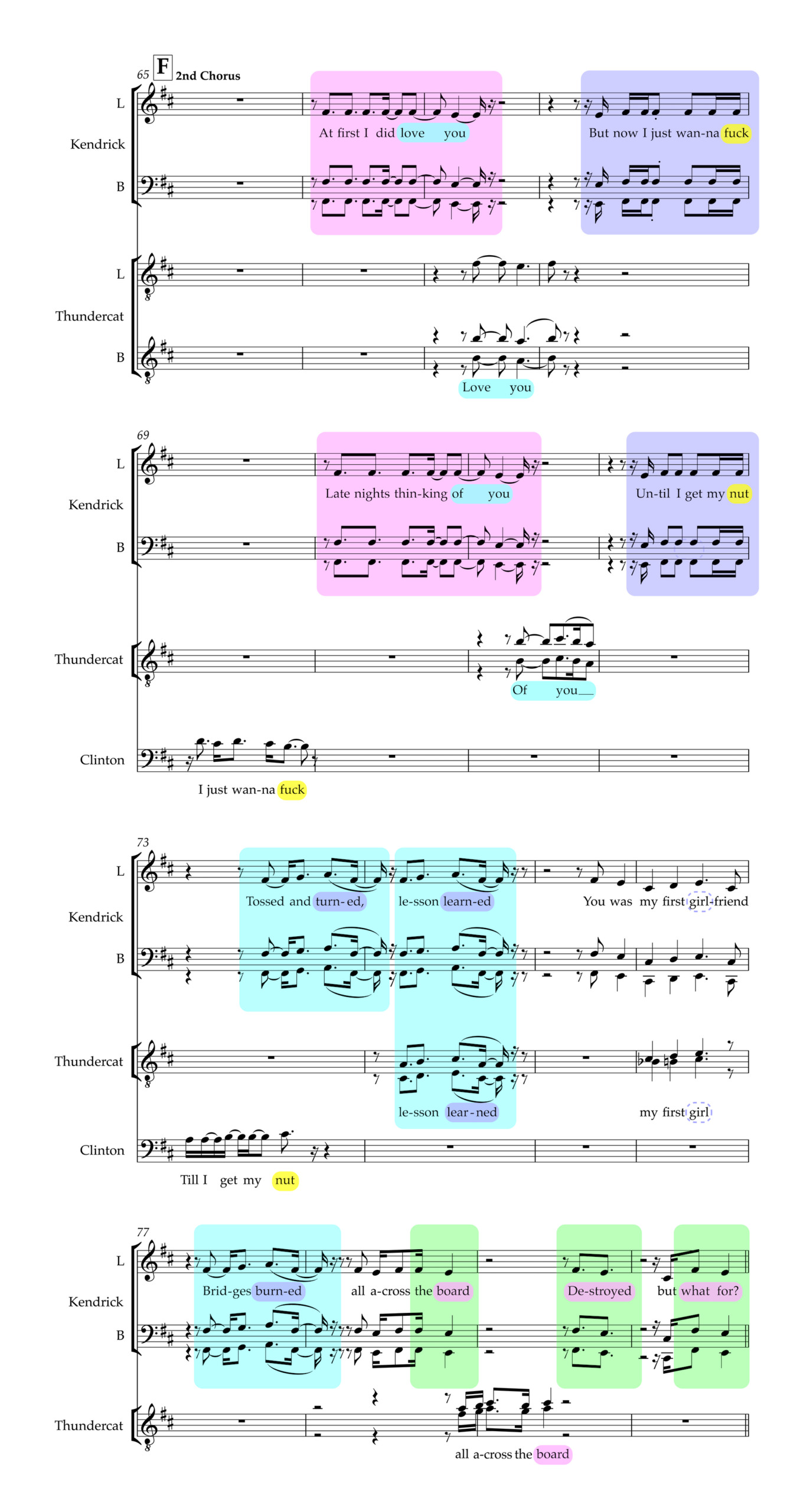
At first, I did love you
Love you
But now I just wanna fuck
I just wanna fuck
Late nights thinking of you
Of you
Until I get my nut
Til I get my nut
Tossed and turned, lesson learned
You was my first girlfriend
Bridges burned all across the board
Across the board
Destroyed, but what for?
BREAK
Dr. Dre
Yo, what’s up? It’s Dre
Remember the first time you came out to the house?
You said you wanted a spot like mine
But remember, anybody can get it
The hard part is keeping it, motherfucker25This fake answering machine message comes from Dr. Dre, a producer who is notable for commercializing the sound of gangsta rap and selling headphones through his company Beats by Dre. Dre has acted as a mentor to Lamar, signing him to his label and producing songs on his first album. Like Lamar, Dre is from Compton, California, and one of Lamar’s key memories is seeing Dre and 2Pac record the video for “California Love” in Compton when he was a child. He appears on this track as the ideal representation of success for a black man in hip hop — someone who has managed to come from humble beginnings to great financial success and managed to make wise investments while still helping younger artists from similar backgrounds.
2nd VERSE
Kendrick Lamar
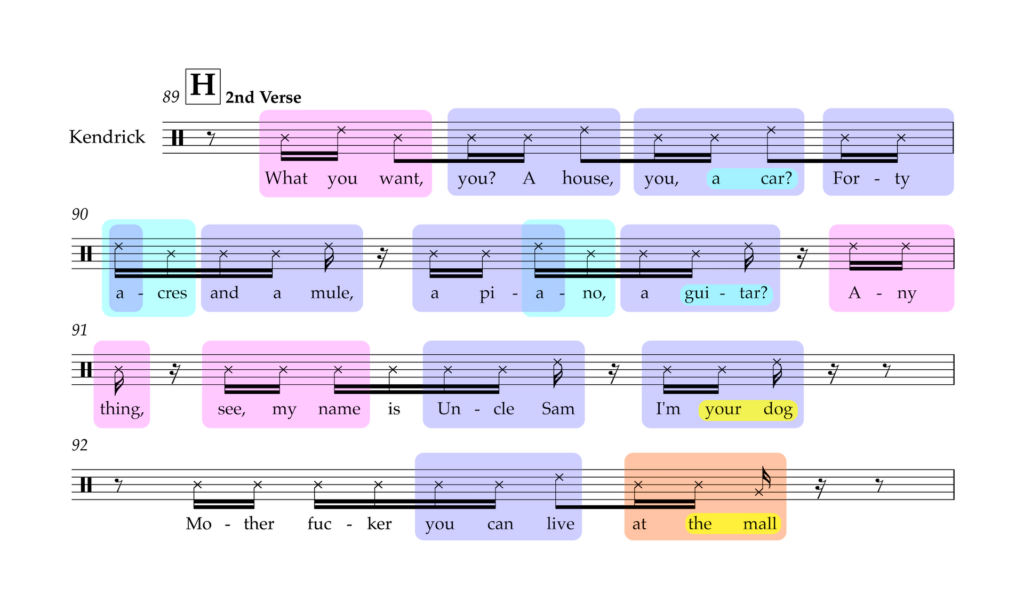
What you want, you? A house, you, a car?
Forty acres and a mule, a piano, a guitar?26Lamar shifts persona here to Uncle Sam, the personification of America, representing both the financial opportunities and pitfalls presented by American capitalism. Uncle Sam’s offers represent some of the basic concerns for black Americans: “a house or a car” were common expectations for black Americans moving from the South to California in the 1950s during the Great Migration; “a piano, a guitar” represent black music, one of the key ways that black Americans have historically been able to have an income even while living under Jim Crow laws; and forty acres and a mule is a promise of land ownership that was infamously made during the American Civil War to many freed black families, before being rescinded by Andrew Johnson once he became U.S. President. The fact that Uncle Sam offers all of these options implies that they don’t hold the same deep social value for white people, and that (like the forty acres and a mule) they are merely bargaining chips.
Anything, see, my name is Uncle Sam, I’m your dog27Lamar puns on the various meanings of “dog” here. The overt slang definition is “trusted friend”, but it also implies that Uncle Sam is deceptively presenting himself as someone who is fiercely loyal to him, when in reality he will attack Kendrick the moment that he views him as a threat.
Motherfucker, you can live at the mall28Shopping malls became widespread in the U.S. during the post-war economic boom, representing the abundance of options available to middle-class American consumers. However, the experienced a strong decline after the Great Recession, leading to current phenomenon of abandoned dead malls. As a result, Uncle Sam’s suggestion that Kendrick can “live at the mall” reflects the fact that materialism ultimately creates an illusory world of empty signifiers, since while a mall does contain things like clothes and furniture, it can't provide the family, safety and wealth that a home provides.
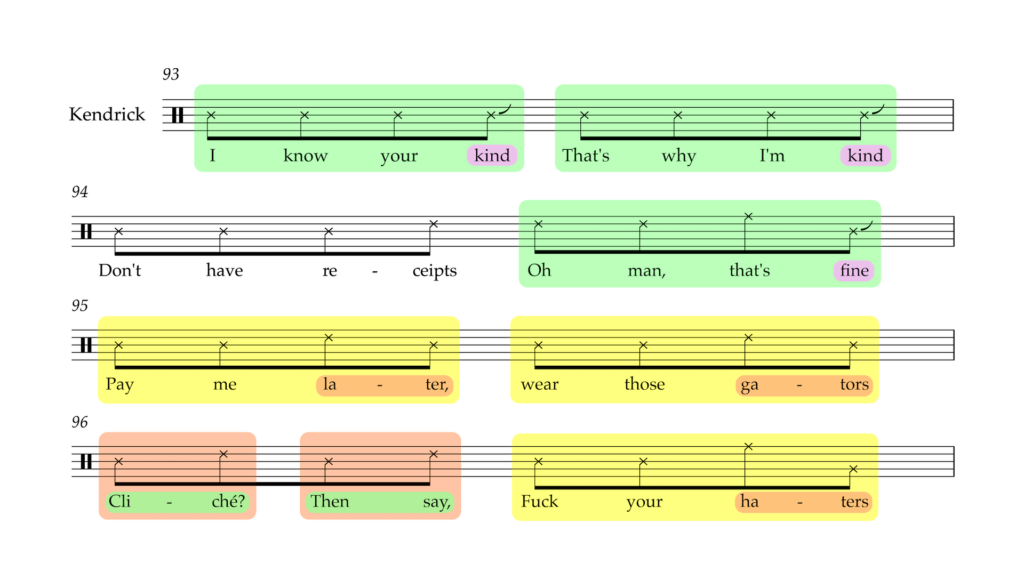
I know your kind (That’s why I’m kind)29Lamar provides Uncle Sam with deceptively equivocating language to show how the American dream tricks well-intentioned black people — he plays on the homonymic nature of the word “kind” and the homophone of “you’re” vs. “your”, implying both that Uncle Sam is flattering Kendrick (“I know you’re [a] kind [person]”) and that he is stereotyping him (“I know your kind [of people]”).
Don’t have receipts (Oh, man, that’s fine)
Pay me later, wear those gators30Buy now, pay later (BNPL) financing and credit card usage are common methods for poor people to be able to own expensive goods immediately while delaying payments. However, both methods can cause the consumer to rack up debt if they aren’t able to make their repayments and are charged further interest. Uncle Sam is not only encouraging Kendrick to enter into this kind of debt; he is telling him to do it for a pair of alligator shoes, a flashy luxury good and status symbol in the U.S. that is nevertheless a sign of being nouveau riche rather than old money wealth. doesn’t necessarily serve any practical value.
Cliché? Then say, “Fuck your haters”31Uncle Sam encourages Kendrick to use a cowardly defence, arguing that people who critique you are merely “haters”, thereby ignoring the actual content of their arguments by always assuming they are making them out of insecurity.
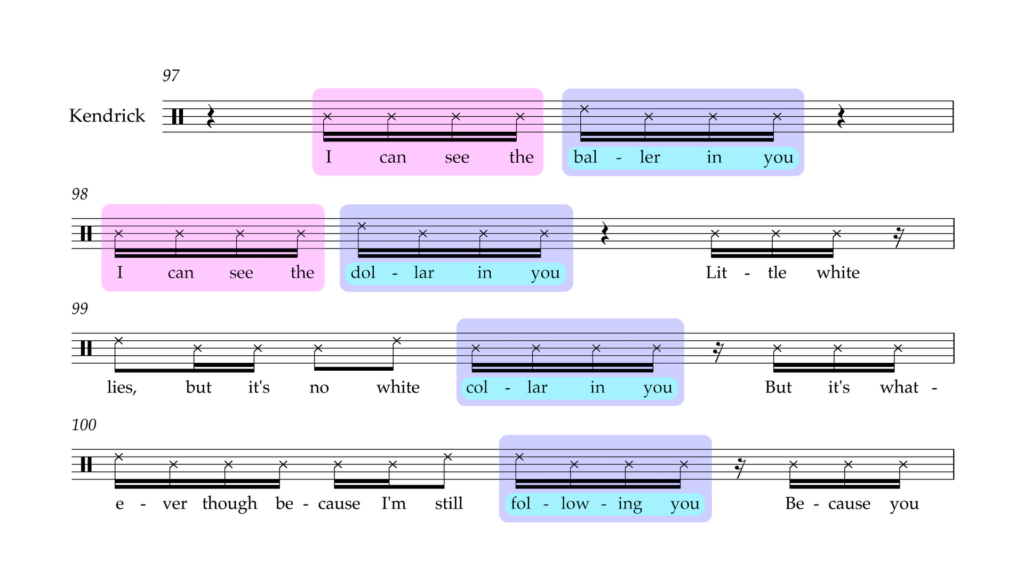
I can see the baller in you, I can see the dollar in you32Echoing his earlier equivocation around the word “kind”, Uncle Sam calls Kendrick a “baller”, suggesting both that he can see the same raw talent in Kendrick that he might see in a young basketball player,  and that he can see the opportunities for financial exploitation that come with “balling” — spending money lavishly. Similarly, he claims he can see the “dollar” in Kendrick, meaning both that he can imagine ways for Kendrick to make money from his talent, and that he can see himself successfully exploiting this situation for his own financial gain.
Little white lies, but it’s no white-collar in you
But it’s whatever though because I’m still following you33Lamar again highlights the difference between economic capital vs. cultural and social capital, stating that even though Kendrick has earned money from rapping, it’s not the same as being a white-collar worker since he doesn’t have the education or connections to be able to maintain a high societal status.
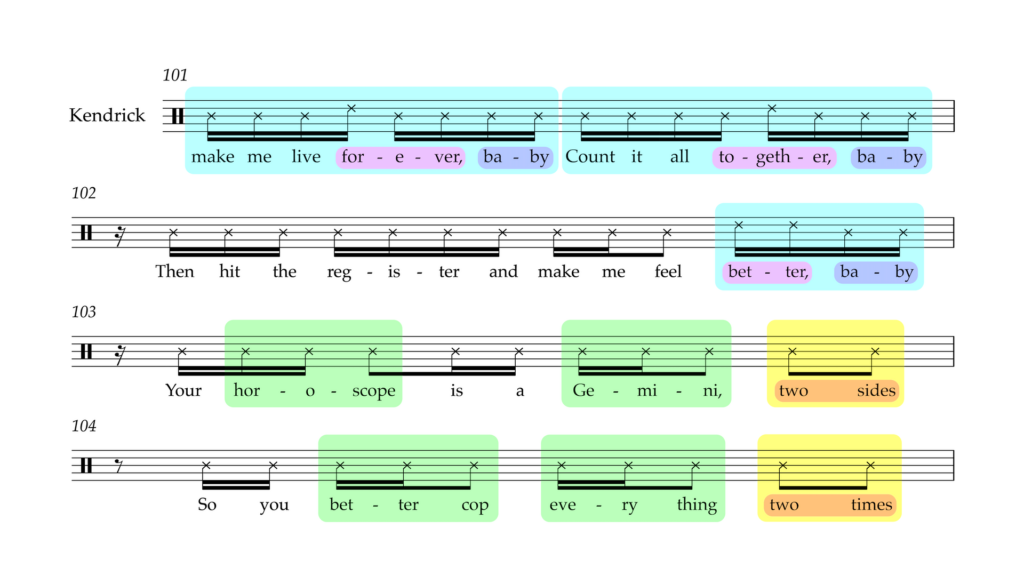
Because you make me live forever, baby
Count it all together, baby
Then hit the register and make me feel better, baby34Uncle Sam appears throughout the modern history of the United States and the ideals that he represents are often invoked by Americans, thereby allowing him to “live forever” as a cultural figure. Since Kendrick presents Uncle Sam as the embodiment of consumerism, he implies that heedless consumerism is the very lifeblood of how modern U.S. society functions.
Your horoscope is a Gemini, two sides
So you better cop everything two times
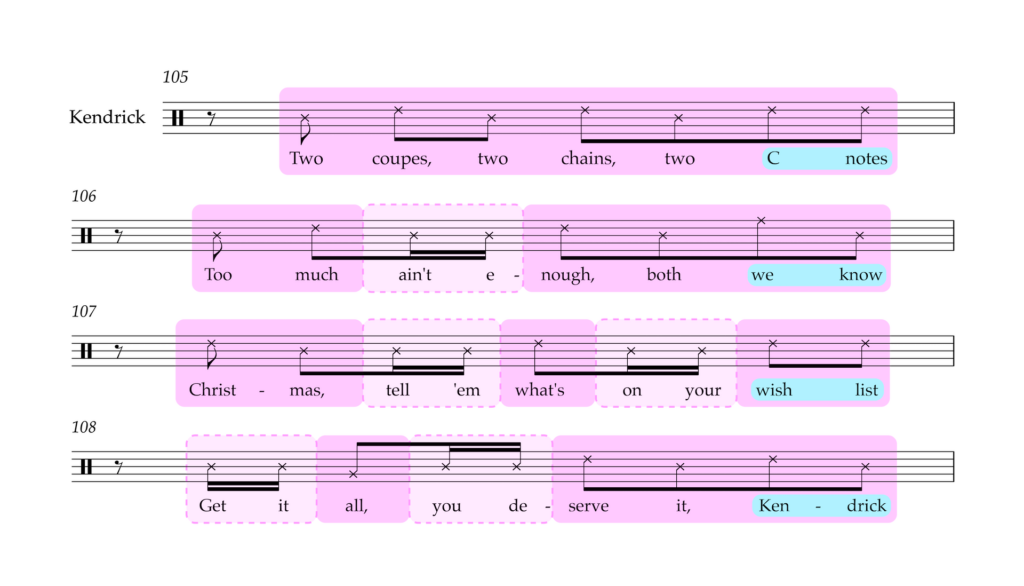
Two coupes, two chains, two C-notes
Too much ain’t enough, both we know35Kendrick Lamar was born on June 17, 1987, which makes him a Gemini — a zodiac sign that is represented through the symbol of twins. Uncle Sam takes this mystical imagery and perverts it into another consumerist pursuit, telling Kendrick to buy everything twice. The objects that Lamar are a visually alliterative chains of phrases beginning with ‹t› and ‹c›, but they become increasingly abstract — while a coupe car is an object with a specific purpose, a chain is merely a luxury good that serves no practical purpose, and a C-note ($100 bill) serves even less purpose since most shopowners will be suspicious of the possibility of the note being counterfeit. Uncle Sam encourages Kendrick to go from buying actual things to simply purchasing money itself, a meaningless gesture that gives him the appearance of being rich with increasing his wealth. This need for two of each thing also links back to the Biblical and apocalyptic imagery in the song’s opening, since Noah is told to bring two of each animal onto the ark before God floods the Earth. While Noah’s command serves a societal purpose, Uncle Sam’s commands are purely materialistic. He ends by paradoxically stating “too much ain’t enough”, homophonically twisting the need for "two" of each thing into a desire for “too much”, a hedonistic desire for excess.
Christmas, tell ’em what’s on your wish list
Get it all, you deserve it, Kendrick36Uncle shifts between roles here, encouraging Kendrick to tell his parents or Santa Claus about his “wish list” before encouraging Kendrick to “get it all”, implying that Kendrick is both a child and an adult, and that these acts of consumerism are designed to fulfil a childlike — and arguably childish — desire to own many things without paying any mind to whether or not you can afford them.
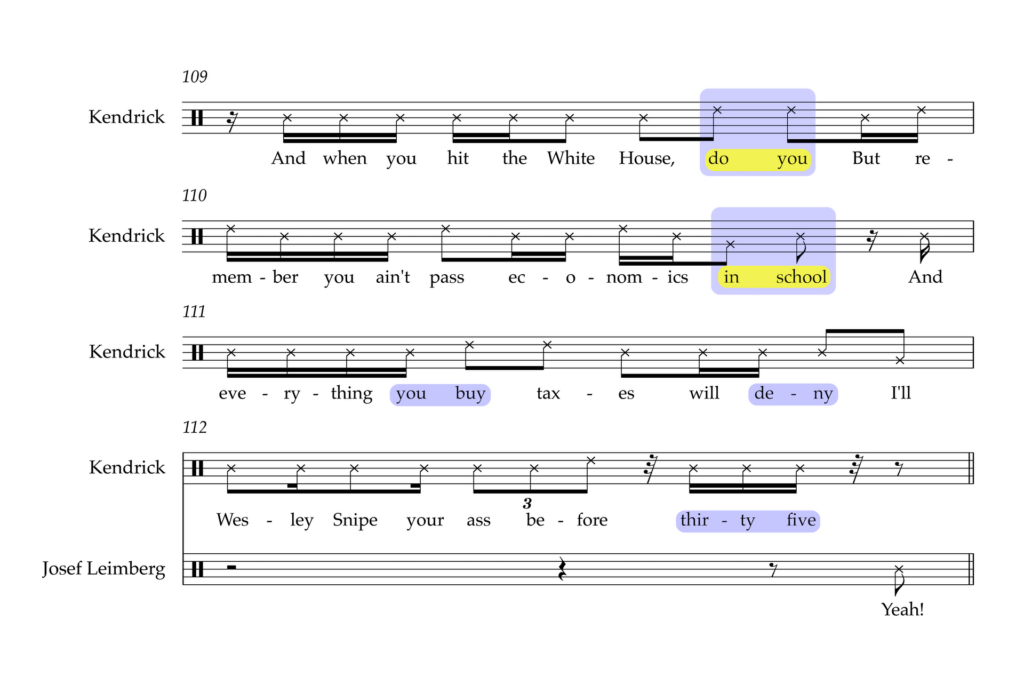
And when you hit the White House, do you
But remember, you ain’t pass economics in school37As with at other points in the song, Uncle Sam leads Kendrick towards his failure by simultaneously telling him he will eventually make it to “the White House”, the highest seat of power in the U.S., while also reinforcing the idea that he doesn’t have the knowledge and skills to rub shoulders with other members of the political establishment.
And everything you buy, taxes will deny
I’ll Wesley Snipe your ass before thirty-five38The U.S. has a complex sales tax system since it varies from state to state, and many people are expected to file tax returns each year to account for various deductions and repayments. While this system leads to Americans paying less in taxes than people in other developed economies through various methods of tax avoidance, it can also lead to widespread tax evasion, whether through intentional or unintentional means. Lamar is suggesting that the complexity of this tax system is a way for America, as a nation, to prevent the undereducated nouveaux riches from ever gaining real power and wealth.
BRIDGE
George Clinton
with Kendrick Lamar
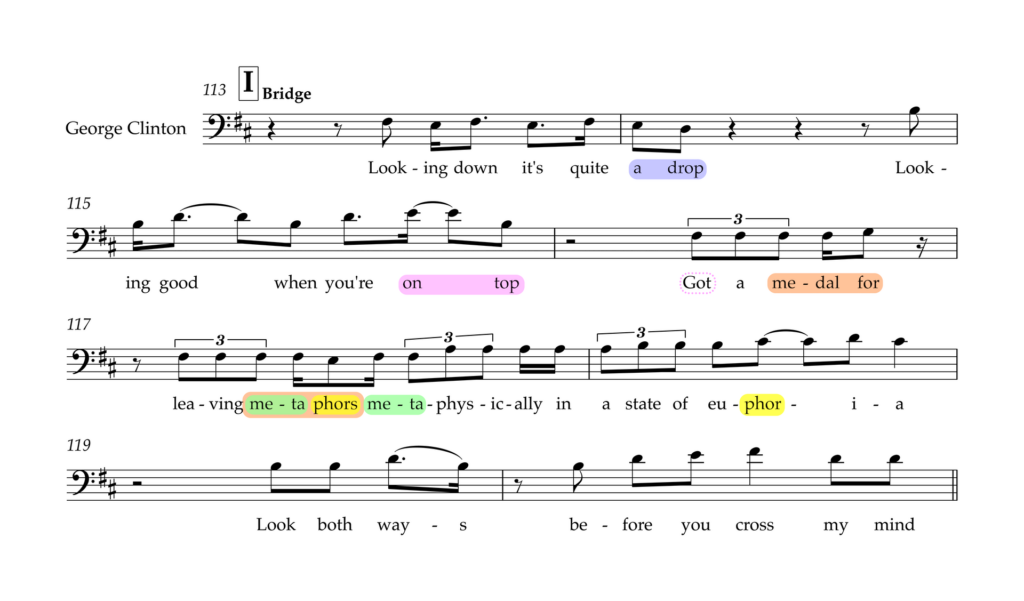
Yeah, looking down, it’s quite a drop
It’s quite a drop, drop, drop
Looking good when you’re on top39George Clinton, one of the song’s two mentor figures, appears again to provide advice here. However, much like Dr. Dre, his advice doesn’t provide solutions, and he simply implies that you need to remain mindful even as you’re experiencing success.
We’re on top together
You got a medal for us40Unlike Dre, Clinton appears to taunt Kendrick, asking him if he has any measurable proof of his critical acclaim, in the same way that a soldier would be given a medal if they did something honourable during their duty. Although this question is slipped in just before a particularly dense line, its presence might link back to the fact that Lamar’s major label debut, good kid, m.A.A.d city, was snubbed at the 56th Grammy Awards for nearly every hip hop nomination in favour of The Heist by Macklemore and Ryan Lewis, a group who benefitted from the privilege of being white American men who received votes from the mostly white Grammy voters, who have historically shown little interest in hip hop culture.
Leaving metaphors metaphysically in a state of euphoria41This line seems to be intentionally abstract, providing the kind of “lyrical miracle” complexity-for-complexity’s-sake that Lamar otherwise studiously avoids in his songwriting. In the context of the lines immediately preceding and following it, the sentence appears to be part of Lamar’s critique of himself via George Clinton’s voice, warning Kendrick if he purely focuses on “lyrical miracle” rapping without focusing on the substance of what he is saying, he will be bound to “drop” and “slip through the cracks”.
Look both ways before you cross my mind42The phrase “cross my mind” simply means for a thought to occur, but the warning to “look both ways” implies that these thoughts pose a danger to the thinker, like an oncoming vehicle. Again, Clinton doesn’t provide solutions; his warning is just that — a reminder to Kendrick that he needs to be careful as he tries to unknot his internal and external conflicts.
REFRAIN
Thundercat
and George Clinton
with Anna Wise
and Whitney Alford
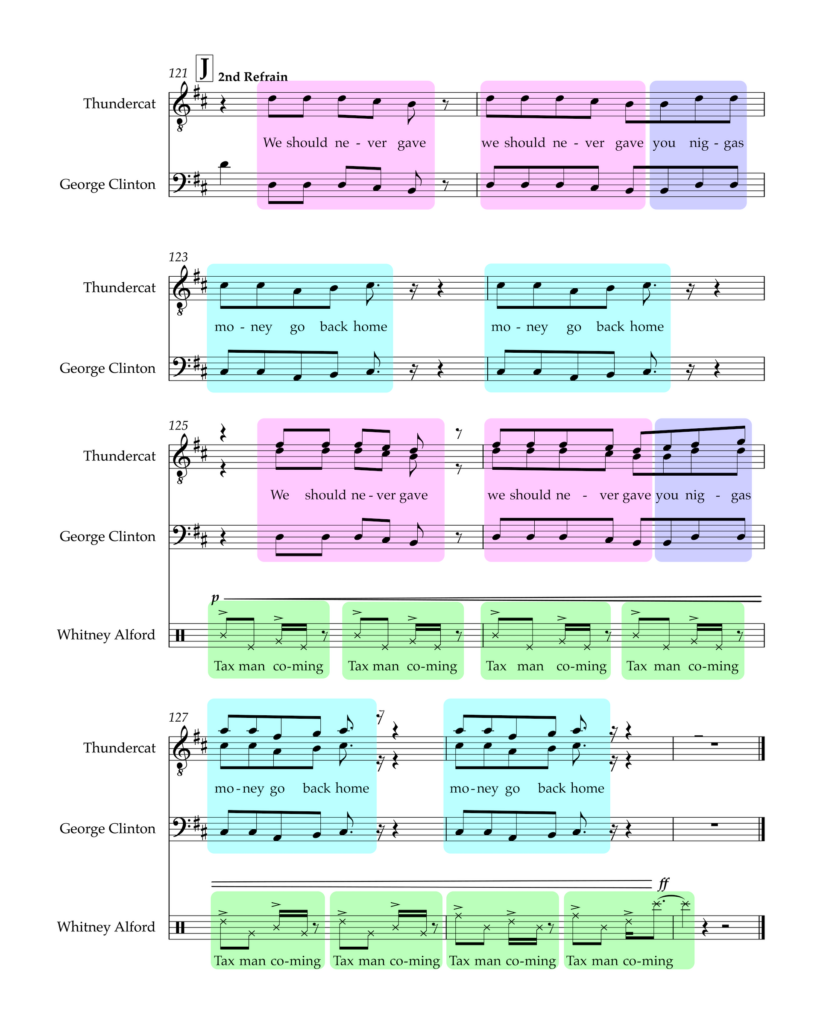
We should never gave,
We should never gave you niggas money,
Go back home,
Money, go back home
We should never gave,
We should never gave niggas money,
Go back home,
Money, go back home
Tax man coming,
Tax man coming,
Tax man coming,
Tax man coming,
Tax man coming,
Tax man coming,
Tax man coming,
Tax man coming!43The shouting female voices abruptly end the song like a scene from a horror film. We are no longer considering the idea of Kendrick losing his wealth (and, by extension, his fame) as a remote possibility; instead, it is something that is going to happen imminently, unless Kendrick can run away — which explains the frenetic jazz rhythms that he employs on the next track in the album’s sequence.
—L.O.E.
Flying Lotus
Producer

Ronald Colson
a.k.a. Flip
Producer
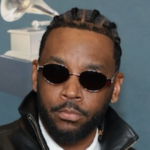
Sounwave
Producer

Thundercat
Producer, electric bass and vocals (background and chorus)

Terrace Martin
Alto saxophone and horn arrangements
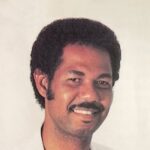
Boris Gardiner
Vocals
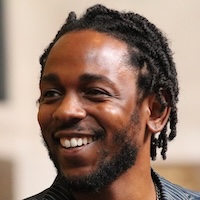
Kendrick Lamar
Vocals

Josef Leimberg
Spoken vocals (intro) and trumpet
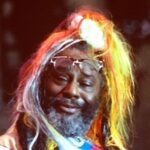
George Clinton
Vocals (chorus and bridge)

Dr. Dre
Spoken vocals (break)

Ash Riser
Vocals (background)

Anna Wise
Vocals (background)

Whitney Alford
Vocals (background)
Bootsy Collins
Drums?
James Hunt
Audio engineer

Derek Ali
a.k.a. MixedByAli
Mixing

Mike Bozzi
Mastering
Footnotes
- 1The title alludes to the actor Wesley Snipes, who was indicted in 2006 for tax evasion and tried to claim he was a “non-resident alien” of the U.S. By presenting this pseudo-legal defence as a “theory”, Lamar asks us to consider the socio-economic forces that lead black celebrities to struggle with fame and view themselves as outsiders to the country and culture that gave birth to them. ↩︎
- 2Of course, this is actually an artfully simulated record skip, done by having the producer loop the first beat of the bar. Wisely, Lamar gets us to suspend our disbelief by providing the record noise at the start of the song so that we buy into the skeuomorphic ruse that we are listening to an old, scratchy record. ↩︎
- 3Here’s a video of Bootsy talking about why he likes the Mu-tron III pedal for creating a funky envelope filter sound. ↩︎
- 4It’s also worth noting that Clinton provided the introduction to the song “Can’t C Me” on 2Pac’s album All Eyez on Me, so Lamar’s use of the legendary singer on “Wesley’s Theory” is also another nod to the fact that he is both literally and figuratively in conversation with Pac throughout To Pimp a Butterfly. ↩︎
- 5This repeated declarative establishes the album’s focus on the conflicts of being a black celebrity. Gardiner’s song (which arguably interpolates Sly and the Family Stone’s “Everybody is a Star”, making this intro a moment of deep intertextuality) came out of the black power movement and aims to counteract the historical racism shown towards black people by dignifying them by reappropriating the slur “nigger”. The repetition of the sample highlights the tension in Gardiner’s mission: Is it ever possible to fully reverse the word’s connotations? By extension, is it possible to reverse the effects of historic racism and achieve a sense of self-worth that is equal to that of white privilege? [N.B. While the word is spelled “nigger” in the song’s official title, I opted for the reappropriated spelling of “nigga” since Boris Gardiner’s pronunciation lacks the hard rhotic R, and the inclusive message at the heart of the song suggests he too would probably spell it without the hard R if it came out today.] ↩︎
- 6This final question, sampled from Gardiner’s song, is left unanswered as the song skips on the word “star”. The use of the sample recontextualises the rhetorical question as an open interrogative — in other words, instead of musing “How could anyone deny this?” it accusatorially asks “Who are the people that we will meet who deny this?”. The open question implies that the album will explore the mindsets that deny black people this sense of dignity. In addition, the mention of “you” and “I” links to the songs “u” and “i” that will appear later on the album, signalling the inclusive conclusion that Kendrick will reach in the final two tracks on the album: every black person is descended from African royalty, making them “star[s]”, yet he is “just another nigga”, making him no different from others. In other words, his problem is everyone else’s problem; while closing the album by saying he’s “just another nigga” could be interpreted as Kendrick shirking the burden of moral rectitude that he’s laid out for himself throughout the album, the idea that “every nigga is a star” implies that this burden sits on the back of every black American, so better get on with dealing with it. ↩︎
- 7This imperative was commonly said by the funk musician James Brown to his horn section. In the 1970s, Brown’s band were led by trombonist Fred Wesley; Wesley went on to play for Parliament-Funkadelic, whose bandleader, George Clinton, makes a cameo later in the song. These allusions to 1970s funk draw a connection between Lamar’s experiences as a black American celebrity in the 2010s and the black celebrities of that era, many of whom were expected to navigate the divide between being famous with white audiences while being viewed as important figureheads by the burgeoning black power movement. It is also an allusion to the opening of Public Enemy‘s “911 is a Joke”, which samples Brown’s own voice saying the exhortation. Since Public Enemy are a political hip hop group who explore social issues affecting black Americans, Lamar is subconsciously aligning himself with the lineage of conscious rappers like Public Enemy’s Chuck D. ↩︎
- 8The intentionally mixed metaphor of this opening line is the first instance of the album’s overall conceit, which Lamar outlines in his poem on the album’s final song, “Mortal Man”: the caterpillar represents our base desire “to eat or consume everything” in order to survive, while the butterfly represents our “talent [ . . . ] thoughtfulness and [ . . . ] beauty”; meanwhile, “the cocoon which institutionalizes him” is the lifestyle and culture that the caterpillar grows up in. By mixing metaphors and claiming that this “cocoon” has “four corners” which “collide” and form “cracks”, Lamar implies that what initially appears suffocating can eventually be escaped in some way. The reference to “four corners” alludes to street corners, locations where dealers people usually sell heroin and crack in impoverished neighbourhoods — thereby suggesting that the ghetto is just as much a mindset or “cocoon” as it is a physical space. It’s also an apocalyptic image, alluding to biblical verses such as Revelation 7:1, where four angels stand on four corners of the earth before the Second Coming of Christ. Lamar will go on to explore his role as a Messianic figure in the rest of the album. This apocalyptic imagery is echoed in the mock-interview with 2Pac in “Mortal Man”, where Pac says “the ground is gonna open up and swallow the evil”. In a similar way, the idiom of slipping “through the cracks” is repurposed here, alluding to the great crack in the Earth mentioned in apocalyptic Biblical passages such as Isaiah 24:20. Through this allusion, Lamar implies that rejecting his celebrity status might only lead to failure, so he will need to “gather [his] wit” so that he can “pimp a butterfly” and become a self-actualised figurehead for black Americans. ↩︎
- 9In the first chorus, Lamar establishes one of his conceits for this song: hip hop is a woman who he mistreats. This conceit is an allusion to the hip hop classic “I Used to Love H.E.R.” by Common, which paints hip hop as a woman who has become less respectable over time, forming an analogy for how the commercialisation of hip hop in the 1990s led to gangsta rap becoming the dominant style. While Common’s song is filtered through an uncomfortably patriarchal lens, judging hip hop for her promiscuity, Lamar subverts this by making himself into the sex-obsessed individual who is only focused on the short-term gratification of commercial success, reinforced in the harsh monosyllabic slap of consonants in the words “fuck” and “nut”. ↩︎
- 10While the relationship is initially presented in the present tense, Lamar shifts to the past tense for the second half, making it seem as if he has already given up. He draws on weasel wording and cliches — for example, saying “bridges burned” without explaining who burned the bridge — a tactic often used by a guilty person to avoid taking responsibility for their actions. Similarly, the usual meaning of tossing and turning is subverted into a sexual metaphor where Lamar deals with his stress and anxiety through sex: hip hop is either metaphorically “tossed” over, or he is “tossed” off (slang for masturbation), and she is “turned” on, then “turned” out of his house without any sense of romance. However, even though Lamar is implying that he has sold out and just wants to “fuck”, the playful density of consonance and assonance in this section reinforces the idea that he still feels some deeper love towards hip hop. We hear /t/, /l/, /b/ and /ae/ phonemes appearing across phrases such as “tossed and turned” and “bridges burned”, and he slants his rhymes, going from “turned”, and “learned” to “first” and “girl”, while somehow making the vowel sound in the middle of “destroyed” rhyme with “board” and “for”. ↩︎
- 11Lamar adopts a nasally, juvenile tone of voice here and satirises the aspirations of naïve rappers by adopting the persona of a sell-out who only imagines the material things that he will gain from signing his contract. ↩︎
- 12The rapper exaggerates the misogyny and promiscuity of this sell-out persona, with the implicit sexual violence reinforced by the plosive consonance on the words “snatch” and “bitch”. The mention of “homies” in a sexual context alludes to Snoop Dogg’s “Ain’t No Fun (If the Homies Can’t Have None)”, an incredibly misogynistic song that appeared on his bestselling album Doggystyle, which would have been hugely popular during Lamar’s youth. ↩︎
- 13“Blue-eyed devil” is a racial epithet for white people, historically used by members of the Nation of Islam. The speaker implies that he is giving in to his temptations by seeking out a seductive white woman (“monkey” is slang for vagina), which foreshadows the coming personification of Lucifer as “Lucy”, a temptress, on “For Sale? (Interlude)”. ↩︎
- 14Cadillac cars were popular with pimps in the 1970s, became unfairly associated with black people on social welfare in the 1980s, and were intentionally marketed to black people from the 1990s onwards (see this article for more). The speaker seeks to gain social status by emphasising the same misogyny and symbols of wealth that other rappers have, without realising that these signifiers don’t provide any further social capital since they are still seen as “hood” or “ghetto” by the white establishment. ↩︎
- 15To throw up gang signs (using your hands) in your neighbourhood. ↩︎
- 16The speaker plans to get huge 24-inch rims on his car; however, the specific phrasing of “deuce-four” draws an ironic parallel between the shallow materialism and violence of the speaker and the deeper history of black Americans, since the 24th Infantry Regiment was a group of black American soldiers who fought in a number of wars throughout the 20th century and were colloquially known as “deuce four”. ↩︎
- 17The speaker associates platinum with wealth since a platinum record represents a high watermark for record sales. The fact that this is then extended to a wedding ring shows that, in both cases, the speaker is more focused on the hollow symbols of wealth than the things they are supposed to signify (musical talent and love). ↩︎
- 18If someone is “married to the game”, they are dedicated to a life of organised crime, so Lamar is using this as an extension of the misogyny presented elsewhere in this persona — he is not marrying a person since he doesn’t see women as having any value; instead, he values the hood lifestyle and culture. ↩︎
- 19Lamar provides some allusions here that add an ironic element to the speaker’s desires: while he just plans to buy a gun, the idea that it will be bought “straight from the CIA” alludes to the agencyvs role in providing arms to terrorist groups such as the Afghan mujahideen and the Syrian opposition, which have often led to those groups later attacking U.S. armed forces. Lamar is implying that there is a correlation between legalised state violence and illegal crime. Moreover, the speaker’s plans to “set it on [his] lap” allude to the self-defence tactics used by the Black Panther Party, a Socialist organisation who sought to exploit gun laws and prevent police brutality by openly carrying loaded guns. Again, Lamar suggests that the complex past of black Americans and their fight for civil rights has been reduced to a hollow symbol, one which can be commodified and sold back to white people for profit, thereby providing short-term economic capital to individuals like himself, rather than providing solutions that will empower black people and create wealth and equality for them in the long-term. ↩︎
- 20The M-16 is an automatic rifle; similar to the AK-47, it is used in drive-by shootings, which became the preferred method of attack for gangs in Los Angeles (where Kendrick Lamar is from) in the 1990s due to the state’s permissive gun laws and flat, open suburban spaces. ↩︎
- 21The Compton Fashion Center, an indoor flea market, is a landmark in West Coast hip-hop. In this context, it represents the tensions that socially mobile people experience between living in relative poverty and seeking to remain fashionable and stylish. Lamar builds on the implication that the speaker has gained economic capital without social capital; he still chooses to shop at a flea market rather than using his wealth to visit boutique stores. This then leads into the metaphor of a Republican getting “socked out” — a pun that suggests they will either learn how to be stylish like black people from Compton, or get beaten up by them. (N.B. A high majority of black Americans vote for the Democratic Party). ↩︎
- 22Cuban link chains are a popular form of jewellery worn by rappers, as referenced on Raekwon’s album Only Built 4 Cuban Linx . . . ↩︎
- 23The national rate of high school graduation for Black teenagers is 59%, compared to 80% for their White peers and there are a number of issues around absenteeism. This is caused by a range of socio-economic factors that aren’t simply solved by becoming rich; as Wesley Snipes exemplifies, people often don’t know what to do with wealth once they gain it, since they were not educated in a way that ever expected them to be rich. ↩︎
- 24This is paraphrased from a famous sketch in Chappelle’s Show, where Charlie Murphy recounts his ridiculous encounters with Rick James at the height of the James’s fame and cocaine addiction. Dave Chappelle, playing Rick James, shouts it after being beaten up by Murphy, implying that Murphy is an embarrassing him by acting like a hoodlum. In this song, “they” is changed to “we” and the determinative phrase “you niggas” is shortened to “niggas”, suggesting that the phrase is being said to black people by white people in positions of power, representing the racist view that black people shouldn’t become rich because they won’t be able to spend the money wisely. This argument gains an extra layer of irony since, in both the song and the sketch, it is said by a rich and successful black person, implying that fame and money can separate black people from their own community and cause them to create an artificial distinction between themselves and “niggas”. Moreover, it could be seen as an ironic allusion to the history of slavery, since black people weren’t given money in the form of reparations and the idea of going “back home” to Africa was impossible for many black people who were born as English-speaking citizens of the U.S. ↩︎
- 25This fake answering machine message comes from Dr. Dre, a producer who is notable for commercializing the sound of gangsta rap and selling headphones through his company Beats by Dre. Dre has acted as a mentor to Lamar, signing him to his label and producing songs on his first album. Like Lamar, Dre is from Compton, California, and one of Lamar’s key memories is seeing Dre and 2Pac record the video for “California Love” in Compton when he was a child. He appears on this track as the ideal representation of success for a black man in hip hop — someone who has managed to come from humble beginnings to great financial success and managed to make wise investments while still helping younger artists from similar backgrounds. ↩︎
- 26Lamar shifts persona here to Uncle Sam, the personification of America, representing both the financial opportunities and pitfalls presented by American capitalism. Uncle Sam’s offers represent some of the basic concerns for black Americans: “a house or a car” were common expectations for black Americans moving from the South to California in the 1950s during the Great Migration; “a piano, a guitar” represent black music, one of the key ways that black Americans have historically been able to have an income even while living under Jim Crow laws; and forty acres and a mule is a promise of land ownership that was infamously made during the American Civil War to many freed black families, before being rescinded by Andrew Johnson once he became U.S. President. The fact that Uncle Sam offers all of these options implies that they don’t hold the same deep social value for white people, and that (like the forty acres and a mule) they are merely bargaining chips. ↩︎
- 27Lamar puns on the various meanings of “dog” here. The overt slang definition is “trusted friend”, but it also implies that Uncle Sam is deceptively presenting himself as someone who is fiercely loyal to him, when in reality he will attack Kendrick the moment that he views him as a threat. ↩︎
- 28Shopping malls became widespread in the U.S. during the post-war economic boom, representing the abundance of options available to middle-class American consumers. However, the experienced a strong decline after the Great Recession, leading to current phenomenon of abandoned dead malls. As a result, Uncle Sam’s suggestion that Kendrick can “live at the mall” reflects the fact that materialism ultimately creates an illusory world of empty signifiers, since while a mall does contain things like clothes and furniture, it can’t provide the family, safety and wealth that a home provides. ↩︎
- 29Lamar provides Uncle Sam with deceptively equivocating language to show how the American dream tricks well-intentioned black people — he plays on the homonymic nature of the word “kind” and the homophone of “you’re” vs. “your”, implying both that Uncle Sam is flattering Kendrick (“I know you’re [a] kind [person]”) and that he is stereotyping him (“I know your kind [of people]”). ↩︎
- 30Buy now, pay later (BNPL) financing and credit card usage are common methods for poor people to be able to own expensive goods immediately while delaying payments. However, both methods can cause the consumer to rack up debt if they aren’t able to make their repayments and are charged further interest. Uncle Sam is not only encouraging Kendrick to enter into this kind of debt; he is telling him to do it for a pair of alligator shoes, a flashy luxury good and status symbol in the U.S. that is nevertheless a sign of being nouveau riche rather than old money wealth. doesn’t necessarily serve any practical value. ↩︎
- 31Uncle Sam encourages Kendrick to use a cowardly defence, arguing that people who critique you are merely “haters”, thereby ignoring the actual content of their arguments by always assuming they are making them out of insecurity. ↩︎
- 32Echoing his earlier equivocation around the word “kind”, Uncle Sam calls Kendrick a “baller”, suggesting both that he can see the same raw talent in Kendrick that he might see in a young basketball player, and that he can see the opportunities for financial exploitation that come with “balling” — spending money lavishly. Similarly, he claims he can see the “dollar” in Kendrick, meaning both that he can imagine ways for Kendrick to make money from his talent, and that he can see himself successfully exploiting this situation for his own financial gain. ↩︎
- 33Lamar again highlights the difference between economic capital vs. cultural and social capital, stating that even though Kendrick has earned money from rapping, it’s not the same as being a white-collar worker since he doesn’t have the education or connections to be able to maintain a high societal status. ↩︎
- 34Uncle Sam appears throughout the modern history of the United States and the ideals that he represents are often invoked by Americans, thereby allowing him to “live forever” as a cultural figure. Since Kendrick presents Uncle Sam as the embodiment of consumerism, he implies that heedless consumerism is the very lifeblood of how modern U.S. society functions. ↩︎
- 35Kendrick Lamar was born on June 17, 1987, which makes him a Gemini — a zodiac sign that is represented through the symbol of twins. Uncle Sam takes this mystical imagery and perverts it into another consumerist pursuit, telling Kendrick to buy everything twice. The objects that Lamar are a visually alliterative chains of phrases beginning with ‹t› and ‹c›, but they become increasingly abstract — while a coupe car is an object with a specific purpose, a chain is merely a luxury good that serves no practical purpose, and a C-note ($100 bill) serves even less purpose since most shopowners will be suspicious of the possibility of the note being counterfeit. Uncle Sam encourages Kendrick to go from buying actual things to simply purchasing money itself, a meaningless gesture that gives him the appearance of being rich with increasing his wealth. This need for two of each thing also links back to the Biblical and apocalyptic imagery in the song’s opening, since Noah is told to bring two of each animal onto the ark before God floods the Earth. While Noah’s command serves a societal purpose, Uncle Sam’s commands are purely materialistic. He ends by paradoxically stating “too much ain’t enough”, homophonically twisting the need for “two” of each thing into a desire for “too much”, a hedonistic desire for excess. ↩︎
- 36Uncle shifts between roles here, encouraging Kendrick to tell his parents or Santa Claus about his “wish list” before encouraging Kendrick to “get it all”, implying that Kendrick is both a child and an adult, and that these acts of consumerism are designed to fulfil a childlike — and arguably childish — desire to own many things without paying any mind to whether or not you can afford them. ↩︎
- 37As with at other points in the song, Uncle Sam leads Kendrick towards his failure by simultaneously telling him he will eventually make it to “the White House”, the highest seat of power in the U.S., while also reinforcing the idea that he doesn’t have the knowledge and skills to rub shoulders with other members of the political establishment. ↩︎
- 38The U.S. has a complex sales tax system since it varies from state to state, and many people are expected to file tax returns each year to account for various deductions and repayments. While this system leads to Americans paying less in taxes than people in other developed economies through various methods of tax avoidance, it can also lead to widespread tax evasion, whether through intentional or unintentional means. Lamar is suggesting that the complexity of this tax system is a way for America, as a nation, to prevent the undereducated nouveaux riches from ever gaining real power and wealth. ↩︎
- 39George Clinton, one of the song’s two mentor figures, appears again to provide advice here. However, much like Dr. Dre, his advice doesn’t provide solutions, and he simply implies that you need to remain mindful even as you’re experiencing success. ↩︎
- 40Unlike Dre, Clinton appears to taunt Kendrick, asking him if he has any measurable proof of his critical acclaim, in the same way that a soldier would be given a medal if they did something honourable during their duty. Although this question is slipped in just before a particularly dense line, its presence might link back to the fact that Lamar’s major label debut, good kid, m.A.A.d city, was snubbed at the 56th Grammy Awards for nearly every hip hop nomination in favour of The Heist by Macklemore and Ryan Lewis, a group who benefitted from the privilege of being white American men who received votes from the mostly white Grammy voters, who have historically shown little interest in hip hop culture. ↩︎
- 41This line seems to be intentionally abstract, providing the kind of “lyrical miracle” complexity-for-complexity’s-sake that Lamar otherwise studiously avoids in his songwriting. In the context of the lines immediately preceding and following it, the sentence appears to be part of Lamar’s critique of himself via George Clinton’s voice, warning Kendrick if he purely focuses on “lyrical miracle” rapping without focusing on the substance of what he is saying, he will be bound to “drop” and “slip through the cracks”. ↩︎
- 42The phrase “cross my mind” simply means for a thought to occur, but the warning to “look both ways” implies that these thoughts pose a danger to the thinker, like an oncoming vehicle. Again, Clinton doesn’t provide solutions; his warning is just that — a reminder to Kendrick that he needs to be careful as he tries to unknot his internal and external conflicts. ↩︎
- 43The shouting female voices abruptly end the song like a scene from a horror film. We are no longer considering the idea of Kendrick losing his wealth (and, by extension, his fame) as a remote possibility; instead, it is something that is going to happen imminently, unless Kendrick can run away — which explains the frenetic jazz rhythms that he employs on the next track in the album’s sequence. ↩︎